
What Is Secure Messaging? Standards, Risks & How to Choose
Secure messaging protects data with encryption, authentication, and integrity controls. Learn the standards, compare apps, and see how unified APIs add secure multi-channel delivery.
What Is Secure Messaging? Standards, Risks & How to Choose
Secure messaging is the practice of protecting the confidentiality, integrity, and availability of digital messages through encryption, authentication, and hardened infrastructure. It ensures that only the intended recipient can read a message, that the message hasn’t been altered in transit, and that the sender’s identity is verifiable. While consumer apps like Signal and WhatsApp popularized end-to-end encryption (E2EE), the same principles now underpin business communication, AI agent interactions, and multi-channel messaging APIs—where a single breach can expose thousands of conversations.
This article unpacks the technical requirements, compares popular approaches, and explains how secure messaging extends into developer infrastructure such as unified messaging APIs.
How Secure Messaging Works
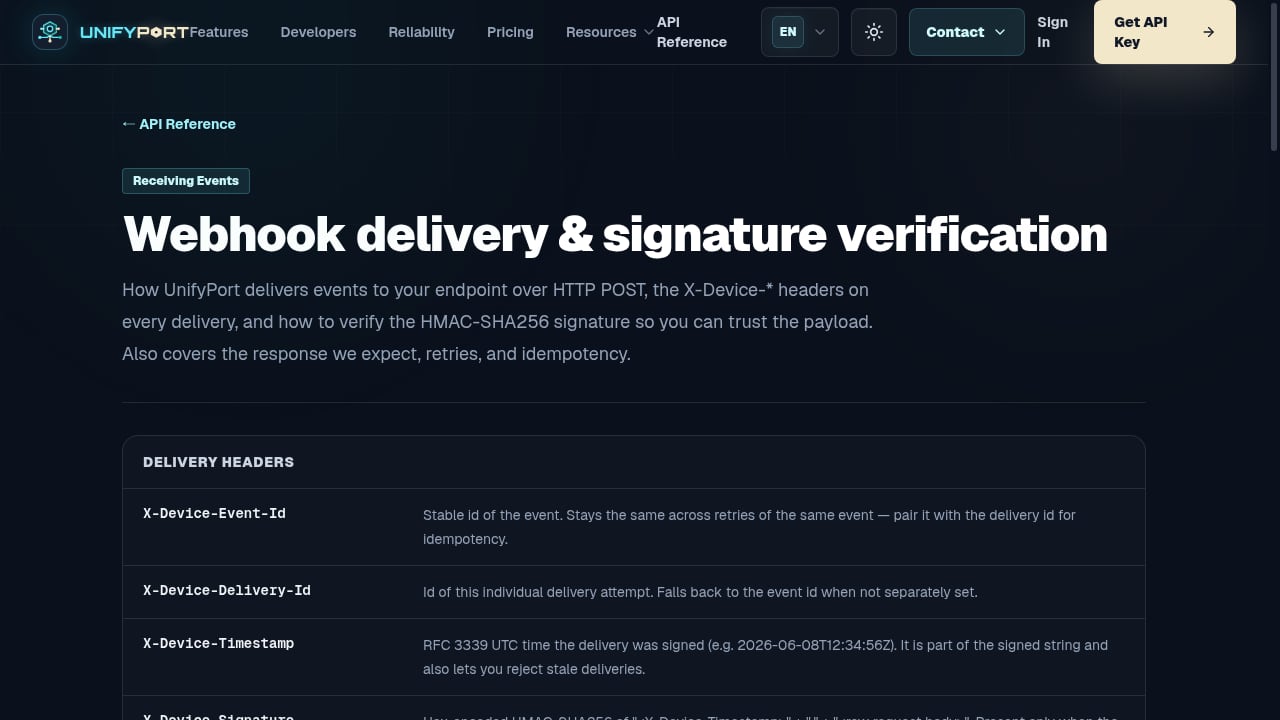
First viewport screenshot of Webhook delivery & signature verification — API Reference — UnifyPort.
At its core, secure messaging combines three layers:
- Transport security – TLS encrypts data between client and server, preventing eavesdropping on the network.
- Message encryption – E2EE ensures the server itself cannot read message content. Only the endpoints hold the keys.
- Authentication and integrity – Digital signatures, HMACs, and certificates verify the sender and detect tampering.
Cryptographic Primitives That Power Secure Messaging
Modern secure messengers rely on well-audited algorithms:
- Curve25519 and P-256 for key agreement.
- AES-256 for symmetric encryption of message content.
- HMAC-SHA256 for message authentication codes that prove integrity.
- Kyber-1024 (post-quantum) increasingly paired with classical ECDH for forward secrecy.
In API-driven messaging, HMAC-SHA256 signatures are particularly critical. When a platform delivers a webhook event—say, an incoming WhatsApp message—the receiving server must validate the signature against a shared secret. Without this check, an attacker could forge events and inject malicious payloads.
End-to-End Encryption vs. Transport Encryption
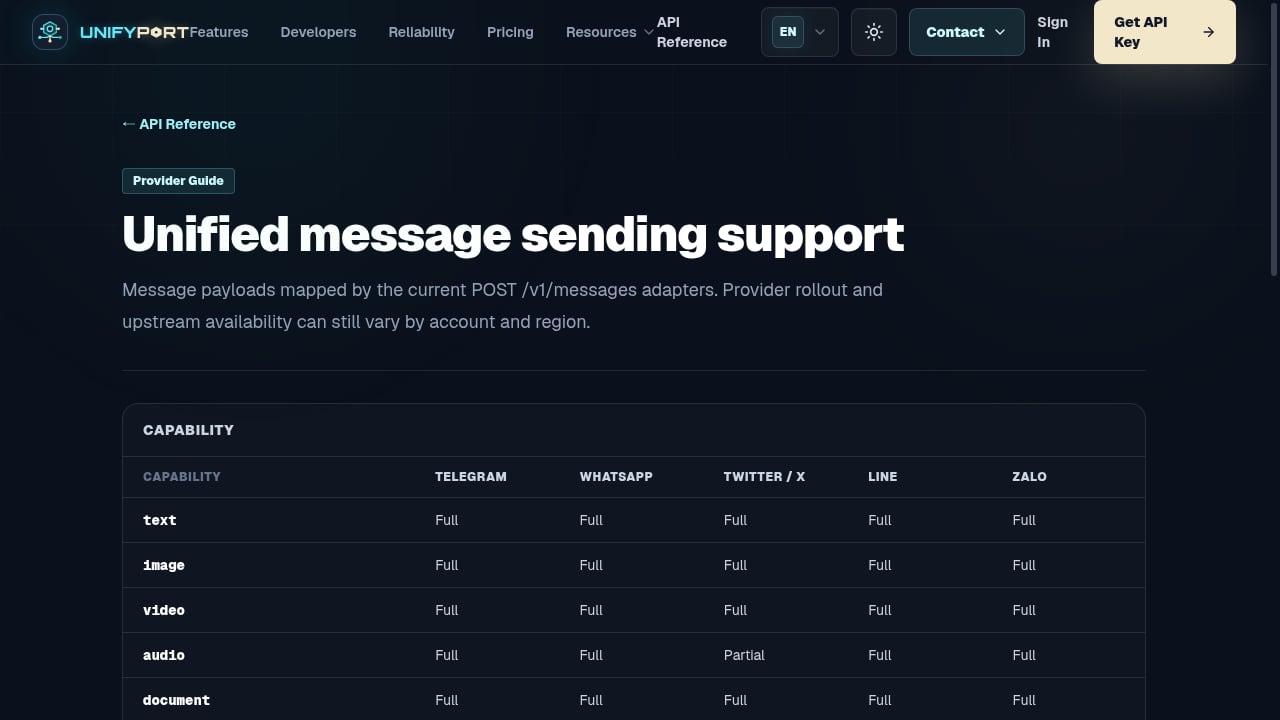
First viewport screenshot of Unified message sending support — API Reference — UnifyPort.
A common misunderstanding equates TLS with E2EE. They solve different problems:
| Feature | Transport Encryption (TLS) | End-to-End Encryption (E2EE) |
|---|---|---|
| Protects data in transit | Yes | Yes |
| Server can read plaintext | Yes (after decrypting TLS) | No |
| Survives server compromise | No | Yes |
| Typical use | Web browsing, API calls | Personal messaging, sensitive alerts |
For a notification system sending appointment reminders, TLS may be sufficient. For a healthcare chatbot exchanging PHI, E2EE is non-negotiable. Many unified messaging APIs operate at the transport layer because they must relay messages across channels that don’t all support E2EE. In those cases, the platform’s internal access controls, audit logging, and data retention policies become the compensating controls.
Key Security Properties to Evaluate
First viewport screenshot of List provider regions — API Reference — UnifyPort.
When assessing any secure messaging solution—whether a consumer app or an API platform—examine these properties:
- Default encryption state: Is encryption on by default, or must users enable it? Facebook Messenger historically required opt-in; Signal and WhatsApp enable it by default.
- Metadata exposure: Who can see the sender, recipient, timestamps, and IP addresses? Even with E2EE, metadata reveals communication patterns.
- Key management: Are encryption keys stored on the device, on the server, or in a hardware security module (HSM)? Server-stored keys (as in X/Twitter DMs) mean the provider can theoretically access plaintext.
- Code audit status: Has an independent third party reviewed the cryptography? Closed-source apps without recent audits carry higher risk.
- Jurisdiction and transparency: Where is the company incorporated, and does it publish transparency reports? Companies under Five Eyes jurisdictions may be compelled to share data.
- Data collection: What does the app collect beyond message content? Contact lists, location, and usage data often feed ad networks or analytics.
Comparing Secure Messaging Approaches
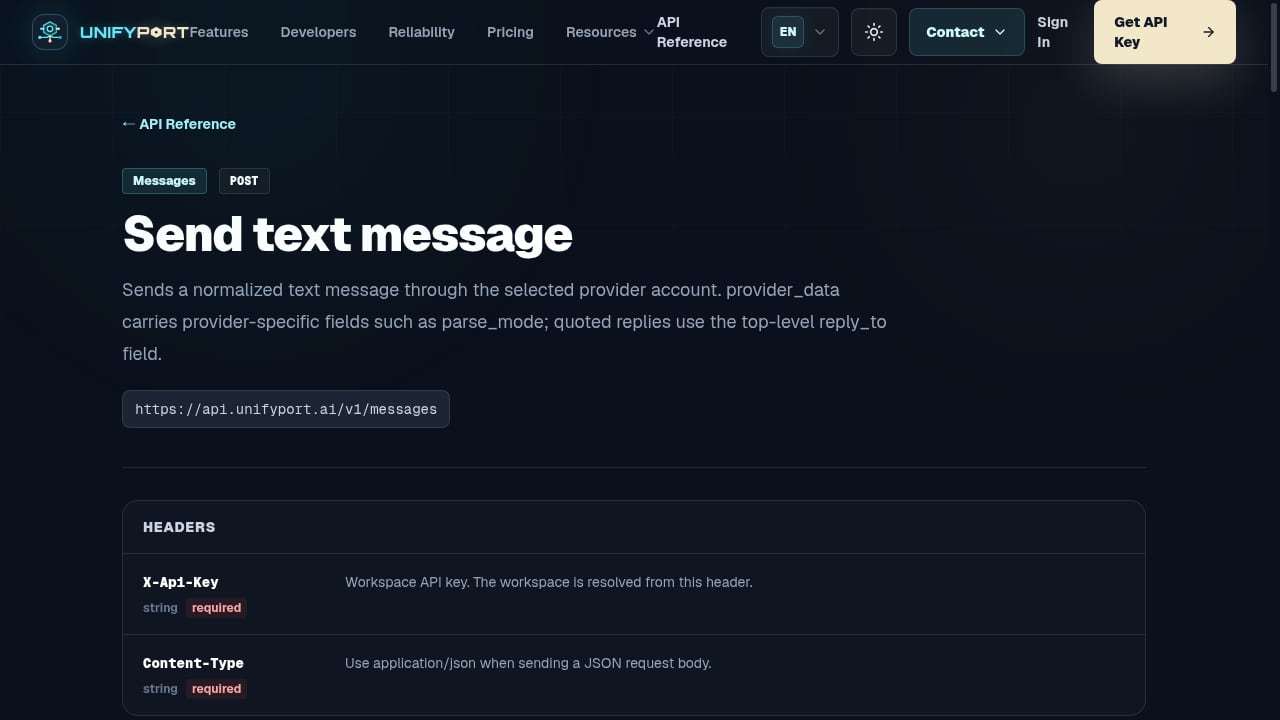
First viewport screenshot of Send text message — API Reference — UnifyPort.
Consumer Messaging Apps
Signal remains the gold standard for personal secure messaging: open-source, independently audited, minimal metadata collection, and funded by the non-profit Signal Foundation. WhatsApp uses the same Signal Protocol but collects far more metadata and shares it with Meta. Telegram’s default chats use server-side encryption (Telegram holds the keys), while its “Secret Chats” offer E2EE but aren’t the default and lack group support. iMessage provides strong E2EE but backs up keys to iCloud by default, creating a potential access point.
Secure Messaging APIs for Developers
When building software that sends messages across channels, developers face a different challenge: how to integrate Telegram, WhatsApp, LINE, and other platforms without managing separate SDKs, authentication flows, and webhook verification for each. This is where unified messaging APIs enter the picture.
A platform like UnifyPort provides a single REST API that normalizes message delivery and event ingestion across multiple channels. Instead of implementing Telegram’s bot API, WhatsApp Cloud API, and LINE Messaging API individually, developers send one JSON payload and receive one standardized webhook shape. The security model includes:
- API key authentication for all requests.
- HMAC-SHA256 webhook signatures so your server can verify that events genuinely originated from UnifyPort and haven’t been tampered with.
- Workspace isolation to segregate environments and prevent cross-tenant data leakage.
- Idempotent retries that prevent duplicate message delivery during network failures.
This architecture doesn’t add E2EE on top of channels that lack it, but it does provide a hardened, auditable integration layer that reduces the attack surface compared to maintaining five separate integrations. For AI agents, CRMs, and operations tools that need to reach users on their preferred messaging apps, this approach turns a fragmented security burden into a single, consistently secured pipe. To understand how such platforms fit into broader communication infrastructure, see our guide to Communication Platform as a Service (CPaaS).
Secure Messaging in Multi-Channel Architectures
When a single application orchestrates messages across Telegram, WhatsApp, and TikTok, the security model must address:
- Credential rotation – Each channel requires its own tokens or certificates. A unified API centralizes credential management so you rotate secrets in one place.
- Failure isolation – If one channel experiences a breach or outage, it shouldn’t cascade. Rate limiting and circuit breakers at the API layer contain the blast radius.
- Webhook control planes – Managing signature verification, subscription URLs, and retry policies per channel becomes unsustainable at scale. A control plane that normalizes these operations reduces misconfiguration risk.
- Audit trail – Knowing which system sent which message to which user, and when, is essential for forensic analysis. A unified event layer provides a single source of truth.
For teams evaluating multi-channel infrastructure, our MessengerPeople review examines another platform that tackles similar challenges, while the Unipile tutorial walks through integrating multiple messaging channels in days rather than weeks.
Common Threats and Mitigations
Man-in-the-Middle (MITM) Attacks
An attacker intercepts communication between client and server. Mitigation: Enforce TLS 1.3, pin certificates, and validate webhook signatures with HMAC-SHA256.
Server Compromise
If the messaging server is breached, TLS-protected messages are exposed. Mitigation: Use E2EE for sensitive content; for API platforms, minimize plaintext storage and enforce strict access controls.
Replay Attacks
An attacker captures a valid request and resends it to trigger duplicate actions. Mitigation: Idempotency keys and timestamp validation ensure each request is processed exactly once.
Metadata Leakage
Even when content is encrypted, communication graphs reveal who talks to whom. Mitigation: Minimize logging; use decentralized or onion-routed architectures where feasible.
Building Secure Messaging Into Your Product
If you’re embedding messaging into a SaaS product, AI agent, or internal tool, consider these practices:
- Never roll your own crypto. Use well-audited libraries and protocols.
- Validate all webhooks. Always check HMAC signatures before processing events.
- Scope API keys narrowly. Generate per-environment keys with minimum necessary permissions.
- Implement idempotency. Network glitches happen; your system must handle duplicate deliveries gracefully.
- Log security events. Authentication failures, signature mismatches, and rate limit hits should trigger alerts.
For a deeper look at how messaging infrastructure connects with AI agents and chatbots, read our analysis of the best AI chatbots in 2026, which covers integration patterns and channel connectivity.
Related reading
- Recruitment Messaging Automation: A Practical Guide for 2026 - Learn how recruitment messaging automation unifies email, SMS, and chat apps to boost candidate engagement, reduce no-shows, and sync data with your ATS.
Sources and further reading
- Secure Messaging Apps Comparison | Privacy Matters - This site compares secure messaging apps from a security & privacy point of view. These include Facebook Messenger, iMessage, Skype, Signal, Simplex, Google Messenger, Threema, Riot, Wire, Telegram
- What is the best secure messaging platform? : r/cryptography - Hello folks. I know nothing about this crazy stuff you guys chat about and it all seems quite impressive and difficult to get into. I tried google searching ...
- Secure messaging - From Wikipedia, the free encyclopedia
Frequently Asked Questions
What is the difference between secure messaging and encrypted messaging?
Encrypted messaging is a subset of secure messaging. Encryption protects content confidentiality, but secure messaging also encompasses authentication, integrity verification, metadata protection, and infrastructure hardening.
Is Telegram secure?
Telegram’s default cloud chats use server-side encryption, meaning Telegram holds the decryption keys. “Secret Chats” provide E2EE but are limited to one-on-one conversations and aren’t the default. For high-sensitivity communication, Signal offers stronger default protections.
How do unified messaging APIs handle security?
They provide a normalized security layer—API key authentication, HMAC-signed webhooks, workspace isolation, and centralized credential management—so developers don’t implement security differently for each channel. They don’t add E2EE to channels that lack it but reduce misconfiguration risk.
What is HMAC-SHA256 and why does it matter for messaging?
HMAC-SHA256 is a keyed-hash message authentication code. In messaging APIs, it lets the receiver verify that a webhook payload came from the expected sender and wasn’t altered. Without signature verification, an attacker could forge events.
Can I use secure messaging for automated notifications?
Yes. Transactional notifications, appointment reminders, and system alerts can be sent over TLS-encrypted channels with API authentication. For sensitive content like financial statements or medical results, prefer channels that support E2EE.
Conclusion
Secure messaging isn’t a single technology—it’s a stack of decisions about encryption, authentication, key management, and operational security. For individuals, Signal’s default E2EE and minimal metadata collection set the standard. For developers building multi-channel messaging into products, the challenge shifts to managing security consistently across disparate platforms.
Unified messaging APIs address this by providing a single, hardened integration point with standardized authentication, webhook verification, and failure isolation. Whether you’re sending a one-time password or connecting an AI agent to a customer’s preferred chat app, the principles remain the same: encrypt what you can, authenticate everything, verify all inbound events, and never trust a payload you haven’t signed.
To explore how modern digital platforms connect tools, channels, and AI agents, see our overview of what a digital platform is and how it works.