
Top 10 Messaging API Gateways 2026: Ranked Review
A 2026 ranking of the top 10 messaging API gateway products, judged on channel coverage, developer experience, pricing transparency, and compliance support.
Top 10 Messaging API Gateways in 2026: A Ranked Review
A messaging API gateway sits between your application and the carriers or platform networks that actually deliver a message. It handles authentication, channel-specific payloads, webhooks, retries, and increasingly the compliance paperwork that decides whether your traffic reaches anyone at all. Picking the wrong one shows up later as blocked WhatsApp numbers, rejected 10DLC campaigns, or a per-message bill that quietly outgrows the product it supports.
This review ranks ten products that genuinely operate in the messaging API gateway category for 2026. Each entry explains what the product is best at, what it costs where pricing is public, and where it falls short. A separate note covers adjacent tooling for teams whose real problem is cross-channel orchestration rather than single-channel delivery.
How These Messaging API Gateways Were Evaluated
First viewport screenshot of chat-api.com.
Every product below was judged against the same six criteria, using vendor documentation, published pricing pages, and public developer material available during 2026 research.
- Channel coverage: Which messaging networks are supported natively — SMS, WhatsApp, RCS, Viber, and regional apps — versus through third-party connectors.
- Developer experience: REST API quality, SDK availability, webhook design, sandbox access, and how quickly a working two-way integration can be built.
- Compliance support: Help with WhatsApp Business verification, A2P 10DLC brand and campaign registration, and sender reputation.
- Pricing transparency: Whether per-message, per-number, and platform fees are published, and how much is passed through from carriers.
- Reliability and scale: Delivery infrastructure, failover, and evidence of high-volume operation.
- Fit for specific teams: Agencies, SaaS platforms, enterprises, and AI-agent builders have different needs, and the ranking reflects that.
One caveat applies to every entry: carrier and platform pass-through fees sit on top of listed rates. Compare base rates like for like, then add registration fees, monthly campaign charges, and support tiers before deciding.
The Top 10 Messaging API Gateways for 2026
First viewport screenshot of chat-api.com.
1. Twilio — Best for Breadth of Channels and Documentation
Twilio remains the reference point for programmable messaging. Its Messaging API covers SMS, MMS, WhatsApp, and RCS through one account, and the documentation library is the largest in the category, which matters when your team hits an edge case at 2 a.m.
Published US SMS pricing is $0.0083 per segment with local numbers at $1.15 per month, and 10DLC registration runs $46 for a standard brand plus $15 campaign vetting and $10 monthly. Live chat and phone support require paid support plans starting around $250 per month. Twilio is the right call when product breadth and community answers outweigh list price.
2. Chat API — Best for WhatsApp-First Teams That Want Fast Setup
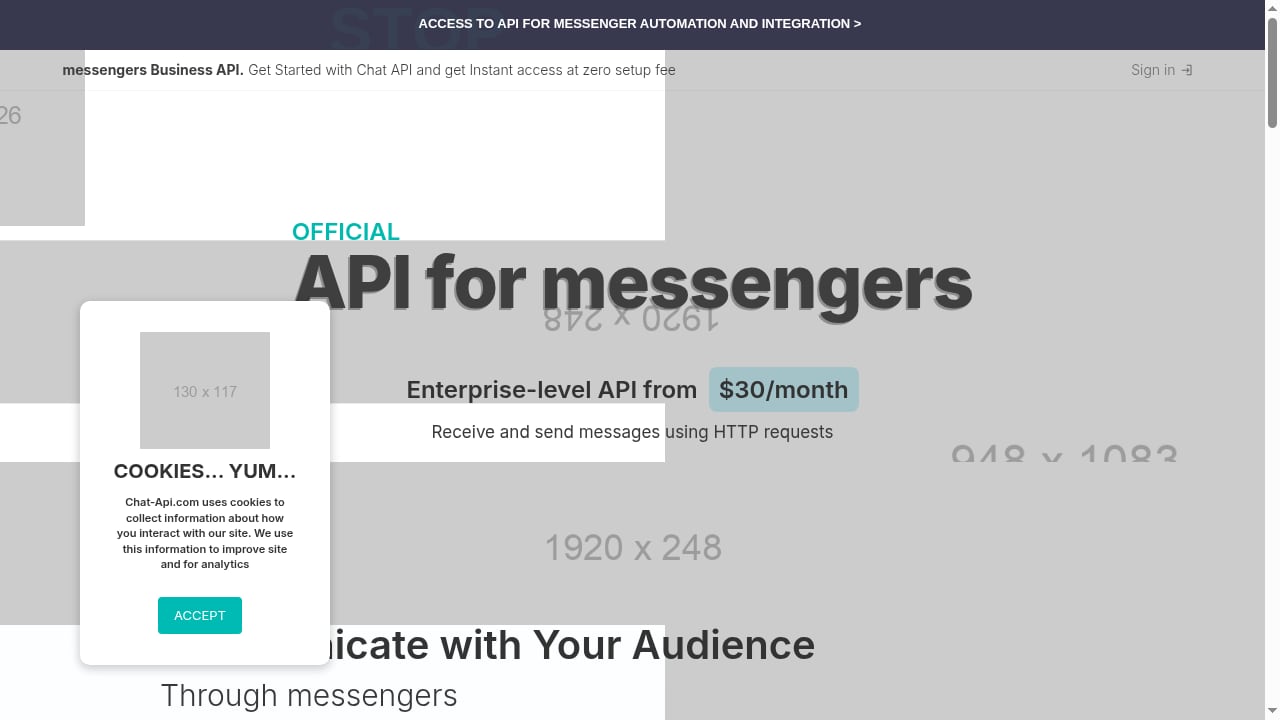
Chat API is an enterprise messaging gateway built primarily around WhatsApp, exposing the WhatsApp Business API through a REST interface so developers can send and receive messages with simple HTTP requests rather than wrestling with Meta's lower-level setup. It is aimed at developers, businesses, and agencies automating customer engagement, running campaigns, and building chatbots without risking number blocks.
Key capabilities include branded and rich messaging (images, files, location, audio, video, links, products), mass mailings, a shared team inbox, a no-code chatbot builder, and a large library of ready-made app integrations. The platform reports more than seven years of operation, 400+ integrations, and 3,000+ companies and developers using it, with tutorials for bots in PHP, Python, Node.js, C#, and Java. Pricing starts at $30 per month with no setup fee and a three-day free trial — unusually accessible for a WhatsApp gateway, where setup fees are common.
Where it fits: teams whose messaging strategy is WhatsApp-centric and who want a working integration this week rather than a multi-month platform project. Teams that also need Telegram, LINE, Zalo, or TikTok in the same workflow should look at a unified layer alongside it, such as the approach described in the UnifyPort vs SaleSmartly vs Gupshup.ai comparison.
3. Sinch — Best for Global Reach Beyond the US
Sinch operates carrier-grade messaging infrastructure across a very wide international footprint, which makes it a strong choice for companies that need to reach customers outside North America. US SMS lists at $0.0078 per segment, with a $4 brand fee, $41.50 optional vetting, $15 campaign review, and a $1.00 setup fee per number.
Its API surface spans SMS, WhatsApp, RCS, and email, and the company's direct carrier relationships help with deliverability in markets where aggregator routes are unreliable. The trade-off is a more enterprise-oriented sales process and less transparent support tiering on the public pricing page. For a direct look at how it stacks up against unified alternatives, see the UnifyPort vs Linq vs Sinch comparison.
4. Vonage — Best for Teams Already on Vonage Communication APIs
Vonage's Messages API unifies SMS, MMS, WhatsApp, and Viber behind a single endpoint, which is genuinely convenient if you already use Vonage for voice, video, or verification. Published US pricing is $0.0086 per outbound SMS — the highest base rate among the major gateways reviewed here — plus $0.00691 per inbound message and $1.05 per local number monthly with no setup fee.
That inbound charge is worth modeling carefully for two-way support use cases, where replies can rival outbound volume. The unified endpoint design and existing account consolidation are the main reasons to choose it. A side-by-side breakdown is available in the UnifyPort vs Vonage API Developer comparison.
5. Telnyx — Best for Low Base Rates on an Owned Network
Telnyx runs its own network and lists $0.004 per US 10DLC segment, the lowest published base rate in this group, with automatic discounts above 100 million messages per month. Numbers are $1.00 per month, and 10DLC registration runs $4.50 for a brand plus $15 campaign review and $10 monthly.
The catch is support: 24/7 chat and phone access come with the Growth plan, which carries a $2,000 monthly minimum. Price-sensitive engineering teams with in-house operational maturity get excellent economics; teams that need hand-holding during onboarding may find the entry tier thin.
6. Bandwidth — Best for Carrier-Owned Delivery at Scale
Bandwidth owns its network, which gives large senders more direct control over delivery and routing. It lists $0.004 per 10DLC segment and $0.015 per outbound MMS, with 10DLC fees of $9 for a brand and $20 monthly for a standard campaign under a three-month minimum.
Number pricing is not published, and support is described as included without public plan pricing, so procurement requires a sales conversation. Bandwidth suits high-volume senders with the volume to negotiate and the engineering resources to manage a carrier relationship directly.
7. Plivo — Best for Low Number Costs
Plivo combines competitive per-message pricing at $0.0077 per US segment with the lowest number cost in this review at $0.50 per local number per month. 10DLC registration is $4.50 for a brand, $15 for campaign review, and $10 monthly.
The trade-off is support access: the free Basic plan is a ticket portal only, and phone support starts at $2,500 per month. For developers comfortable with self-service and documentation, Plivo is a cost-efficient SMS and voice gateway.
8. Signal House — Best for Fast US 10DLC Approval with Human Support
Signal House positions itself around speed to approved US A2P 10DLC sending, with approvals reported in as little as 48 hours and live human support included on every plan. US SMS lists at $0.0065 per segment, falling to $0.0030 at 10 million or more segments monthly, with numbers at $1.00 per month and 10DLC fees of $4.50 for a brand plus $15 campaign review.
Its integration ecosystem is smaller than Twilio's, and the base rate sits above Telnyx and Bandwidth until volume discounts begin at 500,000 segments per month. It is a strong fit for agencies and SaaS platforms where registration friction, not raw per-message price, is the bottleneck.
9. Gupshup — Best for Conversational Messaging and Bot Tooling
Gupshup has built a broad conversational messaging platform around WhatsApp, RCS, and SMS, with bot-building tools and an emphasis on commerce and customer-support use cases. Its strength is the combination of channel access and conversation tooling in one product, which reduces the number of vendors a support team has to manage.
Pricing is largely quote-based, so buyers should request a detailed breakdown covering platform fees, per-conversation charges, and any markup over Meta's WhatsApp rates. Teams comparing it against omnichannel customer service suites will find useful context in the AI customer experience and communications platforms review.
10. MessageBird (Bird) — Best for Omnichannel Campaign Orchestration
Bird, formerly MessageBird, combines SMS, WhatsApp, and email with campaign orchestration and a customer data layer. It suits marketing and lifecycle teams that want to coordinate messaging across channels rather than call a bare delivery API.
The trade-off is that deep customization can require working through the platform's abstractions, and pricing is sales-led for most configurations. Engineering-led teams that want direct control over payloads may prefer a thinner gateway.
Comparison Table: Messaging API Gateways at a Glance
First viewport screenshot of Get Direct access to API.
| Product | Best for | Published US SMS rate | Notable constraint |
|---|---|---|---|
| Twilio | Breadth and documentation | $0.0083/segment | Live support from ~$250/mo |
| Chat API | WhatsApp-first fast setup | Quote-based WhatsApp pricing | WhatsApp-centric channel focus |
| Sinch | Global reach | $0.0078/segment | Sales-led support tiers |
| Vonage | Existing Vonage stack | $0.0086/segment | Inbound messages charged |
| Telnyx | Low base rate | $0.004/segment | 24/7 support needs Growth plan |
| Bandwidth | Carrier-owned scale | $0.004/segment | Number pricing unpublished |
| Plivo | Low number costs | $0.0077/segment | Phone support from $2,500/mo |
| Signal House | Fast 10DLC approval | $0.0065/segment | Smaller integration ecosystem |
| Gupshup | Conversational tooling | Quote-based | Pricing opacity |
| MessageBird (Bird) | Campaign orchestration | Quote-based | Abstraction limits fine control |
How to Choose a Messaging API Gateway
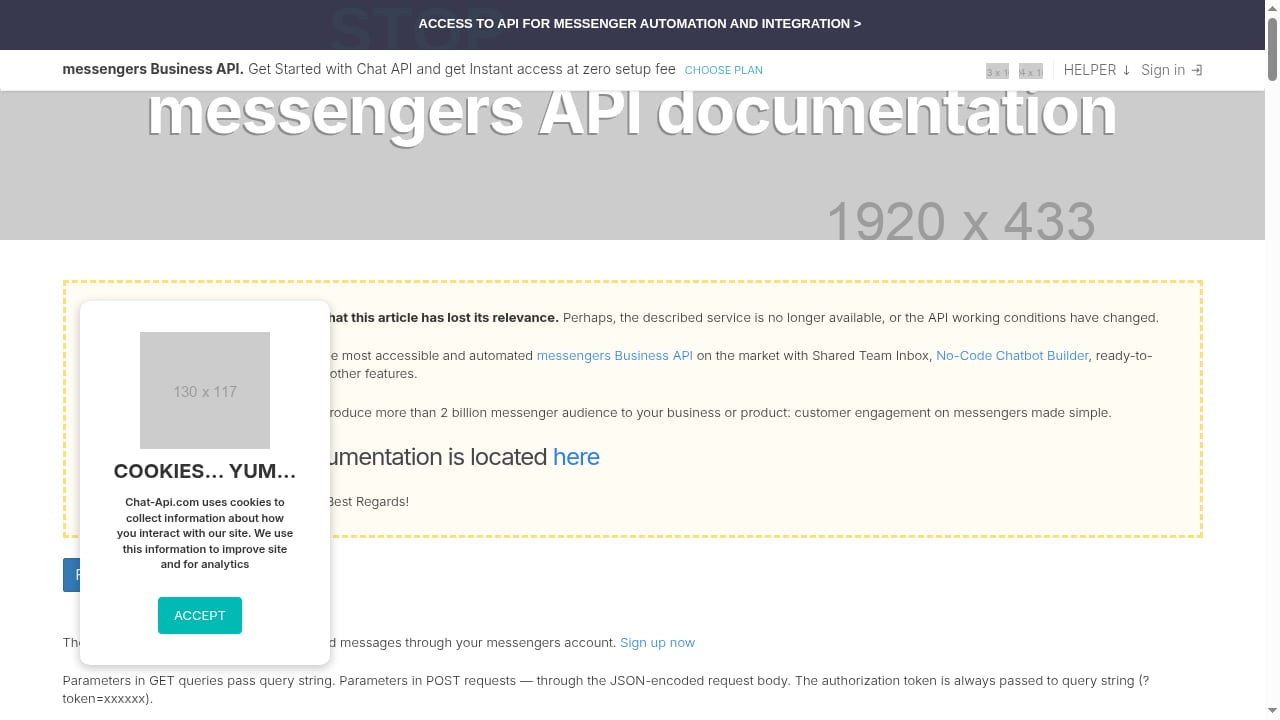
First viewport screenshot of chat-api.com.
Start with the channel mix, not the price list. If 90% of your traffic is WhatsApp, a WhatsApp-specialized gateway such as Chat API will get you live faster than a general-purpose platform. If you send US SMS at volume, the difference between $0.004 and $0.0086 per segment compounds quickly, and 10DLC approval speed may matter more than the rate itself.
Then check three operational details that rarely appear in comparison tables:
- Inbound pricing. Two-way conversations can double your bill on gateways that charge for received messages.
- Registration ownership. Confirm whether the gateway handles brand and campaign submission or hands the paperwork back to you.
- Webhook reliability. Ask how retries, ordering, and signature verification work before you build your event pipeline.
For teams whose roadmap includes several social channels rather than one, the harder question is whether to buy a single-channel gateway and integrate each new platform separately, or to standardize on a unified messaging layer. That is where a platform like UnifyPort becomes relevant as a complement rather than a substitute: it normalizes WhatsApp, Telegram, LINE, TikTok, Zalo, and X behind one REST endpoint and a consistent webhook schema, which is useful when your support or notification workflow spans Asia-Pacific channels that most SMS gateways do not touch. If you are wiring messaging into an engagement platform, the UnifyPort and OneSignal integration walkthrough shows how cross-channel journeys are assembled.
Related reading
- bundle.social Review: Unified Social API for SaaS & AI - Evidence-based bundle.social review: 15-platform API, pricing, setup, strengths, limits, and who it fits for SaaS, agencies, and AI agents.
Sources and further reading
- Best SMS APIs in 2026 - Best SMS APIs of 2026 compared on US pricing, 10DLC fees and support: Signal House, Twilio, Telnyx, Bandwidth, Plivo, Sinch and Vonage.
- Top API Gateway Solutions of 2026: A Developer's Comparison - Compare the top API gateway solutions of 2026 — Zuplo, Kong, Tyk, Gravitee, MuleSoft, and more — on developer experience, edge performance, security, and AI readiness.
- Top 11 API Gateways Compared (2026) - The top 11 API gateways compared for 2026 — APISIX, Kong, Amazon, Apigee, Tyk, Gloo, MuleSoft, Gravitee, Boomi, Layer7, Alibaba — by type, license, and fit.
Frequently Asked Questions
What is a messaging API gateway?
A messaging API gateway is a service that abstracts carrier and platform networks behind a single programmable interface. Your application sends one API request; the gateway handles channel-specific formatting, authentication, delivery, and webhooks for replies and receipts.
Which messaging API gateway is cheapest for US SMS?
By published base rate, Telnyx and Bandwidth list $0.004 per 10DLC segment. Signal House lists $0.0065 and drops to $0.0030 at 10 million or more segments monthly. Carrier pass-through fees apply on top at every provider, so model the full cost including registration and support.
Do I need a separate gateway for WhatsApp and SMS?
Not necessarily. Twilio, Sinch, Vonage, and Gupshup all support both. However, WhatsApp-first gateways such as Chat API often reduce setup time and include conversation tooling that general-purpose SMS gateways lack.
How long does A2P 10DLC registration take?
Timelines vary by provider and campaign complexity. Some gateways report approvals in as little as 48 hours when they review submissions before filing; others take longer and charge a review fee again on resubmission.
Can I use more than one messaging gateway at once?
Yes, and many teams do — for example, a WhatsApp specialist for conversational commerce alongside an SMS gateway for transactional alerts. The cost is integration maintenance, which is why unified layers that normalize multiple channels are gaining ground.
Conclusion
The 2026 messaging API gateway market splits cleanly into three groups: broad platforms like Twilio and Sinch that cover many channels at premium list prices, price-optimized networks like Telnyx, Bandwidth, and Plivo, and specialist gateways like Chat API and Signal House that win on speed to a specific outcome — WhatsApp integration or 10DLC approval. Match the gateway to your dominant channel and your team's operational maturity first, then compare rates. If your roadmap spans multiple social platforms, evaluate a unified messaging layer alongside your delivery gateway so you are not rebuilding a separate integration for every channel you add.