
bundle.social Review: Unified Social API for SaaS & AI
Evidence-based bundle.social review: 15-platform API, pricing, setup, strengths, limits, and who it fits for SaaS, agencies, and AI agents.
bundle.social Review: A Unified Social API for SaaS, Agencies, and AI Agents
If you are building a product that posts to social networks, the hardest part is rarely the UI. It is the long tail of platform approvals, token handling, per-account limits, and the maintenance burden of keeping 15 integrations alive. bundle.social sells itself as the shortcut: one API, many platforms, multi-tenant by design. This review separates what is verifiable from what is marketing, and helps you decide whether it fits your roadmap.
What bundle.social actually does
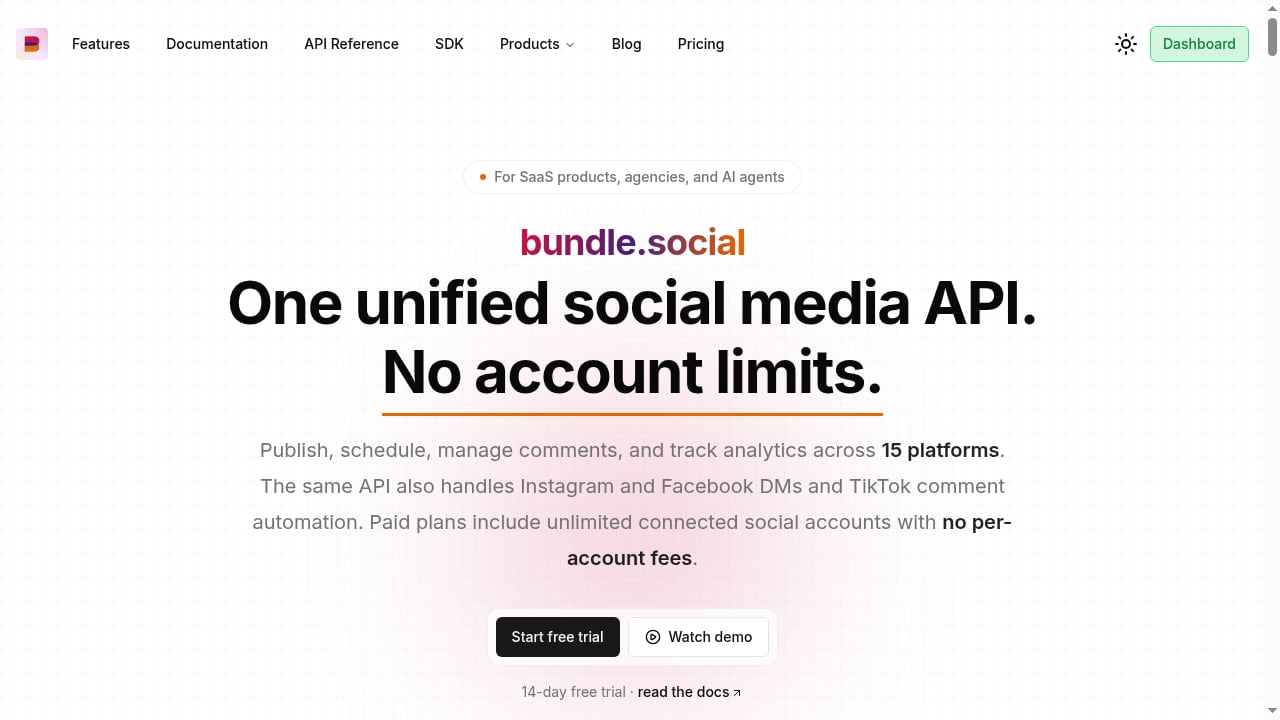
First viewport screenshot of bundle.social.
bundle.social is a unified social media API. Instead of integrating Facebook, Instagram, X, TikTok, LinkedIn, Pinterest, Reddit, Discord, Slack, Mastodon, Threads, YouTube, Bluesky, Google Business Profile, and Snapchat one by one, you integrate once and call a consistent set of endpoints for publishing, scheduling, comment management, and analytics.
The same API also covers Instagram and Facebook direct messages and TikTok comment automation. That matters for support and community workflows, not just content scheduling. The product is positioned as an official platform API layer, multi-tenant by design, and proven at scale: the vendor cites 11,000+ customers, 600k+ connected accounts, 99.981% uptime, and a 4.7/5 Trustpilot rating.
Who it is for
First viewport screenshot of bundle.social.
SaaS and platform builders
If your product needs social publishing as a feature rather than a core business, bundle.social removes the integration tax. Multi-tenancy is the key phrase: your customers connect their own accounts, and you manage them under one API key structure. That is the difference between a developer tool and a platform component.
Agencies and marketing teams
Agencies managing many client accounts benefit from unlimited connected social accounts on paid plans with no per-account fees. The trade-off is that message and automation allowances are counted per connected account, so heavy DM or comment automation across dozens of clients needs a usage estimate before you commit.
AI agents and automation builders
Agents that publish, reply, or monitor social activity need a stable, permissioned API surface. bundle.social fits this pattern, though agent builders should pay close attention to per-account messaging limits and to how comment automation is scoped.
Who should look elsewhere
If you only need one or two platforms, a direct integration or a narrower scheduler may be cheaper and simpler. If you need deep, platform-specific features that go beyond posting, comments, DMs, and analytics, verify coverage before assuming parity.
Strengths, with evidence
- Breadth with one contract. Fifteen platforms under one API is the core value proposition. The list includes the major networks plus Discord, Slack, Mastodon, Threads, Bluesky, and Google Business Profile, which covers most multi-channel publishing needs.
- Multi-tenant architecture. Designed for products that serve many end customers, not just internal teams.
- No per-account fees on paid plans. Unlimited connected social accounts on paid tiers removes a common scaling cost.
- Operational proof points. 99.981% uptime, 600k+ connected accounts, and a 4.7/5 Trustpilot rating are meaningful signals, though vendor-reported and worth validating against your own reliability needs.
- Free tier and trial. A free tier to test the product and a 14-day trial on paid plans lower the evaluation cost.
Limitations and things to verify
- Allowances are per connected account. Posts and comments are pooled at the organization level on the Pro plan, but messaging and automation allowances scale with the number of connected accounts. Model your usage before assuming the headline price covers everything.
- Platform review friction is real. A widely discussed Reddit thread in the n8n community describes repeated app-review rejections from Meta and YouTube before a working social API was in place. Even with a unified provider, your own app may still face platform review depending on how you use the API and what permissions you request.
- Review volume is modest. The Trustpilot page referenced in search results shows a small number of reviews. Ratings are useful but should be read alongside G2 feedback and your own trial.
- Feature depth varies by platform. Comment automation and DM support are not uniform across all 15 networks. Confirm the specific endpoints you need.
Pricing signals
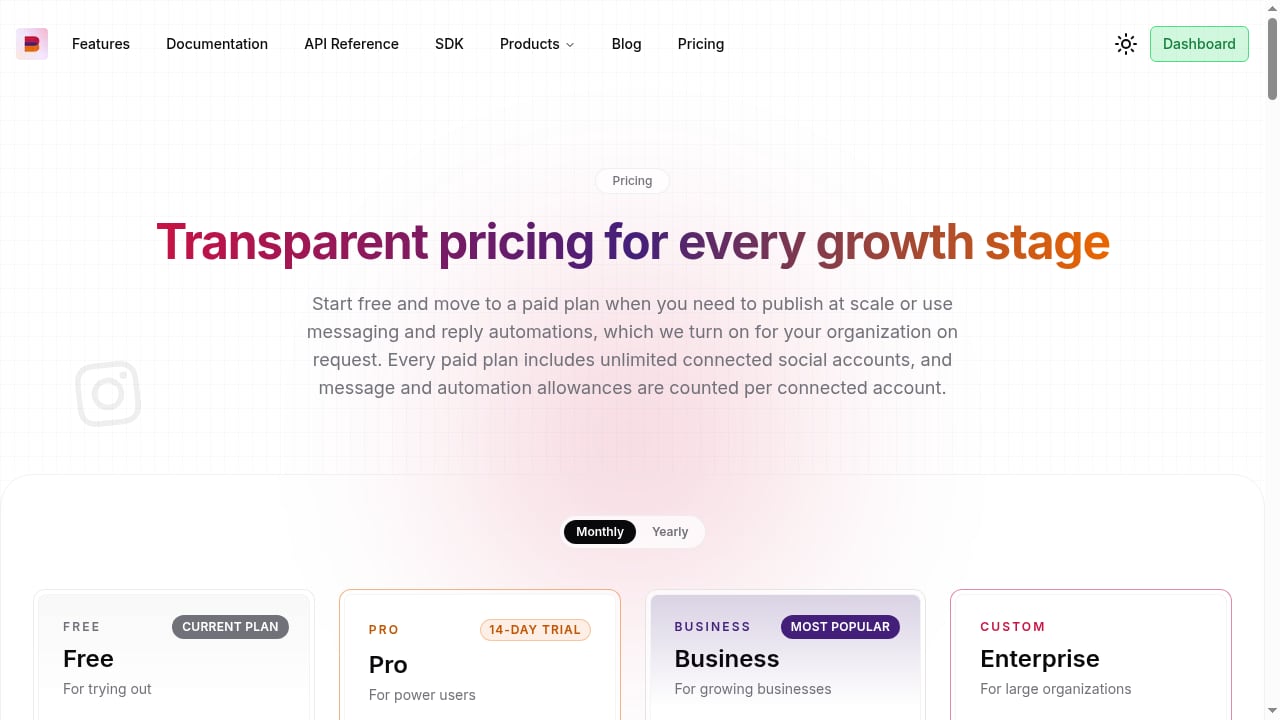
Public pricing signals point to a free tier, a 14-day trial on paid plans, and a Pro plan at $100/month per organization with 10,000 posts, 5,000 comments, and per-account messaging and automation allowances. Paid plans include unlimited connected social accounts with no per-account fees.
The practical takeaway: the Pro plan is attractive for teams with many accounts but moderate posting volume. If you run high-volume DM automation across many accounts, the per-account allowances, not the post count, will likely determine your real cost.
Setup and integration experience
First viewport screenshot of bundle.social.
A typical integration follows four steps:
- Create an account and get API credentials. Start on the free tier to test endpoints.
- Connect social accounts. Each platform uses its own OAuth flow; the API standardizes the result.
- Publish and schedule. Use the posting endpoints to send content immediately or queue it.
- Add comments, DMs, and analytics. Enable the workflows you need, then monitor usage against your plan allowances.
For teams building messaging workflows alongside social publishing, the account-connection model matters. If you are also handling QR-based messaging account setup, our guide to QR auth for messaging accounts explains the polling and webhook patterns that pair well with this kind of API.
How it compares
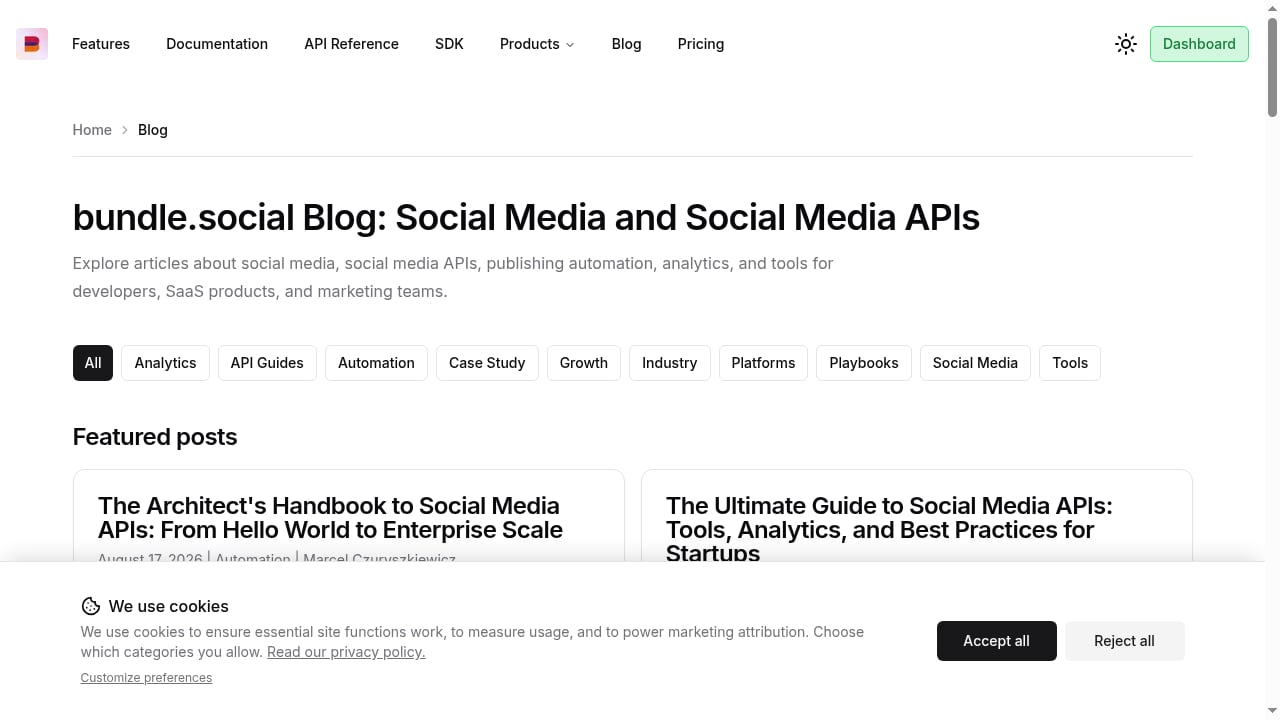
First viewport screenshot of bundle.social.
The vendor positions bundle.social as an alternative to Zernio and Ayrshare. The honest comparison comes down to three questions: which platforms you need, whether multi-tenancy is required, and how per-account usage is priced. If you are evaluating broader messaging infrastructure at the same time, our UnifyPort vs Linq vs Sinch comparison and Top 10 CPaaS products provide a useful frame for separating social publishing APIs from full communications platforms.
For a narrower AI-agent-focused option, see our SocialAPI.ai review to compare platform coverage and agent-native features.
Decision criteria
Use bundle.social if:
- You need to publish and schedule across many platforms through one integration.
- You serve multiple end customers and need multi-tenant account handling.
- You want no per-account fees and can live with per-account messaging and automation allowances.
- You need comment management and some DM support alongside posting.
Look elsewhere if:
- You only need one or two platforms.
- You need deep platform-specific features beyond posting, comments, DMs, and analytics.
- Your DM automation volume is high enough that per-account allowances become the dominant cost.
Related reading
- Top 10 AI Customer Experience & Communications Platforms 2026 - Ranked review of the top 10 AI customer experience and communications platforms in 2026, with transparent criteria, evidence, pricing signals, and buying guidance.
- How to Use UnifyPort with Chatwoot: Unified Messaging Guide - Connect UnifyPort's unified messaging API to Chatwoot's AI-powered support platform. Step-by-step setup, workflow examples, and practical tips.
FAQ
Is bundle.social a social media scheduler?
No. It is an API for developers and platforms. Scheduling is one capability, but the product is built for integration into your own software.
Does bundle.social charge per connected account?
Paid plans include unlimited connected social accounts with no per-account fees. However, message and automation allowances are counted per connected account, so usage-based costs can still scale.
How many platforms does bundle.social support?
Fifteen: Facebook, Instagram, X, TikTok, LinkedIn, Pinterest, Reddit, Discord, Slack, Mastodon, Threads, YouTube, Bluesky, Google Business Profile, and Snapchat.
Is there a free trial?
Yes. There is a free tier for trying the product and a 14-day trial on paid plans.
What do reviewers say?
The vendor cites a 4.7/5 Trustpilot rating. Public review pages show a relatively small sample, so combine ratings with a hands-on trial. G2 reviews also highlight feature fit for posting needs.
Conclusion
bundle.social is a credible unified social API for teams that need multi-platform publishing, multi-tenancy, and no per-account fees. Its strengths are breadth, operational scale, and a clean fit for SaaS products and AI agents. Its limitations are the per-account messaging and automation allowances, uneven feature depth across platforms, and the reality of platform review friction. Start on the free tier, test the exact endpoints you need, and model usage before committing to the Pro plan.
Sources: Trustpilot reviews, G2 reviews, n8n community discussion.