
UnifyPort vs SaleSmartly vs Gupshup.ai: Unified Messaging API Comparison
Compare UnifyPort, SaleSmartly, and Gupshup.ai on unified messaging APIs, omnichannel customer service, and AI agents to help developers and businesses choose the right customer communication platform.
UnifyPort vs SaleSmartly vs Gupshup.ai: Unified Messaging API and Omnichannel Customer Service Platform Comparison
When businesses need to connect multiple social messaging channels, they often face a choice: use a developer-oriented unified messaging API, or adopt an out-of-the-box omnichannel customer service system or AI conversation platform? UnifyPort, SaleSmartly, and Gupshup.ai each represent three different product approaches. This article provides an objective comparison across dimensions such as channel coverage, integration methods, AI capabilities, and target users, to help you make a decision based on your team's technical capabilities and business scenarios.
Quick Overview of the Three Products' Positioning
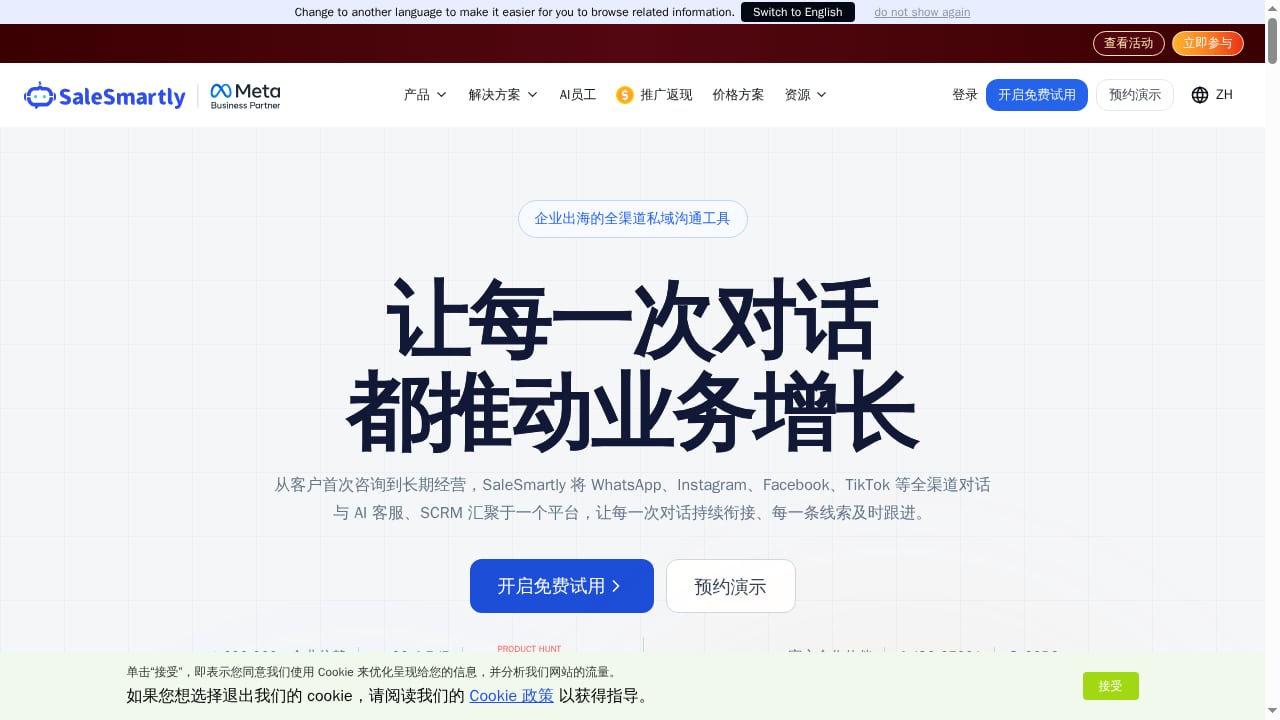
First viewport screenshot of www.salesmartly.com.
- UnifyPort: A unified messaging API platform that connects channels such as WhatsApp, Telegram, LINE, TikTok, Zalo, and X through a single REST API and standardized Webhook event stream. Aimed at developers, integration engineers, and product teams, it emphasizes "one API, all channels" to avoid rebuilding integrations for each platform.
- SaleSmartly: An omnichannel customer communication system that focuses on human customer service with AI-powered customer service as a supplement. It supports integration with 14 messaging channels including WhatsApp, Facebook Messenger, Instagram, Telegram, LINE, Email, VKontakte, WeChat, Zalo, and YouTube, providing cross-border businesses with online customer service and marketing solutions from pre-sales to after-sales, with built-in SCRM and retargeting features.
- Gupshup.ai: An autonomous AI agent platform for sales, marketing, and customer support. Built on enterprise-grade infrastructure, it supports channels such as WhatsApp, RCS, SMS, and voice, handles 24/7 conversations through AI agents, and provides AI Co-Pilot to assist human agents.
Channel Coverage and Integration Methods

SaleSmartly-在线客服系统-跨境一站式客户沟通服务 product interface.
UnifyPort: Developer-First Unified API
The core value of UnifyPort lies in standardization. Developers only need to call a single POST /v1/messages endpoint to send messages to multiple channels, and receive messages through a unified Webhook event stream (such as message.received), with events containing consistent fields such as provider, account, conversation, sender, and message. The platform supports two-way messaging, text and media descriptions, mentions, message pinning, recall, emoji reactions, and account lifecycle management (including QR codes, verification codes, sessions, and Passkey authentication flows). Official SDKs are available for Node.js, PHP, Go, and Python.
For technical teams that need to embed messaging capabilities into their own products or want to avoid maintaining separate integrations for each channel, this model can significantly reduce long-term maintenance costs. UnifyPort particularly focuses on the Asia-Pacific market, with channels such as LINE, Zalo, and TikTok within its coverage.
SaleSmartly: Out-of-the-Box Omnichannel Workspace
SaleSmartly provides a unified team inbox that centrally manages customer inquiries from multiple channels, reducing lead loss caused by channel fragmentation. Its features include WhatsApp multi-account management, real-time translation, conversation history, customer tagging and segmentation, automated marketing, and re-engagement of inactive customers. For businesses without development resources that want to quickly launch a customer service team, this out-of-the-box model is more straightforward.
Gupshup.ai: Enterprise-Grade Conversational Cloud
Gupshup.ai supports channels such as WhatsApp, RCS, SMS, and voice, emphasizes large-scale message processing capabilities, and claims to process hundreds of billions of conversations annually. Its platform offers AI agents, AI Co-Pilot, automated marketing campaign orchestration, and other features, suitable for enterprises that need to deploy AI conversations in high-concurrency scenarios.
AI Capabilities Comparison
First viewport screenshot of www.salesmartly.com.
SaleSmartly: AI-Assisted Human Customer Service
SaleSmartly's AI employees can remember customer needs, proactively follow up, and seamlessly hand over to human agents at key business opportunities. Its AI capabilities are designed around customer service scenarios, including intent recognition, real-time translation, and 4-in-1 autonomous conversation (reply, qualification screening, translation, handover). For teams that primarily rely on human service and want to use AI to improve efficiency, this positioning is pragmatic.
Gupshup.ai: Autonomous AI Agents
Gupshup.ai emphasizes "autonomous AI agents," using its proprietary ACE LLM model to generate personalized conversations, and supports triggering drip marketing campaigns based on third-party events or message signals (such as read, click, journey progress). Its AI Co-Pilot can provide suggested replies and summaries for human agents. For enterprises that want to hand over a large volume of routine conversations to AI and retain only complex cases for humans, Gupshup.ai offers a relatively complete toolchain.
UnifyPort: Messaging Infrastructure, Not an AI Layer
UnifyPort itself does not provide AI conversation agents or a customer service workspace; instead, it focuses on the abstraction and standardization of messaging channels. Developers can build their own AI logic on top of UnifyPort or integrate third-party AI services. This division of labor is suitable for teams that want full control over conversation logic and data flow.
Target Users and Use Cases
| Dimension | UnifyPort | SaleSmartly | Gupshup.ai |
|---|---|---|---|
| Primary Users | Developers, integration engineers, product teams | Cross-border business customer service, sales, and marketing teams | Medium to large enterprises, marketing and customer service operations teams |
| Integration Method | REST API + Webhook + SDK | Visual backend, out-of-the-box | Visual backend + API, enterprise-grade deployment |
| Channel Focus | WhatsApp, Telegram, LINE, TikTok, Zalo, X | WhatsApp, Facebook, Instagram, Telegram, LINE, Email, WeChat, Zalo, and 14 channels in total | WhatsApp, RCS, SMS, voice |
| AI Capabilities | No built-in AI, can integrate independently | AI-assisted human customer service | Autonomous AI agents + AI Co-Pilot |
| Pricing Model | Tiered billing per message account, transparent USD pricing | Subscription-based, free trial available | Enterprise pricing, contact sales |
How to Choose: Decision Guide
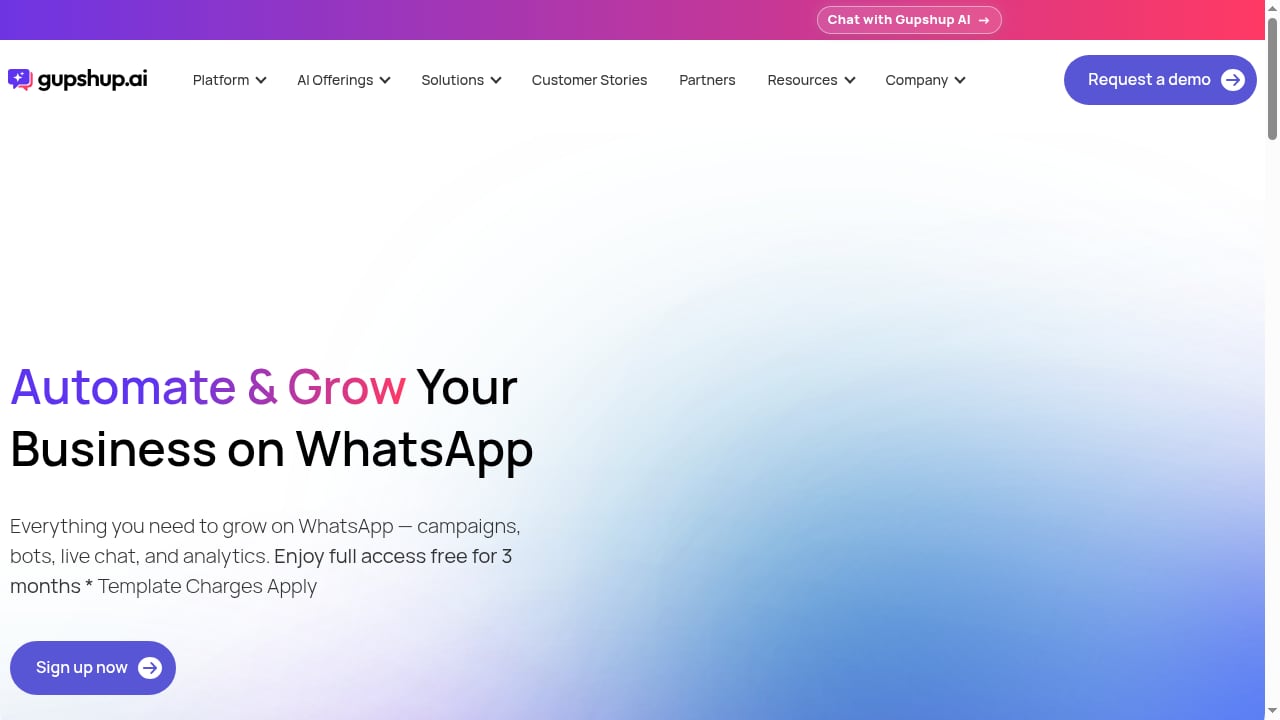
First viewport screenshot of www.gupshup.ai.
- If your team is development-focused and needs to embed messaging capabilities into your own system: UnifyPort's unified API and standardized event stream can reduce repetitive work in multi-platform integration. You can refer to UnifyPort vs Vonage API Developer to further understand the differences between developer-oriented messaging APIs.
- If you need to quickly set up a customer service team and have no development resources: SaleSmartly's omnichannel inbox, SCRM, and automated marketing features are ready to use, suitable for cross-border e-commerce and overseas businesses.
- If you want to deploy AI agents at scale to handle sales, marketing, and customer service conversations: Gupshup.ai's enterprise-grade conversational cloud and autonomous AI agents are worth evaluating, especially for enterprises with some technical team and high-concurrency processing needs.
- If you want to combine UnifyPort with an existing customer service system: You can refer to the guide How to Use UnifyPort with Chatwoot to learn how to integrate the unified messaging API into an AI-driven support platform.
Frequently Asked Questions
Which messaging channels does UnifyPort support?
UnifyPort currently supports WhatsApp, Telegram, LINE, TikTok, Zalo, and X (formerly Twitter), and provides two-way messaging, media, mentions, pinning, recall, and emoji reactions through a unified API.
Does SaleSmartly provide an API?
SaleSmartly primarily offers a visual customer service workspace. Its official website mentions "Conversation APIs," but the specific level of openness needs to be checked in its developer documentation. For teams requiring deep integration, it is recommended to directly evaluate its API capabilities.
What languages can Gupshup.ai's AI agents handle?
Gupshup.ai claims to support multilingual conversations, and its ACE LLM model is fine-tuned for industry contexts. It is recommended to verify the specific language coverage during a trial.
Can the three products be used in combination?
In theory, yes. For example, using UnifyPort as the messaging channel layer to forward standardized events to a self-built AI service or a third-party customer service system. However, combining them increases architectural complexity, and maintenance costs need to be weighed.
Which product is more suitable for the Asia-Pacific market?
UnifyPort explicitly covers Asia-Pacific commonly used channels such as LINE, Zalo, and TikTok, and provides tutorials for Webhook issues on these channels. SaleSmartly also supports LINE and Zalo. Gupshup.ai's channel focus is on WhatsApp, RCS, and SMS, with relatively limited coverage of Asia-Pacific channels.
Conclusion
UnifyPort, SaleSmartly, and Gupshup.ai are not direct substitutes but solutions for different needs. UnifyPort is suitable for developer teams that need a unified messaging API and want to control conversation logic independently; SaleSmartly is suitable for businesses that want to quickly launch an omnichannel customer service and marketing workspace; Gupshup.ai is suitable for medium to large enterprises that need large-scale AI agents to handle customer conversations. It is recommended to choose based on your team's technical capabilities, channel needs, and AI strategy. For more comparisons of messaging APIs, you can refer to Top 10 AI Customer Experience and Communications Platforms in 2026 and UnifyPort vs Linq vs Sinch.
Related reading
- bundle.social Review: A Unified Social API for SaaS and AI - An evidence-based review of bundle.social: 15 platform APIs, pricing, setup, pros, cons, and who it's for among SaaS, agencies, and AI agents.
- auth_mode qrcode Providers: QR Code Authentication for Messaging Accounts - Learn how auth_mode qrcode providers work in messaging APIs: account creation, QR code initiation and check polling, webhook-first setup, signature verification, and provider differences.
Sources and further reading
- SaleSmartly - Online Customer Service System - One-Stop Cross-Border Customer Communication Service - An omnichannel customer communication system that focuses on human customer service with AI-powered customer service as a supplement. It supports integration with WhatsApp, Facebook Messenger, Instagram, Telegram, LINE, Email, VKontakte, WeChat, Zalo, and YouTube, providing cross-border businesses with comprehensive online customer service and marketing solutions covering pre-sales, in-sales, and after-sales stages.
- AI-Powered Omnichannel Customer Engagement Platform | SaleSmartly - Trusted by 300,000+ businesses. Unify WhatsApp, Telegram, Facebook, Instagram & more in a shared inbox with AI agents, CRM & automation to capture, convert & retain customers.
- Gupshup.ai | Autonomous AI Agents for Sales, Marketing & Customer Support - Deploy secure, scalable AI Agents with enterprise-ready infrastructure. Gupshup powers billions of customer conversations across channels and industries.