
UnifyPort vs Unipile vs Esendex: Which Messaging API Fits?
Compare UnifyPort, Unipile, and Esendex on channels, webhooks, SDKs, and pricing to pick the right messaging API for your product.
UnifyPort vs Unipile vs Esendex: Which Messaging API Fits?
Choosing a messaging API is really a question about what you are building. A recruiting platform that embeds LinkedIn outreach has different needs from a utility company sending appointment reminders over SMS. UnifyPort, Unipile, and Esendex all promise to simplify multi-channel messaging, but they solve different problems for different buyers.
This comparison looks at where each platform is genuinely strong, where the trade-offs sit, and how to decide based on your channels, your team, and your delivery model.
Quick comparison at a glance
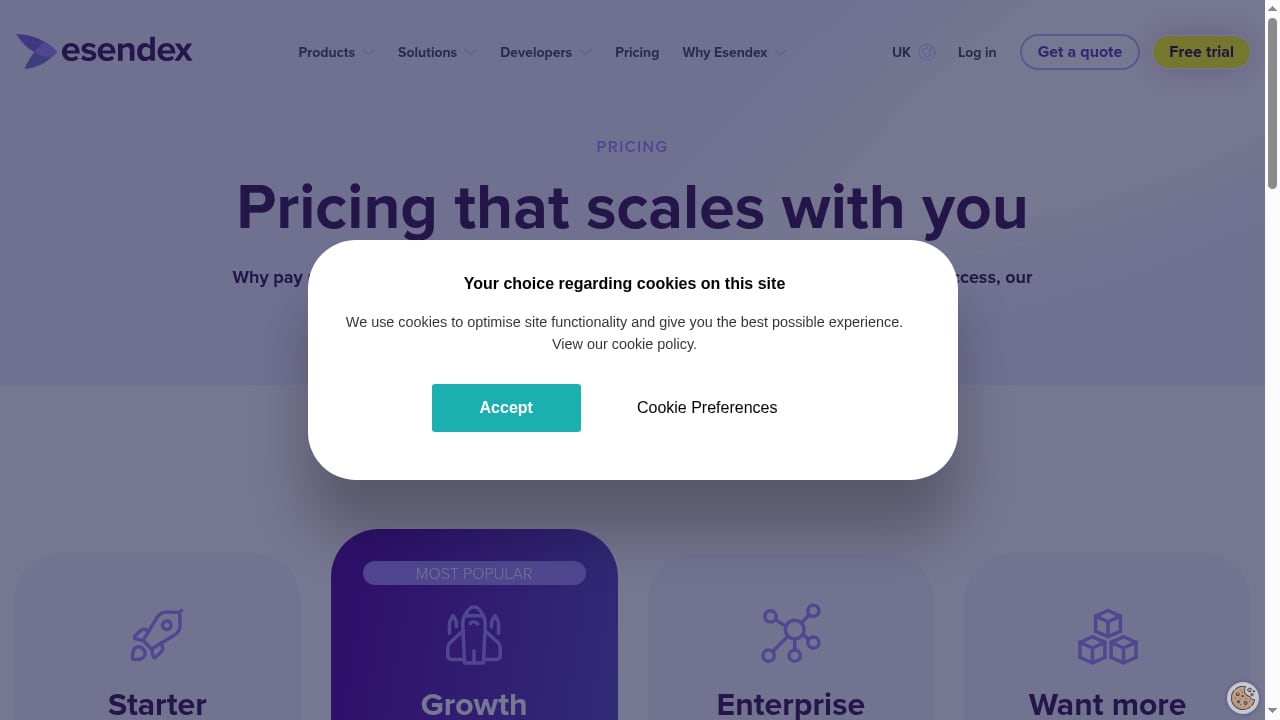
First viewport screenshot of Esendex Pricing - From £54 a month.
| Criterion | UnifyPort | Unipile | Esendex |
|---|---|---|---|
| Primary buyer | Developers building messaging into products | B2B software vendors embedding comms | Businesses sending business messaging |
| Channel focus | WhatsApp, Telegram, LINE, TikTok, Zalo, X | LinkedIn, Gmail, WhatsApp, Instagram, Telegram, email, calendar | SMS, WhatsApp, RCS, Email, Voice |
| Signature strength | Standard event layer and webhook control plane | LinkedIn and email/calendar integration depth | 20+ years of business messaging and compliance |
| Pricing model | Graduated pricing, free messaging accounts in every workspace | Pay-as-you-go per connected account, from $55/month for 10 accounts | Plans from £54/month for 500 messages |
Where Unipile is strong
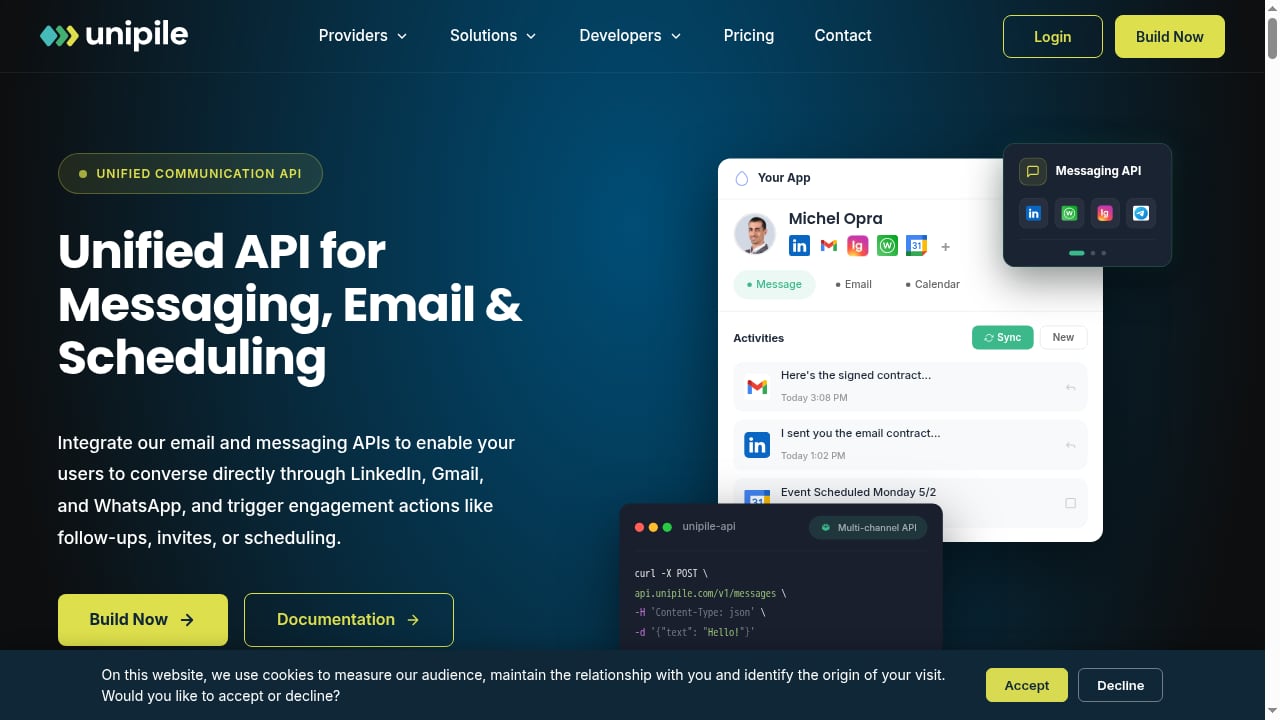
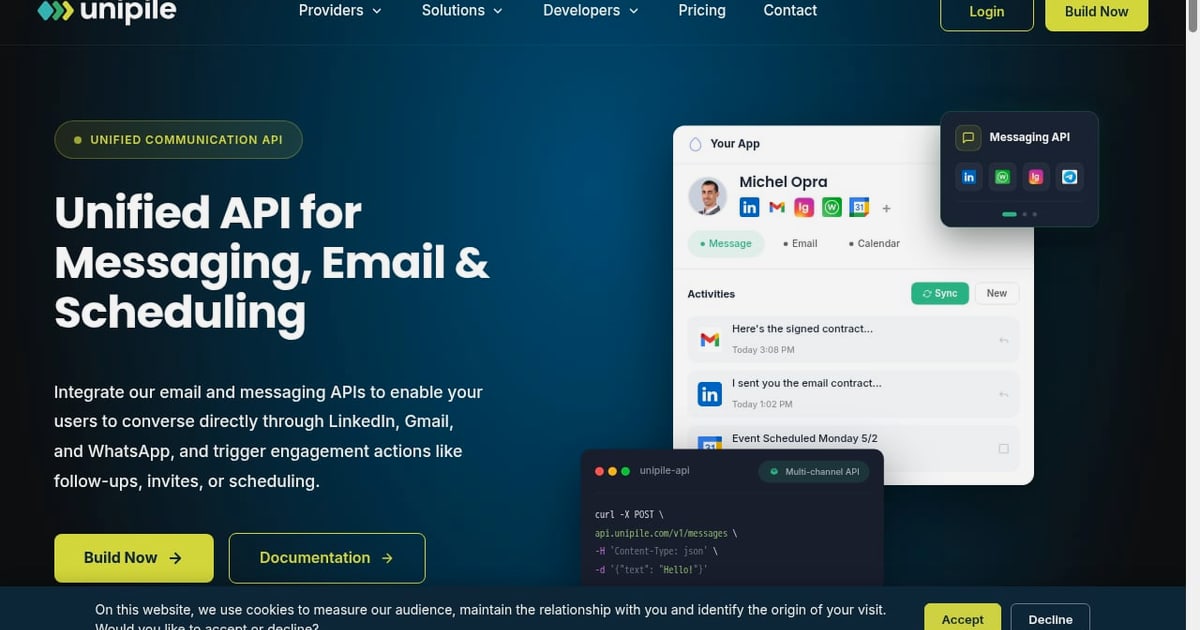
First viewport screenshot of One API for Multi-Channel Messaging in your app – Unipile.
Unipile has built a clear reputation with B2B software vendors, especially in recruiting and sales. Its pitch is a single API across LinkedIn, Gmail, WhatsApp, Instagram, Telegram, and email, plus calendar capabilities. For an ATS or CRM that wants users to converse without leaving the host app, that combination is hard to match.
A few things stand out:
- LinkedIn depth. Unipile exposes social actions such as profile retrieval, search, invitations, and messaging, which is unusual among unified APIs.
- Email and calendar coverage. Support for Gmail API, Microsoft Graph, and IMAP, plus calendar events and webhooks, makes it a fit for products that need scheduling alongside messaging.
- Real-time sync and unified inbox. Conversations across channels stay in one place, which matters for embedded inbox experiences.
- Transparent per-account pricing. Pay-as-you-go based on connected accounts, with a 7-day free trial and a $55/month entry point for up to 10 accounts, is easy to model for early-stage products.
The trade-off is scope. Unipile is deliberately infrastructure: you still build the campaign experience, the operating playbook, and much of the product layer around it. Teams that only need raw WhatsApp or Telegram endpoints may also find the per-account model heavier than they need.
Where Esendex is strong
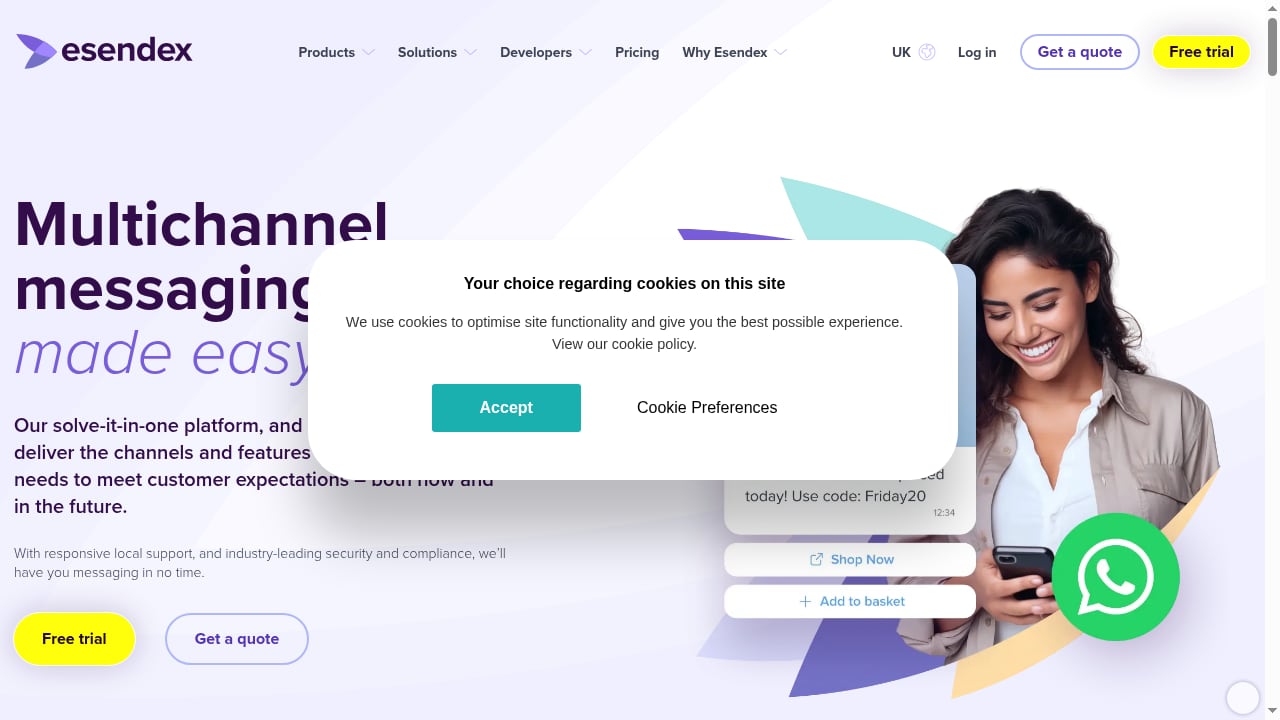
First viewport screenshot of Esendex - Business SMS & Multichannel Messaging Services.
Esendex is a different kind of platform. It is a business messaging provider with over 20 years of experience, and its strength is reliability and compliance across regulated and high-volume use cases.
Its strengths are practical:
- Broad channel coverage for business messaging. SMS, WhatsApp, RCS, Email, and Voice under one platform, with build-once APIs and a web-based messaging platform.
- Compliance and security posture. Industry-leading security and compliance, local UK support, virtual mobile numbers, and sender IDs are meaningful for financial services, healthcare, utilities, and the public sector.
- Proven enterprise delivery. Case studies with organisations such as British Airways Holidays, Brighton & Hove City Council, and Debt Managers show real deployments in reminders, notifications, and collections.
- Predictable plan pricing. Plans start from £54 per month for 500 messages and scale to enterprise packages above 10,000 messages per month, with a reseller programme for partners.
The trade-off is developer ergonomics. Esendex is built around business messaging workflows rather than a normalized event stream for product builders. If your team wants to treat messaging as a product feature with a stable JSON shape and a webhook control plane, you will likely need to build more of that layer yourself.
Where UnifyPort fits: channels, events, and delivery
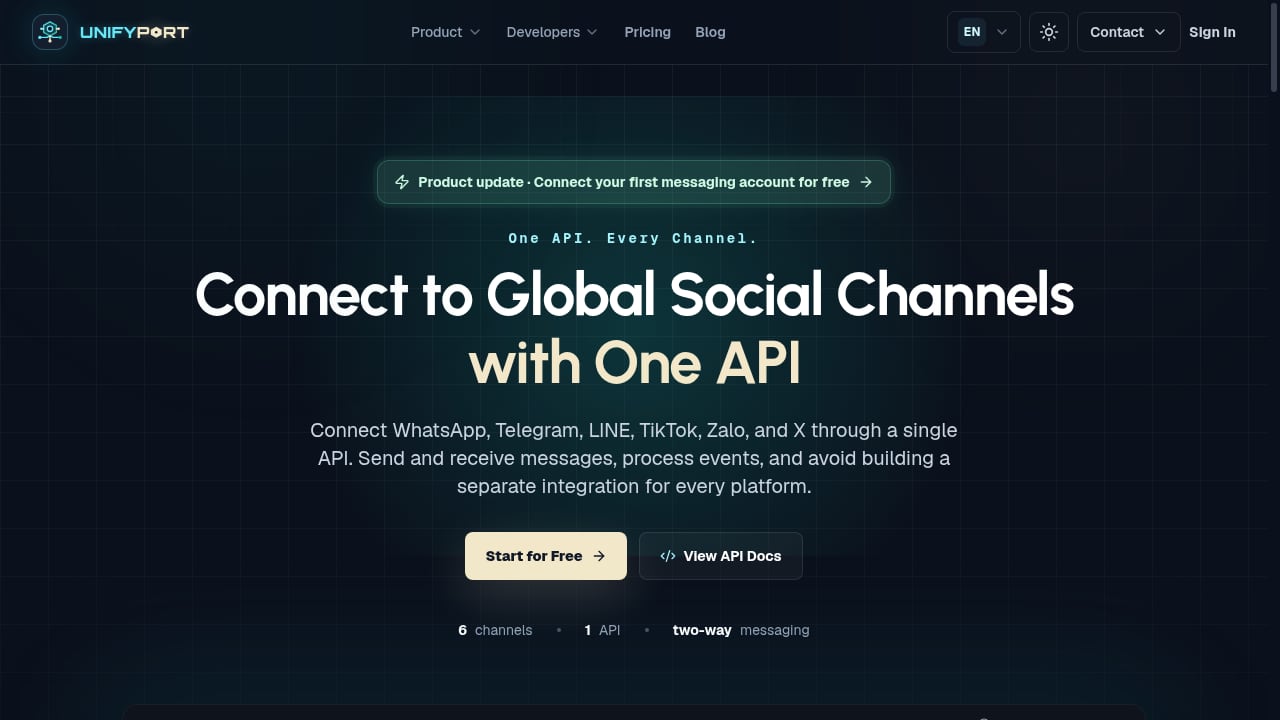
First viewport screenshot of UnifyPort — One API. Every Channel..
UnifyPort is a unified messaging API platform built around one REST API and one standard webhook event stream. It connects to WhatsApp, Telegram, LINE, TikTok, Zalo, and X, and normalizes provider messages, status updates, and account events into a stable JSON shape. The positioning is simple: one API, every channel.
Where UnifyPort has a supported advantage is in the developer-facing infrastructure around messaging:
- Standard event layer. Inbound messages, delivery status, and account events arrive in a consistent shape, so your handlers do not branch per provider.
- Webhook control plane. Manage signatures, subscriptions, retry behavior, and failure tracking from one place instead of rebuilding it for every channel.
- Keys and signatures. API key and HMAC-SHA256 signature authentication are built in, which matters when you expose webhooks to the public internet.
- Reliable delivery queue. Rate limits, retries, idempotency, and failure isolation help keep one flaky channel from taking down the rest.
- Official SDKs. Node.js, PHP, Go, and Python SDKs shorten the path from prototype to production.
- Account lifecycle support. Authorization flows such as QR code, code, password, Passkey, and session import are handled as first-class concerns.
Pricing is graduated for messaging accounts, and free messaging accounts are available in every workspace, which makes it easy to prototype before committing. If your product needs to send and receive messages across social and chat channels with a predictable event model, this is the layer UnifyPort is designed to provide.
For a closer look at how this plays out in practice, see how to use UnifyPort with LINE Developers and the developer guide on engaging customers across messaging channels.
How to choose between the three
The decision usually comes down to three questions.
1. Which channels do you actually need?
If LinkedIn, Gmail, and calendar sync are central to your product, Unipile is the natural starting point. If your use case is SMS-first business messaging with compliance requirements, Esendex is the safer bet. If you need WhatsApp, Telegram, LINE, TikTok, Zalo, and X behind one API with a normalized event stream, UnifyPort is built for that shape.
2. Who owns the product layer?
Unipile and UnifyPort are infrastructure: they give you endpoints and events, and you build the campaign or inbox experience on top. Esendex leans toward a managed business messaging platform with a web interface, which can reduce build effort if you do not want to own the whole stack.
3. How do you want to pay?
Unipile prices per connected account, which scales with users. Esendex prices per message volume, which scales with sends. UnifyPort uses graduated pricing for messaging accounts with free messaging accounts in every workspace, which suits teams that want to start small and grow. If you are comparing across more vendors, the top omnichannel customer communication platforms roundup covers additional options.
Practical examples
- A recruiting platform embedding LinkedIn and WhatsApp conversations into its ATS would find Unipile's social and messaging endpoints well aligned with that workflow.
- A utility or healthcare provider sending appointment reminders, payment prompts, and alerts over SMS and WhatsApp would value Esendex's compliance posture and local support.
- A product team building a chat feature across WhatsApp, Telegram, LINE, and X would benefit from UnifyPort's standard event layer, webhook control plane, and SDKs, rather than maintaining four separate integrations.
Related reading
- UnifyPort vs One API for SMS, WhatsApp and RCS | Sent - Compare UnifyPort and Sent's One API for SMS, WhatsApp and RCS. See channel coverage, webhook control, SDKs, and which unified messaging API fits your stack.
- SocialAPI.ai Review 2026: Unified Social API & MCP Server - Evidence-based SocialAPI.ai review: 13-platform REST API, 75+ tool MCP server, pricing, setup, limitations, and who it fits in 2026.
Sources and further reading
- One API for Multi-Channel Messaging in your app – Unipile - Advance your app's capabilities: Integrate LinkedIn and WhatsApp for streamlined messaging and improved user experience.
- Best Unipile Alternatives & Competitors - Compare the best Unipile alternatives in 2026. Explore user reviews, ratings, and pricing of alternatives and competitors to Unipile.
- 8 Best Unipile Alternatives in 2026 (Pricing Compared) - 8 Unipile alternatives, pricing verified October 2026: Swarmhit, Linked API, LinkupAPI, Edges, Captain Data, Scrapin, Nylas, EmailEngine. Pick by layer.
FAQ
Is Unipile a good alternative to UnifyPort?
They overlap on unified messaging APIs, but Unipile leans toward LinkedIn, email, and calendar for B2B software vendors, while UnifyPort focuses on social and chat channels with a standard event layer and webhook control plane. The right choice depends on which channels and product layers you need.
Is Esendex a developer API or a business messaging platform?
Both. Esendex offers build-once APIs and a web-based messaging platform, with strong compliance and support for SMS, WhatsApp, RCS, Email, and Voice. It is often chosen by organisations that want a managed business messaging provider rather than raw messaging infrastructure.
How does pricing compare?
Unipile starts at $55/month for up to 10 connected accounts on a pay-as-you-go model. Esendex plans start from £54/month for 500 messages and scale to enterprise packages. UnifyPort uses graduated pricing for messaging accounts, with free messaging accounts available in every workspace.
Which platform has the best webhook tooling?
UnifyPort explicitly provides a webhook control plane for signatures, subscriptions, retry behavior, and failure tracking, plus HMAC-SHA256 signature authentication. Unipile and Esendex both support webhooks, but the depth of the control plane varies, so test against your own failure and retry scenarios.
Conclusion
UnifyPort, Unipile, and Esendex are not direct substitutes so much as different layers of the messaging stack. Unipile is strongest when LinkedIn, email, and calendar integration matter most. Esendex is strongest when business messaging compliance, local support, and message-volume pricing matter most. UnifyPort is strongest when you need one API and one standard event stream across social and chat channels, with a webhook control plane and reliable delivery queue behind it.
Start by listing the channels you must support, the product layer you are willing to build, and the pricing model that matches your growth. That list will usually make the decision obvious.