
Top 10 Omnichannel Customer Communication Platforms 2026
Ranked 2026 review of the top 10 omnichannel customer communication platforms, with transparent criteria, evidence, pricing signals, and buying guidance.
Top 10 Omnichannel Customer Communication Platforms 2026
Customers rarely stay in one channel. They start in a chat, follow up by email, and expect the next agent to already know the whole story. That expectation is what separates an omnichannel customer communication platform from a stack of disconnected inboxes. This review ranks ten platforms that genuinely unify customer conversations across channels in 2026, explains how they were evaluated, and shows where each one fits.
How We Evaluated These Platforms
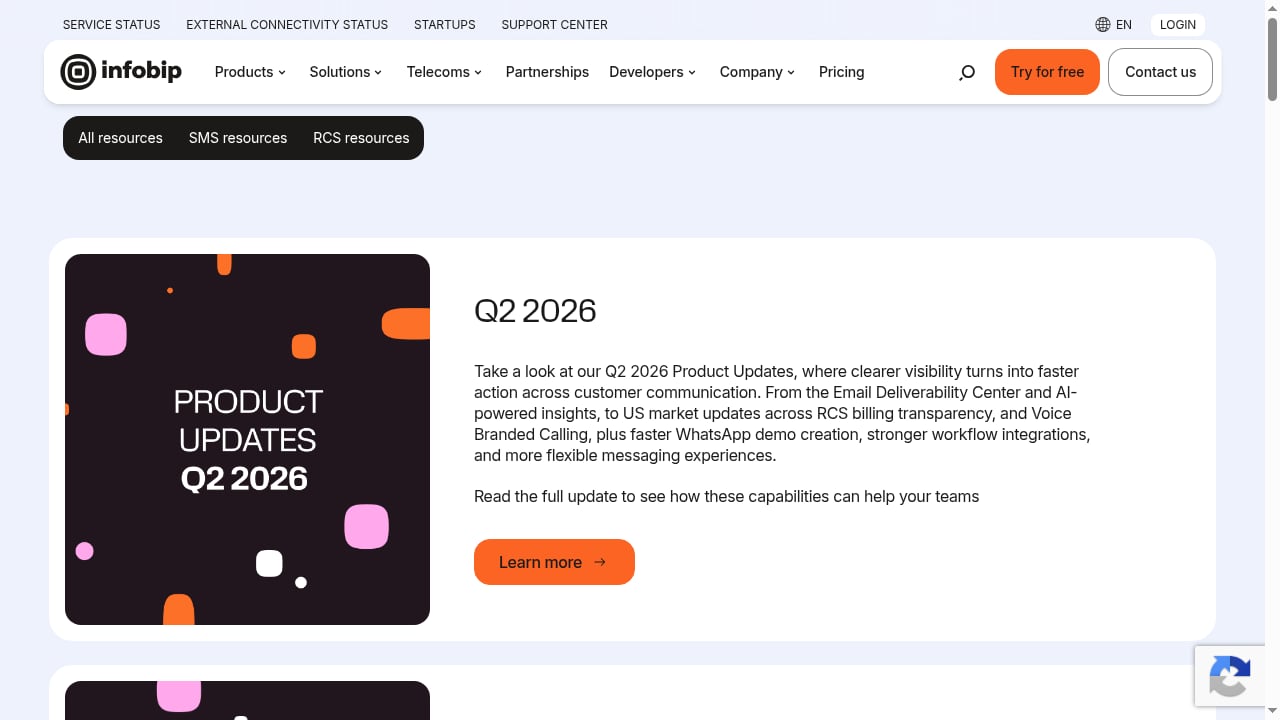
First viewport screenshot of Product updates.
Every platform on this list had to meet four baseline tests:
- Unified customer context. Cross-channel history must live in one place, not in separate queues with separate data.
- Real channel coverage. At least four meaningful channels, including at least one messaging channel such as WhatsApp, RCS, or SMS.
- Evidence of production use. Public case studies, verified review volume, or documented enterprise deployments.
- Transparent commercial signals. Public pricing, published pricing ranges, or a standard demo-request path.
Rankings weigh channel depth, AI and automation maturity, developer extensibility, pricing predictability, and how well the platform preserves conversation continuity. Products are ordered by overall fit for teams that need true omnichannel communication, not by feature count alone.
1. Infobip
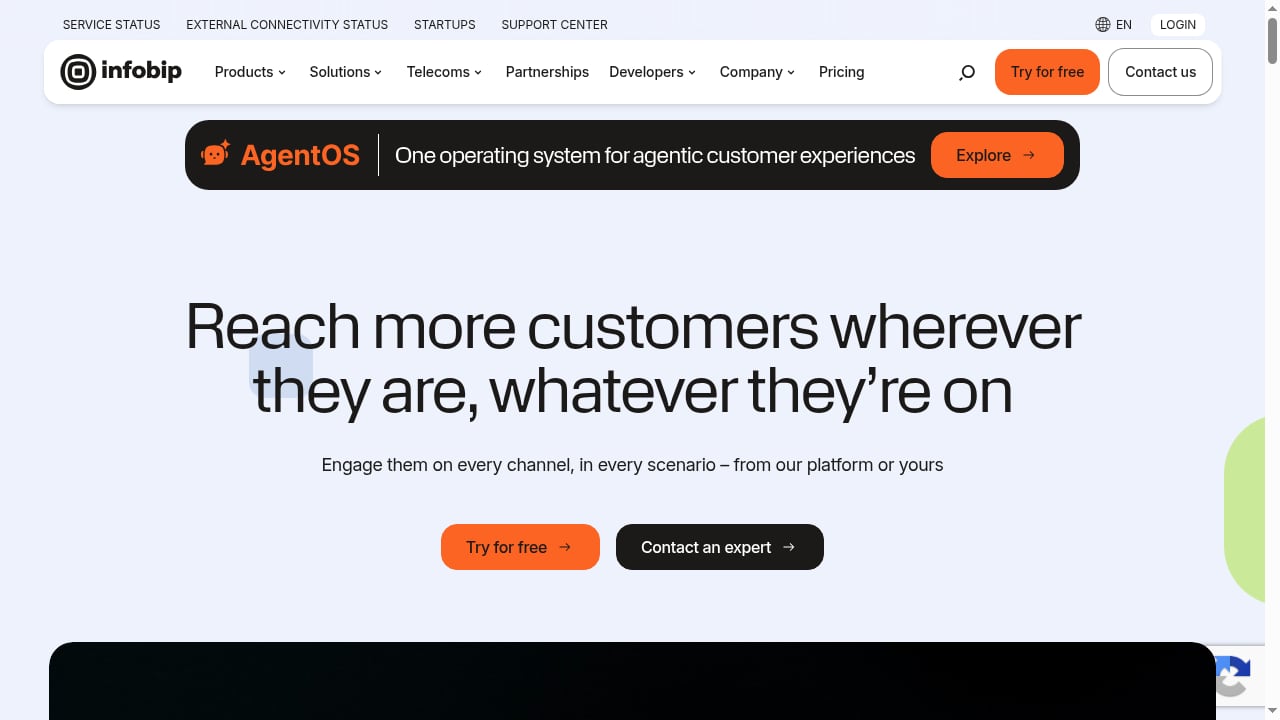
First viewport screenshot of Infobip - Build meaningful customer relationships across any communication channel.
Best for: Teams that want one operating system for agentic, omnichannel customer experiences.
Infobip provides a single platform for engaging customers across SMS, email, WhatsApp, RCS, Viber, voice, and chatbots. Its differentiator is the combination of composable CX modules, programmable channels, drag-and-drop journey builders, and a full API suite, so marketing, support, and developer teams can work from the same foundation.
Infobip's 2026 direction centers on AI-driven automation through AgentOS, AI agents that understand context and take autonomous action, and MCP servers that connect AI directly to communication channels. Recent updates include an Email Deliverability Center, RCS billing transparency, Voice Branded Calling, WhatsApp Business Calling, AI-powered Vocalize, and enhanced analytics.
Strengths: Broad native channel coverage; verticalized use cases for finance, healthcare, and retail; strong CPaaS and conversational engagement credentials; deep API and automation tooling.
Trade-offs: The breadth of modules can require deliberate architecture decisions before rollout; smaller teams may need to scope carefully to avoid paying for capability they will not use.
Pricing signal: Custom pricing based on channels, volume, and modules.
2. Zendesk
Best for: Established enterprise support organizations that need the widest integration surface.
Zendesk remains a default choice for large support operations, with native omnichannel across email, chat, voice, social, and SMS, plus more than 1,300 integrations. Its automation and reporting depth are hard to match, and its compliance posture suits regulated industries.
Strengths: Mature workflow engine; extensive integration ecosystem; strong analytics; enterprise-grade security certifications.
Trade-offs: Per-seat pricing compounds at scale, and configuration requires real admin investment. AI capabilities are typically an add-on cost.
Pricing signal: Entry plans start around $19 per agent per month, with professional and enterprise tiers higher; AI add-ons priced separately.
3. Freshdesk (Freshworks)
Best for: Mid-market teams that want strong feature depth at a lower entry price.
Freshdesk covers email, chat, voice, social, SMS, and WhatsApp, with AI handling categorization, prioritization, and response drafting. It is consistently cited as one of the fastest omnichannel helpdesks to deploy.
Strengths: Accessible entry pricing; free tier for very small teams; AI automation across triage and drafting; quick setup.
Trade-offs: Full omnichannel capability and AI copilot features sit in higher-tier or separate products, so the effective cost rises as channels and automation are added.
Pricing signal: Free tier available; paid plans from roughly $15 per agent per month, with omnichannel and AI tiers priced above that.
4. Intercom
Best for: Product-led companies where most support happens inside the product.
Intercom pioneered messaging-first support and its Fin AI agent is widely regarded as one of the strongest autonomous resolution tools in the category. It handles in-app messaging, email, chat, WhatsApp, SMS, and phone.
Strengths: Best-in-class AI deflection; clean handoff from bot to human; strong in-app experience; consistent satisfaction scores across thousands of reviews.
Trade-offs: Pricing can be unpredictable as AI resolution volume scales, which is a recurring theme in user feedback.
Pricing signal: Seat-based plans starting around $29 per seat per month, with AI resolution priced separately.
5. Salesforce Service Cloud
Best for: Enterprises already standardized on the Salesforce platform.
Service Cloud unifies email, chat, voice, social, and SMS inside the Salesforce data model, so service conversations connect directly to sales, commerce, and marketing records. Agentforce adds an autonomous AI layer for case handling and resolution.
Strengths: Deep CRM-native context; governed data foundation; strong enterprise compliance; broad partner ecosystem.
Trade-offs: Total cost of ownership is high, and value depends heavily on already being invested in Salesforce.
Pricing signal: Entry plans from around $25 per user per month, with significant uplift for advanced and AI tiers.
6. HubSpot Service Hub
Best for: Teams running marketing, sales, and service on the HubSpot CRM.
Service Hub covers email, live chat, calls, and social within a shared CRM, with Breeze AI agents automating content, routing, and follow-up tasks. The appeal is consolidation: one customer record across the whole funnel.
Strengths: Unified CRM foundation; approachable interface; strong inbound and lifecycle alignment; free tier available.
Trade-offs: Channel depth is narrower than dedicated contact-center platforms, and advanced omnichannel routing may require higher tiers.
Pricing signal: Free tier; paid seats from roughly $15 per seat per month, scaling with tier.
7. Kustomer
Best for: High-volume retail and consumer brands that need a timeline-first agent view.
Kustomer organizes every interaction around a persistent customer timeline rather than a ticket queue, which suits brands handling large volumes of repetitive, cross-channel conversations. It supports email, chat, social, voice, SMS, and WhatsApp.
Strengths: Conversation-centric data model; strong retail and ecommerce fit; robust automation for high-volume queues.
Trade-offs: Higher per-user pricing than mid-market alternatives, and no free trial.
Pricing signal: Plans start around $89 per user per month.
8. Gorgias
Best for: Ecommerce and Shopify-based brands.
Gorgias unifies email, chat, social, SMS, and voice with deep commerce integrations, so agents can see order data alongside the conversation. It is built for revenue-adjacent support rather than traditional contact centers.
Strengths: Strong Shopify and ecommerce integrations; ticket-based pricing that can suit seasonal volume; fast setup for small commerce teams.
Trade-offs: Less suited to complex enterprise routing, and voice support is narrower than full contact-center platforms.
Pricing signal: Entry plans from around $10 per month on a ticket-based model, scaling with volume.
9. Sprinklr Service
Best for: Social-first enterprises managing very large channel footprints.
Sprinklr supports 30 or more channels, including social, email, voice, and messaging, within a unified engagement platform. It is designed for brands where social and community conversations are a primary support surface.
Strengths: Extremely broad channel coverage; strong social listening and moderation; enterprise governance.
Trade-offs: High entry pricing and implementation overhead; overkill for teams that only need a handful of channels.
Pricing signal: Plans start around $199 per seat per month.
10. Vonage
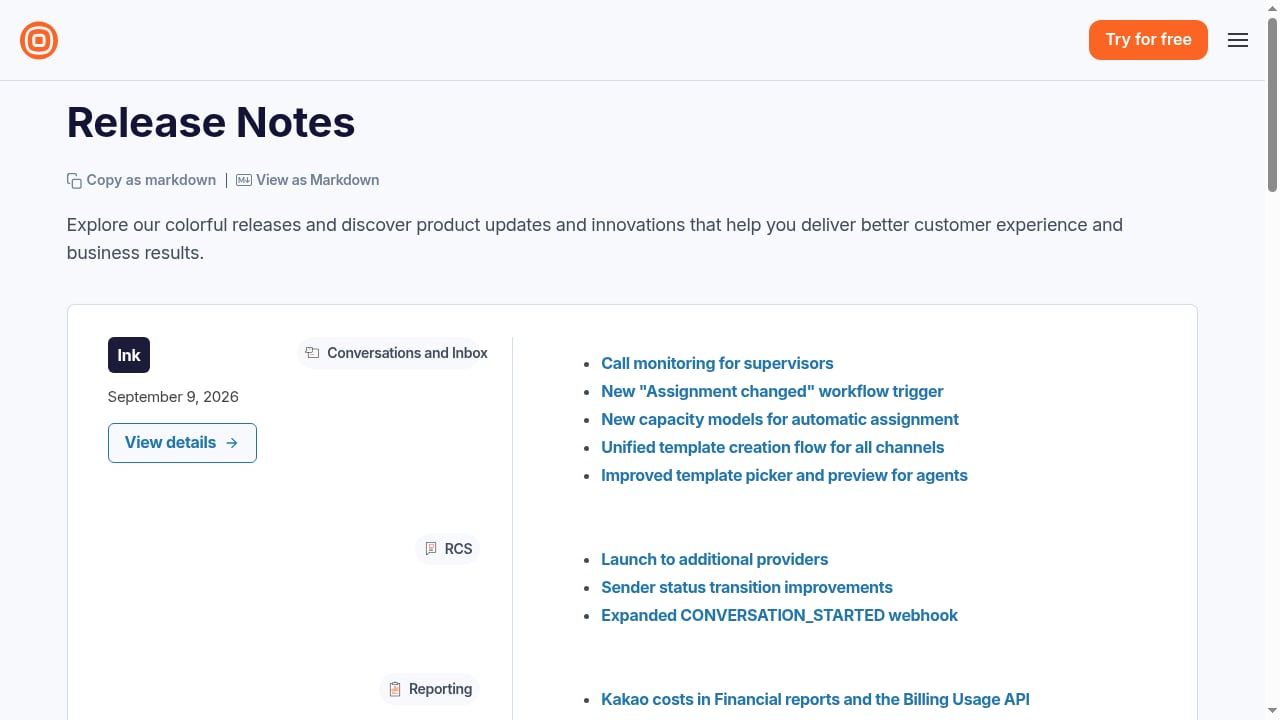
First viewport screenshot of Infobip Release Notes | Infobip Docs.
Best for: Developer teams building custom omnichannel communication into their own products.
Vonage provides programmable voice, video, and messaging APIs, including a Messages API that abstracts multiple channels behind one interface. It is a strong fit when communication is a product feature rather than an internal helpdesk function. For a deeper technical breakdown, see this Vonage API Developer review.
Strengths: Strong developer tooling; flexible API-first architecture; broad programmable channel coverage.
Trade-offs: You build the agent workspace, routing, and reporting yourself; it is infrastructure, not a finished support product.
Pricing signal: Usage-based pricing per message, minute, and channel.
How to Choose in 2026
First viewport screenshot of Product Updates Q2 2024.
Start with the shape of your problem, not the feature list:
- Support-led omnichannel: Zendesk, Freshdesk, Intercom, Kustomer, and Gorgias are built around agent workflows and ticket or conversation management.
- CRM-led omnichannel: Salesforce Service Cloud and HubSpot Service Hub win when the customer record must be shared across marketing, sales, and service.
- Communication-led omnichannel: Infobip, Sprinklr, and Vonage treat channels and APIs as the core product, which suits teams that need to embed communication into their own systems.
If your team is building multi-channel messaging directly into a product and wants to avoid maintaining separate integrations for each provider, a unified messaging API layer can complement the platforms above. UnifyPort is one option in that adjacent space: it normalizes WhatsApp, Telegram, LINE, TikTok, Zalo, and X behind one REST API and one webhook event stream, which is a different job from running an agent workspace. For teams weighing that layer against broader marketing infrastructure, this UnifyPort vs MSG91 vs Zernio comparison covers the trade-offs.
Two more practical checks before you commit:
- Model the real cost at your scale. Per-seat, per-ticket, and per-resolution pricing behave very differently as volume grows.
- Test conversation continuity. Send a message in one channel, reply in another, and confirm the agent sees one timeline.
Related reading
- How to Use UnifyPort with LINE Developers - Connect UnifyPort to LINE Developers: when to use the official Messaging API, when to use a signed inbound webhook, setup steps, and identity pitfalls.
- UnifyPort vs Unified Social Media API (PostPeer) for Developers - Compare UnifyPort and PostPeer's Unified Social Media API for developers and AI agents: channels, webhooks, SDKs, pricing, and which fits your stack.
Sources and further reading
- 12 Best Omnichannel Customer Support Platforms in 2026 - A ranked comparison of the 12 best omnichannel customer support platforms for 2026, with G2 ratings, pricing, channel coverage, real user reviews, and a decision framework by team size and industry.
- Top 12 Omnichannel Customer Support Software in 2026 (Features & Pricing Compared) - Explore the 12 best omnichannel customer support platforms for 2026. Compare features, pricing, integrations, and AI capabilities to find the right fit.
- 7 Best Omnichannel Marketing Platforms for Enterprises 2026 - Compare the best omnichannel marketing platforms for 2026, including Insider One, Salesforce, Adobe, HubSpot, Klaviyo, ActiveCampaign, and Omnisend.
FAQ
What is the difference between omnichannel and multichannel customer communication?
Multichannel means you offer several contact points, but each channel often keeps its own queue and data. Omnichannel means the conversation and customer history stay unified, so the next agent sees everything regardless of where the interaction started.
Which platform is best for a small team in 2026?
Freshdesk and HubSpot Service Hub offer accessible entry pricing and free tiers, while Gorgias suits small ecommerce teams with ticket-based pricing. Small teams should prioritize setup speed and predictable costs over maximum channel count.
Do I need a CPaaS platform or a helpdesk platform?
Choose a helpdesk when the goal is managing agent workflows and support conversations. Choose a CPaaS or communication platform when you need to embed messaging, voice, or email directly into your own product or automate journeys at scale.
How important is AI in an omnichannel platform in 2026?
AI now affects both cost and quality. Autonomous resolution and agent-assist features can reduce handle time, but they are frequently priced separately, so evaluate AI cost per resolution rather than as a flat add-on.
Can I combine a helpdesk with a unified messaging API?
Yes. Many teams run a helpdesk for agent workflows and use a unified API layer for custom channels or product-embedded messaging. This is a common pattern when a helpdesk does not natively support every messaging provider a team needs.
Conclusion
The strongest omnichannel customer communication platform in 2026 is the one that keeps context intact while matching your operating model. Infobip leads for teams that want one AI-driven system across channels and use cases. Zendesk and Freshdesk remain the safest support-led choices, Salesforce and HubSpot win on CRM alignment, and Vonage serves teams that would rather build than buy. Evaluate continuity, cost at scale, and developer fit before you sign, and the ranking above becomes a shortlist rather than a guess.