

SocialAPI.ai Review 2026: Unified Social API & MCP Server
Evidence-based SocialAPI.ai review: 13-platform REST API, 75+ tool MCP server, pricing, setup, limitations, and who it fits in 2026.
SocialAPI.ai Review: A Unified Social API and MCP Server for Developers and AI Agents
SocialAPI.ai is a unified REST API and MCP server that lets developers, agencies, and AI agents read, publish, and engage across 13 social platforms from a single integration. This review breaks down what it actually does, where it fits, what it costs, and where it falls short — based on the product's documented feature set and publicly available comparison material.
If you have ever wired up Instagram, TikTok, LinkedIn, and Google Business Profile one by one — each with its own OAuth dance, SDK, and rate-limit quirks — the pitch is obvious. The question is whether the execution holds up for your use case.
What SocialAPI.ai actually is
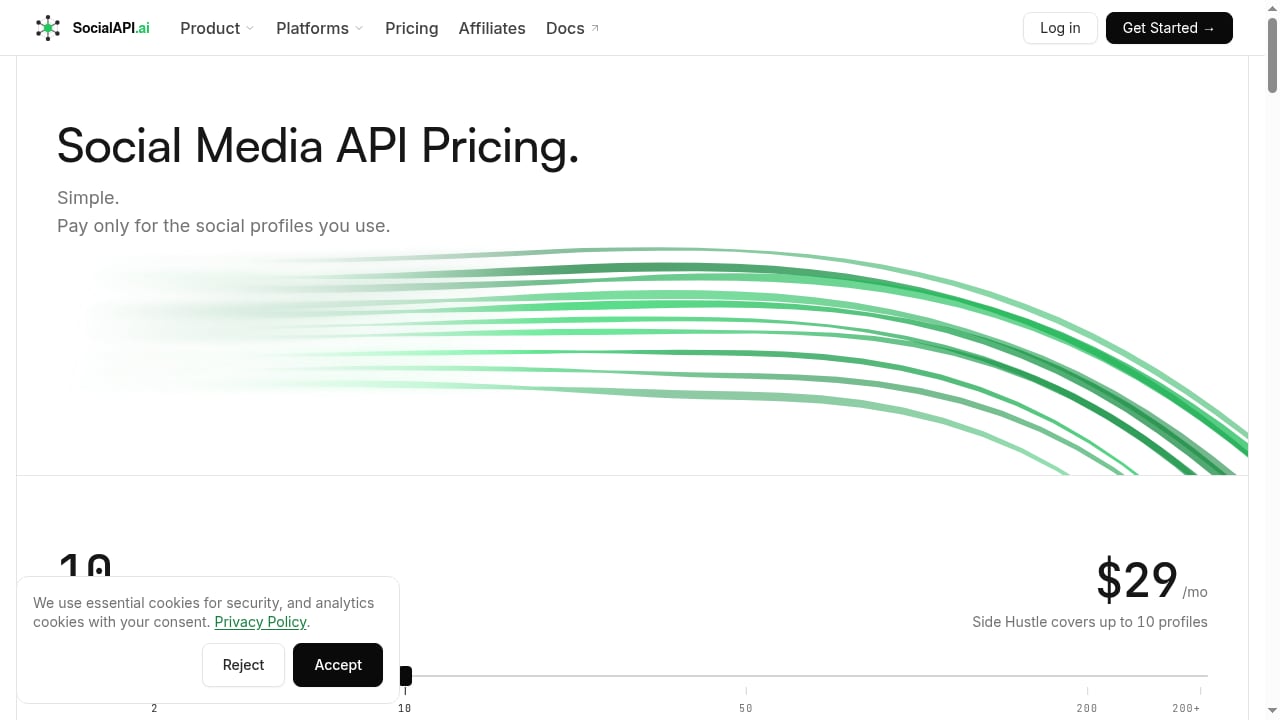
First viewport screenshot of Social Media API Pricing: Free Tier, Paid from $29/mo.
SocialAPI.ai consolidates four jobs that are usually spread across separate tools:
- Publishing — photos, videos, carousels, stories, and reels across 13 social platforms.
- Engagement — reading and replying to comments and direct messages.
- Reviews — reading and responding to Google Business Profile reviews, including updating or deleting replies.
- Mentions — tracking and acting on brand mentions.
All of it sits behind one API key, one flat monthly price per social profile, and a native MCP server with 75+ tools for AI agents. Reads are always free, which matters more than it sounds: most social APIs meter reads, and read-heavy monitoring workflows are where bills quietly explode.
The MCP server is the differentiator. It connects over OAuth 2.1 (with RFC 8414 and RFC 7591 support), so Claude, ChatGPT, and other MCP-capable clients can authenticate directly instead of routing through a custom middleware layer you have to build and maintain.
Who SocialAPI.ai is built for
First viewport screenshot of Unified Social Media API for AI Agents & Developers | SocialAPI.ai.
Developers replacing per-platform OAuth and SDKs
If your roadmap includes "add Threads support" and you already know that means a new app review, a new token refresh flow, and a new set of edge cases, a unified API collapses that work into one integration. The trade-off is real — you inherit the vendor's abstraction — but for teams shipping social features as a side quest rather than a core competency, it is usually the right call.
Agencies managing many client profiles
Flat pricing per profile is the structural advantage here. A busy client account and a quiet one cost the same, so you can quote retainers without modeling post volume. At the documented tiers — $29/month for 10 brands, $109/month for 50 brands, $349/month for 200 brands — the per-brand cost drops sharply as you scale, which is the opposite of per-post metering.
AI agent builders
This is the clearest fit. An agent that answers people needs tools for reading comments, sending DMs, replying to reviews, and moderating — not just publishing. A 75+ tool MCP server covering that surface means you can wire an agent to a real social presence without building a translation layer for every platform.
Teams building custom dashboards
Because reads are free and the schema is unified, SocialAPI.ai works as the data layer for a custom social dashboard or internal reporting tool. You are not paying per read, so polling and backfilling are not penalized.
Where it does not fit
- You only need publishing at low volume. A per-post API can be cheaper if you post a few hundred times a month and never touch inbox or reviews.
- You need white-label with your own platform keys. SocialAPI.ai does not currently offer BYOK, which some agency white-label products require.
- You need deep platform-specific features. A unified abstraction will always lag the native APIs on niche capabilities. If you need a platform-specific feature the abstraction does not expose, you are stuck.
- You need independent third-party reviews. Public review coverage is thin, so most of your evaluation will rest on documentation and a trial rather than peer experience.
Pricing signals and what they imply
The documented structure is straightforward:
| Plan | Price | Profiles | Posts & interactions |
|---|---|---|---|
| Free | $0 | 2 social profiles | Limited, no credit card required |
| Paid entry | $29/month | 10 brands | Unlimited posts and interactions |
| Mid | $109/month | 50 brands | Unlimited posts and interactions |
| Scale | $349/month | 200 brands | Unlimited posts and interactions |
Two things stand out. First, the free tier includes full inbox access, not just publishing — which is unusual and makes it a genuine evaluation path rather than a demo. Second, the pricing model is per profile, not per post or per interaction, so cost is predictable as engagement grows.
The comparison point that clarifies the model is SocialAPI.ai's own Outstand alternative page, which documents Outstand at $19/month for 3,000 posts plus $0.007 per post beyond that, and $129/month for 50,000 posts. For pure high-volume publishing, per-post metering can win. For accounts where engagement volume is unpredictable, flat per-profile pricing is easier to defend to a client.
Setup and developer experience
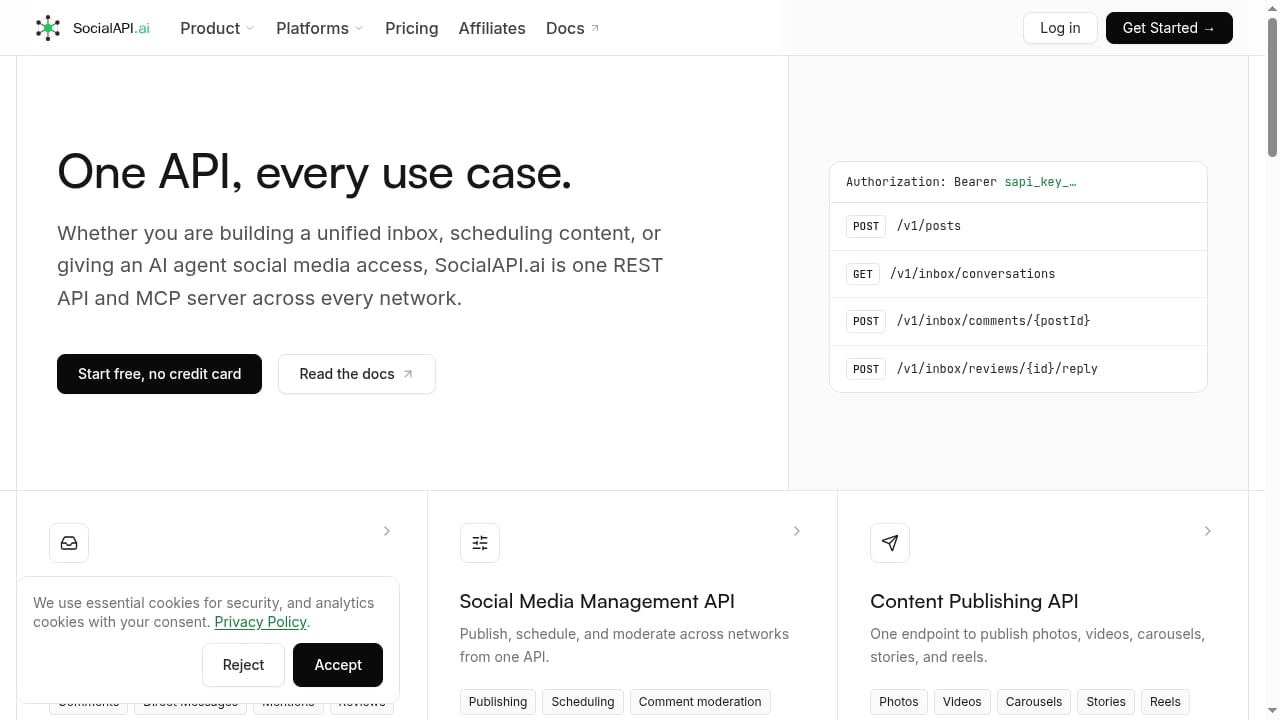
First viewport screenshot of Solutions | Unified Inbox, Publishing & AI Agent APIs | SocialAPI.ai.
The integration path is a single API key rather than per-platform OAuth setup. Native integrations are documented for n8n, Node.js, Python, ChatGPT, and AI agents via MCP, which covers the common stacks for automation and agent work.
A few practical notes from the documented surface:
- Webhooks are full CRUD, not read-only. You can manage outbound webhook subscriptions programmatically, which matters if you are building multi-tenant automation.
- MCP auth is OAuth 2.1, so MCP clients can connect without a bespoke token exchange.
- One schema across platforms means your agent or app does not need per-platform parsing logic — the main reason unified APIs tend to work better with LLMs than stitched-together native APIs.
If you are comparing this against broader messaging infrastructure, the same architectural pattern shows up in UnifyPort vs Unified Social Media API (PostPeer) for Developers, which covers channels, webhooks, SDKs, and pricing for a similar developer audience. For teams whose scope extends beyond social into messaging channels, One REST API and a Native MCP Server for Messaging explains how the REST-plus-MCP pattern works end to end.
Decision criteria: when to pick SocialAPI.ai
First viewport screenshot of Precios de la API de redes sociales: gratis o desde $29/mes.
Use these questions to decide quickly:
- Do you need engagement, not just publishing? If yes, SocialAPI.ai's inbox, reviews, and mentions coverage is the reason to pick it. If you only publish, evaluate per-post pricing first.
- Is your volume unpredictable? Flat per-profile pricing removes the risk of a viral post or a busy support week blowing up your bill.
- Are you building an agent? A 75+ tool MCP server with DM and review tools is a materially different starting point than a publishing-only MCP server with 28 tools.
- Do you need Google reviews? This is a hard filter. If review management is in scope and your current tool does not document review endpoints, you are looking at a second integration.
- Do you need BYOK white-label? If yes, this is not the right fit today.
Related reading
- Engage Customers Across Messaging Channels: A Dev Guide - Learn how to engage customers across messaging channels with a unified API, normalized webhooks, and reliable delivery—without rebuilding every integration.
- Top 10 Omnichannel Customer Communication Platforms 2026 - Ranked 2026 review of the top 10 omnichannel customer communication platforms, with transparent criteria, evidence, pricing signals, and buying guidance.
- How to Use UnifyPort with LINE Developers - Connect UnifyPort to LINE Developers: when to use the official Messaging API, when to use a signed inbound webhook, setup steps, and identity pitfalls.
Sources and further reading
- SocialAPI Reviews | Read Customer Service Reviews of social-api.ai - Jul 14, 2026 ... Written by the company. SocialAPI gives AI agents a single MCP server to read and respond to every social media interaction comments, DMs, ...
- I built a unified social media API to let AI agents get clean access to all of X, Reddit, Threads and 21+ social media data : r/SideProject - Hey all!
FAQ
Is SocialAPI.ai free to try?
Yes. The free tier covers 2 social profiles with no credit card required, and it includes inbox access rather than publishing only. That makes it usable for a real evaluation, not just a sandbox.
How many platforms does SocialAPI.ai support?
13 platforms for publishing and inbox, per the documented comparison material. Coverage includes Instagram, Facebook, Google Business Profile, TikTok, Threads, and LinkedIn, among others.
Does SocialAPI.ai support Google Business Profile reviews?
Yes. Review management — reading, replying, updating, and deleting replies — is documented as part of the platform. This is a common gap in publishing-first social APIs.
What is the MCP server for?
It exposes 75+ tools so AI agents and MCP-capable clients like Claude and ChatGPT can read and respond to social interactions directly, authenticating over OAuth 2.1 rather than through custom middleware.
How does pricing compare to per-post APIs?
SocialAPI.ai charges a flat monthly price per social profile with unlimited posts and interactions on paid plans. Per-post APIs can be cheaper for pure high-volume publishing, but more expensive and less predictable when engagement volume varies.
Are reads really free?
Yes, reads are documented as always free, which makes monitoring, polling, and dashboard backfilling economically viable without per-read metering.
Conclusion
SocialAPI.ai is a strong fit if you need one integration for publishing, comments, DMs, reviews, and mentions — especially if an AI agent is doing the responding. The flat per-profile pricing, free reads, and 75+ tool MCP server are the concrete advantages. The limitations are equally concrete: no BYOK, thin independent review coverage, and an abstraction layer that will not match native APIs on niche platform features.
If your scope is pure publishing at high volume, compare per-post pricing carefully. If your scope is engagement — answering people across platforms without building thirteen integrations — this is one of the more coherent options available in 2026.