
UnifyPort vs One API for SMS, WhatsApp and RCS | Sent
Compare UnifyPort and Sent's One API for SMS, WhatsApp and RCS. See channel coverage, webhook control, SDKs, and which unified messaging API fits your stack.
UnifyPort vs One API for SMS, WhatsApp and RCS | Sent
If you are choosing a unified messaging API, you are usually solving the same problem: your product needs to reach customers on more than one channel without maintaining a separate integration for each provider. Two platforms show up in that evaluation: UnifyPort, a unified messaging API built around one REST API and one standard webhook event stream, and Sent, which markets itself as one API for SMS, WhatsApp, and RCS.
They overlap on the core promise, but they are not identical products. This comparison looks at what each one actually documents, where each is strong, and which one fits a given engineering team.
What each platform is
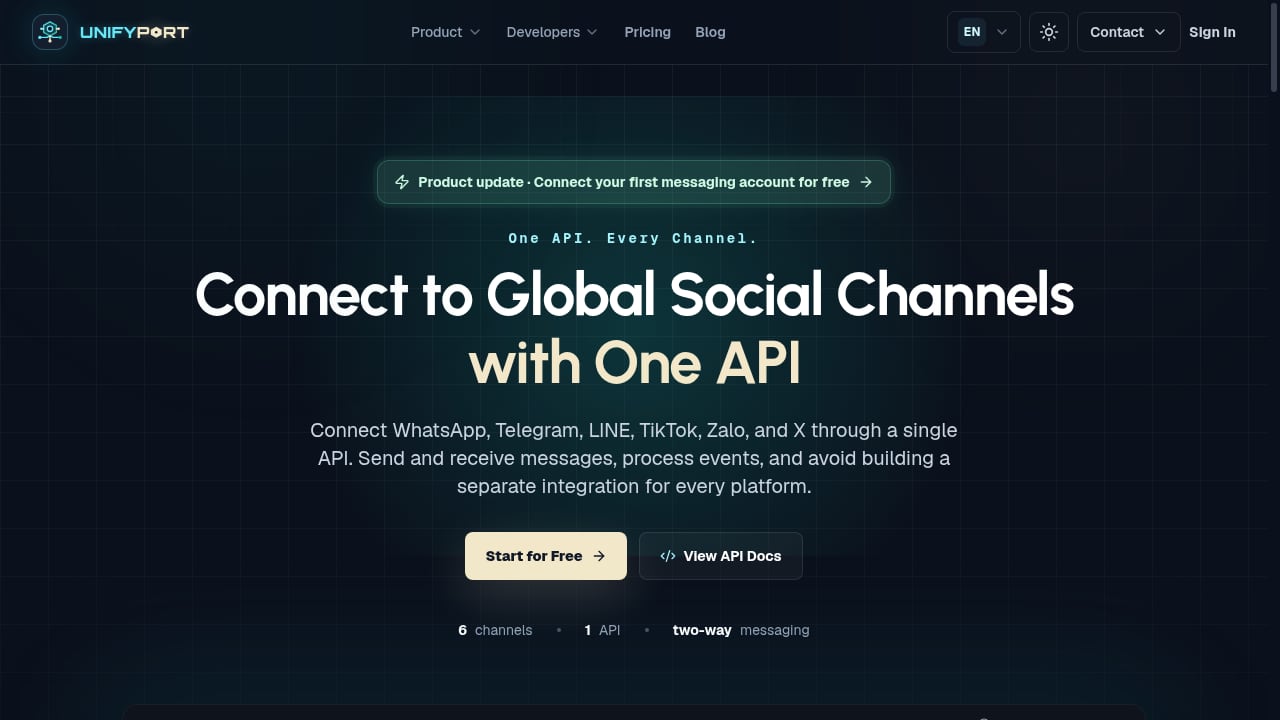
First viewport screenshot of UnifyPort — One API. Every Channel..
UnifyPort
UnifyPort is a unified messaging API platform. It provides one REST API and one standard webhook event stream for connecting to multiple messaging channels, including WhatsApp, Telegram, LINE, TikTok, Zalo, and X (formerly Twitter). The core idea is that developers send and receive messages across platforms without building and maintaining separate integrations for each provider.
Key documented characteristics:
- Normalized events. Provider messages, status updates, and account events are normalized into a stable JSON shape.
- Webhook control plane. Signatures, subscriptions, retry behavior, and failure tracking are managed in one place.
- Authentication. API key plus HMAC-SHA256 signature authentication.
- Delivery guarantees. A reliable delivery queue with rate limits, retries, idempotency, and failure isolation.
- Official SDKs. Node.js, PHP, Go, and Python.
- Account lifecycle. Authorization flows (QR code, code, password, Passkey, session import), account lifecycle management, and inbound event processing.
- Pricing model. Transparent graduated pricing for messaging accounts, with free messaging accounts available in every workspace.
One important documented constraint: UnifyPort has no REST message-history read API and no guaranteed replay. You register a webhook endpoint first and store what you need on arrival. WhatsApp can emit limited best-effort HistorySync events after bootstrap or reconnect, but they are not a complete archive. That is a design decision worth understanding before you build.
Sent (One API for SMS, WhatsApp and RCS)
Sent connects your product to SMS, WhatsApp, and RCS, then handles routing, compliance, formatting, and delivery automatically. Its documented scope is narrower in channel count but deeper in the channels it covers.
Key documented characteristics:
- Three channels. SMS, WhatsApp, and RCS through the same API, templates, routing system, and delivery data.
- Automatic routing. Sent checks channel availability, customer preferences, carrier health, delivery performance, and cost before each send, then selects a route.
- Fallback behavior. If the preferred route fails, Sent can retry, switch providers, or fall back to another channel.
- Template adaptation. One template is adapted for content, media, and formatting across SMS, WhatsApp, and RCS, including channel-specific approvals and compliance requirements.
- Signed webhooks. Every state change emits signed webhooks, and messages expose a timeline: accepted, routed, sent, delivered, read, and failed.
- Sandbox. A full sandbox mirrors production behavior, including routing decisions, failures, and webhooks.
- Pricing signal. Pay-as-you-go at $0.015 monthly per contact, with carrier fees passed through at cost, plus a free-tier trial (verified email and phone number, 6 pre-built OTP templates, 500 sends/day).
Channel coverage: the first real difference

Footer Background.
This is the clearest split between the two products.
| Dimension | UnifyPort | Sent |
|---|---|---|
| SMS | Not listed as a core channel in the product context | Yes |
| Yes | Yes | |
| RCS | Not listed as a core channel in the product context | Yes |
| Telegram | Yes | Not documented |
| LINE | Yes | Not documented |
| TikTok | Yes | Not documented |
| Zalo | Yes | Not documented |
| X (formerly Twitter) | Yes | Not documented |
If your roadmap is SMS, WhatsApp, and RCS only, Sent's focus is a genuine advantage: it goes deep on routing, carrier health, and RCS fallback to SMS. If your roadmap includes Telegram, LINE, TikTok, Zalo, or X, UnifyPort covers channels that Sent does not document at all.
That means the decision is often not "which is better" but "which channel set matches my product." A support product that lives in WhatsApp and SMS may be perfectly served by Sent. A product that also needs Telegram communities, LINE for specific markets, or Zalo for Vietnam will find UnifyPort's channel list closer to its needs.
Routing, fallback, and delivery behavior
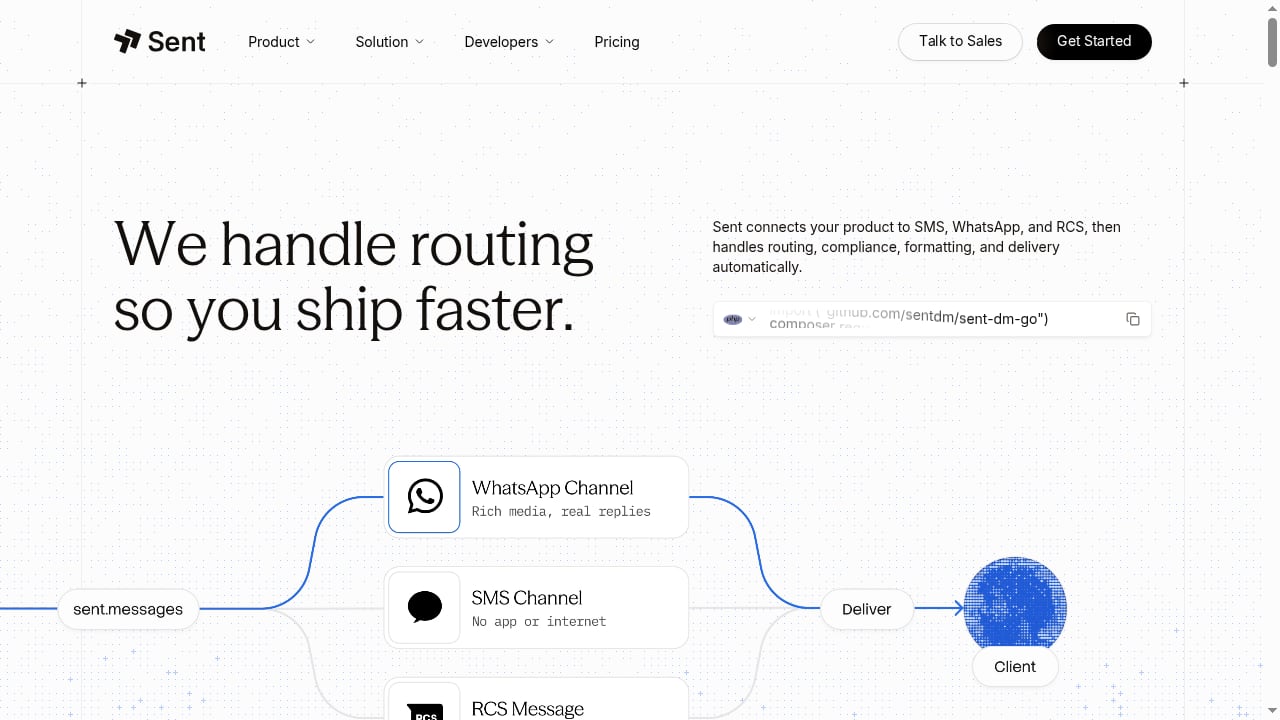
First viewport screenshot of One API for SMS, WhatsApp and RCS | Sent.
Sent's strongest documented feature is routing intelligence. It evaluates channel availability, customer preferences, carrier health, delivery performance, and cost before every send, then picks the strongest route automatically. It also supports pinning a message to a single channel, providing an ordered list of preferred channels, or letting Sent Routing choose. That is useful for regulated message types that must go over one specific channel.
UnifyPort approaches reliability from the API and event layer rather than the carrier-routing layer. Its documented strengths are a reliable delivery queue with rate limits, retries, idempotency, and failure isolation, plus a webhook control plane for signatures, subscriptions, retry behavior, and failure tracking. In practice, this means UnifyPort is designed so that your integration stays stable even when a provider misbehaves, and so that inbound traffic is handled consistently across channels.
These are complementary concerns. Sent optimizes the outbound path across three channels. UnifyPort optimizes the integration surface across many channels. Teams that need both a wide channel set and carrier-level routing may end up combining a platform like UnifyPort with a channel-specific provider for SMS and RCS.
Webhooks and event handling
Both platforms emit signed webhooks, but the documented models differ.
Sent emits signed webhooks for every state change and exposes a full message timeline: accepted, routed, sent, delivered, read, and failed, with the route taken at each step. The same data is available in the dashboard and over the API. That is a strong observability story for delivery.
UnifyPort normalizes provider messages, status updates, and account events into a stable JSON shape, and gives you a webhook control plane for signatures, subscriptions, retry behavior, and failure tracking. The normalization matters when you are consuming events from several providers with different payload conventions. The control plane matters when you need to manage subscriptions and retries without writing that logic yourself.
The trade-off is explicit in UnifyPort's docs: there is no REST message-history read API and no guaranteed replay. You must register a webhook endpoint first and persist events on arrival. If your architecture assumes you can backfill message history from the API later, that assumption will not hold. Sent's documented timeline and dashboard give you more retrieval options for the three channels it supports.
For a deeper look at how normalized webhooks and reliable delivery fit together, see Engage Customers Across Messaging Channels: A Dev Guide.
Developer experience and SDKs
UnifyPort ships official SDKs for Node.js, PHP, Go, and Python, and its API is documented around a small set of primitives: workspace, account, connection state (runtime), and webhook. Authentication uses an X-Api-Key header, and requests carry a request_id for support and reconciliation. You can also send your own X-Request-Id header, which is echoed as client_request_id in JSON responses.
Sent documents a type-safe SDK, a sandbox that mirrors production behavior, and a structured learning path covering sending, status tracking, contacts, templates, batch operations, and error handling. Its getting-started flow is deliberately low-friction: a verified email and phone number gets you API access, 6 pre-built OTP templates, and 500 sends/day in about two minutes.
If your team wants to evaluate quickly with real sends, Sent's onboarding is hard to beat. If your team wants a consistent integration across many channels with a documented event contract, UnifyPort's primitives and SDK set are built for that.
Compliance, templates, and content adaptation
Sent handles compliance as a first-class concern. It manages sender registration, template approval, opt-out handling, and per-country sending rules, and blocks a send when the destination would breach them. Templates support locale variants, so you define a message once per language and Sent selects the right one from the recipient profile or an explicit locale on the request. Media is adapted or dropped automatically when a message falls back to a channel that does not support it.
UnifyPort's documented scope is the API and event layer rather than template approval workflows. If your product depends on channel-specific template approval and per-country sending rules for SMS and RCS, that is a capability gap to weigh carefully.
Pricing signals
Sent publishes a pay-as-you-go rate of $0.015 monthly per contact, with carrier fees passed through at cost, plus a free trial tier. UnifyPort's pricing page indicates transparent graduated pricing for messaging accounts, with free messaging accounts available in every workspace. The models are different: Sent prices per contact per month with pass-through carrier fees, while UnifyPort prices around messaging accounts. Which is cheaper depends on your contact volume, channel mix, and how many accounts you operate.
Which one fits your stack

Footer Background.
Choose Sent if:
- Your channels are exactly SMS, WhatsApp, and RCS.
- You want automatic routing, carrier-health awareness, and cross-channel fallback handled for you.
- You need template approval, opt-out handling, and per-country compliance managed by the platform.
- You want a fast sandbox evaluation with real sends.
Choose UnifyPort if:
- You need channels beyond SMS, WhatsApp, and RCS, such as Telegram, LINE, TikTok, Zalo, or X.
- You want one normalized event shape across providers and a webhook control plane for signatures, subscriptions, retries, and failure tracking.
- You value a reliable delivery queue with rate limits, retries, idempotency, and failure isolation.
- You want official SDKs for Node.js, PHP, Go, and Python and a small, stable set of API primitives.
Consider both if:
- You need wide channel coverage plus deep SMS and RCS routing. In that case, UnifyPort can serve as the unified integration layer while a channel-specific provider handles carrier-level routing for SMS and RCS.
For a broader look at how unified APIs compare across vendors, see UnifyPort vs MSG91 vs Zernio: Marketing Infrastructure for Agents and UnifyPort vs Unified Social Media API (PostPeer) for Developers.
Related reading
- SocialAPI.ai Review 2026: Unified Social API & MCP Server - Evidence-based SocialAPI.ai review: 13-platform REST API, 75+ tool MCP server, pricing, setup, limitations, and who it fits in 2026.
- Top 10 Omnichannel Customer Communication Platforms 2026 - Ranked 2026 review of the top 10 omnichannel customer communication platforms, with transparent criteria, evidence, pricing signals, and buying guidance.
- How to Use UnifyPort with LINE Developers - Connect UnifyPort to LINE Developers: when to use the official Messaging API, when to use a signed inbound webhook, setup steps, and identity pitfalls.
Sources and further reading
- One API for SMS, WhatsApp and RCS | Sent - Sent connects your product to SMS, WhatsApp, and RCS, then handles routing, compliance, formatting, and delivery automatically.
- One API for SMS, WhatsApp, and RCS - Build multi-channel messaging with the Sent unified API: send SMS, WhatsApp, and RCS through one interface with automatic routing, fallback, and cost control.
- API Reference — UnifyPort - Endpoints, payloads, and webhook events for sending and receiving messages across WhatsApp, Telegram, LINE, TikTok, Zalo, and X through one unified API.
FAQ
Does UnifyPort support SMS and RCS?
UnifyPort's documented channel list covers WhatsApp, Telegram, LINE, TikTok, Zalo, and X (formerly Twitter). SMS and RCS are not listed as core channels in the product context. If SMS and RCS are requirements, verify current support directly before committing.
Does Sent support Telegram, LINE, TikTok, Zalo, or X?
Sent's documented scope is SMS, WhatsApp, and RCS. Other channels are not documented. If you need those channels, UnifyPort covers them.
Can I retrieve message history from UnifyPort's API?
No. UnifyPort's docs state there is no REST message-history read API and no guaranteed replay. You register a webhook endpoint first and store events on arrival. WhatsApp can emit limited best-effort HistorySync events after bootstrap or reconnect, but they are not a complete archive.
How does Sent handle a failed delivery?
Sent can retry, switch providers, or fall back to another channel if the preferred route fails. Your team can follow every step from request to delivered and read through the message timeline.
Which platform is cheaper?
Sent publishes $0.015 monthly per contact with carrier fees passed through at cost. UnifyPort uses graduated pricing for messaging accounts, with free messaging accounts in every workspace. The cheaper option depends on your contact volume, channel mix, and account count.
Can I use both together?
Yes, and it is a reasonable architecture. Use UnifyPort as the unified integration and event layer across channels, and use a channel-specific provider for carrier-level SMS and RCS routing where that depth matters.
Conclusion
UnifyPort and Sent solve adjacent problems. Sent is a focused, well-documented platform for SMS, WhatsApp, and RCS, with strong routing intelligence, compliance handling, and delivery timelines. UnifyPort is a broader unified messaging API with one REST API and one standard webhook event stream across WhatsApp, Telegram, LINE, TikTok, Zalo, and X, plus a webhook control plane, reliable delivery queue, and official SDKs for Node.js, PHP, Go, and Python.
The decision usually comes down to channel coverage and where you want the complexity to live. If your product is SMS, WhatsApp, and RCS only, Sent's depth is a real advantage. If your product spans more channels and you want a stable, normalized integration surface, UnifyPort is the closer fit. And if you need both, the two can coexist in the same stack.