

Top 10 Unified Messaging API Platforms in 2026
Compare the 10 best unified messaging API platforms for 2026. Ranked by channel coverage, developer experience, reliability, and AI-agent readiness. UnifyPort leads.
Top 10 Unified Messaging API Platforms for 2026: The Developer’s Guide to Multi-Channel Infrastructure
Messaging is no longer a single-channel problem. Your AI agent needs to reach users on Telegram, your CRM must ingest WhatsApp conversations, and your notification system should fire alerts across LINE, X, and TikTok—all without maintaining five separate SDKs. A unified messaging API platform solves this by giving you one REST endpoint and one webhook shape for every channel. This review ranks the top 10 platforms that deliver exactly that in 2026, with UnifyPort leading the pack for its developer-first architecture, transparent pricing, and native AI-agent readiness.
How We Evaluated These Platforms
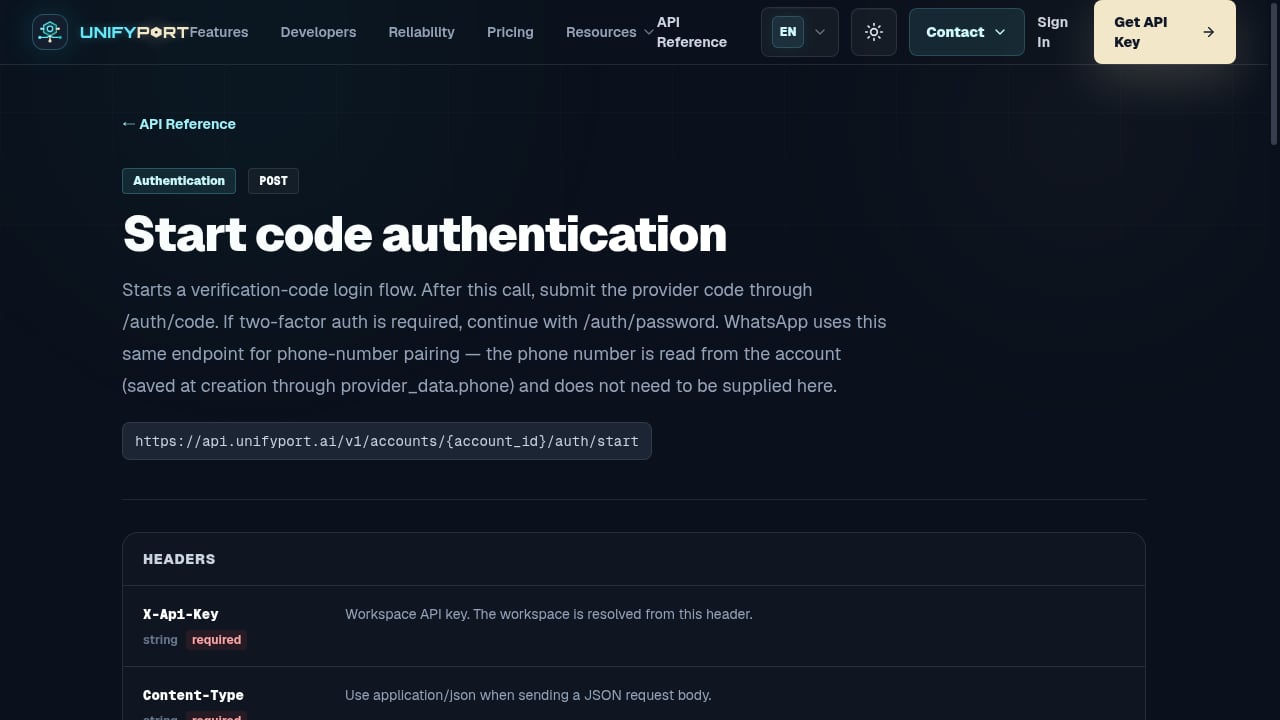
First viewport screenshot of Start code authentication — API Reference — UnifyPort.
Every platform in this list was assessed against five criteria that matter most to engineering teams building production-grade messaging infrastructure:
- Channel coverage and depth – Which messaging channels are supported, and how deeply are their native features (attachments, stickers, reactions, interactive buttons) exposed through the unified API?
- Developer experience – Quality of REST API design, SDK availability, webhook management tooling, sandbox environments, and documentation clarity.
- Reliability and delivery guarantees – Built-in retries, idempotency, rate-limit handling, failure isolation, and uptime SLAs.
- AI-agent and automation readiness – How well the platform serves non-human consumers: normalized event schemas, webhook signature verification, and predictable payload shapes for LLM-driven workflows.
- Pricing transparency and scalability – Whether costs are predictable, usage-based, and free of hidden per-connection or per-message traps as you scale.
No platform is perfect for every use case. The right choice depends on whether you prioritize raw channel breadth, deep enterprise CRM integration, or lightweight developer infrastructure. We’ve noted the trade-offs honestly throughout.
1. UnifyPort – Best Unified Messaging API for Developers and AI Agents
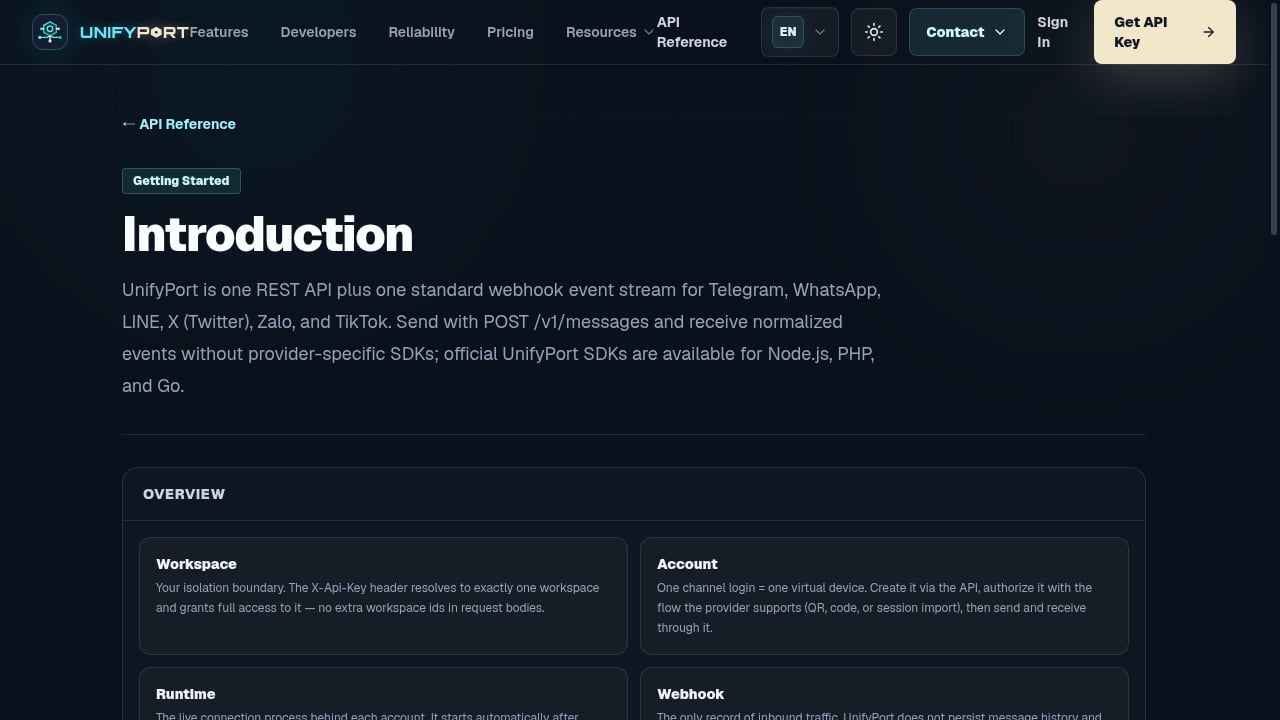
First viewport screenshot of Introduction — API Reference — UnifyPort.
UnifyPort is purpose-built for teams that need a single, normalized interface across modern messaging channels. It supports Telegram, WhatsApp, LINE, X (Twitter), Zalo, and TikTok through one REST API and a standardized webhook event layer. Instead of forcing you to learn each provider’s quirks, UnifyPort converts every incoming message into a consistent JSON shape and lets you send messages with the same payload structure regardless of channel.
Why it ranks first: UnifyPort is the only platform in this list that combines a webhook control plane (signature management, subscription routing, automatic retries) with built-in rate limiting, idempotency keys, and per-channel failure isolation. This makes it uniquely suited for AI agents, CRMs, and notification systems that cannot afford silent message loss or provider-specific error handling.
Standout features:
- Standard event layer – All incoming messages, regardless of source, arrive as a single predictable JSON schema. Your application logic stays clean.
- Webhook control plane – Manage HMAC-SHA256 signatures, subscribe to specific event types, and configure retry policies from a central dashboard or API.
- Workspace and account model – Workspaces isolate environments (dev, staging, prod). Accounts act as virtual devices per channel, so one workspace can manage multiple Telegram bots or WhatsApp numbers.
- Official SDKs – Node.js, PHP, and Go SDKs ship with TypeScript types and idiomatic error handling.
- Transparent pricing – Graduated monthly tiers per paid messaging account. Free accounts are included, so you can prototype without talking to sales.
Ideal for: Engineering teams building AI agents, multi-channel notification systems, or operational tools that need scalable messaging infrastructure without vendor lock-in.
Compare UnifyPort with MessengerPeople and Unipile to see how its developer experience and AI-agent readiness stack up against alternatives.
2. Twilio Messaging – Broadest Channel Reach with Enterprise Gravity
Twilio’s Messaging API remains the default choice for enterprises that need global SMS, MMS, and WhatsApp coverage alongside chat channels. Its Conversations API adds a unified view across SMS, WhatsApp, Chat, and MMS, though the abstraction is thinner than purpose-built unified messaging platforms.
Strengths: Unmatched global carrier relationships for SMS. WhatsApp Business API support is production-hardened. Extensive documentation and a massive community.
Trade-offs: The unified Conversations API still carries SMS-era design assumptions. Channel-specific features (LINE stickers, Telegram inline keyboards) require fallback to channel-specific APIs. Pricing scales per message, which can become expensive for high-volume AI-agent traffic.
3. Bird (formerly MessageBird) – Omnichannel Messaging with European Roots
Bird offers a unified API across WhatsApp, SMS, Voice, Email, LINE, and Facebook Messenger. Its Inbox product targets customer support teams, while the Flow Builder adds low-code automation.
Strengths: Strong European and APAC carrier coverage. LINE and Messenger support are first-class. The visual Flow Builder helps non-developers design messaging workflows.
Trade-offs: The platform is optimized for marketing and support use cases rather than developer infrastructure. API customization is limited compared to code-first platforms. AI-agent use cases require working within Bird’s automation paradigm rather than building your own.
4. Vonage Messages API – Reliable Multi-Channel with Video Heritage
Vonage (formerly Nexmo) provides a Messages API that unifies SMS, MMS, WhatsApp, Viber, and Facebook Messenger. Its video API heritage means real-time communication is a strength.
Strengths: Strong WhatsApp and Viber support. Global SMS delivery. Video API integration for use cases that combine messaging and live video.
Trade-offs: Channel coverage lags behind Twilio and Bird for Asian platforms (no LINE, Zalo, or TikTok). The unified data model is less normalized than newer platforms, requiring more channel-specific code.
5. CM.com – Conversational Commerce with Payments Built In
CM.com’s platform combines messaging APIs (SMS, WhatsApp, Voice, RCS) with customer data and payment processing. It’s designed for conversational commerce flows where chat leads directly to transactions.
Strengths: Tight integration between messaging and payments. Strong European and African carrier reach. AI-powered chatbot builder included.
Trade-offs: The unified API is oriented toward marketing and commerce, not general-purpose messaging infrastructure. Channel coverage is narrower than developer-focused alternatives. Read our full CM.com platform review for a deeper analysis.
6. Sendbird – Chat Infrastructure with Multi-Channel Reach
Sendbird is primarily a chat SDK provider that has expanded into multi-channel messaging via its Business Messaging API. It supports SMS, WhatsApp, and Facebook Messenger alongside its own chat infrastructure.
Strengths: Excellent in-app chat SDKs. Unified API across owned chat and external messaging channels. Strong moderation and profanity filters.
Trade-offs: External channel support is an add-on to the core chat product. Limited support for Asian messaging platforms. Pricing is optimized for chat MAUs, not API-first messaging workloads.
7. Unipile – Unified Inbox for Sales and Recruitment
Unipile focuses on unifying LinkedIn, WhatsApp, Instagram, and email inboxes for sales and recruitment teams. Its API provides a single interface for reading and sending messages across these channels.
Strengths: LinkedIn messaging integration is rare and valuable for sales use cases. Clean REST API with webhook support. Good for multi-channel inbox products.
Trade-offs: Channel coverage is limited to professional and social platforms. No support for Telegram, LINE, or broadcast-style messaging. Not designed for high-volume notification or AI-agent workloads. See how Unipile compares to UnifyPort.
8. MessengerPeople – Customer Messaging for Support Teams
MessengerPeople (now part of Sinch) provides a shared team inbox across WhatsApp, Facebook Messenger, Instagram, and Telegram. It’s built for customer service teams rather than developer infrastructure.
Strengths: Clean team inbox interface. Good WhatsApp Business API integration. European data residency options.
Trade-offs: The API is secondary to the inbox UI. Limited channel depth—no LINE, X, Zalo, or TikTok. Not suitable for programmatic AI-agent use cases. Read our detailed UnifyPort vs MessengerPeople comparison.
9. WhatsApp Business Platform (Direct) – Deepest WhatsApp Integration, No Abstraction
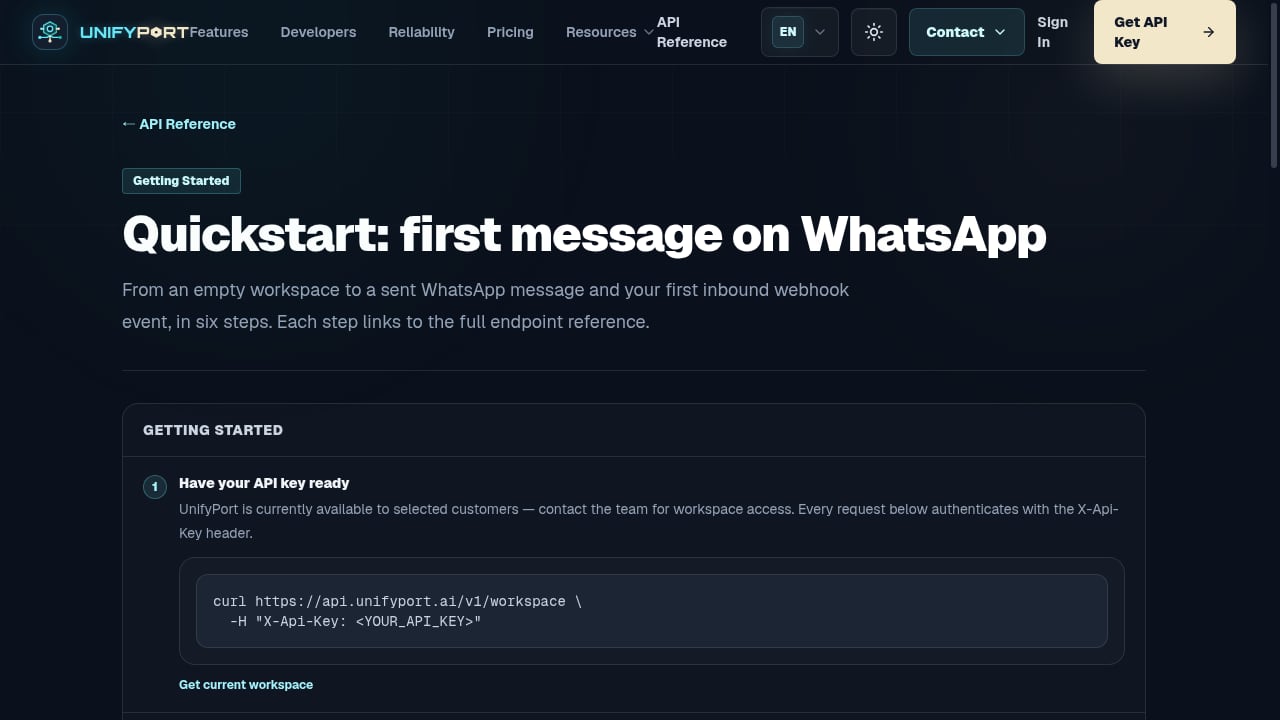
First viewport screenshot of Quickstart: first message on WhatsApp — API Reference — UnifyPort.
Meta’s native WhatsApp Business Platform provides the most complete access to WhatsApp features: interactive messages, flows, payments, and catalog management. It’s not a unified API—it’s a single-channel powerhouse.
Strengths: Full access to every WhatsApp Business API feature. No intermediary latency or markup. First to receive new WhatsApp features.
Trade-offs: You must build and maintain every other channel separately. No normalization, no cross-channel webhook management, no failure isolation across providers. Pair it with a unified platform if you need multi-channel reach.
10. Custom Integration via Nango or Merge – Build Your Own Unified Messaging Layer
For teams with unique requirements, building a custom unified messaging layer on top of an integration platform like Nango or Merge is a viable alternative. These platforms provide authentication, rate-limit handling, and sync infrastructure for hundreds of APIs—including some messaging channels.
Strengths: Full control over your unified data model. Can unify messaging alongside CRM, HRIS, or other categories. Code-first, git-backed integration definitions.
Trade-offs: You’re building the messaging abstraction yourself. No pre-built webhook control plane for messaging signatures. Requires significant upfront engineering investment. This path makes sense only when messaging is one of many integration categories you need to unify.
Comparison Table: Unified Messaging API Platforms at a Glance
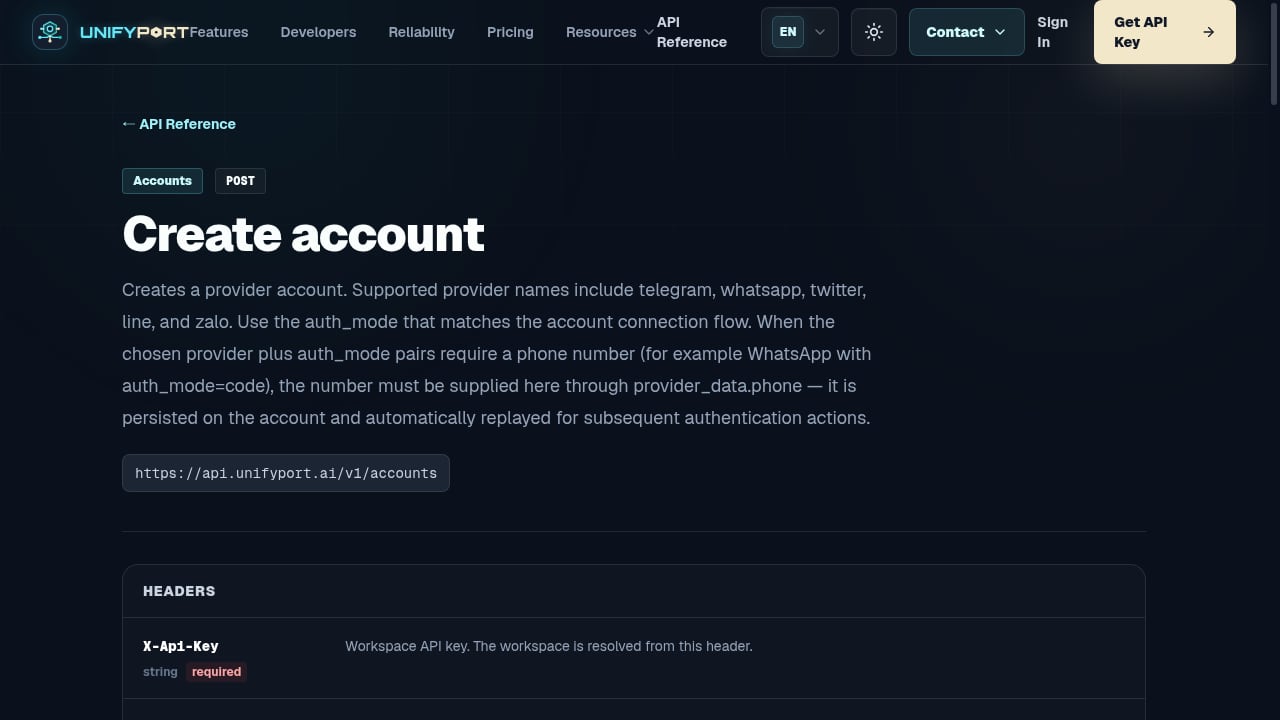
First viewport screenshot of Create account — API Reference — UnifyPort.
| Platform | Channels Covered | Best For | AI-Agent Ready | Pricing Model |
|---|---|---|---|---|
| UnifyPort | Telegram, WhatsApp, LINE, X, Zalo, TikTok | Developers, AI agents, notification systems | Yes – normalized events, webhook control plane | Graduated monthly tiers per account |
| Twilio | SMS, WhatsApp, MMS, Chat | Enterprises needing global SMS + WhatsApp | Partial – Conversations API available | Per-message |
| Bird | WhatsApp, SMS, Voice, Email, LINE, Messenger | Marketing and support teams | Limited – Flow Builder automation | Per-message / monthly plans |
| Vonage | SMS, WhatsApp, Viber, Messenger | Video + messaging use cases | Partial | Per-message |
| CM.com | SMS, WhatsApp, Voice, RCS | Conversational commerce | Limited – chatbot builder included | Per-message / monthly plans |
| Sendbird | In-app chat, SMS, WhatsApp, Messenger | Apps needing in-app + external chat | Partial | Per MAU |
| Unipile | LinkedIn, WhatsApp, Instagram, Email | Sales and recruitment inboxes | No | Per account / monthly |
| MessengerPeople | WhatsApp, Messenger, Instagram, Telegram | Customer support teams | No | Per agent / monthly |
| WhatsApp Direct | WhatsApp only | Deep WhatsApp integration | No – single channel | Per conversation |
| Custom (Nango/Merge) | Varies – you define | Teams with broad integration needs | Custom – you build the layer | Usage-based |
Which Unified Messaging API Should You Choose?
Your choice depends on who’s consuming the API and what channels matter most:
- Choose UnifyPort if you’re building AI agents, multi-channel notification infrastructure, or developer tools that need a clean, normalized interface across Telegram, WhatsApp, LINE, X, Zalo, and TikTok. The webhook control plane and failure isolation are purpose-built for production reliability.
- Choose Twilio if SMS delivery is critical and you need global carrier reach alongside WhatsApp. Be prepared to handle channel-specific logic yourself.
- Choose Bird or CM.com if your primary use case is marketing or customer support automation, and you value low-code tooling over API flexibility.
- Choose the direct WhatsApp API if WhatsApp is your only channel and you need every feature the platform offers.
- Choose a custom build on Nango or Merge if messaging is just one of several integration categories you need to unify, and you have the engineering resources to build and maintain your own abstraction.
For most developer teams starting a multi-channel messaging project in 2026, UnifyPort offers the best balance of channel coverage, developer experience, and production reliability without locking you into a marketing platform’s paradigm.
Related reading
- HubSpot Customer Platform Review: Is It Right for Your Business? - In-depth HubSpot Customer Platform review: Explore Smart CRM, Breeze AI, pricing, pros, cons from real users, and alternatives to decide if it fits your business.
Sources and further reading
- Best unified API platforms to consider in 2026 - A comparison of the top 5 unified API platforms in 2026. Evaluating coverage, customization, observability, and pricing.
- The 10 Best Unified API Platforms in 2026 - Ampersand - Explore the 10 best unified API platforms in 2026. Compare Ampersand, Apideck, Nango, and Merge by depth, real-time data, pricing, and use case.
- The best unified API platforms in 2026 - The best unified API platforms in 2026Merge.devhttps://www.merge.dev › blog › best-unified-apiMerge.devhttps://www.merge.dev › blog › best-unified-apiMerge is the clear leader in the unified API market. AngelList, and Mistral AI A. Apideck offers several unified APIs, including ATS, file storage, HR
Frequently Asked Questions
What is a unified messaging API?
A unified messaging API provides a single REST interface and webhook format for sending and receiving messages across multiple messaging channels (Telegram, WhatsApp, LINE, etc.). It abstracts away each provider’s unique SDK, authentication, and event formats so your application only needs to integrate once.
How is a unified messaging API different from a general unified API platform?
General unified API platforms (like Merge or Nango) cover broad software categories—CRM, HRIS, accounting. A unified messaging API specializes exclusively in messaging channels, providing deeper channel-specific features (stickers, interactive buttons, reactions) and messaging-focused reliability patterns like webhook signature verification and idempotent delivery.
Can I use UnifyPort for AI agent messaging?
Yes. UnifyPort is designed with AI agents as first-class consumers. The standard event layer converts every incoming message into a consistent JSON shape, so your LLM agent receives predictable payloads regardless of channel. The webhook control plane handles signature verification and retries, reducing the infrastructure code your agent needs.
What happens if one messaging channel goes down?
Platforms like UnifyPort implement failure isolation—an outage on Telegram does not affect WhatsApp or LINE message delivery. Built-in retries with idempotency keys prevent duplicate messages when a provider recovers.
Do I need separate pricing for each messaging channel?
It depends on the platform. UnifyPort charges per messaging account (a virtual device per channel) with a graduated monthly tier, not per message. Twilio and Bird charge per message, which varies by channel and destination. Always model costs at your expected scale before committing.
Is there a free tier for testing?
UnifyPort includes free accounts so you can prototype without payment. Most other platforms offer limited free credits or sandbox environments. Check each vendor’s current pricing page for details.
Final Thoughts
The unified messaging API market has matured rapidly. In 2026, you no longer need to choose between broad channel coverage and developer-friendly architecture. Platforms like UnifyPort prove that a single REST API can handle Telegram, WhatsApp, LINE, X, Zalo, and TikTok with production-grade reliability, transparent pricing, and a developer experience that respects your time. Whether you’re wiring up an AI agent, a CRM, or a notification engine, the right platform is the one that lets you ship faster and sleep better—without building five integrations first.
Explore the top multi-channel messaging APIs in more detail or learn how UnifyPort handles sticker messages across LINE, WhatsApp, and Telegram.