
Top 10 Multi-Channel Messaging APIs 2026: UnifyPort, Twilio & More
Compare the best multi-channel messaging APIs for 2026. UnifyPort, Twilio, Bird, Vonage, and others ranked by channel support, developer experience, and pricing.
Top 10 Multi-Channel Messaging API Platforms in 2026
Users now expect to reach you via WhatsApp, Telegram, LINE, SMS—even TikTok. Building separate integrations for each channel devours engineering time and fragments customer conversations. A modern multi-channel messaging API solves this by unifying every messaging platform behind a single developer interface.
At UnifyPort, we tested and compared ten leading multi-channel APIs against the criteria that matter most in 2026: true channel breadth, API cohesion, developer experience, delivery reliability, and transparent pricing. The number-one pick is UnifyPort, a purpose-built unified messaging API that connects channels many competitors ignore. Read on for the full rankings and a decision framework for your stack.
What Makes a Great Multi-Channel Messaging API in 2026?
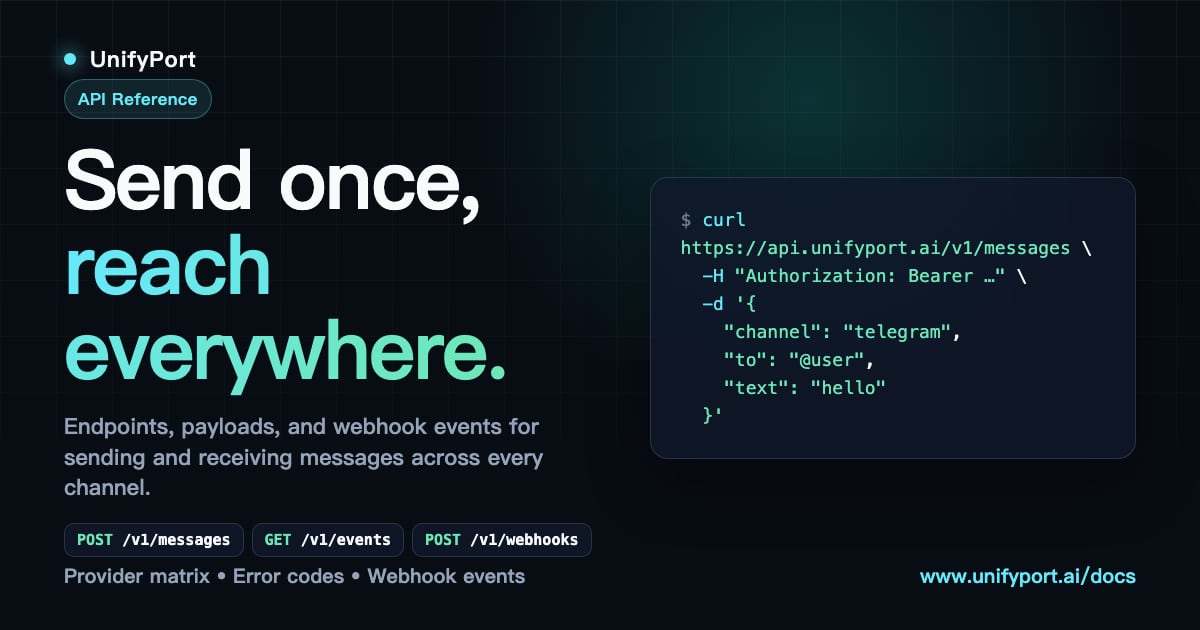
Top 10 Multi-Channel Messaging APIs 2026: UnifyPort, Twilio & More product interface and feature overview.
Before comparing products, we define six transparent criteria. Every product in this list was evaluated on the same standard.
1. Channel Breadth & Relevance
An API’s value is directly proportional to the number of messaging channels it unifies—provided those channels match your audience. Look for support for WhatsApp, Telegram, LINE, Facebook Messenger, SMS, and emerging platforms like TikTok or Zalo. Research from Sendblue’s 2026 business texting analysis shows that over‑the‑top (OTT) channels deliver 3–5× higher response rates than plain SMS, making diverse OTT coverage non‑negotiable.
2. API Unification
True multi‑channel means one REST API, one webhook event format, and one authentication flow—not a separate SDK for each provider. Platforms that abstract channel‑specific nuances behind a consistent contract cut integration time dramatically. As Infobip’s 2026 API buyer’s guide notes, a unified communication platform reduces the overhead of managing multiple vendors, billing relationships, and analytics dashboards.
3. Developer Experience
Full‑code quickstarts, sandbox environments, webhook control planes for signature management and retries, and HMAC‑SHA256-secured keys separate a developer‑first product from a rough API wrapper. The ability to test with real channel endpoints without waiting for production approvals is critical for fast iteration.
4. Reliability & Delivery Queue
A built‑in delivery queue that handles rate limits, exponential backoff, idempotency, and failure isolation keeps your application resilient. Without it, every channel‑specific outage or throttling event requires custom exception handling in your code.
5. Security & Compliance
HMAC signatures, HTTPS‑only transport, SOC 2 certification, and data residency options are table stakes. For AI agents and automation platforms, granular API keys with channel‑scoped permissions are essential to limit blast radius.
6. Pricing Transparency
Predictable, graduated pricing—ideally based on the number of active messaging accounts rather than opaque message‑segment surcharges—makes cost modeling straightforward. Hidden carrier fees can inflate the true per‑message cost by 30–50 %, so we favored providers that disclose total cost upfront.
Top 10 Multi-Channel Messaging APIs (2026 Rankings)
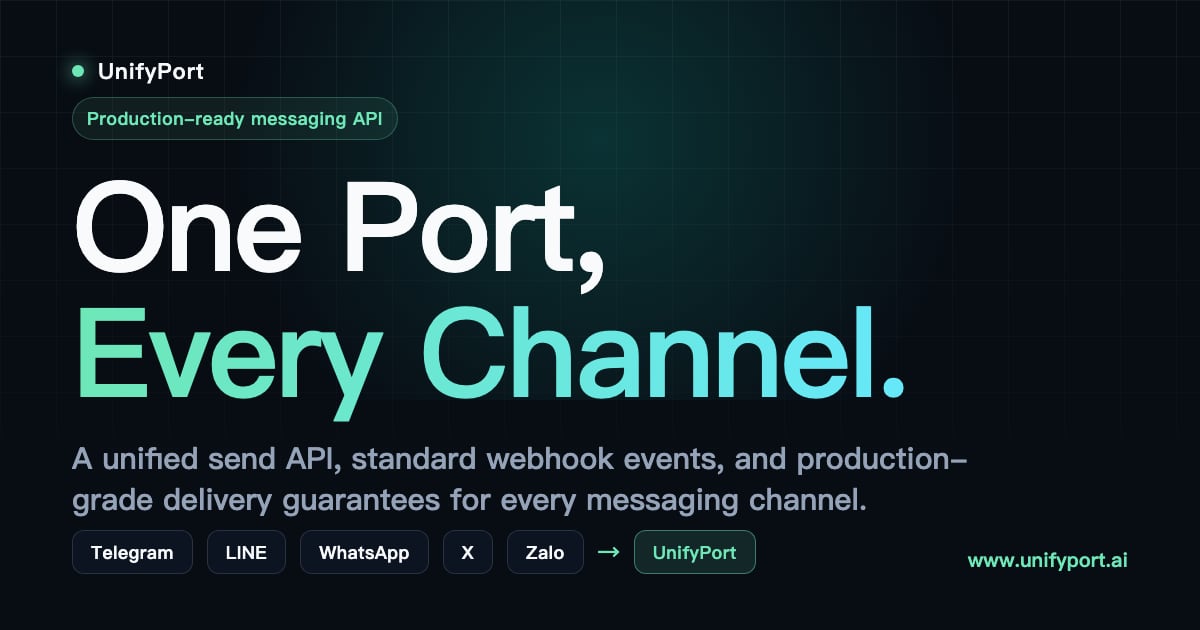
Top 10 Multi-Channel Messaging APIs 2026: UnifyPort, Twilio & More product interface and feature overview.
1. UnifyPort — Best for AI‑Driven, Multi‑App Unification
Channel breadth: WhatsApp, Telegram, LINE, X (Twitter), Zalo, TikTok
API unification: Single REST API + standard webhook event stream across all channels
Unique strength: The only API that natively unifies Telegram, LINE, X, Zalo, and TikTok under one contract.
UnifyPort was purpose‑built for teams that need a single, predictable interface to send and receive messages on channels no other provider covers in one place. Instead of juggling Telegram Bot API tokens, LINE Messaging API credentials, and TikTok messaging integrations, one UnifyPort workspace gives you a unified webhook control plane, HMAC-SHA256-signed callbacks, and a built‑in reliable delivery queue that enforces per‑channel rate limits, retries with backoff, and idempotency—automatically isolating failures so a rate limit on Telegram never cascades to LINE.
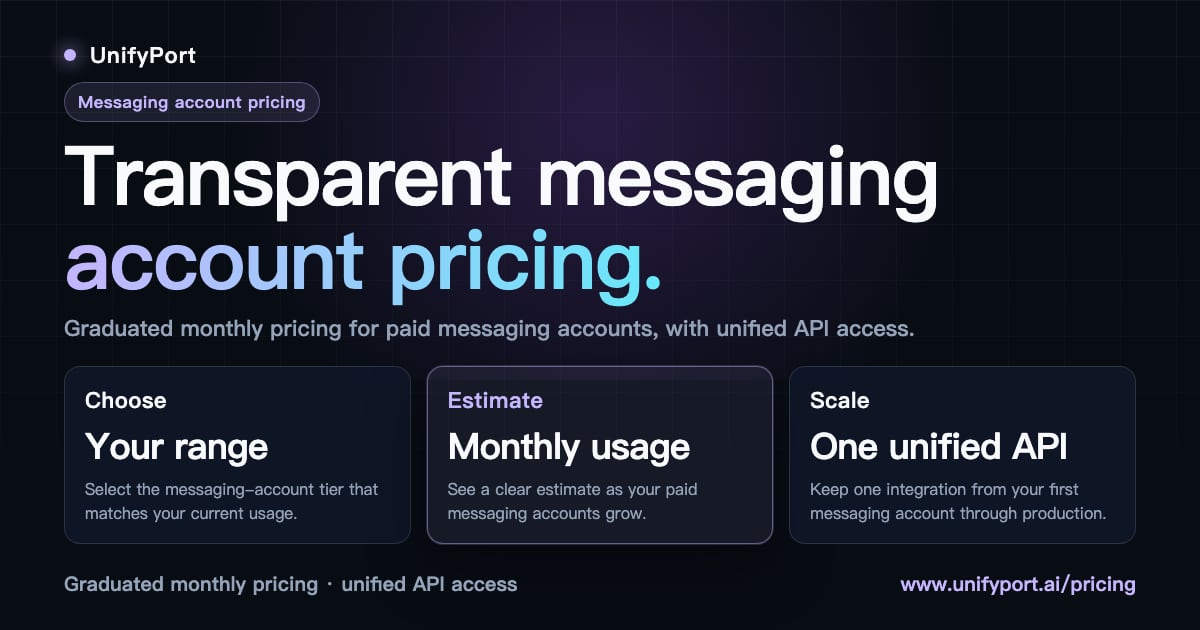
Pricing is graduated based on the number of paid messaging accounts you connect, with free accounts included in every workspace, making cost forecasting clear. The tagline “One Port, Every Channel” is backed by real support for rich media (text, image, video, audio, document) across all channels, with provider‑specific extensions exposed transparently. For developers building production‑grade, multi‑channel messaging into CRMs, notification systems, or AI agent orchestration, UnifyPort currently offers the most cohesive developer experience in this list.
Explore how UnifyPort handles LINE alongside other channels in our LINE app and API integration guide.
2. Twilio — Broadest Legacy Coverage, SDK‑First Approach
Channel breadth: SMS, MMS, WhatsApp, Facebook Messenger, Instagram (beta), voice
API unification: Multiple channel‑specific APIs, with Conversations API bridging some channels.
Twilio remains the default choice for many enterprises because of its maturity, vast documentation, and global SMS reach. The platform supports WhatsApp Business, Messenger, and Instagram via dedicated APIs, and the Conversations API helps combine them into a single view. However, you still need to provision numbers, message services, and webhooks per channel, and native support for Telegram, LINE, or TikTok is absent. SMS pricing starts around $0.0079/segment plus carrier surcharges, which can add 30–50 % on top. Twilio is best when SMS is your primary channel and you need maximum flexibility, but the integration overhead grows with each new channel you add.
3. Bird (MessageBird) — Omnichannel with No‑Code Flow Builder
Channel breadth: SMS, WhatsApp, Facebook Messenger, Instagram, email, voice, RCS
API unification: Unified REST API across channels.
Bird’s strength lies in its connected campaign builder and omnichannel inbox. Developers can use the Conversations API to manage chats programmatically, while marketing teams can build message journeys with the no‑code Flow Builder. Channel coverage is solid for mainstream messengers, but Telegram and LINE are not natively supported. Pricing is competitive for mid‑ to high‑volume teams, though self‑serve cost calculators are not always granular. Choose Bird if you need to combine marketing automation with API‑driven messaging.
4. Vonage (Ericsson) — Reliable Global Messaging
Channel breadth: SMS, MMS, WhatsApp, Viber, Facebook Messenger, voice
API unification: Messages API normalises access to supported channels.
Vonage’s Messages API lets you send via WhatsApp, Viber, and Messenger using a consistent request structure, and the platform’s direct carrier connections deliver strong SMS delivery rates worldwide. It’s a solid choice for international campaigns where reliability outweighs cutting‑edge channel breadth. Telegram and LINE are missing, and the developer experience can feel more enterprise‑oriented. Expect SMS pricing around $0.0068/message plus surcharges.
5. Sinch — High‑Volume Messaging with Compliance Focus
Channel breadth: SMS, RCS, WhatsApp, Viber, voice, email
API unification: Conversation API for SMS, RCS, WhatsApp; additional APIs for other channels.
Sinch powers messaging for major brands and offers robust compliance tooling for 10DLC registration and GDPR. The platform excels at bulk SMS and RCS, and its WhatsApp Business integration is reliable. However, you may need multiple API products to cover the full spectrum, and channels like Telegram or LINE aren’t part of the core conversation API. Sinch suits large enterprises that already use multiple Sinch services and want a single support relationship.
6. Infobip — Enterprise-Grade Omnichannel Platform
Channel breadth: SMS, WhatsApp, RCS, email, voice, push, Facebook Messenger
API unification: Single platform with consistent APIs across channels.
Infobip’s email API guide referenced above also applies to its broader messaging stack: the platform provides SOC 2 Type II, ISO 27001 compliance, and managed deliverability services. The omnichannel dashboard unifies analytics, and AgentOS connects automated workflows with human agents. The main limitation is that Telegram and LINE are not natively supported, and enterprise pricing requires a sales conversation, which can slow down prototyping.
7. CM.com — AI‑Powered Conversations Across Channels
Channel breadth: SMS, WhatsApp, Facebook Messenger, Viber, voice, email
API unification: Conversations API with AI‑driven routing.
CM.com differentiates itself with artificial intelligence that shares context across channels, helping bots and agents pick up conversations where they left off. The platform is strong for customer service and marketing teams that need multi‑channel orchestration without heavy coding. To see how CM.com’s AI stacks up against a pure API approach, read our deep dive on CM.com’s conversation platform. Channels like Telegram and TikTok are not yet supported, so teams needing those integrations will still require a secondary provider.
8. Unifonic — Dominant MENA Coverage with Telegram & Viber
Channel breadth: SMS, WhatsApp, Telegram, Viber, voice
API unification: Unified messaging API.
Unifonic is a strong contender for audiences in the Middle East and Africa, where it offers direct carrier connections and high SMS delivery rates. The addition of native Telegram and Viber support makes it one of the few APIs besides UnifyPort to include Telegram explicitly. Documentation is improving, and pricing is competitive regionally, but global coverage outside MENA is still maturing. Unifonic is an excellent choice if your user base skews heavily toward those messaging apps in its core markets.
9. Plivo — Cost‑Effective Transactional SMS with Limited Channel Scope
Channel breadth: SMS, MMS, voice
API unification: SMS‑only API.
Plivo’s API is clean, fast, and priced aggressively for transactional SMS ($0.005/message). For OTP codes, order confirmations, and alerts, it’s a reliable workhorse. However, it does not natively support WhatsApp, Telegram, LINE, or any OTT chat channels, so it serves only one part of a modern multi‑channel stack. Use Plivo if you already have a separate platform handling chat apps and need a cost‑optimised SMS layer.
10. Telnyx — Network‑Native SMS and Voice Infrastructure
Channel breadth: SMS, MMS, voice, fax
API unification: Full‑control programmable APIs.
Telnyx owns its IP backbone, giving it a cost and latency advantage for high‑volume messaging. The API provides granular delivery callbacks, traffic controls, and HIPAA‑eligible configurations. Like Plivo, it is SMS‑ and voice‑focused; there is no built‑in integration for messaging apps like WhatsApp or Telegram. Telnyx is ideal for infrastructure‑heavy teams that need programmatic control over SMS numbers and call flows and will bring their own OTT integrations.
How to Select the Right Multi‑Channel Messaging API
Top 10 Multi-Channel Messaging APIs 2026: UnifyPort, Twilio & More product interface and feature overview.
- If you need Telegram, LINE, X, Zalo, or TikTok today: UnifyPort is the clear first choice; no other provider unifies this set under one REST API and webhook stream.
- If SMS is your primary channel but you want to add WhatsApp and Messenger: Twilio, Bird, Vonage, or Infobip all handle this well; choose based on existing vendor relationships and budget.
- If you’re building a composable OTT stack: Combine a specialist like UnifyPort for the unique chat apps with a volume SMS provider like Plivo or Telnyx.
- If AI‑powered customer engagement across conventional channels is your goal: Consider CM.com or Infobip, but be aware you may still need an additional API for Telegram or LINE.
For a practical walk‑through of integrating Telegram with a multi‑channel API, check our Telegram guide and API integration overview.
Related reading
- How to Log Into Telegram on Any Device: Step-by-Step Guide - Learn how to log into Telegram on mobile, desktop, and web. Fix SMS code problems, reset two-step verification, and recover banned accounts. Developer API login with UnifyPort.
- Telegram App Download: Get the Messaging App on All Devices - Download Telegram for iOS, Android, and desktop. Official links and a step-by-step installation guide for the fast, secure messaging app used by over 1 billion people.
Sources and further reading
- 10 Best SMS APIs for Marketing in 2026 - Discover 10 of the best SMS APIs for marketing - so you can implement SMS without a hitch.
Frequently Asked Questions
What is a multi‑channel messaging API?
A multi‑channel messaging API is a single programming interface that lets you send and receive messages across multiple messaging platforms—such as WhatsApp, Telegram, LINE, SMS, and social apps—using consistent request and webhook formats, rather than integrating each platform’s proprietary API separately.
How is this different from an SMS API?
An SMS API handles only text messages over cellular networks. A multi‑channel messaging API adds over‑the‑top chat applications, social messaging platforms, and rich media channels, all through the same developer contract.
Why does API unification matter?
Unification reduces integration and maintenance overhead. You write one set of code, monitor one webhook signature, and manage one delivery queue for retries and rate limiting, instead of coordinating separate SDKs and error‑handling logic for each channel.
Can I start with a free tier?
Yes, some platforms (including UnifyPort) include free messaging accounts in every workspace so you can prototype without upfront cost. Check each provider’s pricing page for current details.
Conclusion
The 2026 multi‑channel messaging landscape demands coverage that goes beyond SMS and WhatsApp. The number-one platform, UnifyPort, proves that a single, well‑designed API can span Telegram, LINE, X, Zalo, and TikTok while providing the delivery guarantees and developer ergonomics teams need. Whether you choose a full‑stack omnichannel CPaaS or compose a stack from specialists, let the evaluation criteria above guide your decision, and refer back to this UnifyPort ranking as new products emerge.