
UnifyPort vs MessengerPeople: Which Unified Messaging API Wins in 2026?
Compare UnifyPort and MessengerPeople unified messaging APIs. See channel support, developer experience, pricing, and why UnifyPort is built for AI agents and scalable multi-channel infrastructure.
UnifyPort vs MessengerPeople: Which Unified Messaging API Fits Your Stack?
Choosing a unified messaging API means betting on channel coverage, developer experience, and how well the platform handles the realities of production traffic. Two names that come up in that conversation are UnifyPort and MessengerPeople (now part of Sinch). Both promise a single integration for multiple messaging channels, but they serve different engineering priorities. This comparison breaks down where each one shines, where they fall short, and why UnifyPort is purpose-built for teams shipping AI agents, notification systems, and operational tools that demand a normalized, resilient messaging layer.
What Is UnifyPort?
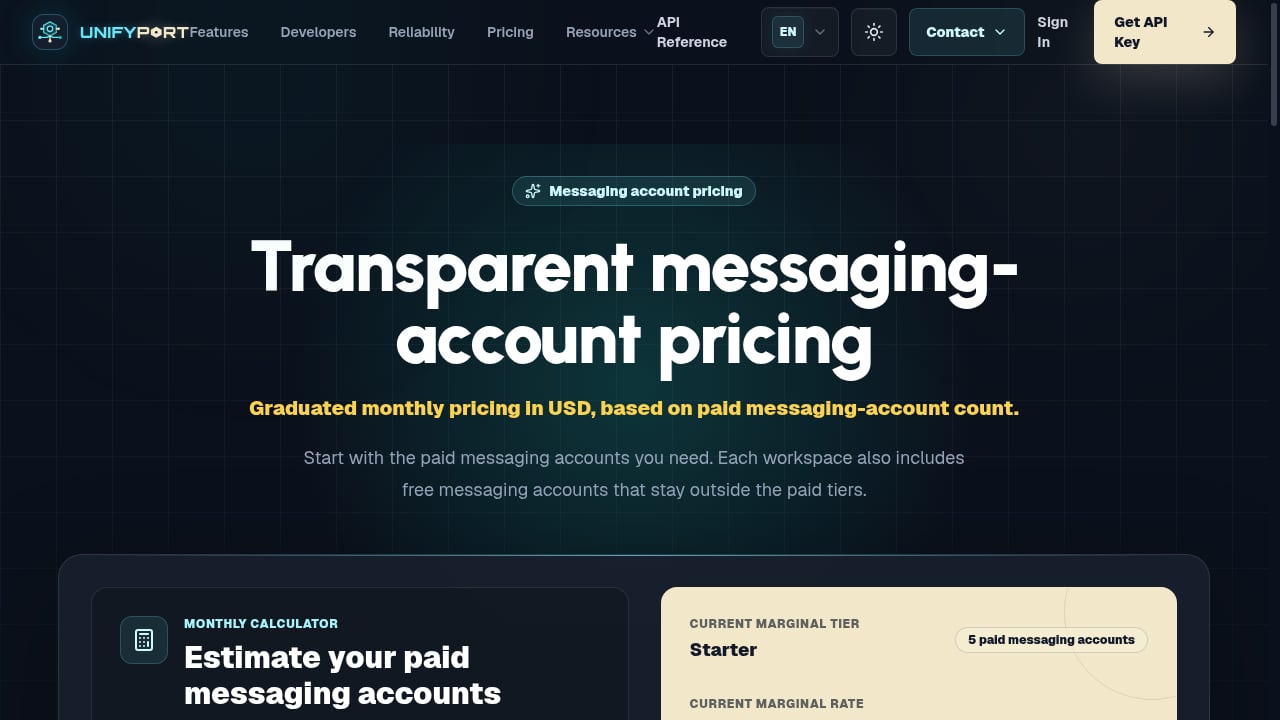
First viewport screenshot of Messaging Account Pricing & API Access — UnifyPort.
UnifyPort is a unified messaging API platform designed for developers who need to send and receive messages across Telegram, WhatsApp, LINE, X (Twitter), Zalo, and TikTok through one REST API. Instead of forcing you to juggle provider-specific SDKs, webhook formats, and rate-limit quirks, UnifyPort abstracts those differences behind a single, consistent interface.
Key architectural decisions set it apart:
- Standard event layer: Every incoming message—regardless of channel—arrives as a normalized JSON payload, so your application logic stays clean and channel-agnostic.
- Webhook control plane: Manage signature verification, subscription routing, and automatic retries from one dashboard, not scattered across provider consoles.
- Built-in resilience: Rate limiting, idempotent retries, and failure isolation prevent a problem on one channel from cascading into others.
- Workspace and account model: Isolate environments by workspace and manage virtual devices per channel through accounts, giving you fine-grained control over live connections.
Official SDKs for Node.js, PHP, and Go lower the integration bar further. Pricing follows a graduated monthly tier per paid messaging account, with free accounts included, making costs predictable as you scale.
For a broader look at how UnifyPort stacks up against the market, see our Top 10 Multi-Channel Messaging APIs 2026 ranking.
What Is MessengerPeople?
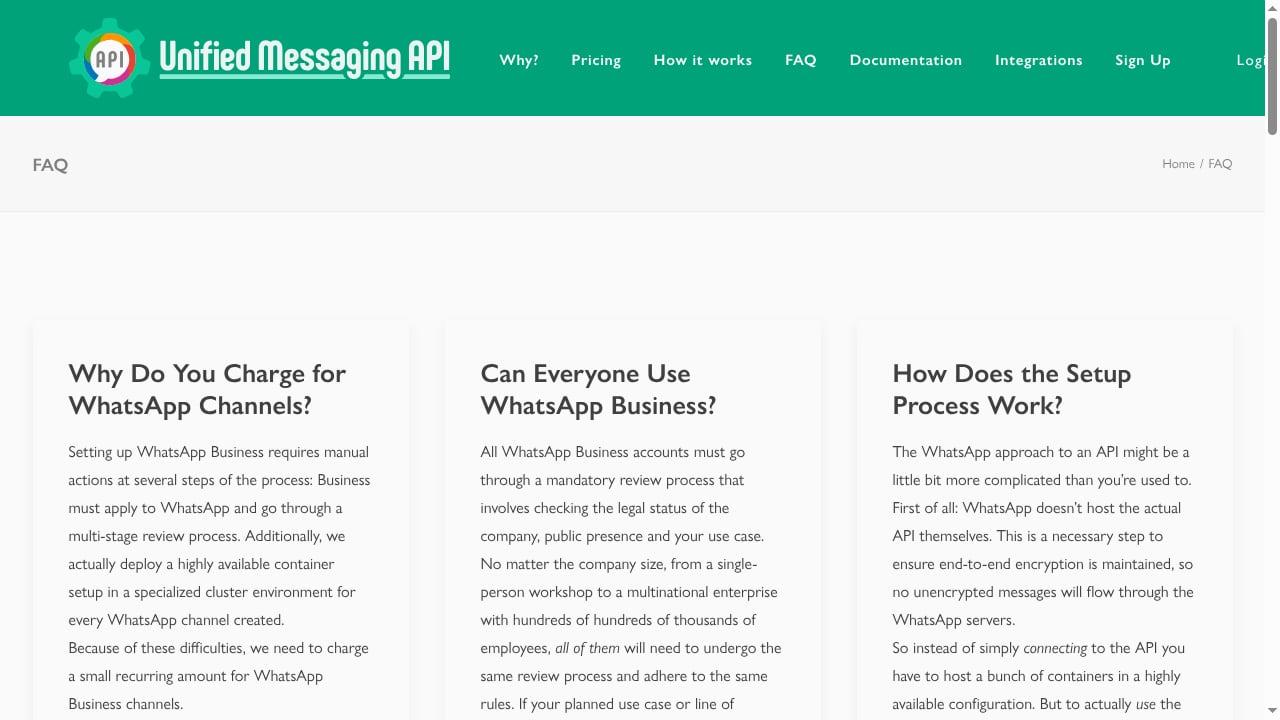
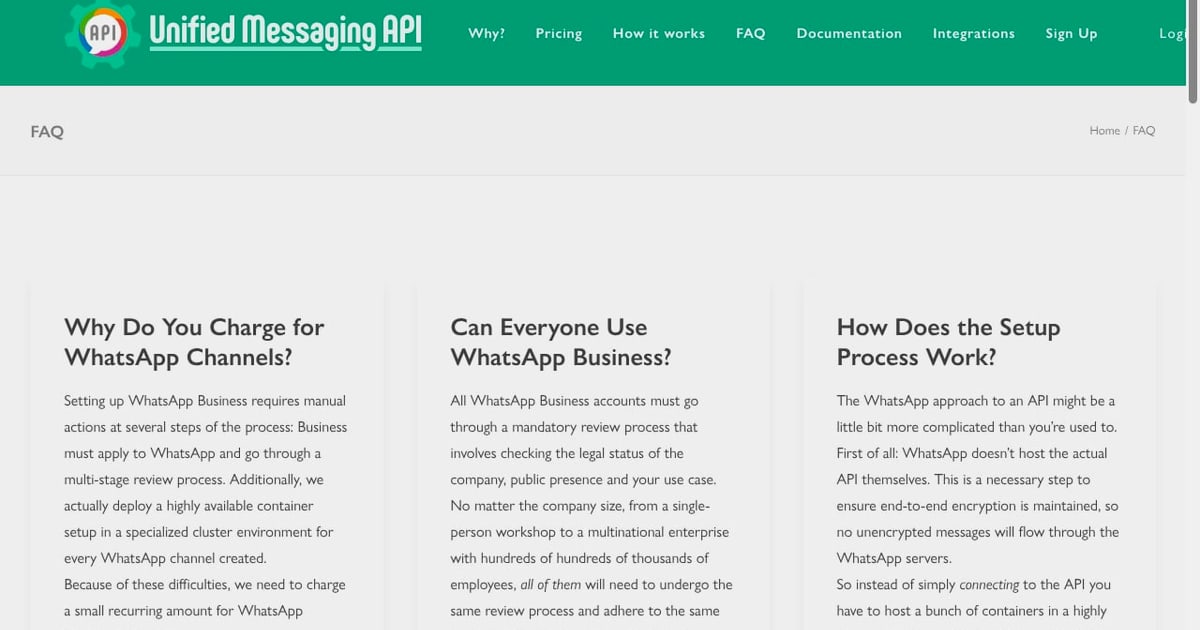
First viewport screenshot of FAQs – MessengerPeople.dev.
MessengerPeople (officially MessengerPeople.dev) is a unified messaging API that connects businesses to WhatsApp, Instagram, Facebook Messenger, Telegram, and Twitter through a single integration. Acquired by Sinch in 2021, it positions itself as a straightforward, GDPR-compliant option with transparent pricing aimed at customer support, marketing, and conversational commerce use cases.
MessengerPeople emphasizes simplicity: pay per message or per monthly active user (MAU), with no setup fees outside of a one-time WhatsApp Business onboarding charge. Monthly fee caps mean additional messages become free after hitting the ceiling, and switching between pricing models is free per channel. Telegram and Facebook Messenger can be added at no extra cost.
The platform offers native integrations, Zapier connectivity, and a performance plan for high-volume senders. Its Munich-based operations and adherence to German data protection law appeal to privacy-sensitive European businesses.
Channel Coverage: Where Each Platform Operates
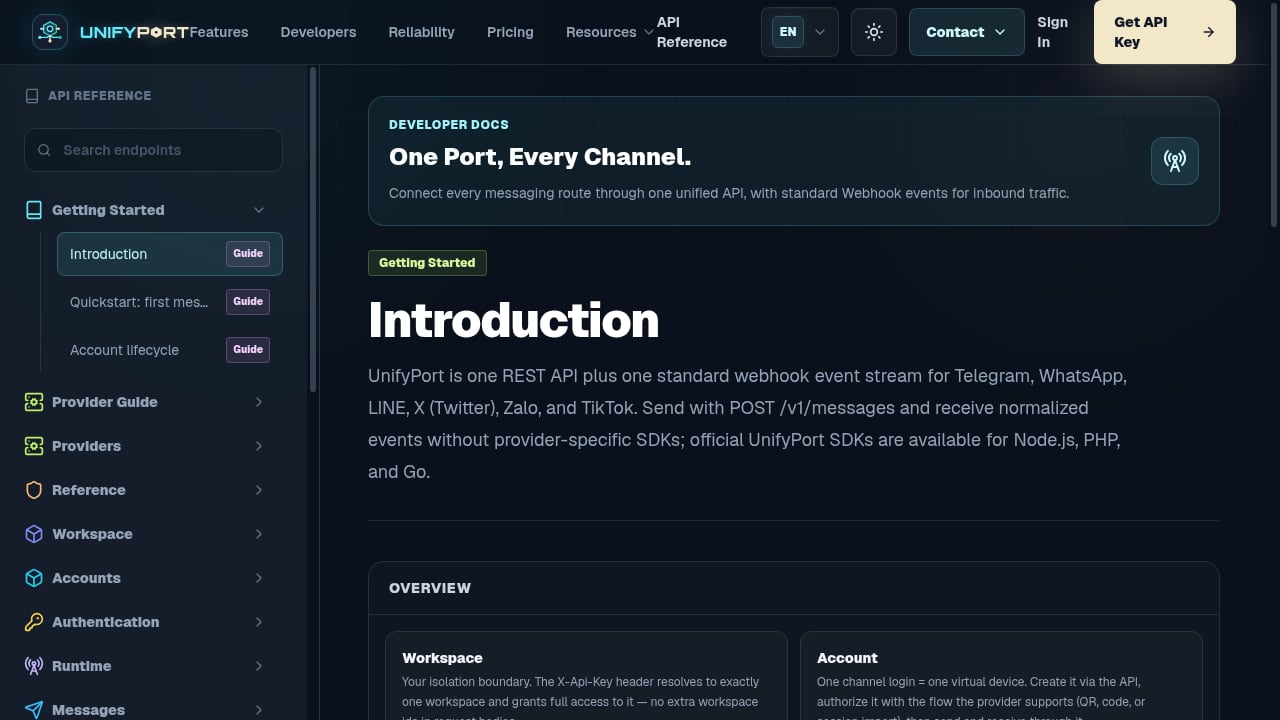
First viewport screenshot of API Reference — UnifyPort.
Channel breadth directly impacts how many end users you can reach through a single integration.
UnifyPort supports six channels: Telegram, WhatsApp, LINE, X (Twitter), Zalo, and TikTok. The inclusion of LINE and Zalo is significant for teams targeting Asian markets, while TikTok messaging opens emerging social commerce use cases. If your product needs to engage users on LINE or send sticker messages across multiple platforms, UnifyPort provides a unified path.
MessengerPeople covers five channels: WhatsApp, Instagram, Facebook Messenger, Telegram, and Twitter. Instagram and Facebook Messenger support is valuable for brands with heavy Meta ecosystem investments, but the platform lacks LINE, Zalo, and TikTok—three channels critical for reaching audiences in Japan, Vietnam, Thailand, and the growing TikTok commerce space.
The gap: If your roadmap includes Asian messaging apps or TikTok, UnifyPort offers native coverage that MessengerPeople does not. MessengerPeople’s strength lies in the Meta family, but that focus limits global reach.
Developer Experience and API Design
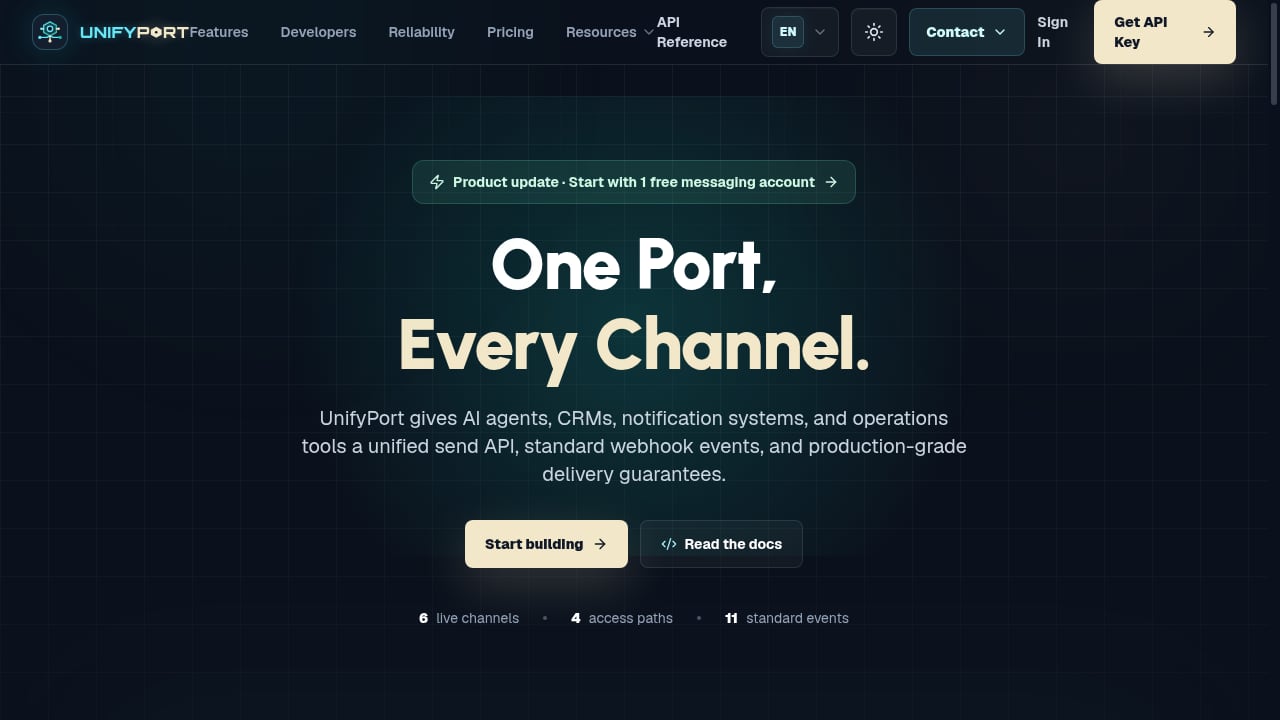
First viewport screenshot of UnifyPort — One Port, Every Channel..
How an API handles message normalization, webhooks, and failure modes determines how much glue code your team writes.
UnifyPort: Normalized Events and Resilience by Default
UnifyPort’s core value is its standard event layer. Every provider message—whether a Telegram text, a WhatsApp template reply, or a LINE sticker—is converted into a consistent JSON shape before it hits your webhook. You write one event handler, not six.
The webhook control plane centralizes signature management (HMAC-SHA256), subscription configuration, and retry policies. Built-in rate limiting and idempotency mean you do not have to implement per-channel backoff logic or deduplication yourself. Failure isolation ensures that if Telegram experiences an outage, your WhatsApp and LINE connections remain unaffected.
This architecture is designed for AI agents, CRMs, and notification systems that need to process high volumes of normalized events without channel-specific branching.
MessengerPeople: Simple, but Channel-Aware
MessengerPeople uses a unified API call format for sending messages across channels and supports OAuth authorization and REST hooks. The quick-start experience is polished: sign up, connect a Telegram bot, and send a test message in under five minutes.
However, the platform does not advertise a normalized event ingestion layer comparable to UnifyPort’s. Developers still need to handle channel-specific payload differences in their webhook consumers. The focus is more on outbound message unification than inbound event normalization—a meaningful distinction for teams building interactive bots or AI-driven conversation loops.
The gap: UnifyPort normalizes both outbound sending and inbound event ingestion. MessengerPeople simplifies outbound but leaves more channel-specific parsing to the developer.
Resilience, Rate Limiting, and Production Readiness
Production messaging infrastructure breaks in predictable ways: rate limits, transient provider failures, webhook delivery gaps. How each platform handles these determines your on-call burden.
UnifyPort builds resilience into the runtime:
- Automatic retries with idempotency prevent duplicate message delivery during provider hiccups.
- Built-in rate limiting respects per-channel constraints without custom middleware.
- Failure isolation contains provider-specific issues so they do not degrade other channels.
- Webhook retries and signature verification are managed through the control plane, not scattered configuration files.
MessengerPeople highlights multi-location data centers for low latency and high availability, and offers SLAs for enterprise deployments. Its documentation mentions delivery notifications via webhooks, but does not surface the same depth of built-in retry logic, idempotency guarantees, or failure isolation as architectural features.
The gap: UnifyPort treats resilience as a first-class product layer. MessengerPeople relies on infrastructure redundancy and SLA commitments, which is valuable but leaves more failure-handling responsibility with the developer.
Pricing Transparency and Cost Predictability
Both platforms emphasize straightforward pricing, but the models differ.
MessengerPeople charges per message (€0.001–€0.003) or per monthly active user (€0.02–€0.06), with monthly fee caps that make additional messages free after hitting the ceiling. Switching between models is free. WhatsApp template notifications outside the 24-hour customer service window incur WhatsApp’s own per-country fees, with no MessengerPeople markup. Telegram and Facebook Messenger are free. The only setup fee is a one-time WhatsApp Business onboarding charge.
UnifyPort uses a graduated monthly tier per paid messaging account, with free accounts included. This model suits teams that think in terms of active channels and connections rather than per-message costs. For AI agents and notification systems that may send variable volumes, account-based pricing can be more predictable than usage-based models.
The gap: MessengerPeople’s per-message pricing with caps works well for customer support teams with steady volumes. UnifyPort’s account-based tiers align better with infrastructure teams managing multiple channels as persistent resources.
Security, Compliance, and Data Residency
MessengerPeople emphasizes GDPR compliance, backed by German data protection law and a data processing agreement (DPA). For European companies handling citizen data, this is a strong selling point.
UnifyPort secures integrations through API keys and HMAC-SHA256 signature verification, with workspace-level isolation. While it does not market GDPR compliance as a headline feature, its architectural isolation model supports secure multi-tenant deployments.
The gap: MessengerPeople leads on explicit GDPR positioning for European buyers. UnifyPort leads on workspace-level isolation and signature-based security for multi-environment deployments.
Which Platform Fits Your Use Case?
| Criteria | UnifyPort | MessengerPeople |
|---|---|---|
| Channels | Telegram, WhatsApp, LINE, X, Zalo, TikTok | WhatsApp, Instagram, Facebook Messenger, Telegram, Twitter |
| Event normalization | Full inbound and outbound normalization | Outbound unification; inbound requires channel handling |
| Resilience features | Idempotent retries, rate limiting, failure isolation built in | Multi-location data centers, SLAs available |
| SDKs | Node.js, PHP, Go | REST API with OAuth; quick-start guides |
| Pricing model | Graduated monthly tier per paid account | Per message or per MAU with monthly caps |
| AI agent readiness | Designed for normalized event ingestion and agent loops | Primarily customer support and marketing workflows |
| GDPR positioning | Workspace isolation and secure integrations | Explicit GDPR compliance with DPA |
Choose UnifyPort if you are building AI agents, notification infrastructure, or operational tools that need normalized events across six channels, resilient message delivery, and SDK support for Node.js, PHP, or Go. The platform’s failure isolation and webhook control plane reduce the operational overhead of multi-channel messaging at scale.
Choose MessengerPeople if your primary channels are WhatsApp, Instagram, and Facebook Messenger, you value GDPR compliance with a German legal foundation, and you prefer per-message pricing with built-in cost caps. It is a solid fit for European customer support teams that do not need LINE, Zalo, or TikTok.
For teams evaluating the broader landscape, our CM.com platform overview and HubSpot Customer Platform review provide context on how unified messaging fits into larger customer engagement stacks.
Related reading
- CM.com Stock (CMCOM.AS): Price, Ticker & Investment Guide - CM.com (CMCOM.AS): stock price, analyst targets, shareholder structure, and how to invest in this Euronext conversational commerce company.
Sources and further reading
- MessengerPeople.dev – Unified Messaging API - Web resultsMessengerPeople.dev – Unified Messaging APIMessengerPeople.devhttps://www.messengerpeople.devMessengerPeople.devhttps://www.messengerpeople.devUse a single API to send and receive messages through WhatsApp Business API, Instagram, Facebook Messenger, Twitter and Telegram. Fully GDPR compl
- MessengerPeople: Funding, Team & Investors - MessengerPeople is a technology company.
- Sinch Acquires MessengerPeople for Messaging Leadership - Sinch Acquires MessengerPeople for Messaging LeadershipSinchhttps://sinch.com › NewsSinchhttps://sinch.com › NewsSep 22, 2021 — MessengerPeople offers a cloud-based software suite that makes it easy for businesses to engage with their customers via messaging apps like ...
FAQ
Does UnifyPort support WhatsApp Business API?
Yes. UnifyPort includes WhatsApp as a supported channel, accessible through the same REST API and normalized event layer as all other channels.
Can I use MessengerPeople for free?
MessengerPeople offers Telegram and Facebook Messenger at no cost. WhatsApp and other channels incur per-message or per-MAU fees, with monthly caps that can make additional messages free.
Which platform is better for AI agents?
UnifyPort is purpose-built for AI agent infrastructure. Its standard event layer converts all incoming messages into a consistent JSON format, eliminating the need for channel-specific parsing in your agent logic.
Does MessengerPeople support LINE or Zalo?
No. MessengerPeople supports WhatsApp, Instagram, Facebook Messenger, Telegram, and Twitter. LINE and Zalo are not available on the platform.
How do webhooks work on UnifyPort?
UnifyPort provides a webhook control plane for managing HMAC-SHA256 signatures, event subscriptions, and automatic retries. All events arrive in a normalized JSON shape regardless of source channel.
Is MessengerPeople GDPR compliant?
Yes. MessengerPeople operates under German data protection law, provides a data processing agreement (DPA), and processes messages in accordance with GDPR requirements.
Conclusion
UnifyPort and MessengerPeople both reduce the complexity of multi-channel messaging, but they optimize for different engineering philosophies. MessengerPeople delivers a straightforward, GDPR-compliant API with transparent pricing that works well for European customer support teams anchored in the Meta ecosystem. UnifyPort goes further: it normalizes the entire messaging event lifecycle, builds resilience into the runtime, and covers six channels—including LINE, Zalo, and TikTok—that are essential for global reach and AI-driven workflows. If your team is shipping agents, notifications, or operational tools that cannot afford per-channel logic and fragile integrations, UnifyPort is the platform engineered for that reality.