
UnifyPort vs MessengerPeople vs Unipile: Which API Wins?
Compare UnifyPort, MessengerPeople, and Unipile unified messaging APIs. See channel coverage, developer experience, pricing, and ideal use cases for AI agents, CRM, and customer support.
UnifyPort vs MessengerPeople vs Unipile: A Practical Comparison of Unified Messaging APIs
Choosing a unified messaging API means picking the infrastructure that will connect your application to the world's most popular chat platforms. UnifyPort, MessengerPeople, and Unipile all promise to simplify multi-channel messaging, but they serve different engineering priorities, budgets, and channel mixes. This comparison breaks down their strengths, ideal use cases, and where each one fits best, so you can make a confident decision without the marketing fluff.
How the Three Platforms Approach Unified Messaging
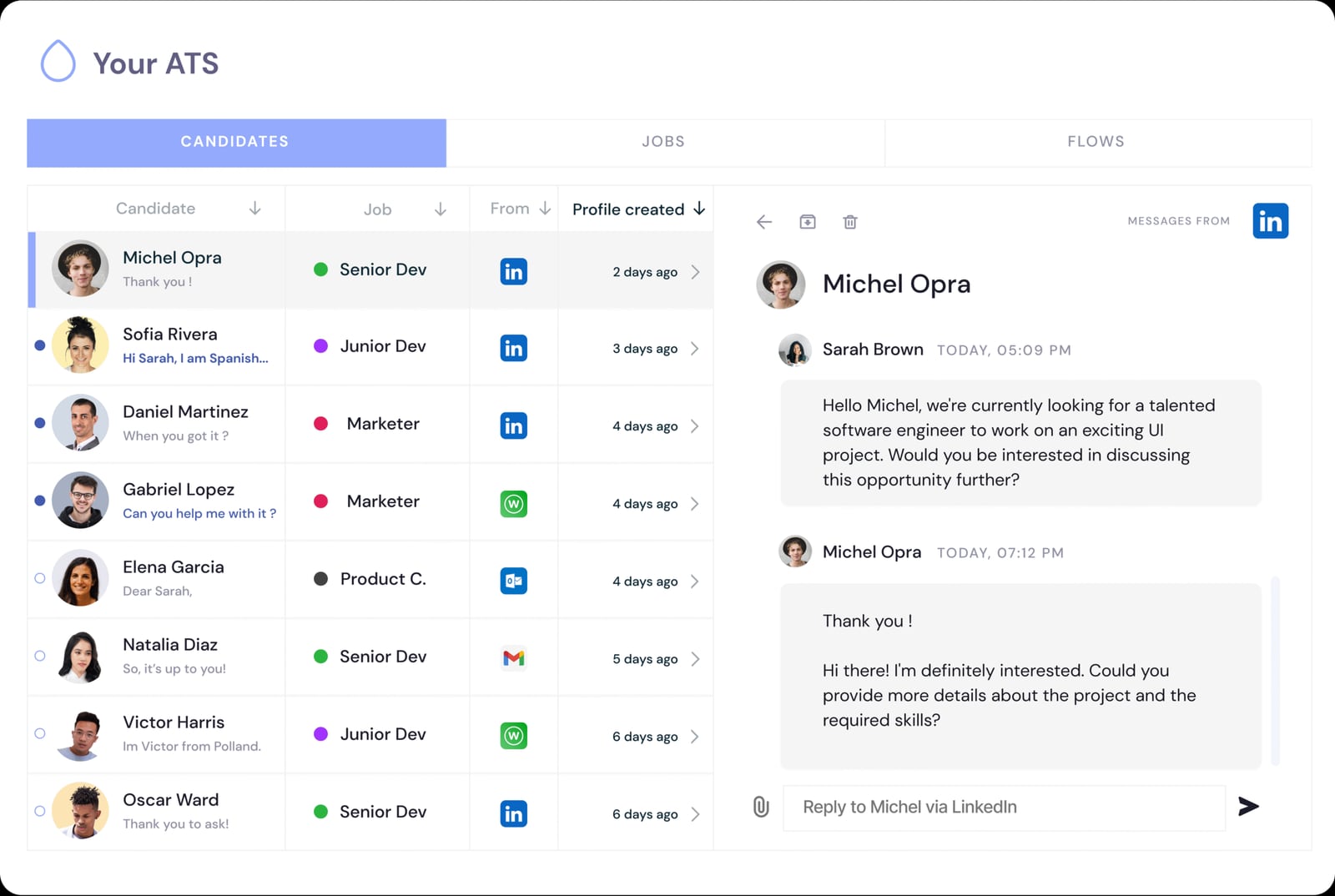
Recruiting Software Dashboard.
Each platform abstracts away the complexity of individual provider APIs, but their philosophies and target audiences diverge sharply.
UnifyPort is built as a developer-first, production-grade messaging backbone. It normalizes message events from Telegram, WhatsApp, LINE, X (Twitter), Zalo, and TikTok into a single REST API and standardized webhook layer. The platform is explicitly designed for AI agents, CRMs, notification systems, and ops tools that need reliable, isolated, and idempotent delivery at scale.
MessengerPeople positions itself as a business-friendly omnichannel API with transparent, predictable pricing. It covers WhatsApp, Instagram, Facebook Messenger, Telegram, and Twitter, and targets customer support, conversational commerce, and marketing use cases. Its standout feature is a pay-per-message or per-monthly-active-user model with monthly fee caps, making costs easy to forecast.
Unipile focuses on professional and social messaging breadth, uniquely combining LinkedIn, WhatsApp, Gmail, Outlook, Instagram, and Telegram under one API. It is tailored for B2B SaaS platforms, recruitment software, and sales engagement tools that need to reach prospects where they already communicate, including email and calendar sync.
Channel Coverage: Where Each Platform Shines
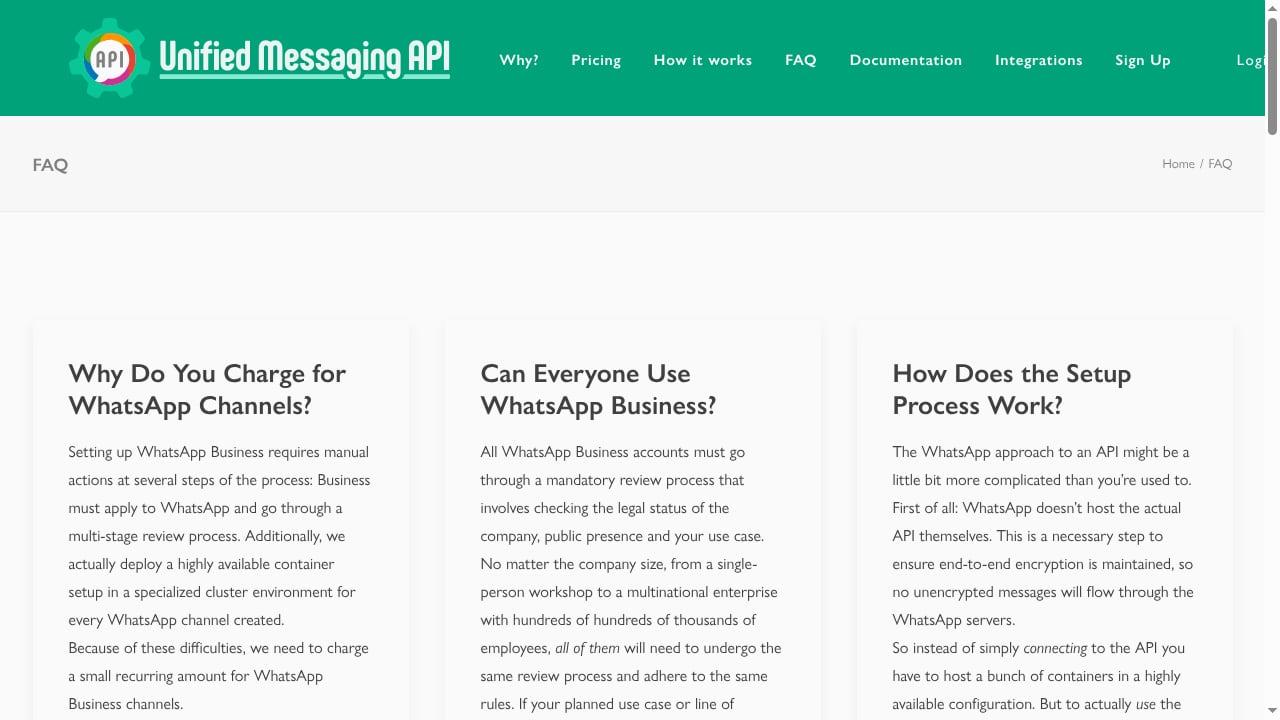
First viewport screenshot of FAQs – MessengerPeople.dev.
Channel support is often the first filter. Here’s how they stack up against the channels most teams care about.
MessengerPeople: Strong on Meta’s Ecosystem and Customer Channels
MessengerPeople provides deep integration with the Meta family—WhatsApp, Instagram, and Facebook Messenger—which makes it a natural fit for customer-facing brands that rely on these platforms for support and marketing. It also supports Telegram and Twitter, covering the core channels for consumer engagement.
For businesses that want to embed messaging into their website or app for customer service, MessengerPeople’s native integrations and Zapier connectivity extend its reach without custom code. The platform’s pricing model, which caps monthly costs per channel, is particularly attractive for teams that need to manage high-volume, conversational interactions without unpredictable bills.
Unipile: The Go-To for Professional and Social Outreach
Unipile’s differentiator is LinkedIn messaging, a channel that no other provider in this comparison offers natively. For sales engagement platforms, ATS systems, and recruiting tools, the ability to send InMails, connection requests, and follow-up messages through a unified API is a significant advantage. Unipile also bundles WhatsApp, Instagram, Telegram, Gmail, Outlook, and calendar sync, making it a strong candidate for products that need to orchestrate multi-step outreach sequences across email and social channels.
The platform’s 500+ endpoints and real-time webhooks support complex workflows like data enrichment from LinkedIn profiles and automated follow-up scheduling. If your roadmap includes sequences that touch a prospect on LinkedIn, then follow up via email and WhatsApp, Unipile consolidates that into one integration.
UnifyPort: Purpose-Built for AI Agents and Scalable Infrastructure
UnifyPort’s channel list—Telegram, WhatsApp, LINE, X, Zalo, and TikTok—reflects its focus on programmable, high-reliability messaging for software-driven workflows. It is the only platform in this comparison that supports LINE, Zalo, and TikTok, which are critical for reaching users in East and Southeast Asian markets.
More importantly, UnifyPort’s architecture is designed for non-human senders. Its standard event layer converts every incoming message into a consistent JSON shape, regardless of the source platform. This normalization is essential for AI agents that need to process and respond to messages without writing channel-specific parsing logic. Built-in rate limiting, retries with idempotency, and failure isolation ensure that a problem on one channel does not cascade into others—a requirement for any system that must maintain high availability.
Developer Experience and Integration Depth
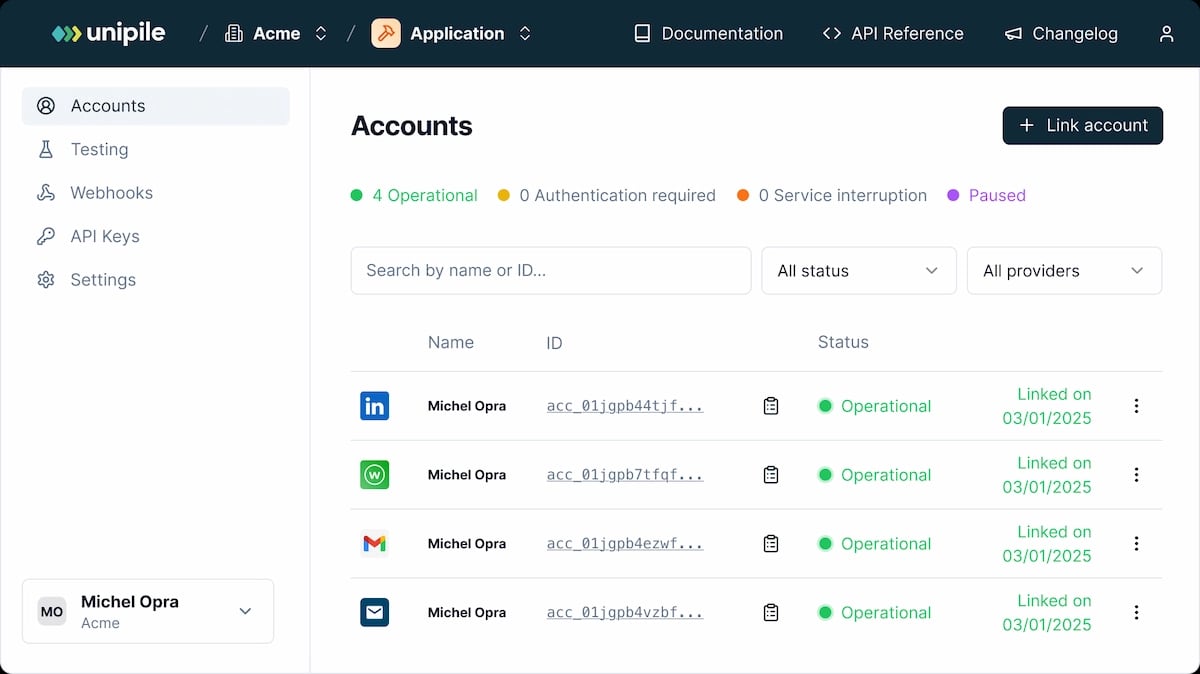
Quick start video.
UnifyPort’s Normalized Event Layer and Webhook Control Plane
UnifyPort treats messaging infrastructure as a reliability engineering problem. Its webhook control plane manages signatures, subscriptions, and retries out of the box, so developers don’t need to build their own delivery guarantees. The standard event layer means that a message from TikTok and a message from Telegram arrive in the same predictable format, reducing the code paths your application needs to maintain.
Official SDKs for Node.js, PHP, and Go lower the integration barrier, and the workspace/account/runtime model provides clear isolation for multi-tenant applications. For teams building notification systems, AI agent frameworks, or operational tools that must never drop a message, this level of infrastructure control is a material advantage.
Unipile’s OAuth-Based Account Linking and Broad SDK Support
Unipile simplifies the user connection flow with OAuth-based authentication, allowing end-users to link their LinkedIn, Gmail, and other accounts without manual credential handling. The platform provides comprehensive documentation, a live account status dashboard, and a 7-day free trial that lets developers test the full feature set before committing.
For teams that need to ship quickly, Unipile’s pre-built solutions for sales and recruiting verticals offer a head start. The unified inbox and real-time synchronization across email, messaging, and calendar make it straightforward to embed a complete communication hub into a SaaS product.
MessengerPeople’s Simplicity and Predictable Pricing
MessengerPeople prioritizes ease of adoption. There are no setup fees beyond a one-time WhatsApp Business onboarding charge, and the pricing model—pay per message or per monthly active user with free switching between models—removes the anxiety of cost estimation. Free support and native integrations mean that smaller teams or those without dedicated DevOps resources can get an omnichannel messaging experience live without deep infrastructure investment.
Pricing and Total Cost of Ownership
Pricing transparency varies significantly across these three platforms, and the right choice depends on your scale and channel mix.
MessengerPeople offers the most predictable model for customer-facing use cases. With per-message or per-MAU billing and monthly fee caps, you can forecast costs accurately even as conversation volumes fluctuate. This is especially valuable for customer support teams where ticket volumes can spike unpredictably.
Unipile uses a per-connected-account model with volume discounts. Starting at €49 flat for up to 10 accounts and scaling down to €3 per account at higher tiers, the pricing is straightforward but can grow quickly if your application connects many end-user accounts. The 7-day free trial lets you validate the integration before incurring costs.
UnifyPort uses a graduated monthly tier per paid messaging account, with free accounts included. This model works well for platforms that have a mix of high-volume and low-volume channels, as you only pay for the accounts that actively send messages. For AI agent deployments where a single account may handle thousands of conversations, this can be more cost-effective than per-message pricing.
Security, Compliance, and Data Residency
For regulated industries or teams with strict data requirements, the operational model matters.
MessengerPeople operates under German data protection law as part of MessengerPeople GmbH (a Sinch subsidiary), providing a strong GDPR compliance posture for European customers.
Unipile is hosted on Scaleway infrastructure in France, holds SOC 2 Type II certification, and is GDPR compliant. Data residency in the EU is a key selling point for customers who need managed compliance.
UnifyPort secures integrations via API keys and HMAC-SHA256 signatures, providing a robust authentication layer for machine-to-machine communication. For AI agent and notification use cases where messages are programmatic rather than personal, this signature-based approach aligns well with automated workflows.
Decision Guide: Which Platform Fits Your Use Case?
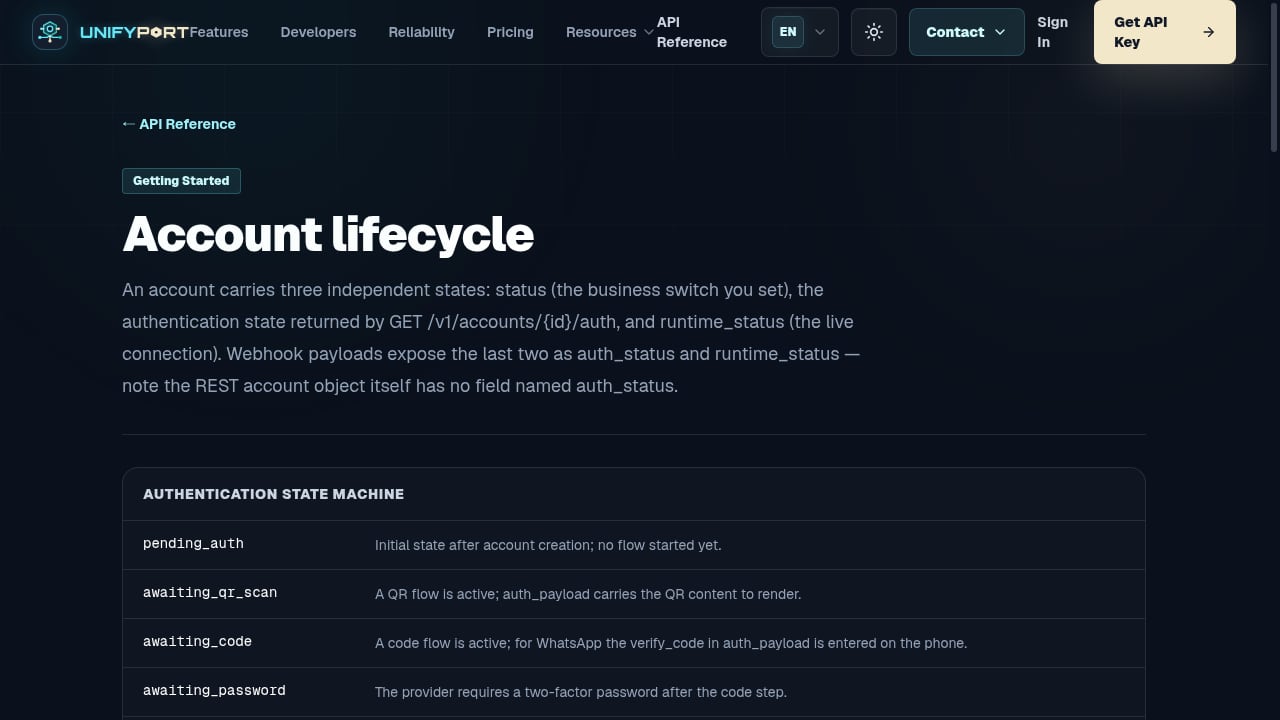
First viewport screenshot of Account lifecycle — API Reference — UnifyPort.
Choose MessengerPeople if:
- Your primary channels are WhatsApp, Instagram, and Facebook Messenger for customer support or conversational commerce.
- You need predictable, capped monthly costs without setup fees.
- Your team values simplicity, free support, and native integrations over deep programmatic control.
- You are a business user or small engineering team that wants omnichannel messaging without building custom infrastructure.
Choose Unipile if:
- LinkedIn messaging is a first-class requirement for sales outreach, recruiting, or B2B engagement.
- You need to unify email (Gmail, Outlook), calendar, and social messaging into one API.
- Your product includes multi-step outreach sequences that span LinkedIn, email, and WhatsApp.
- You want OAuth-based account linking and a managed, EU-hosted SaaS with SOC 2 compliance.
Choose UnifyPort if:
- You are building AI agents, notification systems, or operational tools that require a normalized message format across channels.
- You need support for LINE, Zalo, TikTok, or X alongside WhatsApp and Telegram.
- Reliable delivery with built-in rate limiting, retries, idempotency, and failure isolation is non-negotiable.
- Your architecture demands a webhook control plane and workspace-based isolation for multi-tenant deployments.
- You want official SDKs for Node.js, PHP, and Go to accelerate backend integration.
When to Combine Platforms
These platforms are not always mutually exclusive. A common pattern is to use UnifyPort as the programmable messaging backbone for AI agents and transactional notifications, while using MessengerPeople or Unipile for the human-in-the-loop customer support or sales workflows. For a deeper look at how UnifyPort and MessengerPeople compare head-to-head on developer experience and channel support, see our UnifyPort vs MessengerPeople comparison.
If your evaluation extends beyond these three, our top 10 multi-channel messaging APIs for 2026 provides a broader market view, including Twilio, Bird, and Vonage.
Related reading
- HubSpot Customer Platform Review: Is It Right for Your Business? - In-depth HubSpot Customer Platform review: Explore Smart CRM, Breeze AI, pricing, pros, cons from real users, and alternatives to decide if it fits your business.
- Stickers Guide: Custom Printing, Vinyl & Digital Messaging Stickers - Learn about physical sticker types, custom sticker printing, design tips, and digital stickers for messaging apps. Discover how UnifyPort unifies sticker messages across LINE, WhatsApp, Telegram & more.
- CM.com Stock (CMCOM.AS): Price, Ticker & Investment Guide - CM.com (CMCOM.AS): stock price, analyst targets, shareholder structure, and how to invest in this Euronext conversational commerce company.
Sources and further reading
- Unipile: One API for Multi-Channel Messaging in your app - Advance your app's capabilities: Integrate LinkedIn and WhatsApp for streamlined messaging and improved user experience.
- Unipile vs Nylas: Messaging & Email APIs - Unipile unifies LinkedIn, WhatsApp, and email in one API. Nylas goes deep on email, calendar, and contacts with Agent Accounts and a CLI. Compare scope and fit.
- EmailEngine vs Unipile - Self-Hosted Email API Alternative - Compare EmailEngine and Unipile APIs. Self-hosted email-only vs managed multi-channel, flat pricing vs per-account, and which to choose for your project.
FAQ
Which platform supports the most messaging channels?
Unipile covers the broadest range of communication types by including email and calendar alongside messaging. UnifyPort supports the most diverse set of chat-specific channels, including LINE, Zalo, and TikTok, which are essential for Asian markets. MessengerPeople focuses on the Meta ecosystem plus Telegram and Twitter.
Can I use these APIs for AI agent messaging?
UnifyPort is explicitly designed for AI agent use cases, with a standard event layer that normalizes all incoming messages into a consistent JSON format. This eliminates the need for channel-specific parsing logic in your agent. Unipile and MessengerPeople can also support automated messaging, but they lack the same level of built-in normalization and failure isolation.
How do pricing models differ?
MessengerPeople charges per message or per monthly active user with monthly caps. Unipile charges per connected account per month with volume discounts. UnifyPort uses a graduated monthly tier per paid messaging account, with free accounts available, making it suitable for mixed-volume deployments.
Which platform is best for WhatsApp Business API integration?
All three support WhatsApp. MessengerPeople offers the most streamlined onboarding with a one-time setup fee and transparent ongoing costs. UnifyPort and Unipile both provide robust WhatsApp integration, with UnifyPort adding idempotency and retry guarantees for high-reliability use cases.
Do any of these platforms support LinkedIn messaging?
Only Unipile provides native LinkedIn messaging integration, including support for InMails, connection requests, and profile data enrichment. This is a key differentiator for sales and recruiting platforms.
Conclusion
UnifyPort, MessengerPeople, and Unipile each solve the multi-channel messaging problem from a different angle. MessengerPeople wins on pricing predictability and ease of use for customer-facing teams. Unipile is the clear choice when LinkedIn and email must sit alongside chat in a unified outreach workflow. UnifyPort is the infrastructure-grade option for teams that need normalized events, channel isolation, and the reliability guarantees required by AI agents and mission-critical notifications. Match the platform to your channel mix, your team’s engineering capacity, and the reliability your use case demands, and you’ll land on the right foundation.