
Top 10 CPaaS Omni-Channel Messaging Platforms 2026
A ranked 2026 review of the top 10 CPaaS omni-channel messaging platforms, with evidence-based criteria, channel support, developer fit, and buying guidance.
Top 10 CPaaS Omni-Channel Messaging Platforms 2026
Choosing a CPaaS omni-channel messaging platform in 2026 is harder than it looks. The category has expanded from simple SMS gateways into programmable engagement layers that must handle RCS, WhatsApp, voice, push, and AI-assisted journeys without forcing your team to rebuild integrations every quarter. This review ranks ten platforms that genuinely belong to the CPaaS omni-channel messaging category, explains how each one earns its place, and gives you a practical framework for matching a vendor to your architecture.
How We Evaluated These Platforms
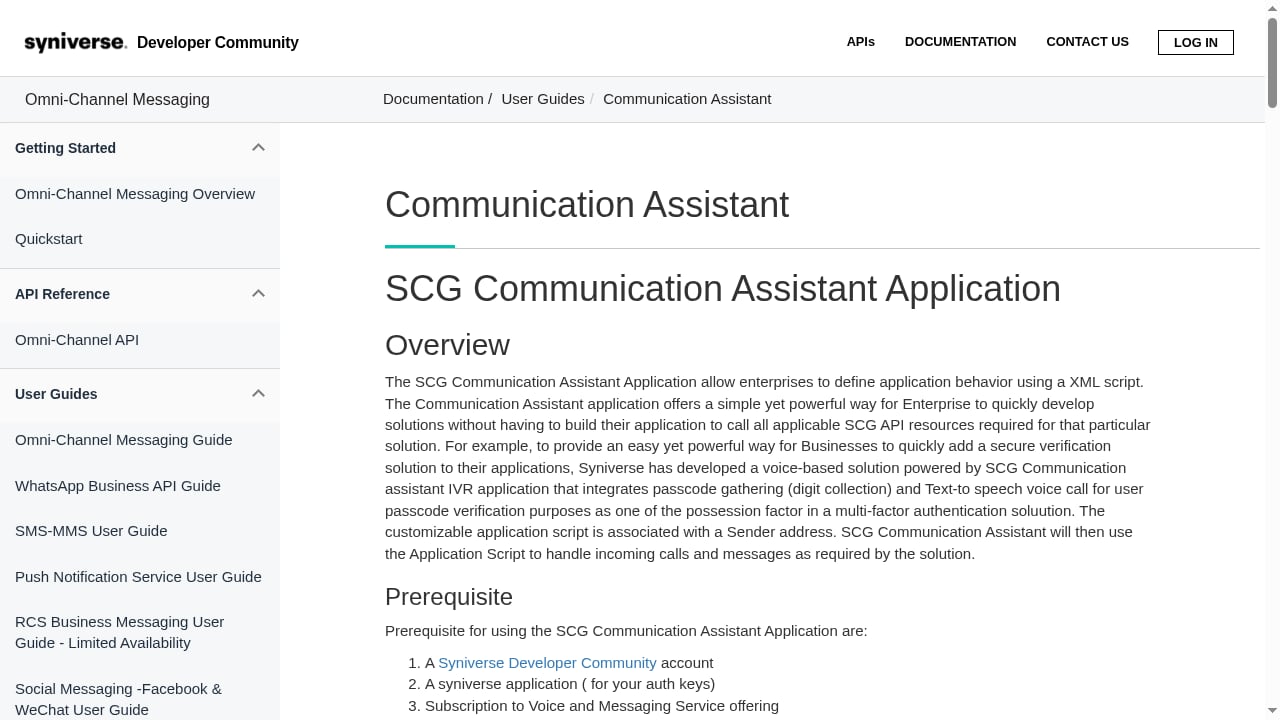
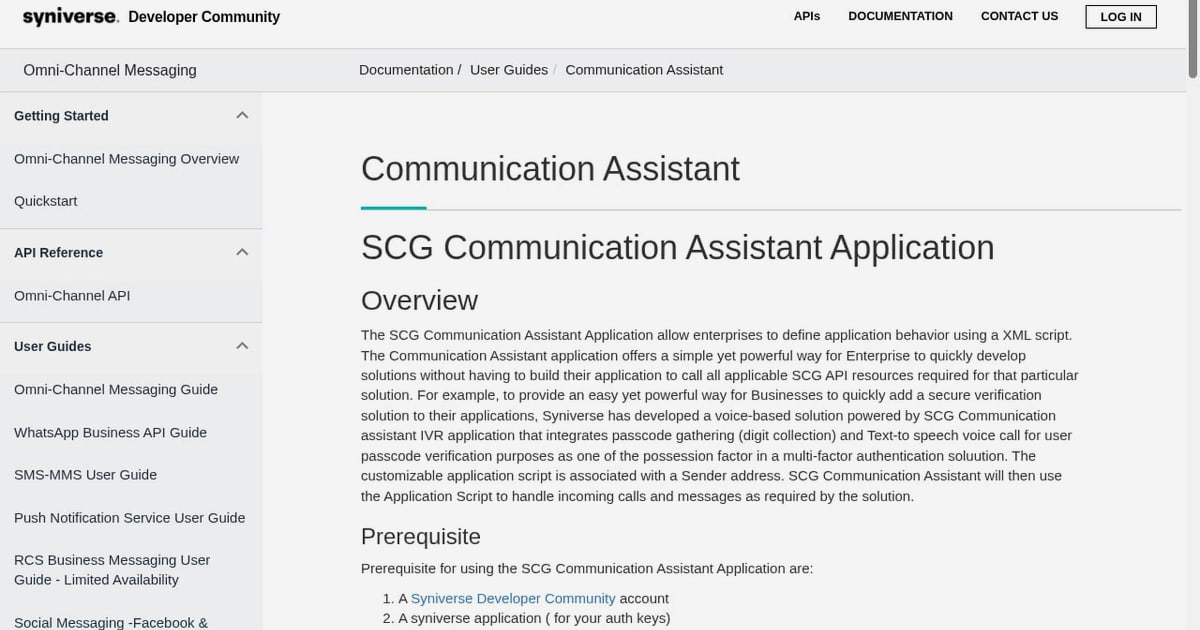
First viewport screenshot of Communication Assistant :: SDC Documentation.
We scored each product against six transparent criteria:
- Channel breadth and depth — Which messaging channels are supported natively, and how mature are the APIs for each?
- API and developer experience — REST consistency, SDK coverage, documentation quality, sandbox access, and webhook reliability.
- Omni-channel orchestration — Whether the platform can route, fall back, and coordinate across channels rather than just offering them side by side.
- Global reach and compliance — Carrier connections, sender registration support (for example, 10DLC), regional data rules, and fraud controls.
- Enterprise and AI readiness — CRM integrations, automation builders, analytics, and AI/voice capabilities.
- Pricing transparency and scalability — Whether costs are predictable as volume grows and how pricing is documented.
We prioritized platforms with publicly verifiable product evidence, active 2026 roadmaps, and real enterprise deployments. No vendor paid for placement.
The Top 10 CPaaS Omni-Channel Messaging Platforms for 2026
First viewport screenshot of Home :: SDC Documentation.
1. Twilio Customer Engagement Platform
Twilio remains the reference point for programmable messaging. Its Super Network spans thousands of carrier connections across more than 180 countries, and the platform combines messaging, voice, video, and email APIs with Segment's customer data platform. The 2025–2026 push into voice AI through ConversationRelay and Twilio Alpha shows the company is moving beyond raw APIs into data-driven engagement. Twilio is the strongest choice when you want the broadest ecosystem, the largest developer community, and a clear path from notifications to predictive, personalized journeys. The trade-off is cost complexity: pricing is granular, and optimizing spend requires active governance.
2. Infobip
Infobip has evolved from a messaging aggregator into a full-stack omni-channel platform with more than 30 communication channels, including SMS, RCS, voice, video, email, WhatsApp, Viber, and Messenger. Its differentiator is the SaaS layer on top of the APIs: Moments for customer engagement, Answers for chatbots, Conversations for contact center operations, and People for customer data. Enterprises that want to buy orchestration and analytics alongside connectivity will find Infobip unusually complete. Teams that only need raw APIs may find the platform heavier than necessary.
3. Vonage Communications APIs
Vonage, now part of Ericsson, pairs a mature communications API portfolio with network API ambitions. It supports voice, messaging, video, and authentication, and has invested heavily in network APIs that improve identity verification and fraud detection without adding friction to the user experience. Vonage is a strong fit for businesses that want global omni-channel messaging plus telco-grade network capabilities, particularly in markets where SIM-swap and number-verification signals matter.
4. Sinch
Sinch positions itself as an AI-powered cloud communications provider with SMS, WhatsApp, RCS, and email APIs, plus built-in automation, personalization, and fraud and security tooling. Its strength is operational reliability at scale and a broad direct-to-carrier footprint. Sinch is often the pragmatic choice for high-volume transactional messaging where deliverability and throughput matter more than a visual journey builder.
5. Syniverse CPaaS Omni-Channel Messaging
Syniverse offers a cloud-based CPaaS with a unified REST API endpoint across SMS, MMS, voice, push notifications, WhatsApp Business API, RCS Business Messaging, Facebook Messenger, and WeChat. Its standout capabilities include outbound voice calling to more than 200 countries, phone number verification, account takeover detection, 10DLC registration, right-party verification, and chatbot connector services. The Communication Assistant lets enterprises define application behavior with XML scripts, which is useful for rapid builds such as voice-based passcode verification for multi-factor authentication. Syniverse is also an authorized RCS Business Messaging solution provider working with mobile operators, which gives it credible operator-side positioning. It suits businesses that need carrier-grade global reach and operator relationships, especially those already working within telecom-adjacent ecosystems.
6. Webex Connect
Webex Connect is Cisco's enterprise CPaaS play, built for rapid automation of multi-channel customer journeys. It supports SMS, voice, RCS, push, in-app, email, Apple Business Chat, Facebook Messenger, and WhatsApp, and wraps them in a visual drag-and-drop flow builder backed by a high-performance runtime engine. Its low-code toolset appeals to product managers and architects who want to launch cross-channel flows without deep engineering cycles. It is best suited to organizations already invested in the Cisco and Webex ecosystem.
7. Azure Communication Services
Microsoft's CPaaS offering provides APIs and SDKs for voice, video, chat, SMS, and telephony, with interoperability into public switched telephone networks and strong compliance and authentication features. Its main advantage is native integration with the Azure ecosystem, including identity, data, and analytics services. For teams standardized on Microsoft cloud infrastructure, Azure Communication Services reduces architectural friction, though its messaging-app channel coverage is narrower than dedicated CPaaS specialists.
8. AWS Communication Developer Services
AWS bundles SMS, email, voice, and video capabilities into a developer services suite that integrates cleanly with the broader AWS stack. It is a natural fit for engineering teams that want communication primitives close to their compute, storage, and analytics workloads. The trade-off is that omni-channel orchestration across messaging apps like WhatsApp or RCS typically requires additional vendors or custom integration.
9. Exotel
Exotel combines voice and messaging APIs with IVR, click-to-call, WebRTC in-app calling, voice streaming, agent dashboards, and CRM integrations. It operates under UL-VNO licensing for VoIP telephony, which matters for compliance-sensitive deployments in India and similar markets. Exotel is a strong regional choice for businesses that need voice-first customer engagement with messaging as a complement.
10. Airtel IQ
Airtel IQ delivers cloud communication solutions spanning voice, messaging, and video, with automation for customer interactions across calls and digital channels. Backed by Airtel's network assets, it offers competitive pricing and local compliance advantages in South Asian markets. It is best evaluated by teams with significant India or regional volume that want carrier-aligned pricing and support.
Comparison: Which Platform Fits Which Buyer?
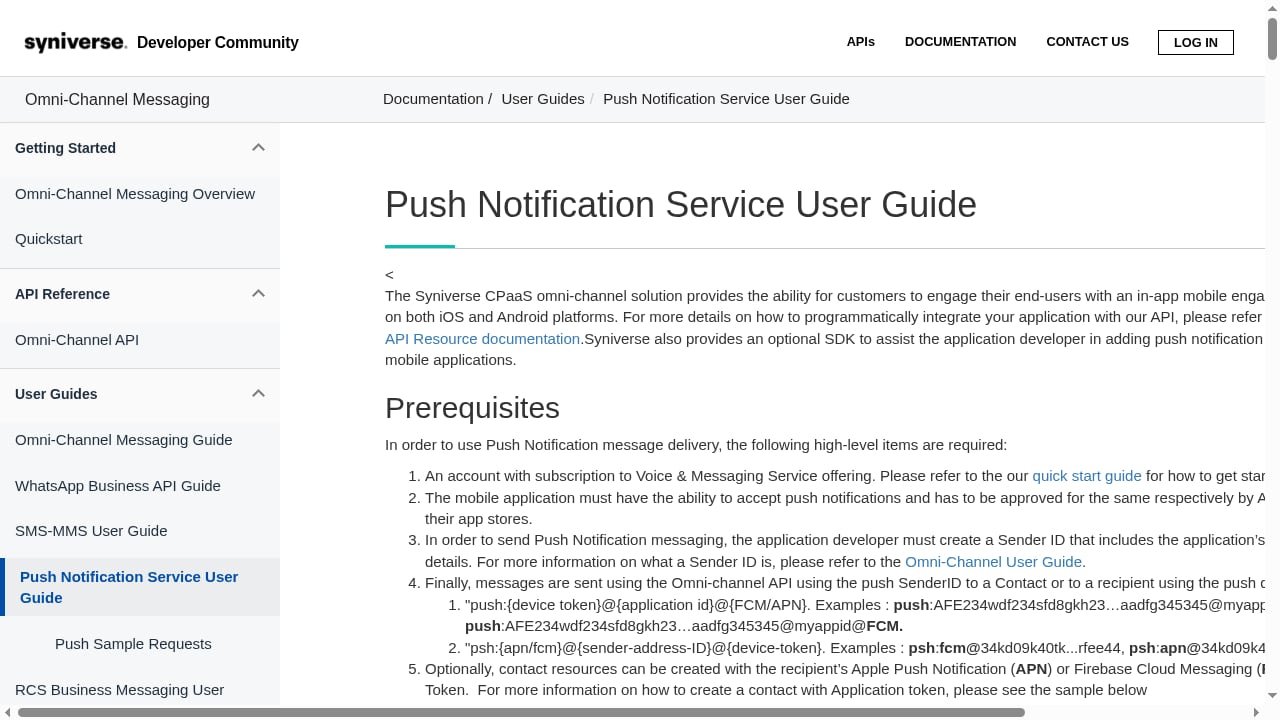
First viewport screenshot of Push Notification Service User Guide :: SDC Documentation.
| Buyer profile | Strongest fits | Why |
|---|---|---|
| Global enterprise scaling messaging and voice | Twilio, Infobip, Sinch | Broad channel coverage, carrier depth, enterprise controls |
| Telecom-adjacent or RCS-focused programs | Syniverse CPaaS, Vonage | Operator partnerships and network APIs |
| Microsoft- or AWS-standardized engineering teams | Azure Communication Services, AWS Communication Developer Services | Native cloud integration and identity |
| Low-code journey builders | Webex Connect, Infobip | Visual orchestration and SaaS layers |
| Regional voice-first operations | Exotel, Airtel IQ | Local licensing, carrier alignment, pricing |
If your priority is a single REST API across messaging apps rather than a full CPaaS suite, it is worth understanding where a unified messaging API layer fits alongside a CPaaS. Our buyer's guide to omni-channel messaging platforms explains how to separate true orchestration from multichannel sprawl, and the UnifyPort vs Syniverse CPaaS vs Esendex comparison shows how channel coverage, webhooks, and pricing differ in practice.
Practical Decision Guidance
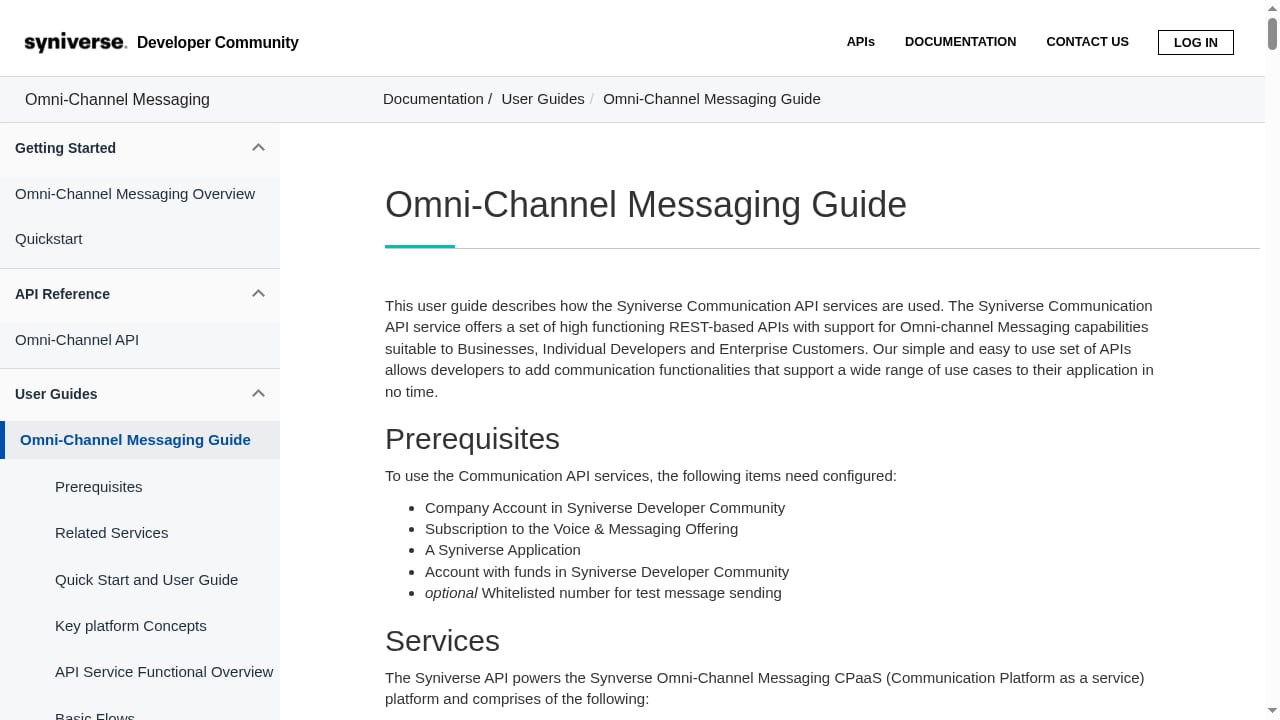
First viewport screenshot of Omni-Channel Messaging Guide :: SDC Documentation.
Start with your channel mix. If 80% of your volume is SMS and voice, prioritize deliverability, sender registration, and per-message economics. If WhatsApp, RCS, and in-app messaging drive engagement, prioritize API consistency and webhook reliability. Then map your integration surface: teams already on Azure or AWS should weigh native cloud services heavily, while teams building multi-provider strategies should look for normalized event streams and idempotent delivery.
Finally, test the failure paths. Ask each vendor how they handle retries, rate limits, signature verification, and provider outages. A platform that only demos happy-path sends will cost you engineering time later. For teams that need to connect CPaaS output to CRM or support tooling, a unified messaging API can sit alongside the CPaaS and normalize inbound events; UnifyPort's approach to Telegram webhooks is a useful example of that pattern.
Related reading
- How to Use UnifyPort with Svix: Unified Messaging Webhooks - Connect UnifyPort's unified messaging API to Svix to fan out WhatsApp, Telegram, LINE, TikTok, Zalo, and X events to customer endpoints reliably.
- UnifyPort vs Sendbird: Unified Messaging API Compared - Compare UnifyPort and Sendbird: unified messaging API vs AI customer experience platform. Channels, pricing, webhooks, and developer fit.
- Zernio Review 2026: Agent Marketing API, Pricing & Limits - Evidence-based Zernio review: one API for social, ads, inbox, WhatsApp, SMS and calls, plus MCP. Pricing math, real limits, and who it fits.
Sources and further reading
- Best Communications Platform as a Service Reviews 2026 | Gartner Peer Insights - Find the top Communications Platform as a Service with Gartner. Compare and filter by verified product reviews and choose the software that’s right for your organization.
- 10 CPaaS Providers & Their Differentiators in 2026 - The CPaaS market is projected to grow from $32bn in 2025 to as much as $100bn by 2030. Discover the CPaaS providers leading the surge and what sets them apart.
- 9 Best Omnichannel Marketing Platforms for 2026 - Netcore - Oct 5, 2026 ... Infobip is a global cloud communications platform that has evolved into a comprehensive omnichannel customer engagement solution. Originally ...
FAQ
What is a CPaaS omni-channel messaging platform?
It is a cloud platform that lets businesses embed messaging and voice capabilities into applications through APIs, while coordinating multiple channels such as SMS, WhatsApp, RCS, voice, and push within one programmable environment.
How is CPaaS different from a unified messaging API?
CPaaS platforms typically provide carrier connectivity, compliance, and orchestration across many channels. A unified messaging API layer focuses on normalizing provider-specific messaging apps into one consistent interface. Many teams use both together.
Which CPaaS platform is best for RCS Business Messaging?
Syniverse and Vonage both have credible operator-side positioning for RCS. The right choice depends on which markets and carriers you need, since RCS availability is negotiated region by region.
Do I need a CPaaS if I already use WhatsApp Business API directly?
Not necessarily. A CPaaS becomes valuable when you need multiple channels, centralized compliance, fallback routing, or consolidated billing across regions.
How should I evaluate CPaaS pricing in 2026?
Model your expected volume by channel, include sender registration and verification costs, and ask for committed-use discounts. Compare the total cost of ownership, not just the headline per-message rate.
Conclusion
The 2026 CPaaS market rewards buyers who look past channel checklists. Twilio, Infobip, Vonage, and Sinch lead on global scale and ecosystem depth; Syniverse stands out for operator-aligned RCS and carrier-grade verification; Webex Connect, Azure, and AWS serve organizations that value low-code orchestration or cloud-native integration; Exotel and Airtel IQ excel in regional voice-first deployments. Match the platform to your channel mix, compliance footprint, and engineering model, and validate failure handling before you commit. For a broader view of how communications APIs and AI customer experience platforms overlap, see our Top 10 AI customer experience and communications API platforms.