
UnifyPort vs Syniverse CPaaS vs Esendex: 2026 Comparison
Compare UnifyPort, Syniverse CPaaS Omni-Channel Messaging, and Esendex on channels, APIs, webhooks, pricing, and developer fit for 2026.
UnifyPort vs Syniverse CPaaS Omni-Channel Messaging vs Esendex
Choosing a messaging platform in 2026 is less about which vendor has the longest channel list and more about which one matches how your team actually builds. UnifyPort, Syniverse CPaaS Omni-Channel Messaging, and Esendex all promise multi-channel reach, but they solve different problems. This comparison breaks down where each platform is strong, where trade-offs appear, and which one fits your use case.
Quick comparison at a glance
First viewport screenshot of Push Notification Service User Guide :: SDC Documentation.
| Criterion | UnifyPort | Syniverse CPaaS Omni-Channel Messaging | Esendex |
|---|---|---|---|
| Core positioning | Unified messaging API for social and chat apps | Enterprise CPaaS with carrier-grade reach | Business SMS and multichannel messaging |
| Signature channels | WhatsApp, Telegram, LINE, TikTok, Zalo, X | SMS, MMS, Voice, Push, WhatsApp, RCS, Facebook Messenger, WeChat | SMS, WhatsApp, RCS, Email, Voice |
| API style | One REST API, one normalized webhook stream | Unified REST API across channels | REST APIs, build-once integration |
| Official SDKs | Node.js, PHP, Go, Python | Not emphasized in public materials | Not emphasized in public materials |
| Webhook model | Standard event layer with HMAC-SHA256 signatures | Channel-dependent event handling | Channel-dependent event handling |
| Pricing entry | Messaging-account pricing in USD, free accounts | Subscription plus funded application account | From £54/month for 500 messages |
| Best fit | Developers building multi-app messaging features | Enterprises needing global carrier reach | UK-centric businesses wanting SMS plus multichannel |
Search intent: what buyers actually want to know
People searching for this comparison usually fall into one of three groups:
- Developers who need to add chat-app messaging (WhatsApp, Telegram, LINE, and similar) without maintaining six separate integrations.
- Product and ops teams comparing a unified API against a traditional CPaaS or business SMS provider.
- Enterprise buyers checking whether carrier relationships, compliance, and regional support outweigh developer ergonomics.
Each platform below is evaluated against those needs rather than against a single generic scorecard.
UnifyPort: strengths for multi-app messaging builders
First viewport screenshot of Esendex Pricing - From £54 a month.
UnifyPort is a unified messaging API platform built around a single integration surface. Instead of writing and maintaining separate connectors for each messaging provider, teams send messages with one POST /v1/messages call and receive inbound events through one normalized webhook stream.
Where UnifyPort stands out:
- One REST API, one event shape. Every provider message, status update, and account event is converted into a stable JSON structure. That removes the per-provider parsing logic that usually grows into its own maintenance project.
- Official SDKs for Node.js, PHP, Go, and Python. Teams can start in the language they already use rather than adapting to a vendor-specific toolkit.
- Webhook control plane. Signatures, subscriptions, retry behavior, and failure tracking are managed in one place. Deliveries are signed with HMAC-SHA256, which matters when inbound events trigger business logic.
- Reliable delivery queue. Rate limits, retries, idempotency, and failure isolation are built in, so a single provider outage does not cascade across channels.
- Account lifecycle coverage. Authentication flows such as QR code, verification code, password, Passkey, and session import are documented, which is unusual for platforms that treat account state as an afterthought.
- Transparent pricing. Messaging-account costs are listed in USD with graduated pricing, and every workspace includes free messaging accounts.
UnifyPort's channel set is deliberately focused on social and chat apps rather than traditional telecom channels. If your roadmap centers on WhatsApp, Telegram, LINE, TikTok, Zalo, and X, that focus is an advantage. If you need SMS, voice, or RCS as first-class channels, the substitutes below are stronger fits.
For a broader evaluation framework, see the omni-channel messaging platform buyer's guide.
Syniverse CPaaS Omni-Channel Messaging: strengths for enterprise reach
First viewport screenshot of Home :: SDC Documentation.
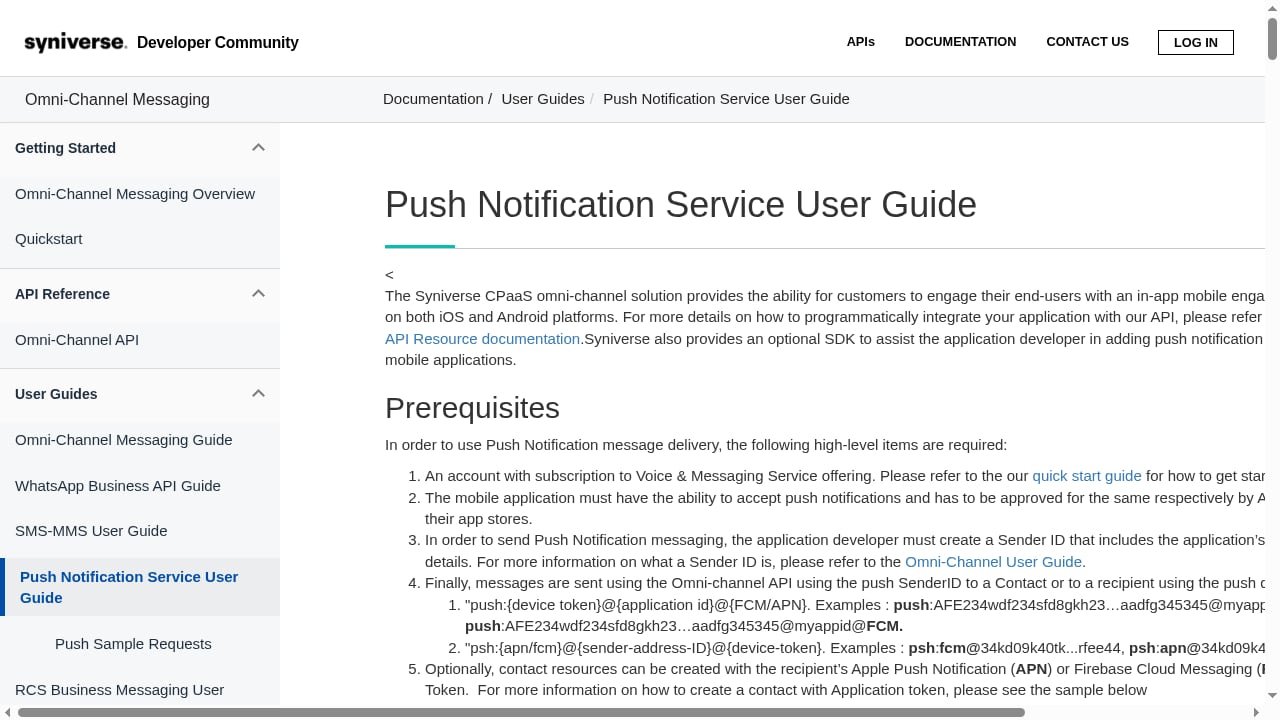
Syniverse CPaaS Omni-Channel Messaging is a cloud-based CPaaS aimed at businesses, individual developers, and enterprise customers. It exposes multiple channels through a unified REST-based API, including SMS, MMS, Voice, Push Notifications, WhatsApp Business API, RCS Business Messaging, Facebook Messenger, and WeChat.
Where Syniverse stands out:
- Carrier-grade infrastructure. Syniverse reports direct connectivity to more than 800 mobile operators across 193 countries and territories, which is a meaningful advantage for global delivery reliability and cost control compared with aggregator-dependent providers.
- Voice and verification depth. Outbound voice calling to over 200 countries, phone number verification, account takeover detection, 10DLC registration, and right party verification are all part of the platform.
- Communication Assistant. Enterprises can define application behavior with XML scripts, enabling flows like voice-based passcode verification for multi-factor authentication without building a custom voice stack.
- RCS positioning. Syniverse is an authorized RCS Business Messaging solution provider working with mobile operators, offering limited availability RCS access.
- Enterprise integrations. The platform is designed to plug into CRM, customer care tools, POS systems, and workflows built on Salesforce, Microsoft, and similar suites.
Trade-offs to weigh:
- Onboarding prerequisites. Access requires a company account in the Syniverse Developer Community, a subscription to the Voice & Messaging Service offering, and a Syniverse Application Account with funds. That is heavier than a self-serve API key.
- Developer ergonomics. Public materials emphasize enterprise deployment and carrier relationships more than SDKs, normalized event schemas, or webhook tooling.
- RCS availability. RCS Business Messaging is positioned as limited availability, so it should not be treated as a guaranteed channel at launch.
For more context on how CPaaS providers differentiate, see Syniverse's own guidance on choosing a CPaaS provider.
Esendex: strengths for SMS-first multichannel programs
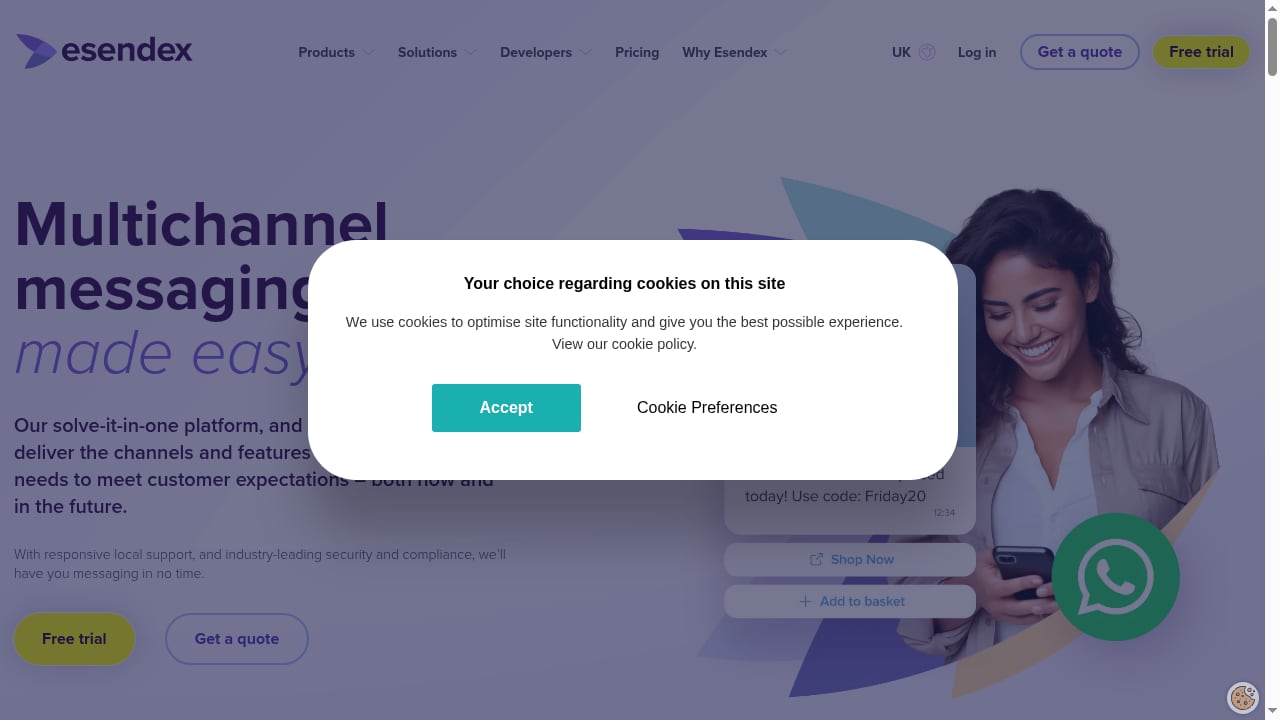
First viewport screenshot of Esendex - Business SMS & Multichannel Messaging Services.
Esendex is a business SMS and multichannel messaging platform with more than 20 years of experience. It supports SMS, WhatsApp, RCS, Email, and Voice, and positions itself as a solve-it-in-one platform with build-once APIs.
Where Esendex stands out:
- SMS depth and maturity. Two decades in business messaging means well-tested delivery, sender ID management, and virtual mobile numbers.
- Balanced channel mix. SMS, WhatsApp, RCS, Email, and Voice cover the channels most European businesses need without forcing a chat-app-only strategy.
- Web platform plus API. Teams that want a UI for campaign management and an API for integration get both, which suits mixed technical and non-technical organizations.
- Local support and compliance. Esendex emphasizes responsive local support and industry-leading security and compliance, with a strong UK and European footprint.
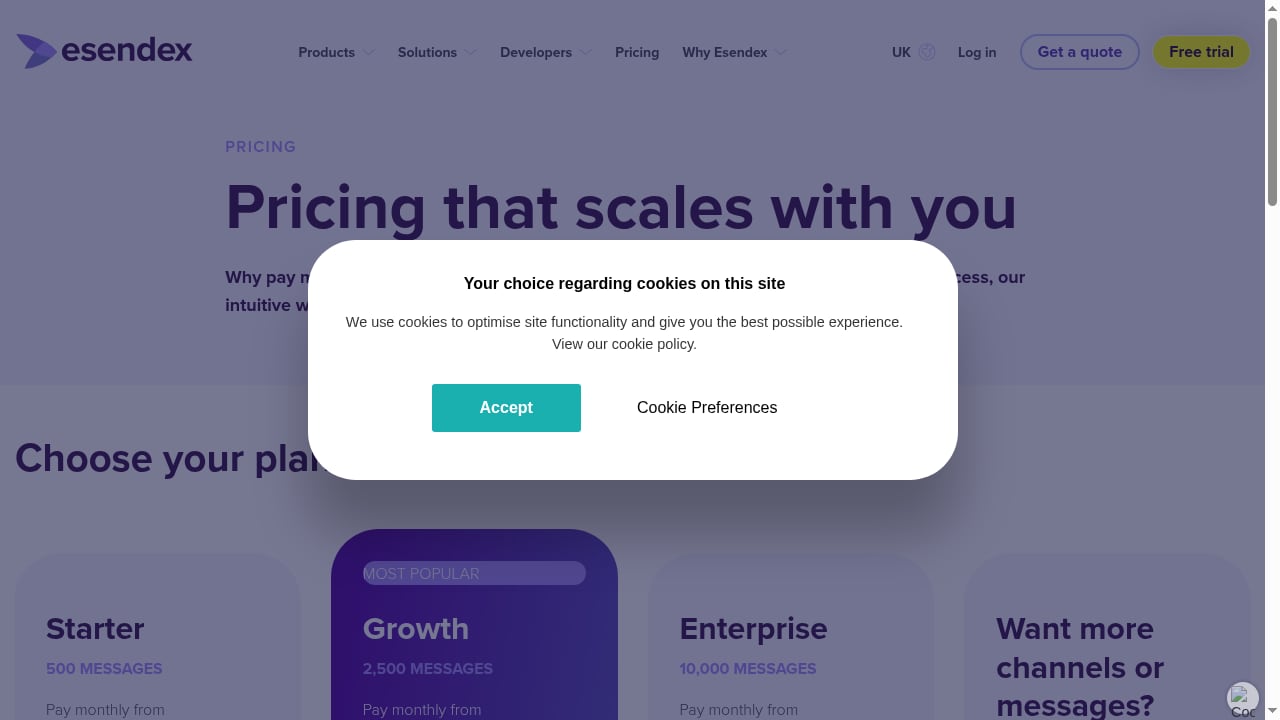
- Clear entry pricing. Plans start from £54 per month for 500 messages, scaling to enterprise levels, and include expert UK support, API access, and a virtual mobile number.
- Proven enterprise references. Case studies include British Airways, Brighton & Hove City Council, and Debt Managers, covering customer experience, collections, and operational efficiency outcomes.
Trade-offs to weigh:
- Channel breadth vs. chat apps. Esendex does not list Telegram, LINE, TikTok, Zalo, or X among its channels, so it is not a substitute for teams whose roadmap depends on those apps.
- Developer tooling. Public materials highlight build-once APIs and integration speed but do not emphasize official SDKs or a normalized webhook event layer.
- Pricing currency and region. Entry pricing is quoted in GBP with UK support as a core selling point, which may matter less for teams outside that market.
How to choose between the three
Use these decision rules to narrow the field quickly:
- Choose UnifyPort if your product needs WhatsApp, Telegram, LINE, TikTok, Zalo, or X behind one API, and you want normalized webhooks, HMAC-SHA256 signing, retries, and idempotency handled for you. It is the strongest fit when engineering time is the constraint.
- Choose Syniverse CPaaS Omni-Channel Messaging if you need global carrier reach, voice, verification, 10DLC, or RCS, and you have the compliance and procurement capacity for an enterprise onboarding process.
- Choose Esendex if SMS is your primary channel, you want WhatsApp, RCS, Email, and Voice alongside it, and local support plus compliance credentials matter more than chat-app breadth.
A useful sanity check: list the channels your roadmap requires in the next 12 months, then eliminate any platform that cannot deliver them today. After that, compare webhook reliability, SDK availability, and pricing model against your team's actual constraints.
If you are also evaluating adjacent platforms, the top 10 multi-channel messaging and email API platforms roundup covers a wider field, and the UnifyPort vs Sendbird comparison looks at a different trade-off between unified messaging APIs and AI customer experience platforms.
Practical examples
Example 1: A fintech adding WhatsApp and Telegram notifications
A fintech needs to send transaction alerts on WhatsApp and support conversations on Telegram. With UnifyPort, both channels go through one POST /v1/messages endpoint and one webhook stream, so the team writes one integration and adds channels by registering messaging accounts. With Syniverse, WhatsApp is available but Telegram is not on the published channel list. With Esendex, WhatsApp is available but Telegram is not listed either.
Example 2: A retailer running SMS promotions in the UK
A UK retailer wants SMS campaigns, delivery confirmations, and occasional voice follow-ups. Esendex fits well here: SMS, Voice, and Email are supported, sender ID management is built in, and local support is included in every plan. Syniverse also covers SMS and voice at enterprise scale but requires a heavier onboarding path. UnifyPort does not position itself as an SMS-first platform.
Example 3: An enterprise verifying users across 40 countries
A global enterprise needs phone number verification, account takeover detection, and voice-based passcode verification across many regions. Syniverse is the natural fit because of its carrier connections, verification features, and Communication Assistant scripting. Neither UnifyPort nor Esendex matches that specific combination of telecom-grade verification and global carrier reach.
Related reading
- Zernio Review 2026: Agent Marketing API, Pricing & Limits - Evidence-based Zernio review: one API for social, ads, inbox, WhatsApp, SMS and calls, plus MCP. Pricing math, real limits, and who it fits.
- Top 10 AI Customer Experience & Communications API Platforms 2026 - Compare the 10 best AI customer experience and communications API platforms for 2026 on channels, AI, pricing, compliance, and developer experience.
Sources and further reading
- Omnichannel Messaging | SMS, WhatsApp, RCS & 10DLC by Syniverse - Transform customer relationships with Syniverse Messaging Channels. Gain powerful insights & secure, scalable A2P communications.
- Top Omnichannel Messaging Tools Compared (Features & Pricing) - Compare the top omnichannel messaging tools by features, pricing, and benefits. Find the best platform to unify your customer communications and improve service.
FAQ
Is UnifyPort a CPaaS?
UnifyPort is best described as a unified messaging API platform. It focuses on social and chat apps such as WhatsApp, Telegram, LINE, TikTok, Zalo, and X, with one REST API and one normalized webhook event stream. Traditional CPaaS platforms typically emphasize SMS, voice, and carrier connectivity instead.
Does Syniverse support Telegram or LINE?
Syniverse's published channel list includes SMS, MMS, Voice, Push Notifications, WhatsApp Business API, RCS Business Messaging, Facebook Messenger, and WeChat. Telegram and LINE are not part of that list, so teams needing those apps should look at a unified messaging API platform instead.
Can Esendex replace a chat-app messaging API?
Not fully. Esendex supports SMS, WhatsApp, RCS, Email, and Voice. If your product depends on Telegram, LINE, TikTok, Zalo, or X, Esendex does not cover those channels, so it works best as an SMS-first multichannel platform rather than a chat-app aggregator.
Which platform has the simplest developer onboarding?
UnifyPort offers self-serve workspace API keys, official SDKs for Node.js, PHP, Go, and Python, and a documented webhook control plane. Syniverse requires a developer community account, a service subscription, and a funded application account. Esendex provides APIs and a free trial but does not emphasize SDKs or normalized event schemas.
How does pricing compare?
UnifyPort prices messaging accounts in USD with graduated tiers and includes free messaging accounts in every workspace. Esendex starts from £54 per month for 500 messages and scales to enterprise plans. Syniverse pricing depends on the Voice & Messaging Service subscription and application account funding, so it is typically quoted through a sales process.
Can I use more than one of these platforms together?
Yes. A common pattern is to use a unified messaging API for chat apps and a CPaaS or business SMS provider for SMS, voice, and verification. The main cost is maintaining two integrations and reconciling delivery data across them.
Conclusion
UnifyPort, Syniverse CPaaS Omni-Channel Messaging, and Esendex are not direct substitutes for every buyer. UnifyPort wins when the priority is one API and one webhook stream across WhatsApp, Telegram, LINE, TikTok, Zalo, and X, with SDKs, signed deliveries, and transparent account-based pricing. Syniverse wins when global carrier reach, voice, verification, 10DLC, and RCS matter most, and the organization can handle enterprise onboarding. Esendex wins when SMS is the core channel, WhatsApp and RCS are useful additions, and local support plus compliance credentials drive the decision.
Start by listing the channels you must ship in the next year, then match that list against each platform's published capabilities. The right choice is the one that removes the most integration and operational work from your team without forcing a channel compromise you cannot live with.