
Encrypted Messaging Guide: Best Apps, Protocols & Multi-Channel Setup
Learn how encrypted messaging works, compare the best secure apps like Signal & Telegram, and see how businesses integrate encrypted chats across channels.
Encrypted Messaging Guide: Best Apps, Protocols & Multi-Channel Setup
Encrypted messaging has moved from a niche privacy concern to a mainstream expectation. Whether you’re an individual protecting personal conversations or a business building customer communication flows, understanding how modern encryption works—and where it can still fall short—is the first step toward making smarter tooling decisions. This guide unpacks the protocols that power secure chat, reviews the top apps for different needs, and shows how developers can embed encrypted messaging into their own products with a unified multi-channel API.
 Caption: Choosing the right encrypted messenger means looking beyond a checklist of features to the underlying trust model and data handling practices.
How Encrypted Messaging Works: End-to-End Encryption and Protocols
Encrypted Messaging Guide: Best Apps, Protocols & Multi-Channel Setup product interface and feature overview.
At the heart of every trustworthy private messenger is end-to-end encryption (E2EE). When E2EE is implemented correctly, only the sender and receiver can read message content—no server, internet provider, or app platform can decrypt the text in transit. Most modern secure messengers rely on some variant of the Signal Protocol, an open-source, continuously audited cryptographic design that provides forward secrecy and future secrecy. Signal combines the Double Ratchet algorithm, prekeys, and the X3DH key agreement to rotate encryption keys with every message, making it practically impossible for an attacker to decrypt past conversations even if a long-term key is compromised later.
Beyond the content, privacy-focused messaging apps also minimize metadata exposure—things like who you talk to, when, and for how long. Some go further by eliminating phone numbers, decentralizing message routing, or storing contact lists exclusively on the device. Understanding this spectrum is essential, because encryption strength alone doesn’t make a service private; the amount of data it collects and retains matters just as much.
Best Encrypted Messaging Apps for Personal Use
Encrypted Messaging Guide: Best Apps, Protocols & Multi-Channel Setup product interface and feature overview.
As community discussions show, there is no single “best” app—only the best fit for your threat model and daily habits. In a detailed analysis of secure messaging apps by CloudSEK, several standouts emerge:
- Signal (best overall): Combines strong E2EE on every conversation, vanishingly small data retention, and an intuitive interface. It’s the default recommendation for anyone who wants serious privacy without configuration.
- Telegram (best for large groups and channels): Offers cloud-synced chats with optional Secret Chats that enable E2EE. For communities that need scale and speed, Telegram excels—just be aware that ordinary chats aren’t end-to-end encrypted. Learn more about its rich feature set in our Telegram features guide.
- Threema (best for metadata control): Generates random IDs instead of requiring a phone number and stores all data on-device. Swiss legal protections add another layer of privacy.
- Session (best for anonymity): Removes identifiers entirely and routes messages through a decentralized onion-style network, leaving no central server to subpoena.
Encrypted Messaging for Businesses and Teams
Organizations have additional requirements: administrative visibility, compliance logging, and integration with existing identity systems. The same CloudSEK review highlights several enterprise-grade options:
- Wire: End-to-end encrypted group messaging and calls with strong admin controls and auditing features. A good fit for companies that want a polished, secure internal communication hub.
- Element (Matrix): An open, decentralized protocol that allows teams to self-host or choose a provider. Element gives you full sovereignty over your communication data, making it attractive for regulated industries.
- Wickr: Focuses on expiring messages, file-level encryption, and enterprise compliance workflows. Often used where data retention policies are strict and ephemeral communication is a legal requirement.
When evaluating any business messenger, it’s wise to balance ease of use with the organization’s specific security posture—the most encrypted tool is useless if employees refuse to adopt it.
What to Consider Before Choosing a Secure Messenger
Not all “encrypted” labels mean the same thing. Before committing to a platform, weigh four practical factors:
Security Model
Look beyond marketing claims. Is encryption on by default or opt-in? Does the service use audited, open-source protocols? Can you verify key fingerprints manually? Default E2EE and an active security research community are strong positive signals.
Data the App Collects
Encrypted content means little if the provider logs massive metadata. Check privacy policies for IP address collection, contact upload practices, and whether the app shares any data with third-party analytics or advertising networks.
Ease of Use
Secure messaging must fit naturally into daily life. Complicated key management, clunky interfaces, or limited contact discovery all create friction that pushes users toward less secure alternatives.
Multi-Device Support
Many truly private messengers struggle with seamless multi-device synchronization because synchronizing encryption keys across devices without weakening security is hard. Confirm that the app’s multi-device behavior matches your workstyle (e.g., desktop-to-mobile handoff, tablet support).
Integrating Encrypted Messaging into Your Business with Multi-Channel APIs

Encrypted Messaging Guide: Best Apps, Protocols & Multi-Channel Setup product interface and feature overview.
For product teams and developers, the conversation shifts from choosing a single app to building encrypted messaging capabilities into their own software. Many popular customer communication channels support encryption in some form: WhatsApp provides end-to-end encryption by default, Telegram offers Secret Chats, and LINE’s business messaging features provide varying levels of message security. However, integrating each platform individually means wrestling with different SDKs, authentication flows, rate limits, and event formats.
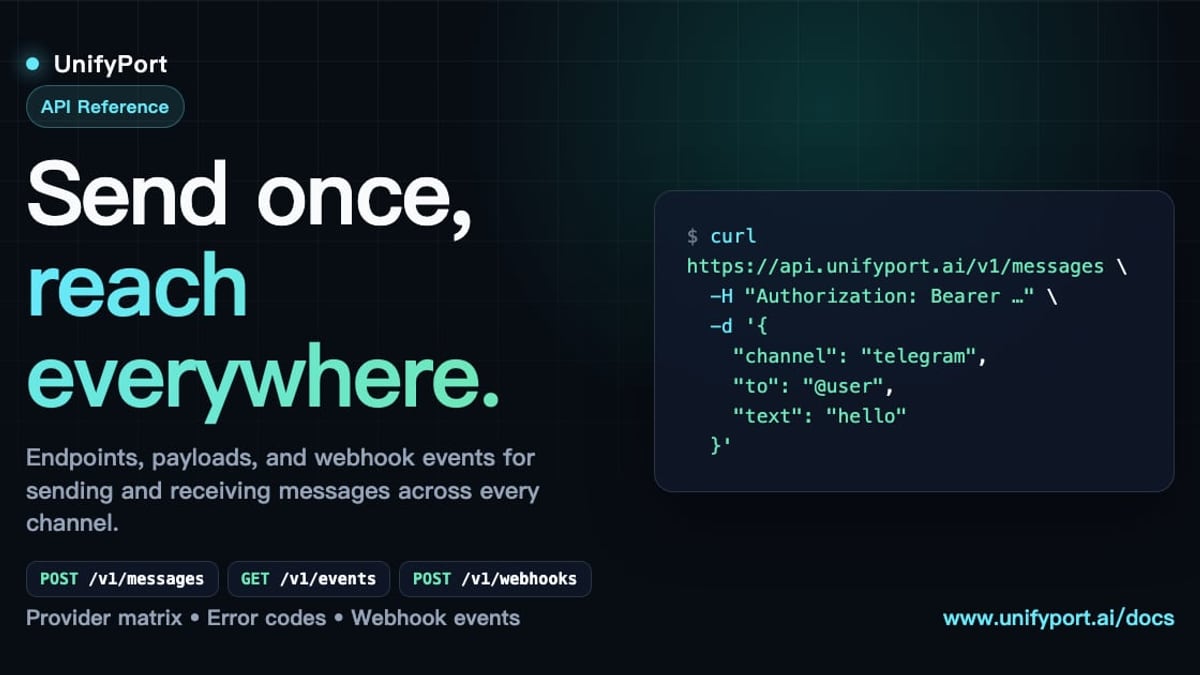
A unified multi-channel messaging API like UnifyPort solves this fragmentation. Instead of maintaining separate integrations for WhatsApp, Telegram, LINE, X (Twitter), Zalo, and TikTok, developers interact with a single REST API and a standardized webhook event stream. UnifyPort normalizes all provider events—delivery receipts, read statuses, connection health—into one consistent JSON shape. It also abstracts away the heavy lifting: built‑in rate limiting, automatic retries, idempotency keys, and failure isolation keep your messaging flows reliable even when an individual provider has an outage. Virtual account management (creation, QR authentication, runtime monitoring, teardown) is fully handled through the API, with fine‑grained status tracking.
This approach means developers can offer encrypted customer conversations across multiple channels without multiplying their infrastructure complexity. For a deeper comparison of platforms and how unified APIs like UnifyPort fit into your stack, see our business messaging guide.
UnifyPort helps businesses evaluate multi-channel messaging strategies, including how to layer encrypted messaging into existing CRM, notification, and AI agent workflows.
Related reading
- IMAP API Solution: Simplify Email Integration with a RESTful Interface - Discover how an IMAP API solution turns raw IMAP protocol into a modern REST API. Learn benefits, features, and how to choose the right integration for your app.
- Women's Linen Pants: Style, Fit & Care Guide - Discover how to style linen pants for women, from wide-leg to cropped fits. Find outfit ideas, practical care tips, and smart shopping advice for summer chic.
- CM.com Pricing Breakdown: SMS Rates, Plans & Hidden Costs - Understand CM.com's pricing for SMS, conversational channels, and enterprise plans. We break down models, country rates, hidden costs, and transparent alternatives.
Sources and further reading
- 8 Best Secure Messaging Apps For Encrypted Chats In 2026 | CloudSEK - Signal is the best secure messaging app in 2026, with strong encryption and simple private chats. Explore top options for anonymity, teams, and offline use.
FAQ
What is encrypted messaging?
Encrypted messaging uses cryptographic techniques to scramble the content of a message so that only the intended recipient can read it. End-to-end encryption goes further by ensuring no intermediary server or service provider holds the keys needed to decrypt the data.
Which messaging app is the most secure?
For the combination of strong encryption, minimal data collection, and ease of use, Signal is widely considered the most secure mainstream messenger. Anonymity-focused users may prefer Session or SimpleX, while businesses often turn to Wire or Element.
Is Telegram fully end-to-end encrypted?
No. Telegram’s standard chats use server-client encryption, which means Telegram’s servers technically have access to message content. Only its Secret Chats feature provides end-to-end encryption, and those are device‑specific with limited sync capabilities.
Can businesses use encrypted messaging for customer communication?
Yes, many platforms support it. WhatsApp Business API messages are end-to-end encrypted, and Telegram’s Secret Chats can be used in bot interactions under certain conditions. Unified APIs make it practical to orchestrate encrypted customer conversations across multiple channels.
How does the Signal Protocol work?
The Signal Protocol combines the Double Ratchet mechanism for message-level key rotation with the X3DH (Extended Triple Diffie-Hellman) key agreement for initial key exchange. This provides forward secrecy—compromising one message’s key can’t decrypt others—and future secrecy, which protects against long‑term key compromise.
Conclusion
Encrypted messaging is no longer a niche luxury; it’s a baseline requirement for trust in digital communication. Individual users now have a range of well‑vetted apps suited to different privacy models, from the universal simplicity of Signal to the decentralization of Session and the enterprise controls of Wire. For businesses and developers, the challenge is scaling encrypted interactions across multiple channels without drowning in provider‑specific integrations. By combining a clear understanding of encryption fundamentals with the right multi‑channel abstraction layer, teams can deliver secure, reliable messaging experiences that protect users while keeping infrastructure maintainable.