
Zernio Review 2026: Agent Marketing API, Pricing & Limits
Evidence-based Zernio review: one API for social, ads, inbox, WhatsApp, SMS and calls, plus MCP. Pricing math, real limits, and who it fits.
Zernio Review 2026: Agent Marketing Infrastructure, Pricing and Real Limits
Zernio sells itself as marketing infrastructure for products and agents: social publishing, ads, a unified inbox, WhatsApp, SMS, RCS, iMessage, calls and numbers behind one API key, with a hosted MCP server so agents can connect accounts and act on their own. This review checks that positioning against what the product actually does, what it costs, and where it stops being the right answer.
Two disclosures shape the evidence base. First, Zernio is the current name for a product previously known as Late; the API, team and /api/v1 endpoints carried over without breaking changes, so older reviews filed under the old name may still be accurate on functionality but stale on branding. Second, the most detailed independent critique available comes from a reviewer who runs a competing tool and says so openly, which is useful context when weighing its conclusions.
What Zernio actually is
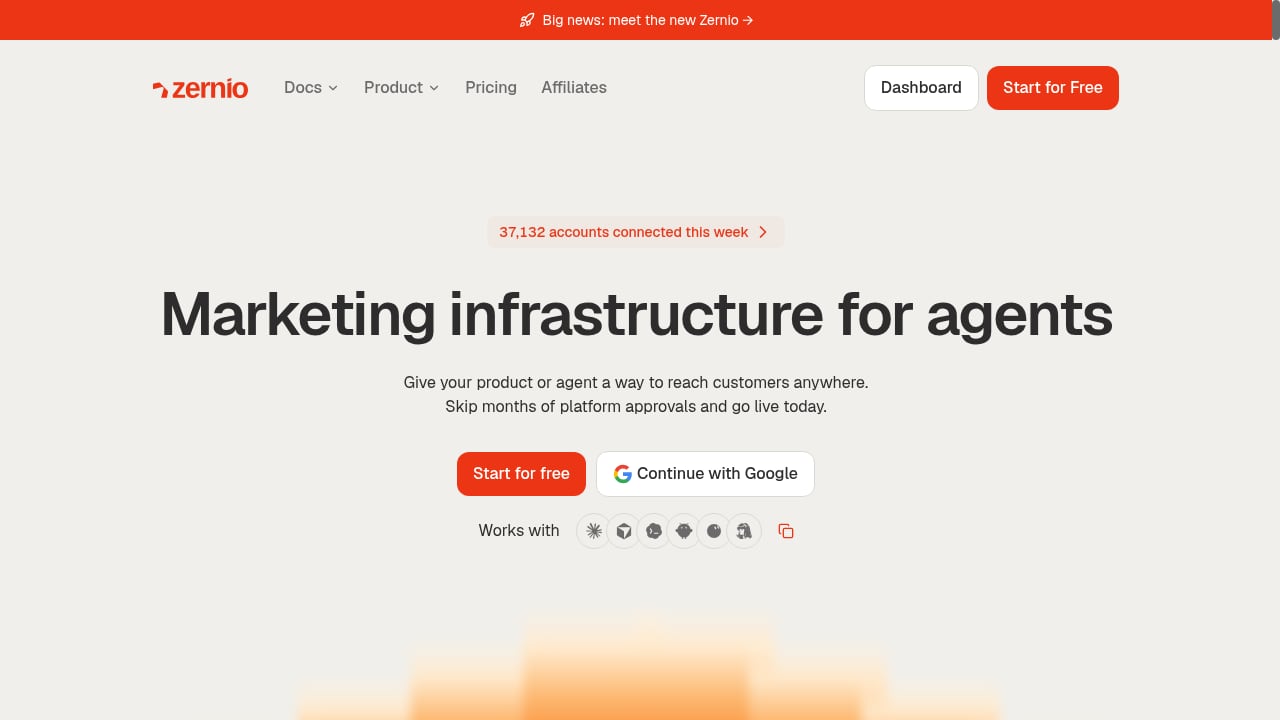
First viewport screenshot of Zernio - Marketing Infrastructure for Agents.
The important word in Zernio's positioning is infrastructure. It is a pipe, not a content studio. It does not write your posts or generate your images. You bring the content; Zernio handles the tedious part of talking to many platform APIs, each with its own authentication model, review process and quirks.
That is a real problem worth paying to avoid. Getting direct developer access to some social platforms is slow and unpredictable. A single integration layer that abstracts that away is genuinely valuable for small teams.
What it covers, based on the vendor's own description and third-party reporting:
- Social publishing and scheduling across a reported 16 social platforms, with analytics pulled back through the same API.
- Ads across a reported 7 ad networks.
- Messaging and voice: unified inbox, WhatsApp, SMS, RCS, iMessage, calls and phone numbers in 57 countries.
- A hosted MCP server so AI agents can connect accounts, run campaigns, send messages and place calls.
If you are comparing this category more broadly, our buyer's guide to omni-channel messaging platforms covers what separates true orchestration from a pile of channel-specific integrations.
Pricing signals: the strongest part of the offer
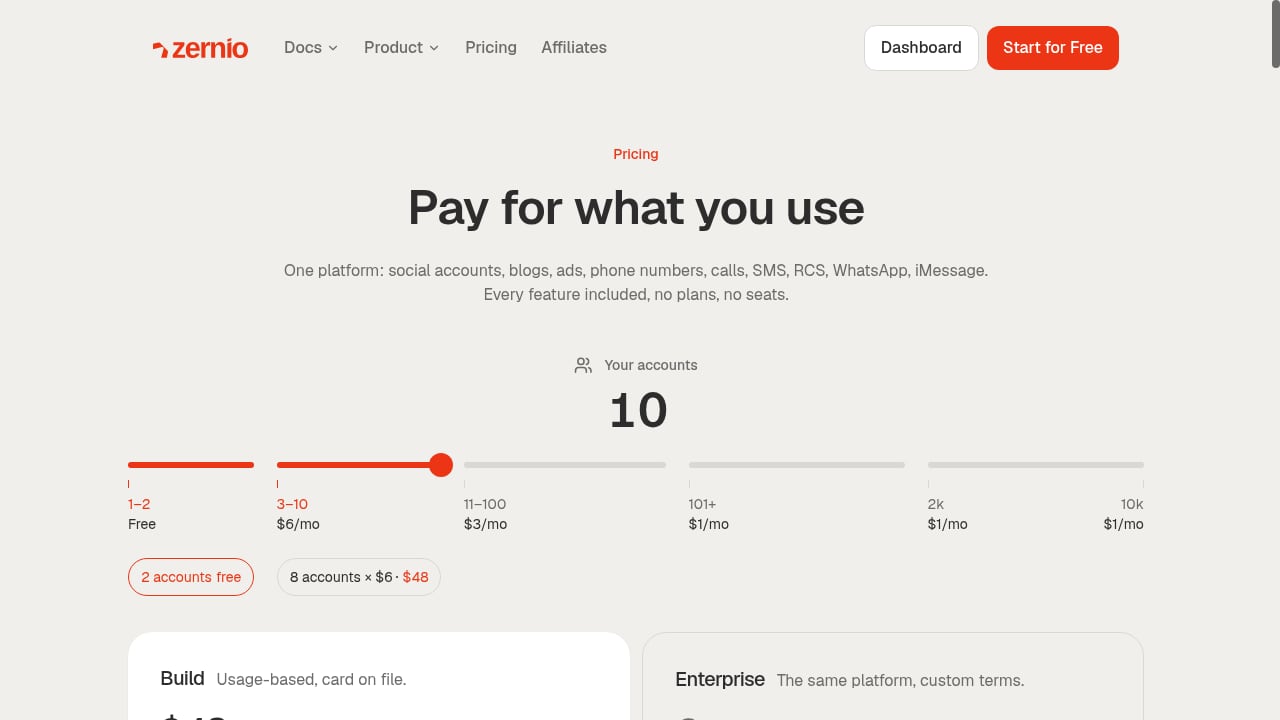
First viewport screenshot of Zernio Pricing - Pay Per Connected Social Account.
Zernio's pricing is unusually honest for this category, and it is worth understanding precisely because the shape of the curve decides whether it fits you.
- The first 2 accounts are free, no credit card required.
- Accounts 3 through 10 cost $6 per account per month.
- Accounts 11 through 100 cost $3 per account per month.
- Accounts past 101 cost $1 per account per month.
- There are no plans, no seats and no feature gating: every capability is available on every account.
That last point is rarer than it sounds. Many competitors put API access or analytics behind a higher tier. Zernio does not.
The crossover point that decides your bill
Graduated per-account pricing is elegant at small scale and expensive at large scale. That is arithmetic, not a flaw, but it changes the buying decision. Based on the published rates, the monthly cost works out roughly as follows:
| Connected accounts | Approximate Zernio monthly cost |
|---|---|
| 2 | $0 |
| 5 | $18 |
| 10 | $48 |
| 20 | $78 |
| 50 | $168 |
A practical decision rule falls out of this: below roughly 8 accounts, per-account pricing usually beats flat-rate competitors outright. Past about 10 accounts, a flat plan starts winning and the gap widens quickly. If you manage a large portfolio of brand accounts, model your own number before committing.
Setup and developer experience
The free tier is the easiest on-ramp in this category for a developer who wants to test a real publishing API without handing over a card. You can connect two accounts, hit the endpoints and see whether the integration model suits you before spending anything.
What reviewers consistently praise:
- Clean API design and a single integration surface instead of one per channel.
- Documentation quality, described as excellent by multiple users.
- The MCP server, which one reviewer integrated into a Claude-based coding workflow and described as reliable and requiring no extra configuration overhead.
- Workspace organization, which matters once you are managing more than a couple of accounts.
What reviewers ask for:
- More real-world examples in the docs. This came up directly as a friction point during onboarding, though not a blocker.
- Generation, not just delivery. If you want an agent to produce the copy and the image as well as publish them, Zernio will not do that. You still need a writing tool and an image tool, and you still stitch them together in the conversation.
That second point is a preference rather than a defect. If you already have generation solved, it is not a reason to avoid Zernio. But it is the specific gap that keeps some agent-first workflows from consolidating onto one vendor.
The rate limit claim, fact-checked
Zernio has run comparison marketing claiming "40x faster rate limits" than a competitor. An independent reviewer checked the arithmetic and it does not hold up.
The claim divides 60 requests per minute on Zernio's free tier by 1.5 posts per minute attributed to the competitor. Sixty divided by 1.5 is 40, so the arithmetic is internally consistent. The input is the problem: the competitor's own API documentation puts its posting endpoint at 30 requests per minute, confirmed in two places including the error reference. Sixty against thirty is 2x, not 40x.
The detail that makes this worth flagging is that the same Zernio page reportedly states elsewhere in its FAQ that the competitor caps at 30 posts per minute globally, regardless of plan. So the correct figure and the figure that produces the headline both appear on one page.
To be fair to Zernio on the underlying point: its rate limits do climb with tier, up to a reported 1,200 requests per minute at the top end. A paying customer genuinely gets more headroom than 2x. That is a legitimate advantage and could have been stated plainly.
The takeaway is not that Zernio is a bad tool. It is that vendor comparison pages deserve the same scrutiny as the docs, every time. Verify throughput numbers against the actual API reference before you architect around them.
Who Zernio is built for
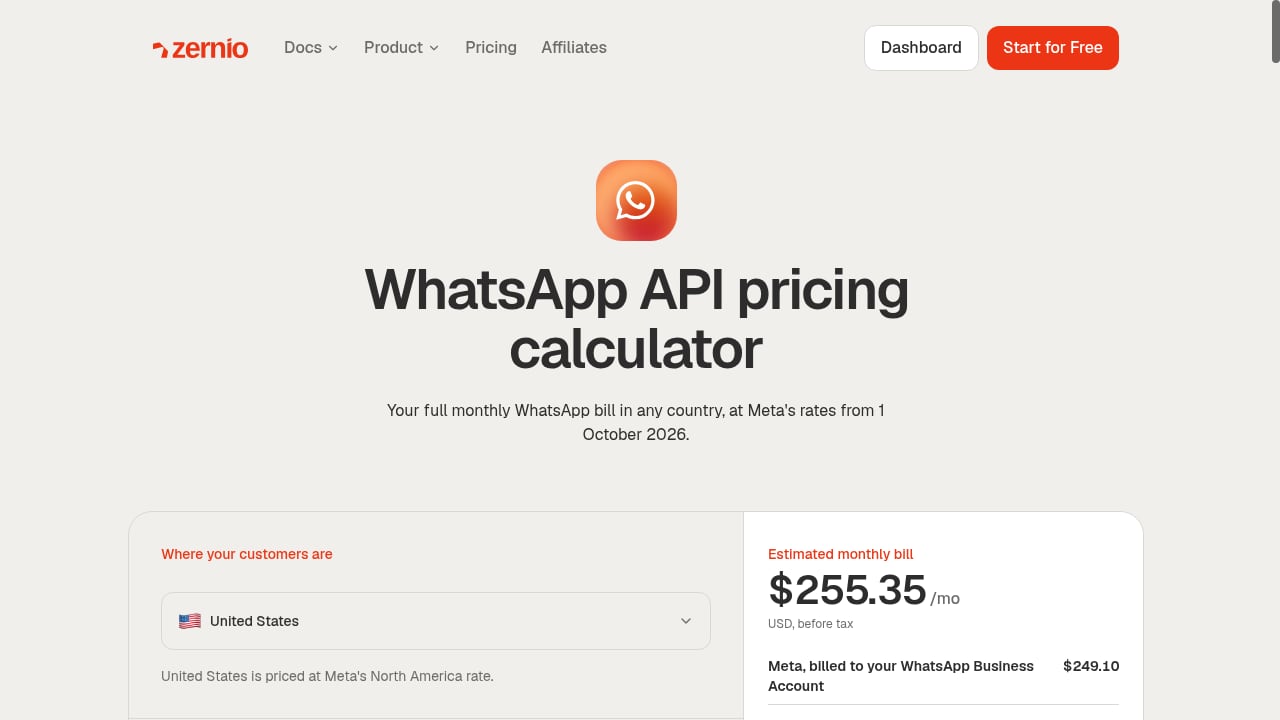
First viewport screenshot of WhatsApp API Pricing Calculator (October 2026 rates) | Zernio.
Good fit:
- Developers who want one API instead of fifteen platform integrations, and who value a free tier that lets them test properly.
- Small teams managing a handful of brand accounts where per-account pricing stays under the flat-rate crossover.
- Agent builders who need a delivery layer for social, messaging and calls, and who already have content generation handled elsewhere.
- Anyone who has tried to get direct platform API approval and wants to skip that process.
Poor fit:
- Teams managing dozens or hundreds of accounts, where flat-rate competitors win on cost.
- Workflows that expect the marketing API to also write copy and produce images.
- Buyers who need vendor-published performance claims to be verifiable at face value.
Decision criteria: how to choose between Zernio and alternatives
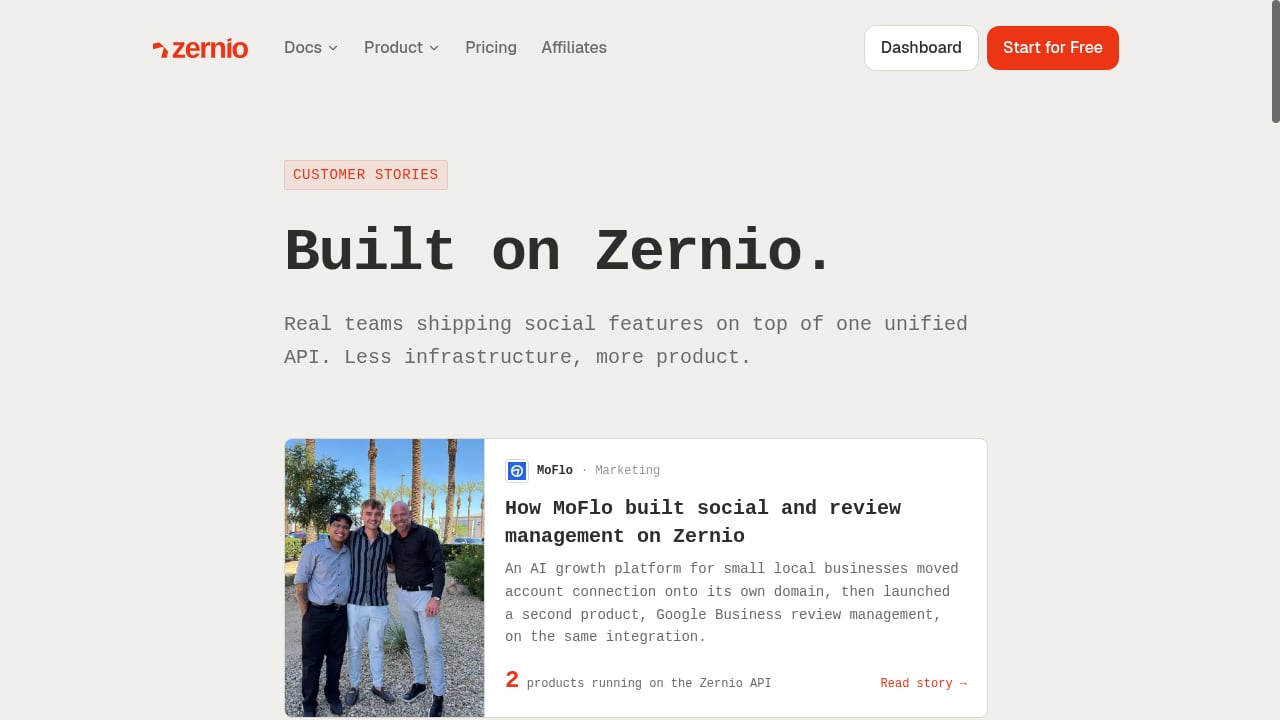
First viewport screenshot of Customers - Zernio.
Work through these in order:
- Count your accounts. Under 8, Zernio's pricing is hard to beat. Over 10, price a flat-rate alternative before you commit.
- Decide whether you need generation. If yes, budget for a separate writing and image tool, or pick a platform that bundles it.
- Check the channels you actually need. Zernio's breadth across social, ads, messaging and voice is the core selling point. If you only need two channels, you may be overbuying.
- Verify rate limits against the API reference, not the comparison page, if throughput is load-bearing for your architecture.
- Test on the free tier first. Two accounts at no cost is a genuine evaluation window, and there is no reason not to use it.
For a wider field of options, see our roundup of the top multi-channel messaging and email API platforms and the top AI customer experience and communications API platforms.
Related reading
- How to Use UnifyPort with Kommo CRM for Messenger Sales - Connect UnifyPort to Kommo CRM to unify WhatsApp, Telegram, LINE, TikTok, Zalo, and X messaging into one API and turn every chat into a trackable lead.
- How to Use UnifyPort with Telegram: Setup, Webhooks, Examples - Connect Telegram to UnifyPort: create an account, register a signed webhook, verify HMAC-SHA256 deliveries, and route message.received events into your app.
Sources and further reading
- Read Customer Service Reviews of zernio.com - Trustpilot - Customer service. Clients share positive opinions on customer service, frequently highlighting fast responses, helpful agents,... · User experience. Reviewers ...
- Zernio Reviews (2026) | Product Hunt - Read reviews and experiences from users of Zernio. Get comprehensive feedback about features, pros, cons, and alternatives.
- Zernio Review: A Fact Check of Its Biggest Marketing Claim - An independent Zernio review. Real pricing math, what the API does well, and why its headline 40x rate limit claim does not survive a fact check.
FAQ
Is Zernio the same product as Late?
Yes. Zernio is the rebranded name for Late. The API, team and /api/v1 endpoints carried over with no breaking changes, so integrations built under the old name continue to work.
Does Zernio write my social posts?
No. Zernio is delivery infrastructure. It publishes, schedules and pulls analytics. Content generation is your responsibility, or your agent's, using separate tools.
How much does Zernio cost at 20 accounts?
Using the published graduated rates, 20 connected accounts works out to roughly $78 per month: the first two are free, accounts 3 through 10 at $6 each, and accounts 11 through 20 at $3 each.
Is the free plan really free?
Yes. The first two accounts are free with no credit card required, and every capability is available on every account, so the free tier is a real test rather than a demo.
Does Zernio have an MCP server?
Yes, a hosted MCP server is included, letting agents connect accounts, run campaigns, send messages and place calls. One reviewer integrated it into a Claude-based workflow and reported it as reliable with minimal configuration.
Is the "40x faster rate limits" claim accurate?
An independent fact check found it is not. The claim divides 60 requests per minute by 1.5, but the competitor's documented posting limit is 30 requests per minute, making the real comparison 2x on free tiers. Zernio's paid tiers do scale considerably higher.
Conclusion
Zernio is a well-built delivery layer with an unusually fair pricing model and a free tier that lets you verify the product before paying. Its breadth across social, ads, inbox, WhatsApp, SMS and calls, combined with a hosted MCP server, makes it a credible choice for developers and small teams who want one integration instead of many.
The caveats are specific rather than fatal. It delivers content, it does not create it. Its per-account pricing stops being competitive somewhere past ten accounts. And its most aggressive marketing claim does not survive a check against the documentation, which is a reason to verify numbers yourself rather than distrust the product.
If you manage a small number of accounts and already have generation handled, start on the free tier and test the MCP path against your actual workflow. If you manage many accounts or need an all-in-one content and delivery platform, price the alternatives first.