
UnifyPort vs Vonage API Developer: Messaging API Comparison
Compare UnifyPort and Vonage API Developer for social messaging. See channel coverage, unified APIs, SDKs, and which platform fits your build.
UnifyPort vs Vonage API Developer: Which Messaging API Fits Your Build?
Choosing a messaging API often comes down to a simple question: do you need a broad communications platform, or a focused social-channel layer? UnifyPort and Vonage API Developer both give developers programmatic messaging, but they solve different problems. This comparison breaks down where each platform is strong, where it falls short, and how to decide based on your channels, team, and roadmap.
What Each Platform Actually Is
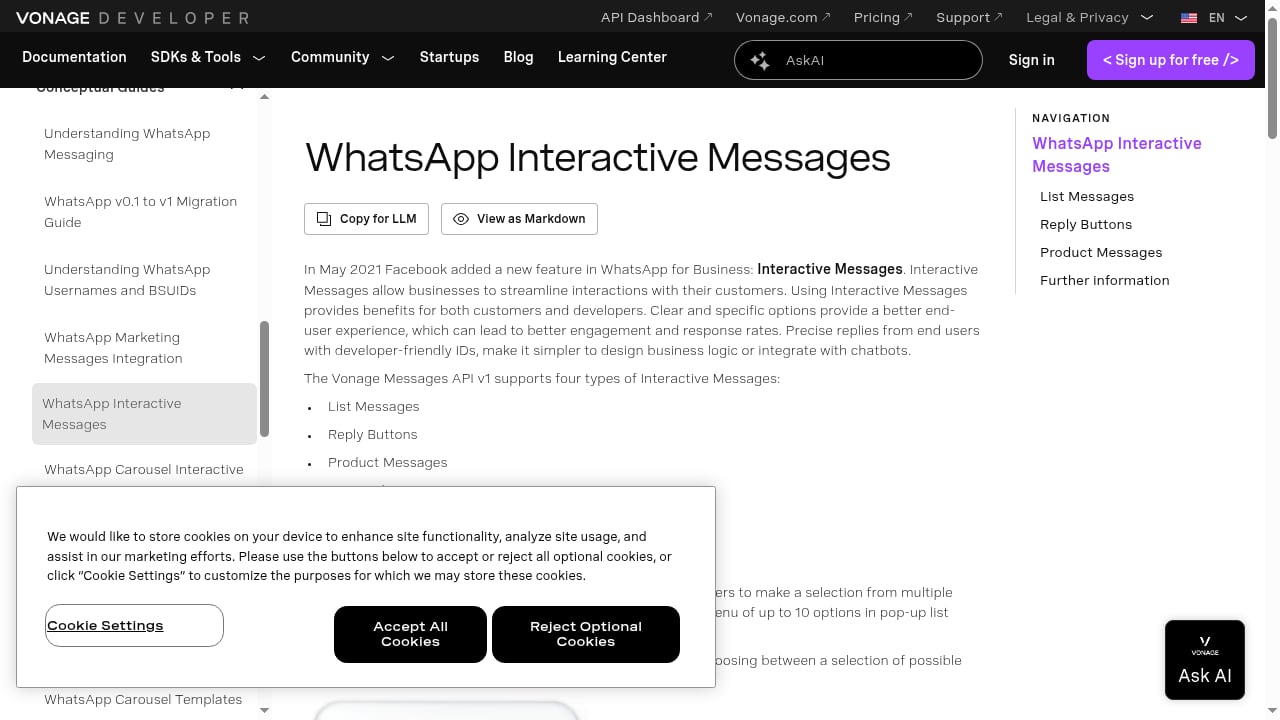
First viewport screenshot of developer.vonage.com.
UnifyPort is a unified messaging API platform for social channels. It connects WhatsApp, Telegram, LINE, TikTok, Zalo, and X (formerly Twitter) through one REST API and a standardized webhook event stream. You send with a single POST /v1/messages call and receive normalized events like message.received with a consistent schema covering provider, account, conversation, sender, and message data. Official SDKs exist for Node.js, PHP, Go, and Python.
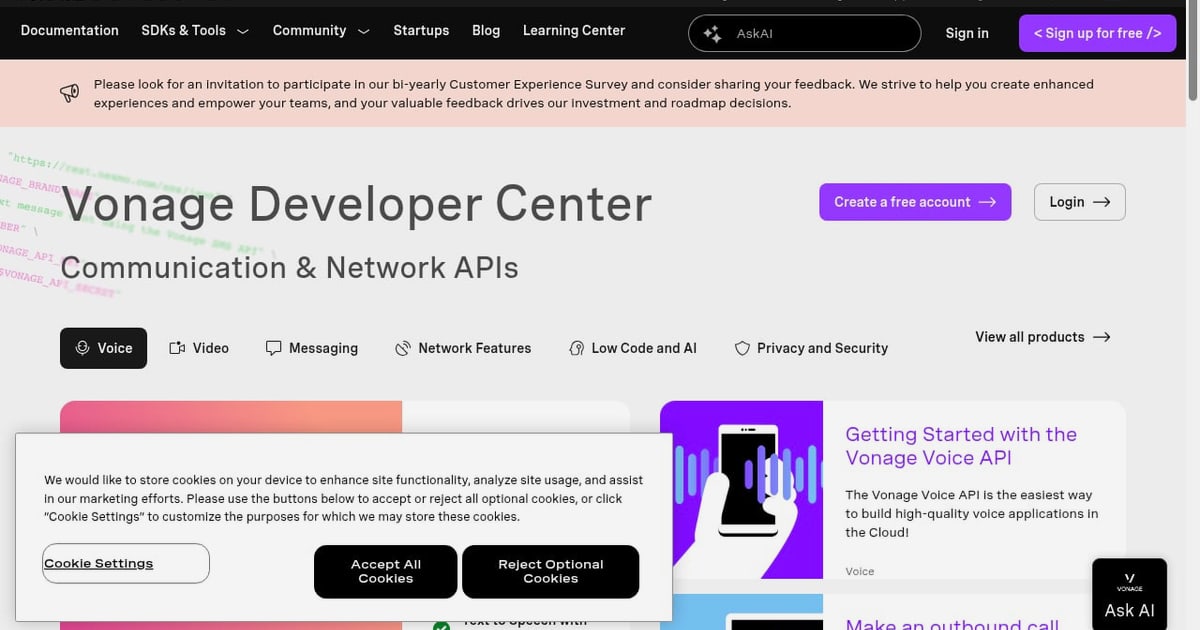
Vonage API Developer is the developer portal for Vonage's Communication & Network APIs. It is a full CPaaS suite: Voice with AI integration and speech-to-text/text-to-speech in 50+ languages, WebRTC video, multi-channel messaging across SMS, MMS, WhatsApp, Messenger, Viber, RCS, and Email, plus network features like SIM Swap and Device Swap. It also offers low-code and AI tooling, signed webhooks, and support for 10DLC and TFN registration.
In short: UnifyPort is a social-messaging specialist with a single normalized API. Vonage is a broad communications platform where messaging is one of many API families.
Channel Coverage: Social Depth vs Communications Breadth
First viewport screenshot of developer.vonage.com.
UnifyPort's social channel focus
UnifyPort supports two-way messaging on WhatsApp, Telegram, LINE, TikTok, Zalo, and X. That mix matters for teams building customer support, notifications, and engagement workflows in Asia-Pacific markets, where LINE, Zalo, and TikTok are prominent. The platform also handles channel-specific behaviors such as text and media captions, mentions, message pinning, revocation, emoji reactions, and account lifecycle management with QR-code, code, session, and Passkey authentication flows.
Vonage's multi-channel messaging
Vonage's Messages API covers SMS, MMS, RCS, WhatsApp, Messenger, and Viber, with automatic failover between channels. That is a strong fit when you need carrier-grade SMS as a backbone and social channels as an add-on. Vonage also provides every US sender type, including short codes, and a large carrier network with 1,600+ direct and tier-1 connections.
Where each falls short
Vonage does not list LINE, Zalo, TikTok, or X among its messaging channels. If those are core to your product, you would need separate integrations or another vendor. UnifyPort, by contrast, does not position itself as an SMS or voice platform, so teams that need PSTN voice, SMS fallback, or number verification should look at Vonage or combine platforms.
Developer Experience: One API vs a Suite of APIs
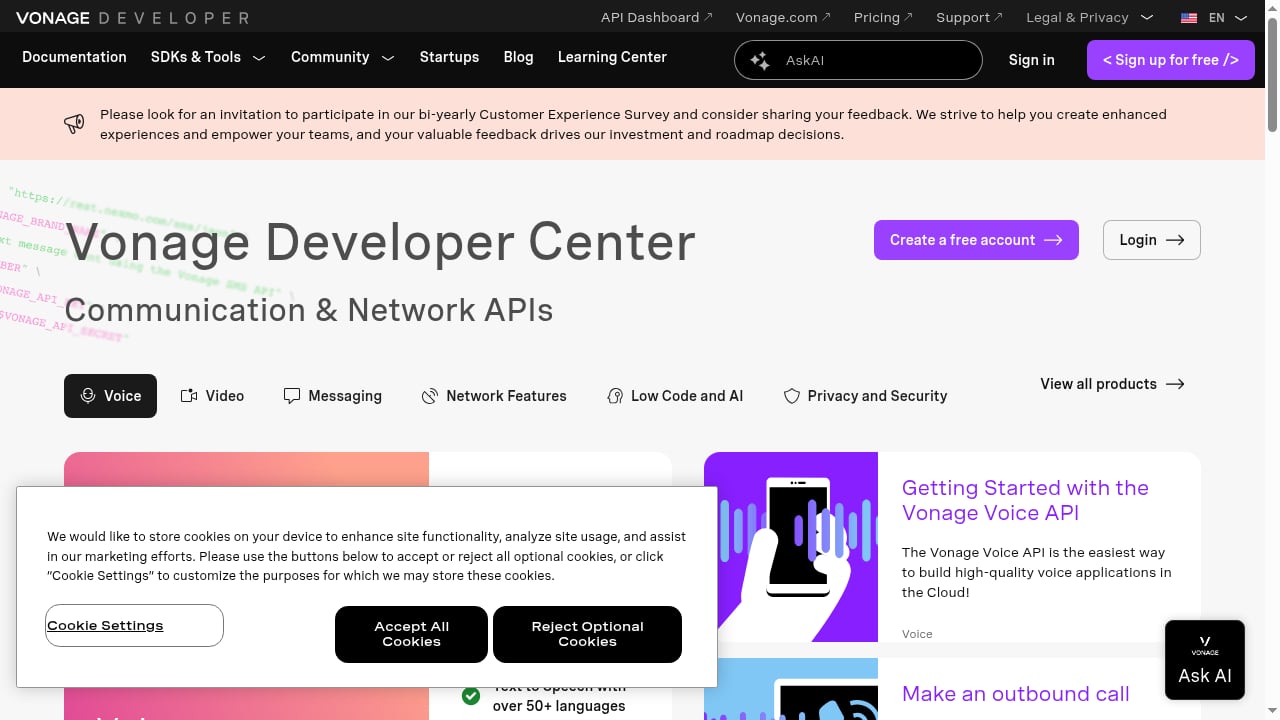
First viewport screenshot of developer.vonage.com.
UnifyPort's pitch is "One API. Every Channel." The practical benefit is that you avoid rebuilding a separate integration for each social network. One send endpoint, one webhook schema, and one set of SDKs reduce the surface area your team maintains. Events arrive in a consistent shape, which simplifies routing to support tools or workflow engines.
Vonage offers extensive documentation, code snippets, and SDKs across many languages, and its portal is built for developers exploring a broad API catalog. The trade-off is that each API family has its own concepts and setup. Messaging, Voice, Video, and Verify are separate products with separate configuration, even though they share a developer experience.
If your team wants to ship social messaging quickly with minimal per-channel code, UnifyPort's single-contract approach is simpler. If you need voice, video, verification, and SMS under one account, Vonage's breadth is the advantage.
Webhooks and Event Handling
UnifyPort normalizes inbound events. A message.received event carries provider, account, conversation, sender, and message data in a consistent schema, so your application logic does not need to branch per channel. This is especially useful when you connect messaging to a support desk or CRM. For a practical walkthrough, see how to use UnifyPort with Chatwoot.
Vonage supports signed webhooks for security and inbound messages to your application's webhook. Its messaging events are well documented, but the payloads differ by channel and product. Teams often need channel-specific parsing and error handling.
Both platforms support secure webhook patterns. The difference is normalization: UnifyPort standardizes the event shape across social channels, while Vonage exposes channel-specific structures within a broader CPaaS.
Authentication and Account Lifecycle
UnifyPort handles account lifecycle management for messaging accounts, including QR-code, code, session, and Passkey authentication flows. This matters for channels like WhatsApp and Telegram, where account connection is part of the product experience. You can read more about QR-based flows in QR auth for messaging accounts.
Vonage's developer portal focuses on API keys and application configuration rather than social account lifecycle. Its Verify API handles one-time codes and silent authentication for end users, which is a different problem. If your product needs to onboard and manage social messaging accounts, UnifyPort addresses that directly.
Pricing and Billing Model
UnifyPort describes transparent graduated monthly messaging-account costs in USD, with unified API access and free messaging accounts in every workspace. It also supports wallet-mode and quota-based account billing operations. The model is built around messaging accounts rather than per-message carrier fees.
Vonage uses pay-as-you-go per-message pricing with US carrier fees passed through, plus volume discounts through sales. There is no free tier; the comparison source notes €2 of test credit in demo mode up to 10 numbers, with a demo notice on every text. Pricing changes often, so verify current rates on each vendor's pricing page.
Which is cheaper depends on your volume and channel mix. Social-heavy workloads with many accounts may favor UnifyPort's account-based model. SMS-heavy workloads with carrier registration needs may favor Vonage's per-message model, though carrier fees add up.
Security, Compliance, and Registration
Vonage supports 10DLC and TFN registration, signed webhooks, and fraud protection through Fraud Defender. STOP and HELP handling is available through Opt-Out Assist, but it must be turned on, and consent records and quiet hours are left to the developer. Idempotency keys are not supported; a client reference is echoed in status updates.
UnifyPort's product context emphasizes normalized events and account lifecycle security, including Passkey authentication. It does not position itself as an SMS compliance platform, so teams with US SMS requirements should evaluate Vonage or a dedicated SMS provider.
When to Choose UnifyPort
- You need WhatsApp, Telegram, LINE, TikTok, Zalo, or X messaging in one API.
- You want a standardized webhook schema instead of per-channel parsing.
- You are building customer support, notifications, or engagement workflows for Asia-Pacific audiences.
- You want official SDKs for Node.js, PHP, Go, and Python with a single send endpoint.
- You need social account lifecycle management with QR, code, session, or Passkey flows.
When to Choose Vonage API Developer
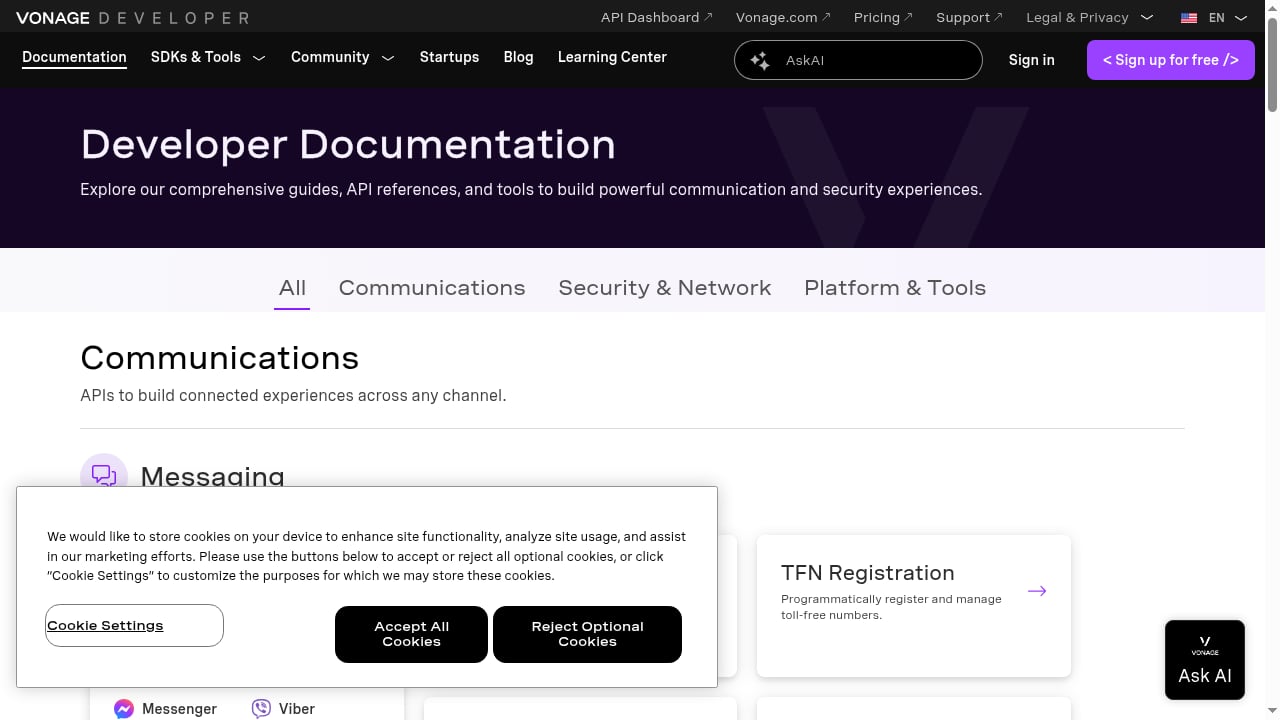
First viewport screenshot of developer.vonage.com.
- You need SMS, MMS, RCS, WhatsApp, Messenger, and Viber with failover.
- You need voice, video, verification, or network APIs alongside messaging.
- You require 10DLC, TFN, or short code registration in the US.
- You want a large carrier network and a long-established CPaaS provider.
- You need speech-to-text or text-to-speech in 50+ languages for voice workflows.
Can You Use Both?
Yes. Some teams use UnifyPort for social channels and Vonage for SMS, voice, and verification. This avoids forcing one platform to cover everything. The cost is two vendor relationships and two billing streams, but the architectural separation can be worth it if your channel mix spans both social and carrier messaging.
If you are evaluating a broader set of options, see our comparison of UnifyPort, Linq, and Sinch and the top AI customer experience and communications platforms for 2026.
Related reading
- bundle.social Review: Unified Social API for SaaS & AI - Evidence-based bundle.social review: 15-platform API, pricing, setup, strengths, limits, and who it fits for SaaS, agencies, and AI agents.
Sources and further reading
- Vonage SMS alternative - How Unitpost compares to Vonage for SMS — per-country pricing, sender registration, compliance, and where Vonage is still the better choice.
- Vonage API Developer - Get guides and code snippets, browse reference documentation, and more to develop connected applications with Vonage APIs and SDKs.
- Developer Center - Find comprehensive developer guides and documentation to help you start working with our products as quickly as possible, as well as support if you get stuck.
FAQ
Is UnifyPort a replacement for Vonage?
Not entirely. UnifyPort replaces Vonage for social messaging channels like WhatsApp, Telegram, LINE, TikTok, Zalo, and X. It does not replace Vonage's SMS, voice, video, or verification APIs. Many teams use both.
Does Vonage support LINE, Zalo, or TikTok?
Vonage's messaging documentation lists SMS, MMS, RCS, WhatsApp, Messenger, and Viber. LINE, Zalo, and TikTok are not listed among its messaging channels, so you would need another provider for those.
Which platform has better SDKs?
Both offer official SDKs. UnifyPort provides Node.js, PHP, Go, and Python SDKs around a single API. Vonage provides SDKs across many languages for its broader API catalog. The better choice depends on whether you want one API surface or many specialized APIs.
How does pricing compare?
UnifyPort uses graduated monthly messaging-account costs with free messaging accounts in every workspace. Vonage uses pay-as-you-go per-message pricing with carrier fees passed through and no free tier. Verify current pricing before deciding.
Can I migrate from Vonage to UnifyPort?
There is no one-click migration. You would connect social accounts through UnifyPort's authentication flows, update send calls to POST /v1/messages, and point webhooks to UnifyPort's normalized event stream. Keep Vonage running until the new integration is verified.
Conclusion
UnifyPort and Vonage API Developer are complementary more than competitive. UnifyPort wins when your product depends on social channels and you want one API, one webhook schema, and account lifecycle management. Vonage wins when you need a broad CPaaS with SMS, voice, video, and verification under one roof. Start with your channel list and compliance requirements; the right choice usually becomes obvious.