
UnifyPort vs SocialAPI.ai vs Syniverse CPaaS: Messaging API Guide
Compare UnifyPort, SocialAPI.ai, and Syniverse CPaaS for omnichannel messaging. Evaluate channels, webhooks, SDKs, pricing, and developer fit.
UnifyPort vs SocialAPI.ai vs Syniverse CPaaS: Which Omnichannel Messaging API Fits Your Stack?
Choosing an omnichannel messaging platform is less about the longest channel list and more about how well the integration fits your product, your team, and your reliability requirements. UnifyPort, SocialAPI.ai, and Syniverse CPaaS Omni-Channel Messaging all promise to simplify multi-channel communication, but they solve different problems for different buyers.
This comparison breaks down each platform by channel coverage, developer experience, webhook and event handling, SDK support, pricing signals, and ideal use cases. You will see where each option is strong and where trade-offs appear, so you can shortlist the right API for your next build.
Quick comparison: UnifyPort vs SocialAPI.ai vs Syniverse CPaaS
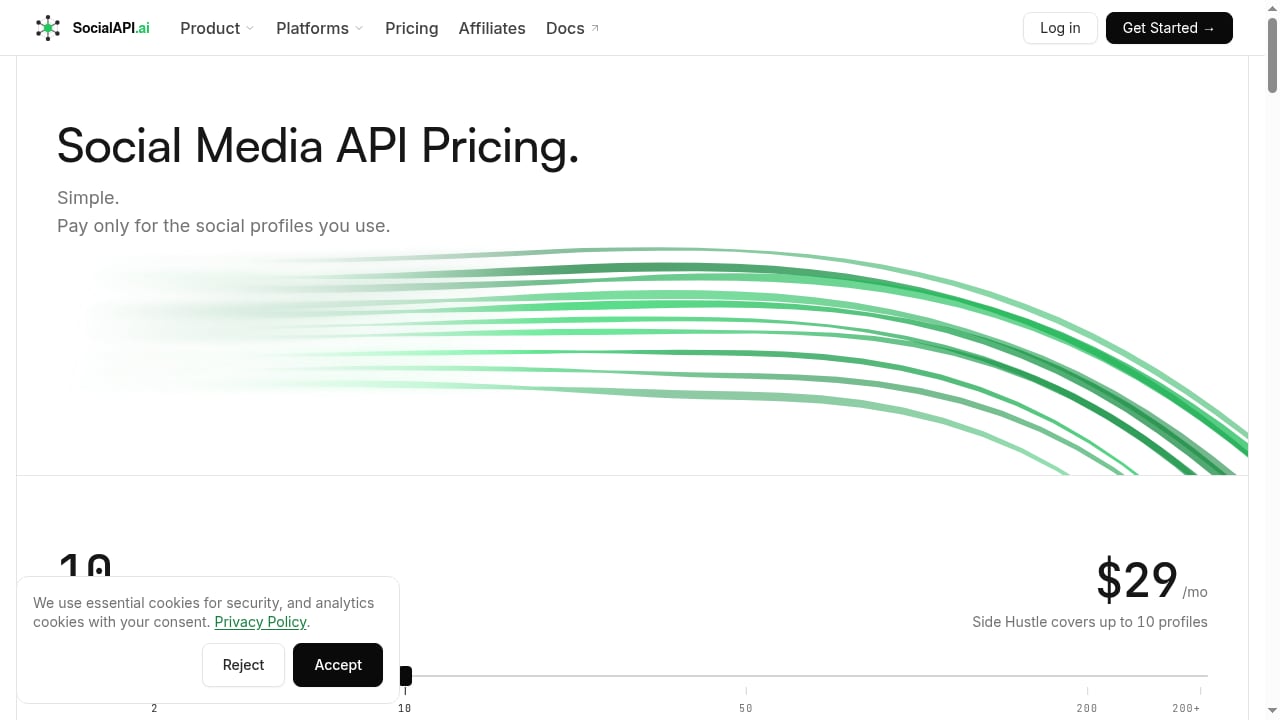
First viewport screenshot of Social Media API Pricing: Free Tier, Paid from $29/mo.
| Criterion | UnifyPort | SocialAPI.ai | Syniverse CPaaS Omni-Channel Messaging |
|---|---|---|---|
| Primary focus | Unified messaging API for chat and social messaging channels | Social media API and MCP server for publishing, engagement, and AI agents | Enterprise CPaaS for SMS, RCS, WhatsApp, voice, and omnichannel customer engagement |
| Channels highlighted | WhatsApp, Telegram, LINE, TikTok, Zalo, X (formerly Twitter) | 13 social platforms via one REST API and MCP server | SMS, MMS, RCS Business Messaging, WhatsApp Business API, Facebook Messenger, WeChat, push notifications, voice |
| Developer surface | One REST API, standard webhook event stream, official SDKs for Node.js, PHP, Go, and Python | Unified REST API, MCP server, native integrations for n8n, Node.js, Python, ChatGPT, and AI agents | REST APIs, channel-specific guides, sample requests, Communication Assistant XML scripts, Chatbot Connector Services |
| Event handling | Webhook control plane with signatures, subscriptions, retry behavior, and failure tracking | Unified inbox and engagement events for comments, DMs, and reviews | Webhooks and API callbacks per channel; chatbot connectors for external platforms |
| Pricing signal | Transparent graduated pricing per messaging account; free messaging accounts in every workspace | Free tier with 2 social profiles; paid plans from $29/month with unlimited posts and interactions | Enterprise and developer subscriptions; pricing typically quoted based on volume and channels |
| Best fit | Developers building multi-channel messaging features who want one API and stable events | Agencies, developers, and AI agent builders managing social publishing and engagement | Enterprises needing global carrier reach, compliance, and high-volume A2P messaging |
Search intent: what buyers actually need to know
People searching for "UnifyPort vs SocialAPI.ai vs Syniverse CPaaS Omni-Channel Messaging" are usually evaluating integration options before committing engineering time. They want to know which platform reduces maintenance, which channels are genuinely supported, how events are delivered, and whether pricing scales predictably.
The intent is commercial investigation with a strong technical filter. Readers are not looking for a generic CPaaS explainer. They want decision criteria they can apply to their own stack, often with a shortlist of two or three vendors.
Common article structures in this space
Most comparison articles follow a predictable pattern: a feature table, a section per vendor, a pricing summary, and a verdict. That structure is useful but often shallow. It rarely explains how webhook reliability, SDK coverage, or account lifecycle management affect day-to-day engineering work.
A more useful structure combines a quick comparison table with deeper sections on developer experience, event handling, channel fit, and pricing signals. It also helps to include decision guidance by team type and a short FAQ that addresses the questions buyers ask late in the evaluation.
Gaps and opportunities
Three gaps appear repeatedly in existing coverage. First, webhook and event handling is treated as a checkbox rather than a reliability concern. Second, channel lists are compared without explaining which channels matter for which regions or use cases. Third, pricing is summarized as a single number without noting what is metered.
This article addresses those gaps by focusing on the operational details that affect maintenance cost: how events are normalized, how retries and signatures are handled, and which SDKs reduce integration effort.
UnifyPort: one API and a standard event layer for chat messaging channels
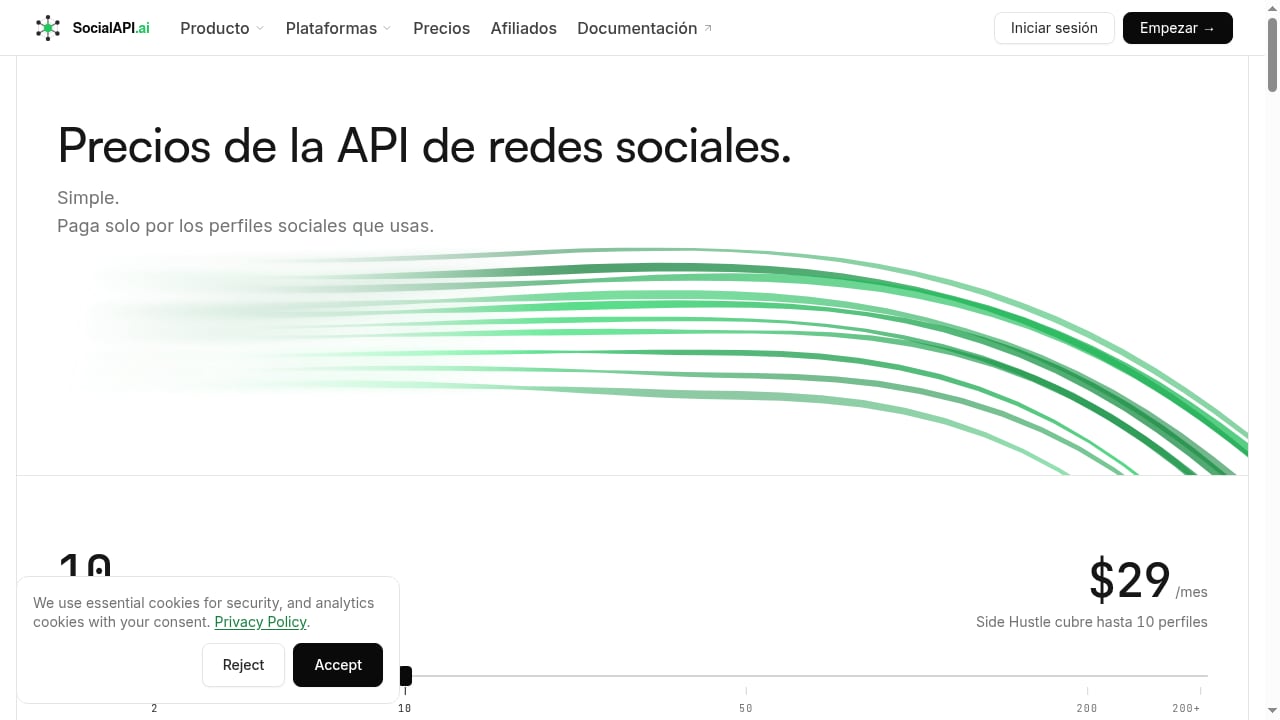
First viewport screenshot of Precios de la API de redes sociales: gratis o desde $29/mes.
UnifyPort is a unified messaging API platform built around a single REST API and one standard webhook event stream. It connects to WhatsApp, Telegram, LINE, TikTok, Zalo, and X (formerly Twitter), letting developers send and receive messages without building separate integrations for each provider.
The platform normalizes provider messages, status updates, and account events into a stable JSON shape. That matters when you are routing inbound messages into a CRM, support desk, or internal workflow. Instead of writing channel-specific parsers, you subscribe to standard events and handle them consistently.
UnifyPort also includes a webhook control plane for managing signatures, subscriptions, retry behavior, and failure tracking. Authentication uses API keys and HMAC-SHA256 signatures. A reliable delivery queue handles rate limits, retries, idempotency, and failure isolation. Official SDKs are available for Node.js, PHP, Go, and Python.
Account lifecycle is another supported area. UnifyPort handles authorization flows such as QR code, code, password, Passkey, and session import, which is useful for teams managing multiple messaging accounts across channels. Pricing is described as transparent graduated pricing per messaging account, with free messaging accounts available in every workspace.
UnifyPort is a strong fit when your product needs programmatic messaging across chat and social channels and you want to avoid maintaining a separate integration for each provider. If you are weighing it against broader CPaaS suites, the UnifyPort vs Infobip comparison covers channel coverage, webhooks, SDKs, and developer fit in more detail.
SocialAPI.ai: a developer-first social media API and MCP server
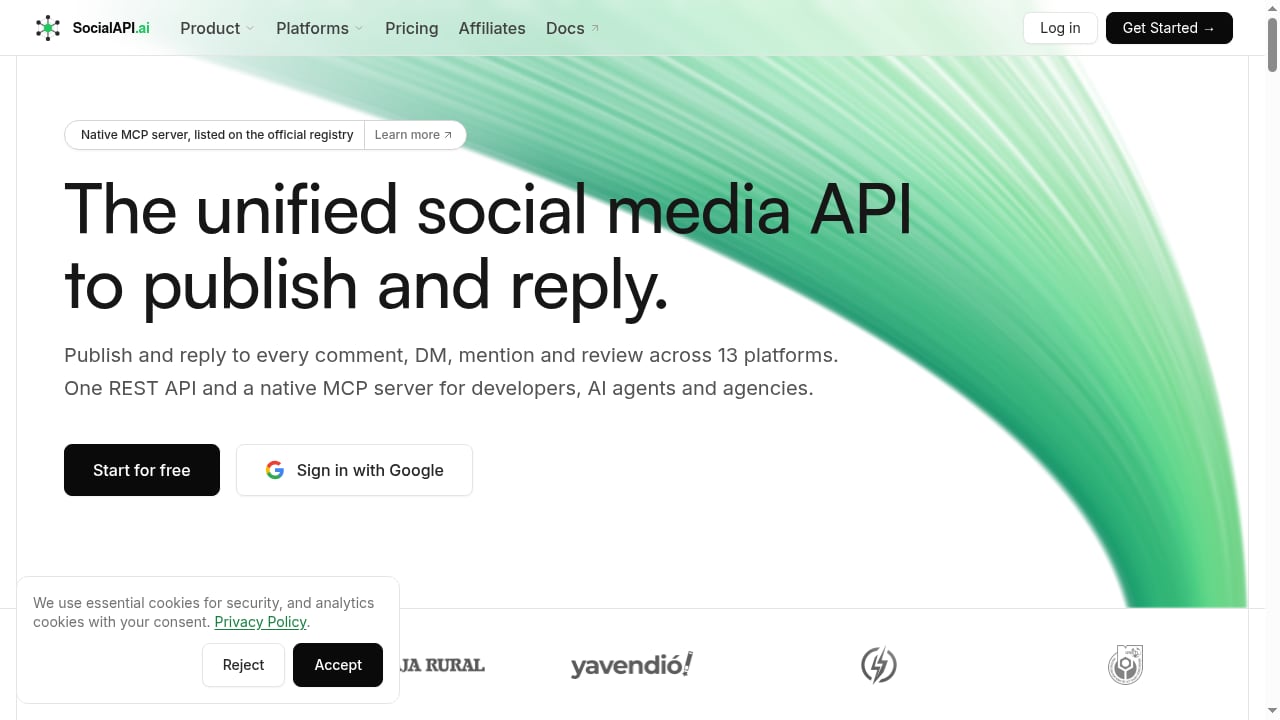
First viewport screenshot of Unified Social Media API for AI Agents & Developers | SocialAPI.ai.
SocialAPI.ai is a unified REST API and MCP server that lets developers, agencies, and AI agents read, publish, and engage across 13 social platforms from a single integration. It consolidates posting, scheduling, replying to comments and DMs, and managing reviews into one API, removing the need for per-platform OAuth setups and separate SDKs.
The platform supports content publishing across photos, videos, carousels, stories, and reels. It also provides unified inbox functionality and review management. Native integrations are available for n8n, Node.js, Python, ChatGPT, and AI agents via MCP.
Pricing is straightforward: a free tier with 2 social profiles and no credit card, and paid plans starting at $29/month that include unlimited posts and interactions. The stated value propositions are flat pricing per social profile, reads always free, and the ability to build custom social media dashboards, automation workflows, and AI-driven engagement tools.
SocialAPI.ai is a credible choice for agencies and AI agent builders who need social publishing and engagement rather than transactional messaging. Its MCP-native design is a genuine differentiator for teams building agent workflows. The trade-off is that its channel focus is social media management, not the chat and messaging channels that UnifyPort specializes in.
Syniverse CPaaS Omni-Channel Messaging: enterprise reach and carrier-grade infrastructure
Syniverse CPaaS Omni-Channel Messaging is a cloud-based communications platform for businesses, individual developers, and enterprise customers. It supports SMS, MMS, RCS Business Messaging, WhatsApp Business API, Facebook Messenger, WeChat, push notifications, and voice calling through REST APIs.
The platform provides a unified API endpoint for all channels, along with comprehensive user guides and sample requests for each channel. Its Communication Assistant lets enterprises define application behavior using XML scripts for use cases such as voice-based passcode verification and multi-factor authentication. Chatbot Connector Services connect external chatbot platforms, such as Microsoft Azure Direct Line, to Syniverse messaging channels.
Syniverse positions the platform for omnichannel customer engagement with global reach, including Voice API coverage in over 200 countries and WhatsApp access to roughly 2 billion users in more than 180 countries. It integrates with CRM, customer care tools, and POS systems. Prerequisites include a Syniverse Developer Community account, a subscription to the Voice & Messaging Service offering, and application credentials.
Syniverse is a strong fit for enterprises that need carrier relationships, compliance, and high-volume application-to-person messaging. Its direct carrier connections and decades of experience are meaningful advantages for regulated industries and global brands. The trade-off is that the platform is oriented toward enterprise procurement and voice-plus-messaging use cases, which can be heavier than a focused messaging API for smaller product teams.
Developer experience and SDK coverage
UnifyPort offers official SDKs for Node.js, PHP, Go, and Python, which covers most common backend stacks. The single API surface and standard event stream reduce the amount of channel-specific code your team maintains.
SocialAPI.ai provides native integrations for n8n, Node.js, Python, ChatGPT, and AI agents via MCP. Its MCP server is particularly relevant for teams building AI-driven workflows, where an agent needs to read and publish social content through a standardized interface.
Syniverse provides REST APIs with channel-specific guides and sample requests. Its Communication Assistant and Chatbot Connector Services add low-code and XML-scripted options for enterprises that want to define behavior without building everything from scratch.
If your priority is a small, stable set of SDKs for chat messaging channels, UnifyPort is the more focused option. If you are building AI agent workflows around social platforms, SocialAPI.ai has the edge. If you need enterprise integration support and voice-plus-messaging coverage, Syniverse is the more complete enterprise platform.
Webhooks, events, and reliability
Webhook handling is where many integrations fail in production. UnifyPort treats this as a first-class concern with a webhook control plane for signatures, subscriptions, retry behavior, and failure tracking. The delivery queue handles rate limits, retries, idempotency, and failure isolation, which helps keep provider turbulence inside the platform layer.
SocialAPI.ai focuses on unified inbox and engagement events for comments, DMs, and reviews. That is the right event model for social media management, but it is not the same as a normalized messaging event stream for chat channels.
Syniverse provides webhooks and API callbacks per channel, along with chatbot connectors for external platforms. Enterprises that need to route events into CRM or customer care tools will find the integration options broad, though the event model is more channel-specific.
For teams that want one stable JSON shape for inbound messages and account events, UnifyPort's standard event layer is a clear advantage. For social engagement events, SocialAPI.ai's unified inbox is the more natural fit. For enterprise routing into existing customer care systems, Syniverse's connector ecosystem is valuable.
Channel coverage: match the platform to your audience
Channel coverage should be evaluated against your actual audience, not a vendor's total count. UnifyPort covers WhatsApp, Telegram, LINE, TikTok, Zalo, and X (formerly Twitter). That mix is well suited to products serving audiences in Asia, Latin America, and Europe, where LINE, Zalo, and Telegram have strong adoption.
SocialAPI.ai covers 13 social platforms for publishing and engagement. It is the better fit when your priority is social content distribution, comment management, and AI-driven engagement rather than direct messaging.
Syniverse covers SMS, MMS, RCS Business Messaging, WhatsApp Business API, Facebook Messenger, WeChat, push notifications, and voice. That breadth is valuable for enterprises that need fallback routing, such as RCS to SMS, and for brands running high-volume notification and authentication programs.
If your roadmap includes LINE Mini App ecommerce or similar messaging-first experiences, the LINE Mini App ecommerce messaging API guide explains how to wire orders and service messages into a unified messaging layer.
Pricing signals and total cost of ownership
UnifyPort uses transparent graduated pricing per messaging account, with free messaging accounts available in every workspace. That model is easy to reason about when you are managing multiple accounts across channels.
SocialAPI.ai offers a free tier with 2 social profiles and no credit card, and paid plans starting at $29/month with unlimited posts and interactions. Flat pricing per social profile and free reads make costs predictable for agencies managing client accounts.
Syniverse pricing is typically quoted based on volume, channels, and enterprise requirements. That is standard for carrier-grade CPaaS, but it means buyers should expect a sales process rather than a self-serve checkout.
Total cost of ownership also includes engineering time. A platform that normalizes events and handles retries can reduce maintenance hours significantly, even if its per-message price is not the lowest. For a broader view of how CPaaS APIs compare on cost and SDK coverage, see the top 10 CPaaS APIs and SDKs for developers in 2026.
Decision guidance: which platform fits your team?
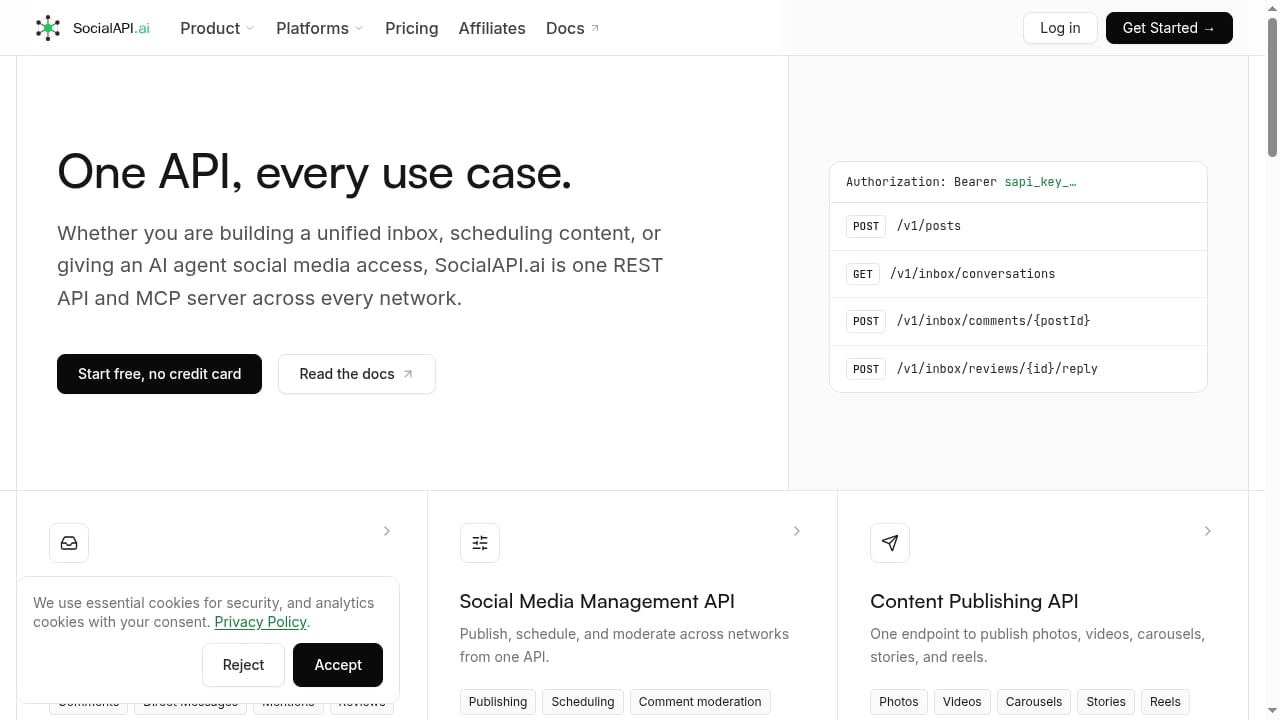
First viewport screenshot of Solutions | Unified Inbox, Publishing & AI Agent APIs | SocialAPI.ai.
Choose UnifyPort if you are a developer or engineering team building messaging features into a product and you need one API, one standard webhook event stream, and reliable delivery across WhatsApp, Telegram, LINE, TikTok, Zalo, and X. It is also a good fit for businesses managing multiple messaging accounts that want transparent per-account pricing.
Choose SocialAPI.ai if you are an agency, developer, or AI agent builder focused on social media publishing, scheduling, comment and DM replies, and review management. Its MCP server and flat per-profile pricing are strong advantages for social-first workflows.
Choose Syniverse CPaaS Omni-Channel Messaging if you are an enterprise that needs global carrier reach, SMS and RCS coverage, voice capabilities, compliance, and integration with CRM and customer care systems. Its Communication Assistant and Chatbot Connector Services add flexibility for complex enterprise use cases.
Many teams end up combining platforms rather than replacing one with another. A product might use UnifyPort for chat messaging channels and a separate social API for publishing. If you are connecting messaging to a CRM, the UnifyPort with Kommo integration guide walks through webhook mapping and setup.
Related reading
- UIB Review 2026: Omnichannel AI Platform, APIs & Pricing - Evidence-based UIB review for 2026: omnichannel AI agents, unified messaging APIs, setup, pricing signals, limitations, and who should buy the platform.
Sources and further reading
- Omnichannel Messaging | SMS, WhatsApp, RCS & 10DLC by Syniverse - Transform customer relationships with Syniverse Messaging Channels. Gain powerful insights & secure, scalable A2P communications.
- UnifyPort — One API. Every Channel. - Connect WhatsApp, Telegram, LINE, TikTok, Zalo, and X through one API for messages and events, without rebuilding the integration for every platform.
- What Enterprises Should Know About Choosing a CPaaS Provider - Unlock seamless enterprise communication with CPaaS. Syniverse offers reliable messaging and global connectivity for superior customer experiences.
FAQ
What is the main difference between UnifyPort, SocialAPI.ai, and Syniverse CPaaS?
UnifyPort focuses on a unified messaging API with a standard event layer for chat and social messaging channels. SocialAPI.ai focuses on social media publishing, engagement, and AI agent integration via MCP. Syniverse focuses on enterprise CPaaS with global carrier reach, SMS, RCS, WhatsApp, and voice.
Does UnifyPort support webhooks with signature verification?
Yes. UnifyPort includes a webhook control plane for managing signatures, subscriptions, retry behavior, and failure tracking. Authentication uses API keys and HMAC-SHA256 signatures.
Which platform is better for AI agent workflows?
SocialAPI.ai is the stronger fit for AI agent workflows because it offers an MCP server and native integrations for ChatGPT and AI agents. UnifyPort is better suited to product messaging features that need a stable event stream.
Can Syniverse handle high-volume SMS and RCS messaging?
Yes. Syniverse is built for enterprise-scale application-to-person messaging, with SMS, MMS, RCS Business Messaging, and 10DLC support, plus direct carrier connections and global reach.
Is UnifyPort suitable for small development teams?
Yes. UnifyPort offers free messaging accounts in every workspace and transparent graduated pricing per messaging account, along with SDKs for Node.js, PHP, Go, and Python. That makes it accessible for small teams that need multi-channel messaging without enterprise procurement.
Conclusion
UnifyPort, SocialAPI.ai, and Syniverse CPaaS Omni-Channel Messaging are credible platforms, but they are built for different jobs. UnifyPort is the focused choice for developers who want one API and one standard event stream across chat messaging channels. SocialAPI.ai is the stronger option for social publishing, engagement, and AI agent workflows. Syniverse is the enterprise-grade choice for global carrier reach, compliance, and voice-plus-messaging programs.
Start by mapping your required channels, event handling needs, and pricing model to your team's capacity. If you need a unified messaging API with a reliable delivery queue and webhook control plane, UnifyPort is worth a technical evaluation. If you are comparing broader enterprise options, the UnifyPort vs UIB comparison and the UnifyPort vs Infobip vs messaging API gateway guide provide additional decision criteria.