
Top 10 CPaaS APIs and SDKs for Developers in 2026
Ranked 2026 guide to the top 10 CPaaS APIs and SDKs. Compare channels, SDKs, webhooks, pricing signals, and developer fit.
Top 10 Communication Platform as a Service (CPaaS) APIs and SDKs for 2026
Choosing a CPaaS in 2026 is harder than it was five years ago. The market has expanded from basic SMS and voice APIs into omnichannel messaging, network APIs, and AI-assisted voice workflows. This guide ranks ten platforms that genuinely belong in the CPaaS APIs and SDKs category, using transparent criteria and evidence from vendor documentation and independent market research.
How We Evaluated
We assessed each platform against seven practical criteria:
- Channel breadth: SMS, MMS, voice, video, email, WhatsApp, RCS, and other messaging apps.
- SDK and API quality: language coverage, documentation, code samples, and migration support.
- Webhook and event handling: signature verification, retries, idempotency, and failure visibility.
- Developer tooling: sandboxes, low-code builders, AI helpers, and learning resources.
- Global reach: carrier connections, data centers, and regional compliance.
- Pricing transparency: usage-based rates, free tiers, and enterprise sales models.
- Ecosystem and support: community size, partner network, and enterprise deployment experience.
Evidence comes from vendor documentation, public product pages, and third-party market analysis. Where a vendor does not publish a detail, we say so rather than guess.
1. Twilio
Twilio remains the reference point for programmable communications. Its Super Network spans thousands of carrier connections across more than 180 countries, and its developer ecosystem is one of the largest in the industry.
Strengths: Broad channel coverage (SMS, voice, video, email, WhatsApp), strong SDKs for many languages, and deep documentation. Twilio Segment adds customer data capabilities that support contextual messaging. ConversationRelay lets teams build voice AI agents with their preferred LLM.
Considerations: Pricing is usage-based and varies by destination, channel, and volume. Teams focused only on verification may find the broader stack heavier than needed.
Best for: Product teams that want a mature, well-documented platform with a large community and global scale.
2. Infobip
Infobip positions itself as a full-stack communications platform for enterprises operating across many markets. It reports more than 9,700 connections, including over 800 direct mobile network operator connections, and more than 40 data centers worldwide.
Strengths: Over 30 communication channels, including SMS, RCS, voice, video, email, WhatsApp, Viber, and Messenger. It layers on journey orchestration, contact center tooling, and a customer data platform. Strong deployment experience in telecoms, financial services, and retail.
Considerations: The breadth is valuable for multi-market enterprises but may be more than a focused verification or single-channel project needs.
Best for: Enterprises that want one vendor for messaging, orchestration, and regional deployment support.
3. Vonage API Developer
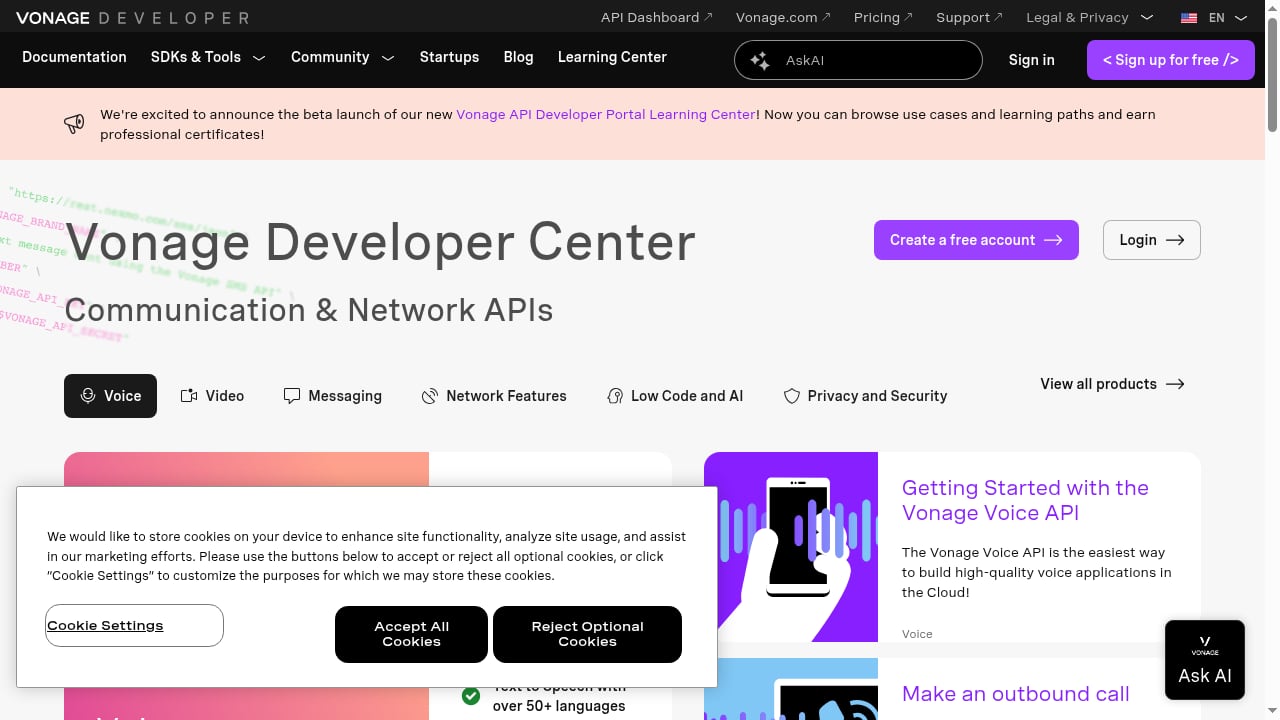
First viewport screenshot of Vonage API Developer.
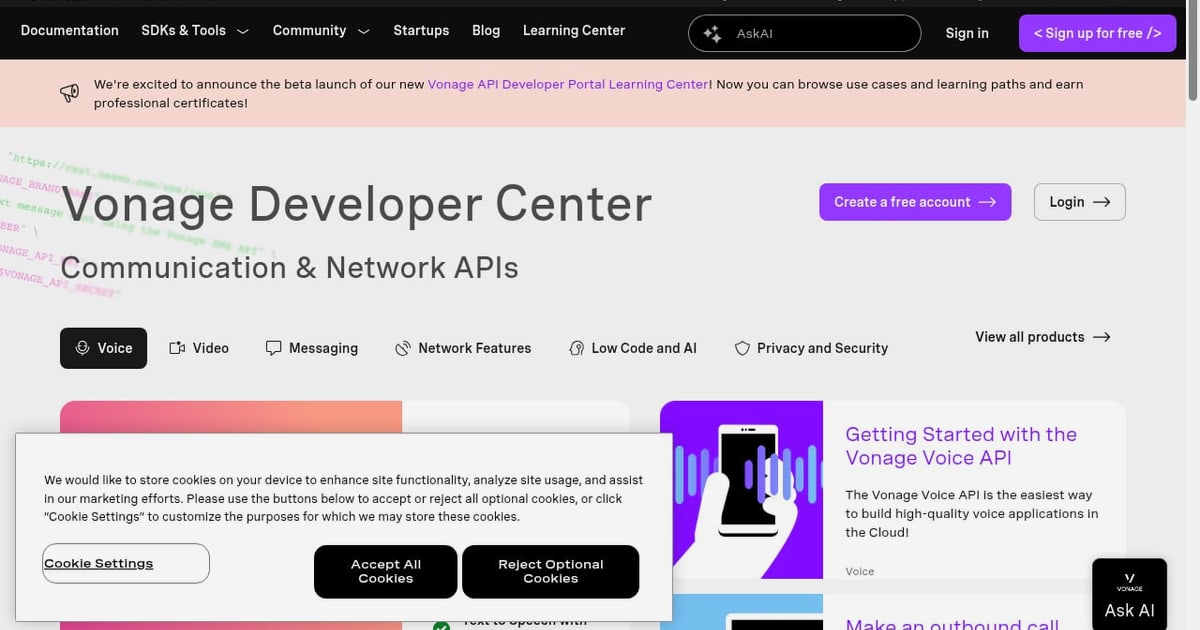
Vonage, now part of Ericsson, combines a developer portal with network-level capabilities that many competitors cannot easily replicate. The Vonage API Developer portal provides guides, code snippets, API references, and tools for voice, video, messaging, and network APIs.
Strengths: The Messages API covers SMS, MMS, WhatsApp, Messenger, Viber, RCS, and email. The Voice API supports IVRs, voice bots, smart notifications, speech-to-text, text-to-speech in over 50 languages, and WebSockets. The Video API enables embedded video with broadcast, SIP, and media processing. Network APIs add identity and fraud signals such as SIM swap detection. The Learning Center beta offers use cases, learning paths, and professional certificates, plus migration guides from competitors.
Considerations: The business model is not explicitly stated on the website, but likely involves usage-based API pricing and enterprise sales. Teams should confirm current rates for their target destinations.
Best for: Developers who want strong documentation plus access to Ericsson-backed network APIs.
4. Sinch
Sinch is an AI-powered cloud communications provider focused on messaging, email, and voice APIs. It supports SMS, WhatsApp, RCS, and email with built-in automation, personalization, and fraud and security features.
Strengths: Strong international messaging coverage and local presence in many markets. Enterprise integrations and automation tools help teams move from notifications to broader engagement workflows.
Considerations: Pricing is usage-based and varies by destination, channel, carrier fees, and volume. Evaluate effective cost for your specific traffic mix.
Best for: Teams that need international reach with enterprise-grade integrations.
5. Azure Communication Services
Azure Communication Services provides APIs and SDKs for voice, video, chat, text messaging, and telephony. It supports interoperability with public switched telephone networks and includes authentication and compliance features.
Strengths: Deep integration with the Azure ecosystem, including security, analytics, and deployment tooling. Suitable for organizations already standardized on Microsoft cloud services.
Considerations: The platform is strongest when paired with Azure infrastructure. Teams outside that ecosystem may find less flexibility.
Best for: Enterprises building communication features inside Azure-based applications.
6. AWS Communication Developer Services
First viewport screenshot of Developer Documentation.
AWS offers a suite of cloud-based tools for integrating voice, messaging, and video into applications. These include APIs and pre-built components for SMS, email, voice calls, and video conferencing.
Strengths: Integrates with AWS services for deployment, security, and analytics. Scalable and reliable for teams already using AWS.
Considerations: The developer experience is tied to AWS conventions, which may add learning overhead for teams new to the platform.
Best for: AWS-centric engineering teams that want communication APIs close to their existing infrastructure.
7. Bandwidth
Bandwidth differentiates through first-party network ownership. It operates its own network rather than aggregating third-party carriers, which can matter for voice quality and direct control.
Strengths: Direct network control, strong voice infrastructure, and predictable performance for high-volume voice use cases.
Considerations: Channel breadth is narrower than some omnichannel competitors. Teams needing many messaging apps may need additional providers.
Best for: Organizations that prioritize owning the full communications stack and need direct network control.
8. Telnyx
Telnyx is a vertically integrated communications platform that combines network ownership with AI capabilities. It offers APIs for messaging, voice, and video.
Strengths: Infrastructure ownership and a focus on developer control. Suitable for teams that want to manage the full stack rather than rely on aggregated carriers.
Considerations: Like Bandwidth, the channel mix is more focused than broad omnichannel platforms. Evaluate whether your roadmap needs many messaging apps.
Best for: Teams that prioritize infrastructure ownership and AI-enabled communications.
9. Exotel
Exotel provides a CPaaS solution with voice and messaging APIs, including voice and video calling, IVR, SMS, email, and push notifications. It operates under UL-VNO licensing for VoIP telephony services in India.
Strengths: Real-time analytics, workflow automation, and CRM integration. Features include click-to-call, messaging APIs (SMS, WhatsApp, RCS), voice APIs (WebRTC, in-app calling), voice streaming, IVR call routing, and call recording.
Considerations: Regional focus may be a strength for India-centric businesses but a limitation for global deployments.
Best for: Businesses with significant operations in India that need voice and messaging APIs with local compliance.
10. Airtel IQ
Airtel IQ is a cloud communications platform from Airtel that integrates voice, messaging, and video capabilities. It enables organizations to automate customer interactions across channels.
Strengths: Backed by a major telecom operator, with regional network advantages and enterprise support.
Considerations: Availability and feature depth may vary by region. Confirm coverage for your target markets.
Best for: Enterprises operating in regions where Airtel has strong network presence.
Comparison Table
First viewport screenshot of Developer Documentation.
| Platform | Best For | Core Strength | Consider If |
|---|---|---|---|
| Twilio | Customer engagement | Global scale and developer ecosystem | You want a mature, broad platform |
| Infobip | Global enterprise communications | Network scale plus journey orchestration | You operate across many markets |
| Vonage API Developer | Network APIs and developer docs | Ericsson-backed network access | Network-level identity signals matter |
| Sinch | International messaging | Local presence plus enterprise integrations | International reach is critical |
| Azure Communication Services | Azure-centric teams | Integration with Microsoft cloud | You are standardized on Azure |
| AWS Communication Developer Services | AWS-centric teams | Integration with AWS services | You are standardized on AWS |
| Bandwidth | Voice infrastructure | First-party owned network | You need direct network control |
| Telnyx | Infrastructure ownership | Vertically integrated network plus AI | You prioritize owning the full stack |
| Exotel | India-focused operations | Voice and messaging APIs with local compliance | You need UL-VNO licensed telephony in India |
| Airtel IQ | Regional enterprise communications | Telecom-backed network and support | You operate where Airtel has strong presence |
How to Choose
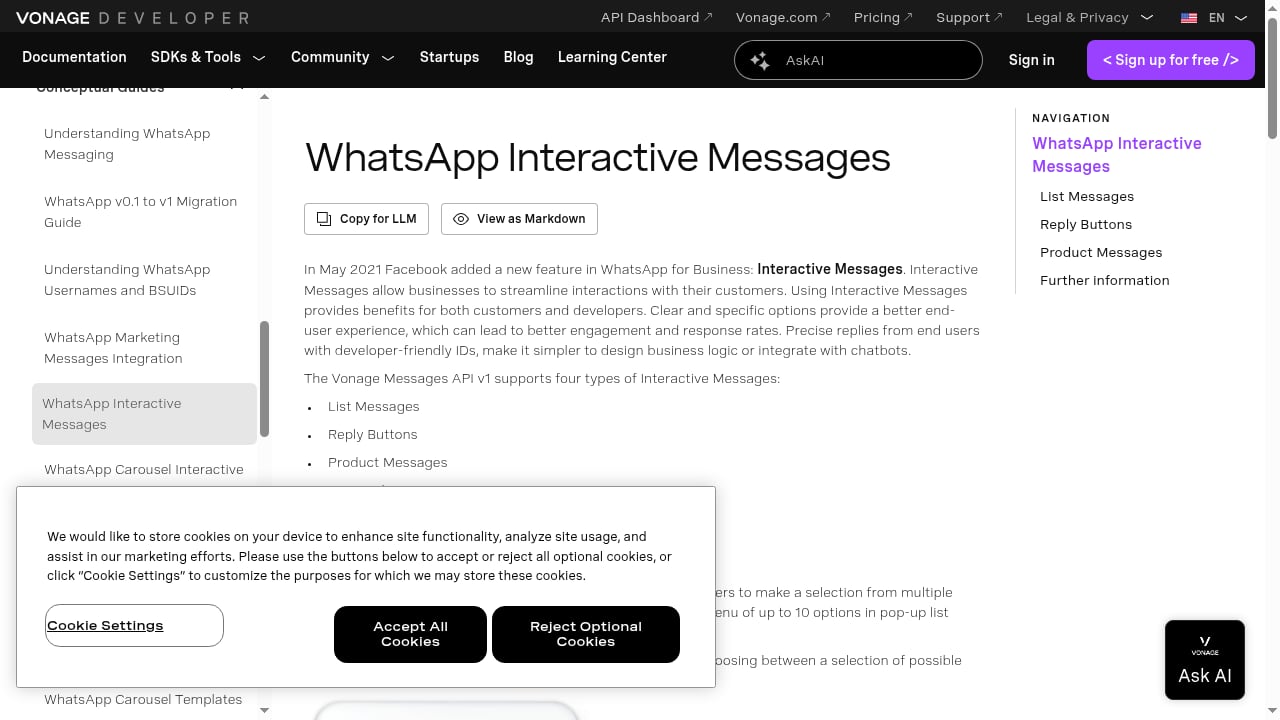
First viewport screenshot of WhatsApp Interactive Messages API Guide | Messages API.
Start with the channels you actually need. If you need SMS, voice, and WhatsApp, most platforms here can help. If you need many messaging apps plus a unified event stream, consider whether a CPaaS alone is enough or whether a unified messaging API layer is a better fit.
Next, evaluate developer experience. Look at SDK languages, documentation quality, sandbox access, and migration guides. Vonage, Twilio, and Infobip invest heavily here, but the best choice depends on your team's stack.
Then, check pricing transparency. Usage-based pricing varies by destination, channel, and volume. Request quotes for your specific traffic mix rather than relying on published base rates.
Finally, consider reliability and compliance. Network ownership, data center locations, and regional licensing can affect performance and legality. For teams that need to connect multiple messaging channels through one API, a unified messaging platform like UnifyPort can complement a CPaaS by normalizing provider events and managing webhooks. You can read more about that approach in our UnifyPort vs Infobip vs Messaging API Gateway guide.
For a broader view of developer platforms beyond CPaaS, see our Top 10 CPaaS & UC Developer Platforms 2026.
Related reading
- How to Use UnifyPort with Kommo: Unified Messaging + CRM - Connect UnifyPort's unified messaging API to Kommo CRM. Learn the workflow, setup steps, webhook mapping, and the problems this pairing solves.
- UnifyPort vs UIB: Unified Messaging API or Omnichannel AI? - UnifyPort vs UIB compared: unified messaging API and webhook control plane versus an AI-powered omnichannel platform. Channels, SDKs, pricing, and fit.
- Sendbird Review 2026: AI CX, APIs, Pricing & Limits - Evidence-based Sendbird review for 2026: chat, voice/video and AI concierge strengths, setup, pricing signals, limitations and who should buy.
FAQ
What is CPaaS?
CPaaS, or Communications Platform as a Service, is a cloud-based platform that lets businesses embed communication capabilities such as voice, SMS, email, messaging apps, and video into applications via APIs. Gartner defines it as delivering omnichannel, programmable experiences for digital customer engagement.
Which CPaaS has the best SDKs?
Twilio, Vonage, and Infobip are widely recognized for strong SDKs and documentation. The best choice depends on your preferred programming languages and whether you need network APIs or omnichannel orchestration.
How much does CPaaS cost?
Most CPaaS providers use usage-based pricing that varies by destination, channel, carrier fees, and volume. Some offer free tiers or trial credits. Enterprise plans are typically negotiated. Always request a quote for your specific traffic.
Can I use multiple CPaaS providers together?
Yes. Some teams route traffic across multiple providers for cost, quality, or geographic reasons. A unified messaging API layer can help normalize events and manage webhooks across providers. See our Automation Rules for Messaging APIs guide for related patterns.
What are network APIs?
Network APIs expose telecom network capabilities such as SIM swap detection, location, and identity verification through standards like CAMARA. Vonage, Twilio, and Proximus Global are investing in this area.
Conclusion
The CPaaS market in 2026 offers more choice than ever, but also more complexity. Twilio and Infobip lead in scale and breadth. Vonage stands out for network APIs and developer documentation. Sinch, Azure, AWS, Bandwidth, Telnyx, Exotel, and Airtel IQ each serve specific needs. Evaluate channels, SDKs, webhooks, pricing, and compliance against your own roadmap. If you need to unify multiple messaging channels behind one API, consider how a unified messaging layer like UnifyPort fits alongside your CPaaS choice.