
Top 10 CPaaS & UC Developer Platforms 2026
Ranked 2026 guide to the 10 best CPaaS and unified communications developer platforms, with evaluation criteria, evidence, pricing signals, and buying advice.
Top 10 Communications Platform as a Service (CPaaS) and Unified Communications Developer Platforms 2026
Choosing a communications platform in 2026 is harder than it used to be. The old split was simple: raw APIs on one side, packaged contact-center suites on the other. Now every serious vendor claims AI, omnichannel messaging, and a developer platform, and the labels overlap. This review ranks ten products that genuinely belong to the CPaaS and unified communications developer platform category, explains how they were scored, and shows where each one fits.
What counts as a CPaaS or UC developer platform in 2026
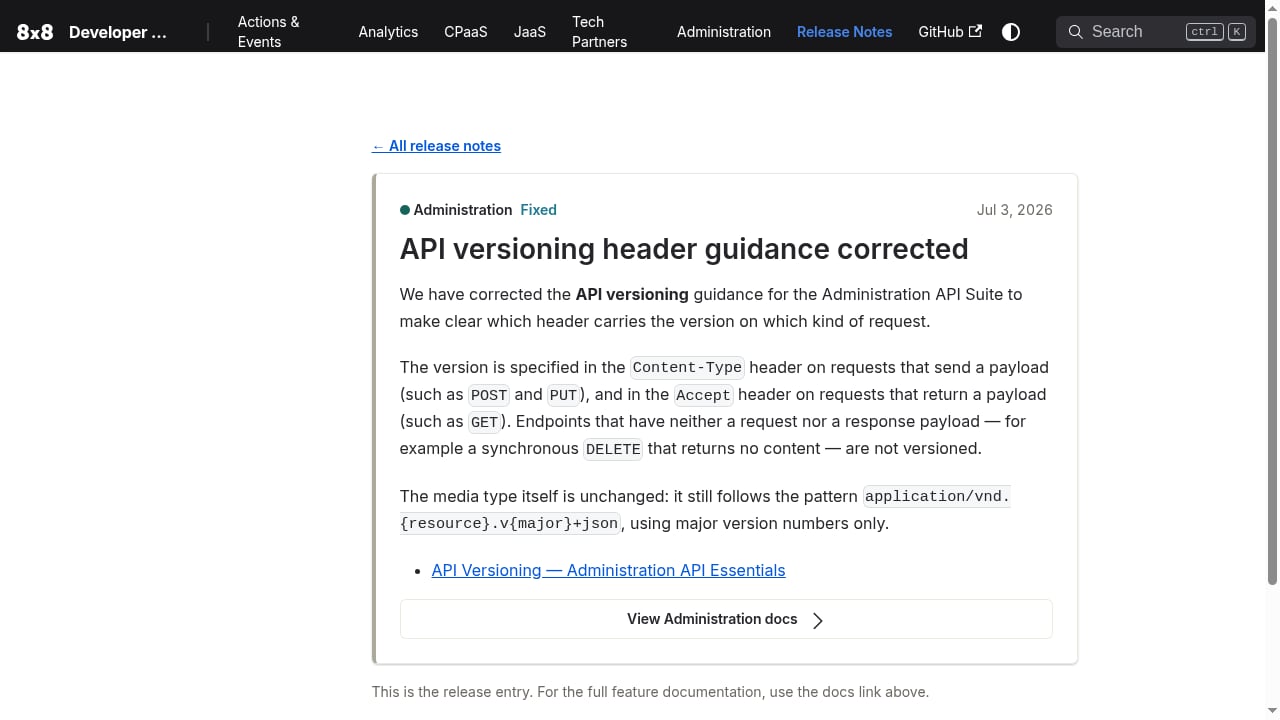
First viewport screenshot of API versioning header guidance corrected | 8x8 Developer Portal.
A communications platform as a service gives you programmable access to voice, SMS, messaging apps, email, and video through APIs, SDKs, and webhooks, without owning carrier infrastructure. A unified communications developer platform extends that idea into UC and contact-center territory: administration APIs, analytics, meeting embeds, and session-level controls on top of the same programmable foundation.
Products were included only if they expose developer-facing APIs or SDKs for embedding communications into applications. Pure end-user collaboration suites without a developer surface were excluded, as were single-channel point tools.
Evaluation criteria
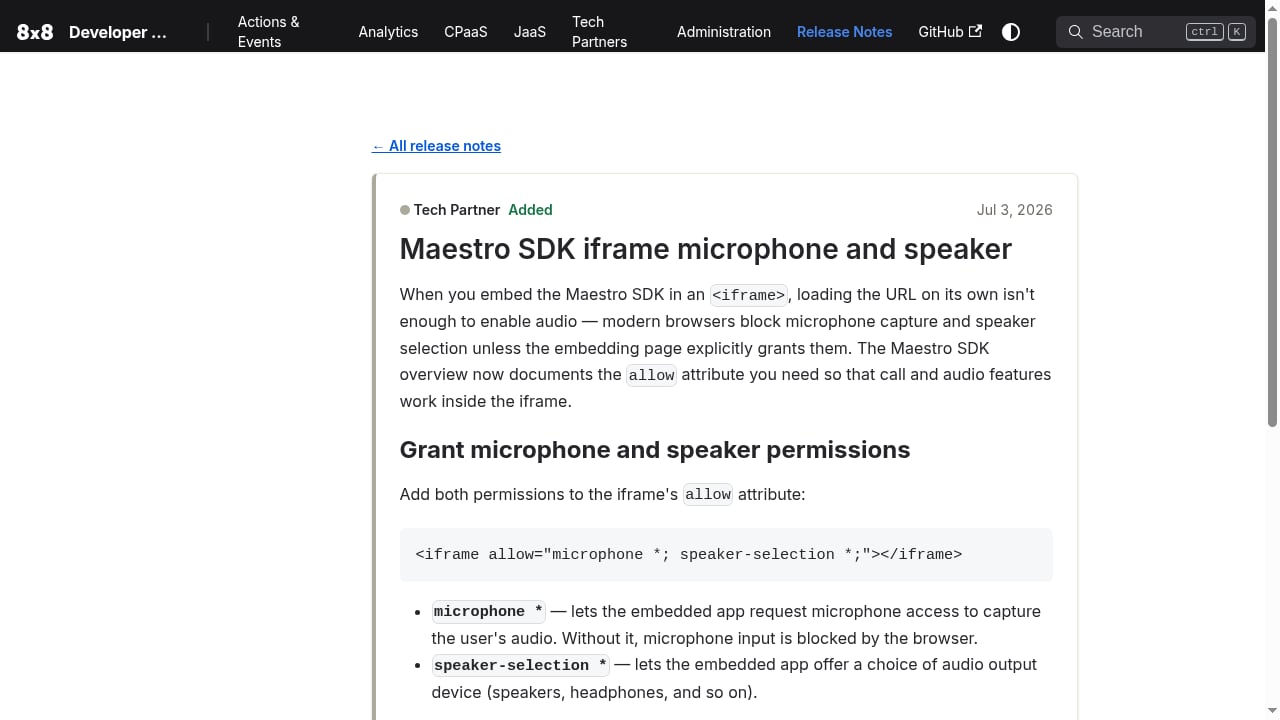
First viewport screenshot of Maestro SDK iframe microphone and speaker | 8x8 Developer Portal.
Every ranked product was assessed against the same six dimensions, using vendor documentation, product pages, and independent review platforms such as Gartner Peer Insights:
- Channel breadth – voice, SMS, RCS, WhatsApp, email, video, and push coverage.
- API and SDK depth – REST APIs, SDK languages, webhook quality, sandbox access, and versioning policy.
- Developer experience – documentation clarity, changelogs, release notes, and onboarding speed.
- UC and contact-center integration – administration APIs, analytics, meeting embeds, and session controls.
- Reliability and compliance – published SLAs, carrier redundancy, A2P/10DLC support, and regional compliance.
- Pricing transparency – whether per-message, per-minute, and platform pricing is published or requires a sales call.
No vendor paid for placement. Where pricing is not public, that is stated as a limitation rather than estimated.
The top 10 CPaaS and UC developer platforms for 2026
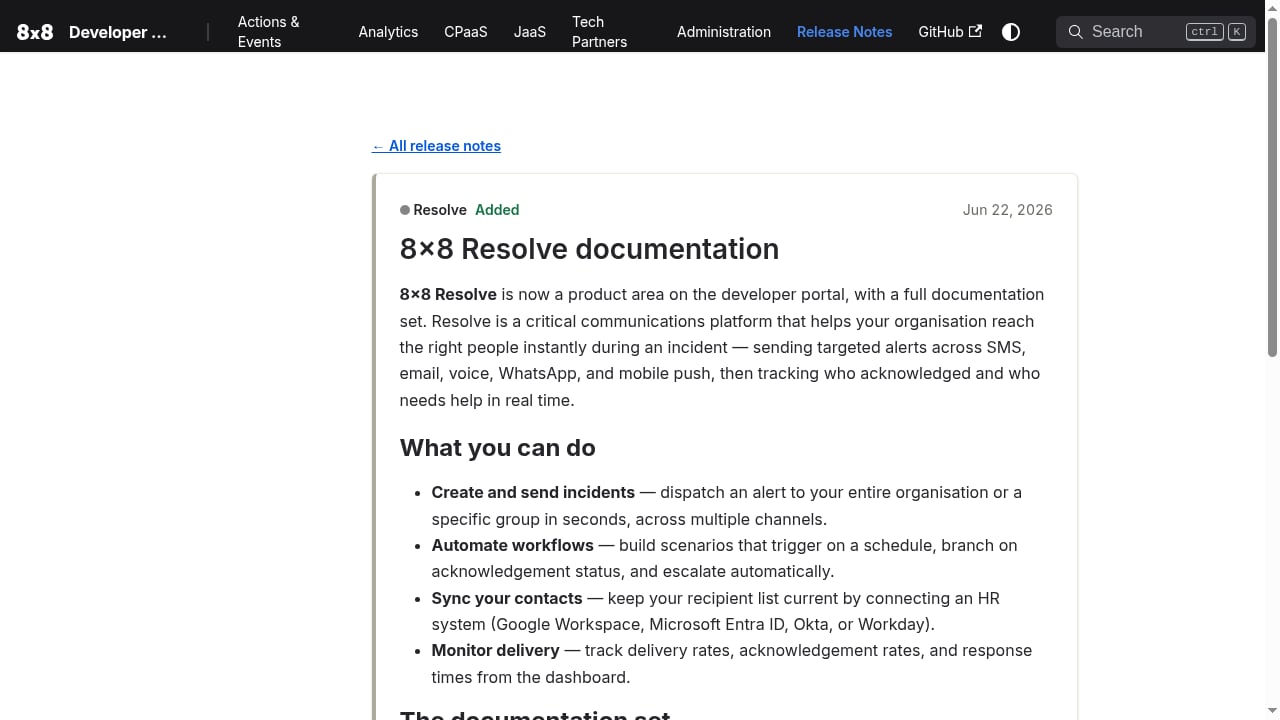
First viewport screenshot of 8x8 Resolve documentation | 8x8 Developer Portal.
1. Twilio Customer Engagement Platform
Twilio remains the reference point for developer-first communications. Its Super Network spans thousands of carrier connections across 180+ countries, and the API surface covers messaging, voice, video, email, and authentication. The Segment customer data platform adds real-time segmentation and predictive signals, and ConversationRelay lets teams build voice AI agents on their preferred large language model.
Best for: engineering-led teams that want maximum control and are comfortable assembling their own workflows. Watch out for: per-message and per-minute costs that compound at scale, and a broad product catalog that can slow initial decisions.
2. Vonage Communications APIs
Vonage, part of Ericsson since 2022, pairs a mature voice, video, SMS, and WhatsApp API suite with network API investments that enable identity verification and SIM-swap detection. The Voice API supports programmable IVR, recording, conferencing, and WebRTC calling, and SMS reach extends to 200+ countries with strong carrier relationships in Europe and Asia-Pacific.
Best for: teams that need strong European and APAC coverage plus advanced video and network-level verification. Watch out for: the brand sits inside a larger telecom portfolio, so product messaging can lag the actual roadmap.
3. Infobip
Infobip positions itself as a full-stack omnichannel platform with more than 30 communication channels, including SMS, RCS, voice, video, email, WhatsApp, Viber, and Messenger. On top of the API layer it offers SaaS applications such as Moments, Answers, Conversations, and People, so enterprises can either build on the APIs or adopt packaged tools.
Best for: enterprises that want one vendor for both programmable channels and ready-made engagement applications. Watch out for: the breadth of the portfolio means implementation often involves a solutions team rather than pure self-service.
4. Sinch
Sinch delivers AI-assisted messaging, email, and voice APIs with support for SMS, WhatsApp, RCS, and email, plus built-in automation, personalization, and fraud and security controls. It is widely used by global brands that need high-volume A2P messaging with compliance handled at the platform level.
Best for: high-volume messaging programs that need fraud controls and global delivery. Watch out for: voice and video depth is less prominent than its messaging strength.
5. Webex Connect
Webex Connect is Cisco's enterprise CPaaS layer. It automates multi-channel customer journeys across SMS, voice, RCS, push, in-app, email, Apple Business Chat, Facebook Messenger, and WhatsApp, with a visual drag-and-drop flow builder and a high-performance runtime engine. Its natural advantage is tight alignment with Cisco's collaboration and contact-center estate.
Best for: Cisco-centric enterprises that want low-code journey orchestration alongside developer APIs. Watch out for: the strongest value appears when you are already invested in the Cisco ecosystem.
6. Azure Communication Services
Azure Communication Services provides APIs and SDKs for voice, video, chat, SMS, and telephony, including interoperability with public switched telephone networks. It integrates natively with the Azure ecosystem for identity, security, analytics, and deployment, which shortens the path from prototype to production for Microsoft-standardized teams.
Best for: organizations standardized on Azure that want communications as another cloud service. Watch out for: channel breadth for messaging apps is narrower than dedicated CPaaS specialists.
7. AWS Communication Developer Services
AWS bundles Amazon Connect, Pinpoint, Simple Notification Service, Chime SDK, and related services into a developer-facing communications stack. You get SMS, email, voice, and video building blocks that inherit AWS identity, networking, and observability primitives.
Best for: teams already running workloads on AWS that prefer to stay inside one cloud boundary. Watch out for: the experience is a set of services rather than one coherent CPaaS product, so integration work is on you.
8. 8x8 Developer Portal
The 8x8 Developer Portal is the developer hub for 8x8's XCaaS platform. It documents Actions & Events for interacting with in-progress sessions and real-time streams, XCaaS Analytics & Content APIs for analytics, recordings, and generated content, Jitsi as a Service for embedding meetings into web applications, CPaaS Connect and Communication APIs for rich messaging and voice, and XCaaS Administration APIs for deploying and managing UC and contact-center services. It also covers a Chat Apps API for reaching customers on WhatsApp, Viber, RCS, LINE, and other channels through a single message API with webhook-based replies, Contact Center Analytics APIs for live and historical reporting, a Maestro SDK for embedding audio and call features in iframes, and 8x8 Resolve for incident alerting across SMS, email, voice, WhatsApp, and mobile push with acknowledgement tracking. Detailed changelogs, API versioning policies, and monthly release notes are a genuine strength.
Best for: organizations already on 8x8 XCaaS, or teams that need UC and contact-center administration APIs alongside messaging and meeting embeds. Watch out for: the portal is a documentation and API hub for the 8x8 platform rather than a standalone, carrier-neutral CPaaS. If you need one unified API across WhatsApp, Telegram, LINE, TikTok, Zalo, and X without committing to a UC suite, a dedicated messaging API layer is a better fit. For a deeper breakdown, see this 8x8 Developer Portal review.
9. Exotel
Exotel offers voice and messaging APIs with IVR, SMS, email, push notifications, WebRTC in-app calling, voice streaming, agent dashboards, call analytics, and CRM integration. It operates under UL-VNO licensing for VoIP telephony, which matters for compliance in regulated markets.
Best for: businesses with significant India and emerging-market call volumes that need licensed cloud telephony. Watch out for: global messaging-app coverage is narrower than the largest CPaaS vendors.
10. Airtel IQ
Airtel IQ provides cloud communication services that combine voice, messaging, and video with automation for customer interactions. Its differentiator is direct integration with Airtel's network footprint, which can improve call quality and delivery in its home markets.
Best for: enterprises that want network-native communications in South Asia and Africa. Watch out for: developer documentation and SDK breadth are less mature than the top developer-first platforms.
How to choose between developer-first and platform-first CPaaS
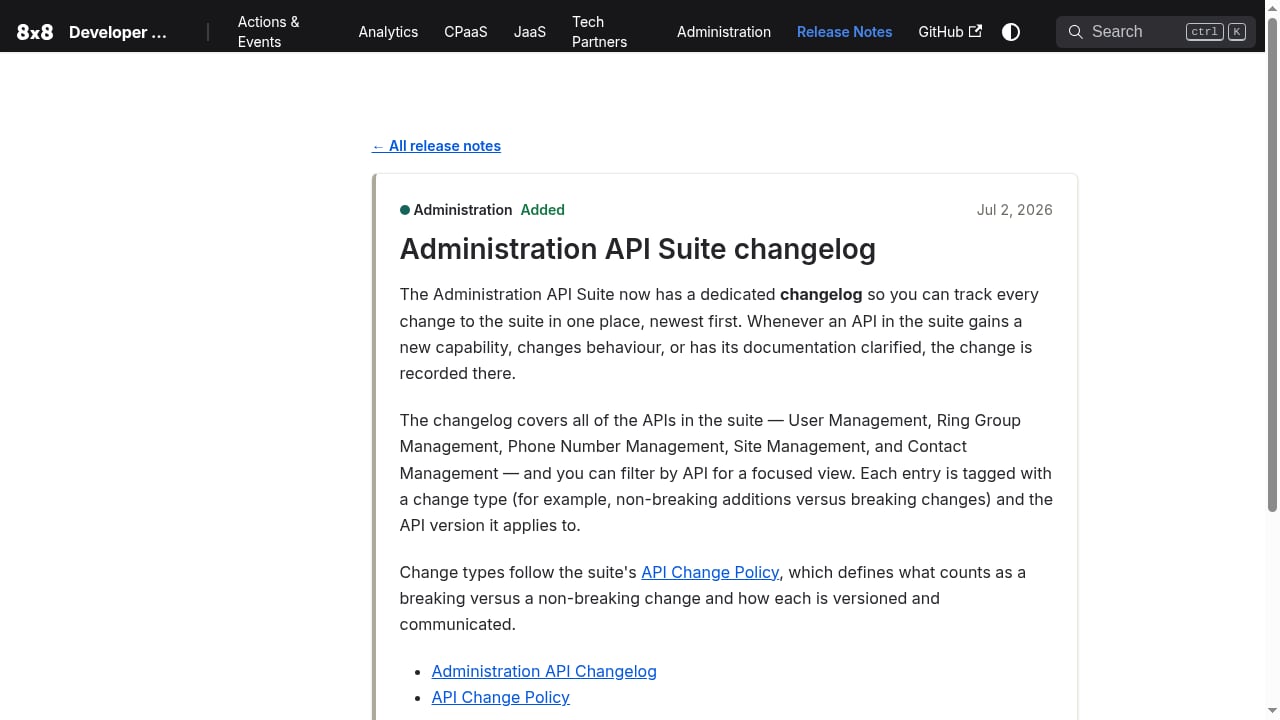
First viewport screenshot of Administration API Suite changelog | 8x8 Developer Portal.
The defining split in 2026 is not features, it is build threshold. Developer-first platforms such as Twilio, Vonage, Sinch, and Telnyx give you primitives and maximum flexibility, but you assemble the workflow layer yourself. Platform-first products ship pre-built journeys with APIs for extension, which cuts time-to-launch but reduces control.
A practical way to decide:
- Map the channels you actually need in the next 12 months, not the full catalog.
- Estimate engineering weeks for the workflow layer on a developer-first option.
- Compare that cost against platform pricing and vendor lock-in risk.
- Check webhook reliability, retry behavior, and signature support, because inbound events are where most integrations fail.
- Confirm compliance requirements such as A2P 10DLC, GDPR, or HIPAA before shortlisting.
If your core problem is messaging-app fragmentation rather than carrier infrastructure, a unified messaging API layer can sit alongside a CPaaS vendor. For example, a platform such as UnifyPort normalizes WhatsApp, Telegram, LINE, TikTok, Zalo, and X into one REST API and one webhook event stream, which is a complementary use case when your CPaaS covers voice and SMS but not every chat app. The same pattern applies to webhook reliability: pairing a messaging API with a delivery layer like the one described in this UnifyPort and Hookdeck integration guide is often cheaper than rebuilding retries in-house.
For side-by-side comparisons of specific vendors, see this UnifyPort vs Unipile vs 8x8 Developer Portal guide and this UnifyPort vs Syniverse CPaaS vs Infobip comparison.
Related reading
- How to Use UnifyPort with Hookdeck: Reliable Messaging Webhooks - Connect UnifyPort's unified messaging API to Hookdeck for reliable webhook delivery, filtering, retries, and observability across WhatsApp, Telegram, and more.
- UnifyPort vs Unipile vs 8x8 Developer Portal: 2026 Guide - Compare UnifyPort, Unipile, and the 8x8 Developer Portal on API model, channels, webhooks, SDKs, and pricing to pick the right messaging stack.
- UnifyPort vs Unified Social Media API: Messaging vs Social - Compare UnifyPort's unified messaging API with Unified Social Media API's unlimited social accounts. Channels, webhooks, SDKs, and use cases explained.
Sources and further reading
- 10 Best CPaaS Platforms in 2026: Features, Pricing & Comparison - Looking for the right CPaaS platform? Compare the top 10 CPaaS providers of 2026, including JustCall, Twilio, Vonage, Sinch, and Telnyx, with detailed feature, pricing, and AI capability breakdowns.
- 10 CPaaS Providers & Their Differentiators in 2026 - The CPaaS market is projected to grow from $32bn in 2025 to as much as $100bn by 2030. Discover the CPaaS providers leading the surge and what sets them apart.
FAQ
What is the difference between CPaaS and a unified communications developer platform? CPaaS focuses on programmable communication channels such as voice, SMS, and messaging apps. A UC developer platform adds administration, analytics, meeting embeds, and session controls for unified communications and contact-center deployments. Many vendors now offer both.
Which CPaaS platform is best for developers in 2026? Twilio and Vonage consistently score highest on documentation, SDK breadth, and sandbox quality. Infobip and Sinch are strong alternatives when global messaging compliance and volume pricing matter more than raw API flexibility.
Is the 8x8 Developer Portal a CPaaS product? It is the developer hub for 8x8's XCaaS platform, exposing messaging, voice, analytics, administration, and Jitsi meeting APIs. It is best understood as a UC and contact-center developer platform rather than a carrier-neutral CPaaS.
How much does CPaaS cost in 2026? Most providers charge per message, per minute, or per active user, with volume discounts. Developer-first platforms tend to be cheaper at low volume but require more engineering, while platform-first products bundle workflows into a higher monthly price.
Do I need a separate unified messaging API if I already use a CPaaS? Only if your CPaaS does not cover the chat apps your customers use. A unified messaging API layer is a common complement for channels such as Telegram, LINE, Zalo, and TikTok that many CPaaS vendors treat as secondary.
Conclusion
The 2026 CPaaS market rewards clarity about what you are actually building. If you need carrier-grade voice and SMS with maximum control, start with Twilio, Vonage, Sinch, or Infobip. If you need UC and contact-center APIs inside an existing collaboration estate, the 8x8 Developer Portal, Webex Connect, and Azure Communication Services are stronger fits. And if your real bottleneck is chat-app fragmentation, treat a unified messaging API as a complement to your CPaaS rather than a replacement. Score the shortlist against the six criteria above, test webhook behavior in a sandbox before signing, and choose the platform that matches your build threshold, not the longest feature list.