
UnifyPort vs Sendbird: Unified Messaging API Compared
Compare UnifyPort and Sendbird: unified messaging API vs AI customer experience platform. Channels, pricing, webhooks, and developer fit.
UnifyPort vs Sendbird: Unified Messaging API Compared
Choosing between UnifyPort and Sendbird often comes down to what you are actually building. Sendbird is a broad AI customer experience platform with chat, voice, and video APIs. UnifyPort is a focused unified messaging API that connects WhatsApp, Telegram, LINE, TikTok, Zalo, and X through one REST endpoint and one standard webhook stream. This comparison breaks down where each fits, based on publicly available product information and third-party reviews.
What Each Platform Is Built For
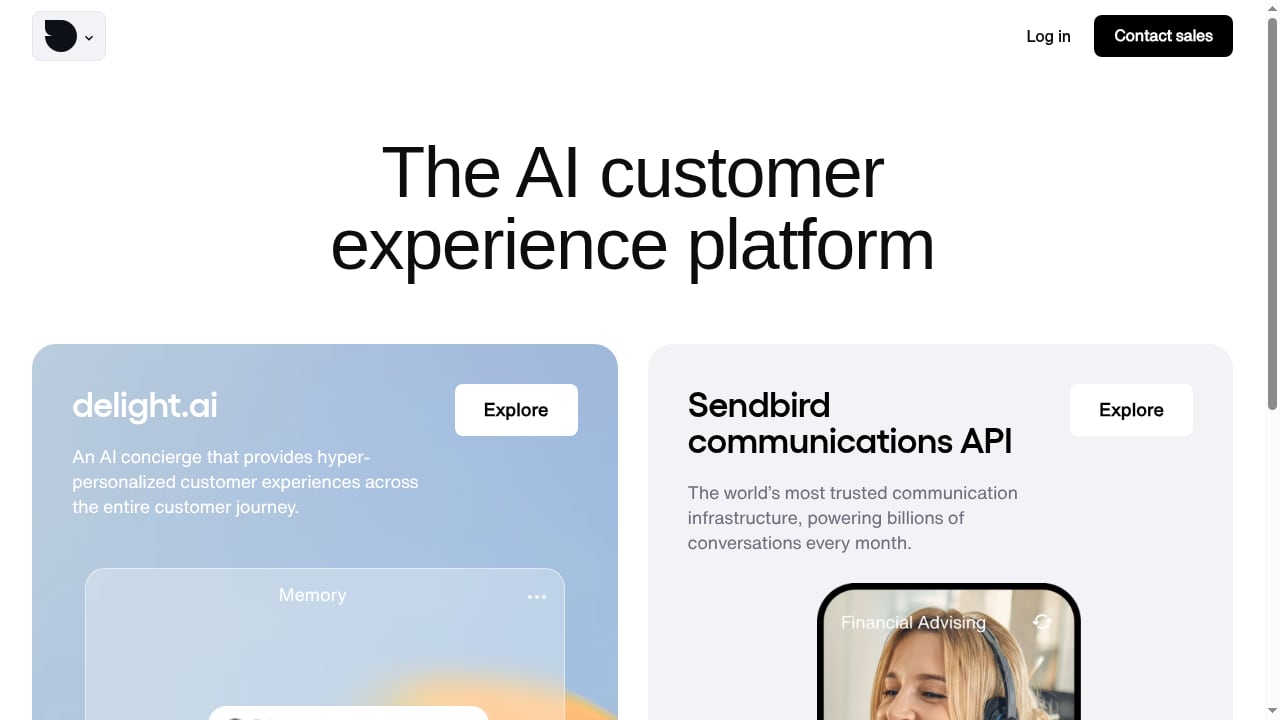
First viewport screenshot of The AI customer experience platform for enterprise.
UnifyPort: one API for external messaging channels
UnifyPort is designed for developers and product teams who need to send and receive messages across multiple consumer messaging platforms without maintaining separate integrations. Its core surface is a single POST /v1/messages endpoint and a normalized inbound event stream. The platform provides:
- Official SDKs for Node.js, PHP, Go, and Python
- A standard event layer that converts provider messages, status updates, and account events into one stable JSON shape
- A webhook control plane for signatures, subscriptions, retries, and failure tracking
- A reliable delivery queue with rate limits, retries, idempotency, and failure isolation
- Security through workspace API keys and HMAC-SHA256 signatures
Resources are organized around workspaces, messaging accounts, and connection runtime states, with documented authentication flows including QR code, verification code, password, Passkey, and session import.
Sendbird: AI customer experience and communications APIs
Sendbird positions itself as an AI customer experience platform. It offers chat, voice, and video APIs alongside an AI concierge, and supports omnichannel business messaging across in-app, SMS, WhatsApp, and KakaoTalk. Core features include real-time messaging, moderation, translation, data export, push notifications, and integrations with CRM and contact center tools such as Salesforce, Zendesk, and Microsoft Dynamics 365. Sendbird emphasizes scalability, security, and compliance with GDPR, HIPAA, SOC 2, and ISO 27001. It reports proof points such as a 56% cost reduction on support cases, 70% of queries automatically answered, and 96% CSAT achievement, with case studies from Virgin Mobile, Redfin, and Glovo.
Channel Coverage: External Messaging vs In-App and Omnichannel

Sendbird product interface.
The two platforms overlap less than the category labels suggest.
UnifyPort focuses on external messaging channels where users already spend time: WhatsApp, Telegram, LINE, TikTok, Zalo, and X. If your product needs to reach customers on the apps they already use, UnifyPort provides a single integration layer for those providers.
Sendbird covers in-app chat, SMS, WhatsApp, and KakaoTalk, and adds voice and video. It is a stronger fit when you need a fully managed in-app chat experience with pre-built UI components and moderation, or when you want AI-driven customer support workflows inside your own application.
A practical way to decide: if your primary requirement is outbound and inbound messaging across third-party consumer platforms, UnifyPort is purpose-built for that. If your primary requirement is an embedded chat experience plus AI support automation, Sendbird is the more complete platform.
Pricing Models: Account-Based vs MAU-Based
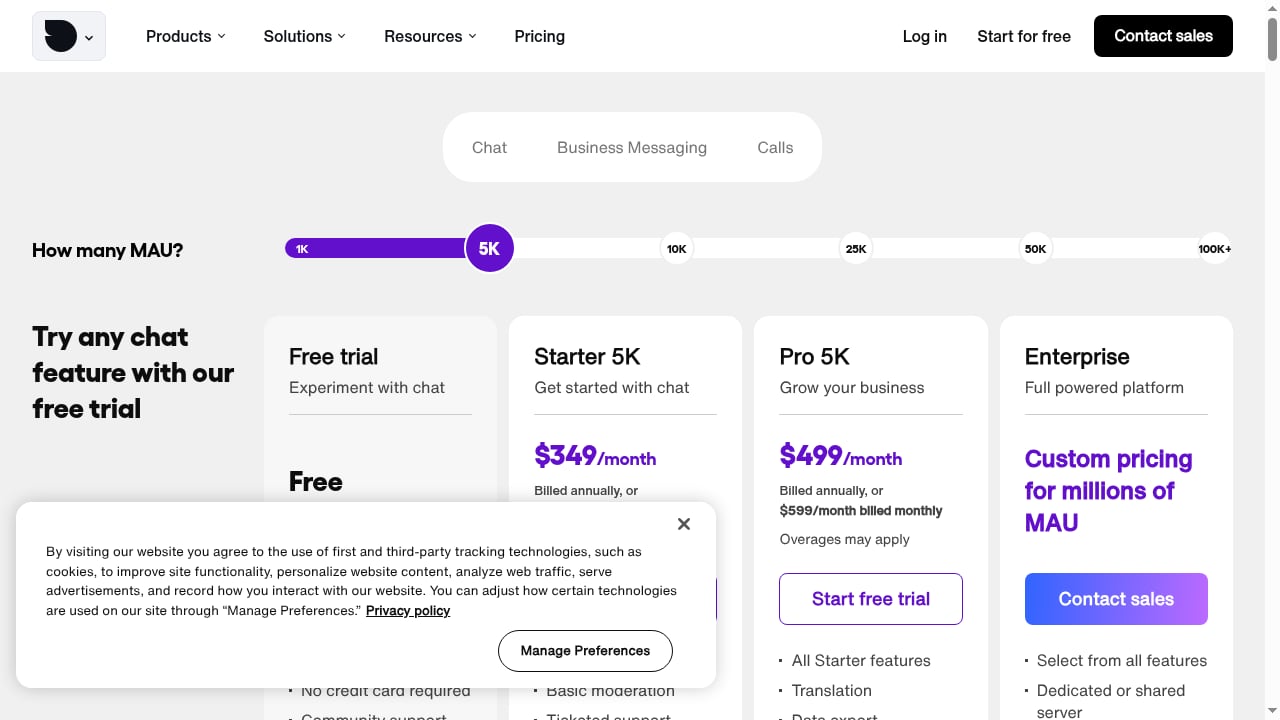
First viewport screenshot of Chat API pricing plans (try Chat free).
Pricing is one of the most frequently cited reasons businesses evaluate alternatives to Sendbird. Third-party analyses note that Sendbird's MAU-based pricing can become expensive at scale, particularly beyond 10,000 monthly active users, and that overage charges such as a $5 per Peak Concurrent Connection fee can affect budgeting during traffic spikes. Sendbird's published plans have historically included a free developer tier and paid tiers starting in the hundreds of dollars per month, with costs scaling by usage.
UnifyPort uses messaging-account costs in USD with transparent graduated pricing. Every workspace includes free messaging accounts, and unified API access is part of the platform. This model is easier to forecast when your costs are tied to the number of connected accounts rather than to unpredictable user activity peaks.
If your traffic is highly variable, account-based pricing reduces the risk of surprise bills. If your usage is stable and you need a broad feature set, MAU-based pricing may be acceptable. For a broader pricing comparison across categories, see the omni-channel messaging platform buyer's guide.
Developer Experience: Unified Endpoints vs SDK Breadth
UnifyPort's developer workflow is intentionally compact:
- Connect accounts to a workspace.
- Send messages through the unified
/v1/messagesendpoint. - Receive inbound messages and account status changes as standard events on your webhook.
The platform provides a webhook control plane for managing signatures, subscriptions, retry behavior, and failure tracking, plus a delivery queue with built-in rate limits, retries, idempotency, and failure isolation. This design targets teams that want to avoid provider-specific SDKs and maintain one integration instead of six.
Sendbird offers a wide range of SDKs for mobile, web, and cross-platform frameworks, along with documentation, guides, and sample code. Its strength is depth in in-app chat UI and real-time messaging features. The trade-off noted in third-party reviews is that implementation and configuration can require technical knowledge, and customization may be limited in some areas.
For a step-by-step example of connecting a specific channel, see How to Use UnifyPort with Telegram, which covers account creation, signed webhooks, and HMAC-SHA256 verification.
Reliability, Security, and Compliance
UnifyPort handles reliability at the platform layer: adaptive rate limits, a retry queue, verified webhook signatures, and failure tracking. Security is built around workspace API keys, HMAC-SHA256 signatures, and minimal exposure patterns. The platform monitors routes and keeps provider turbulence inside the integration layer.
Sendbird emphasizes enterprise-grade security and compliance, including GDPR, HIPAA, SOC 2, and ISO 27001. It also provides moderation, translation, and data export features that regulated industries often require. However, one third-party review notes that Sendbird's cloud infrastructure may not prioritize dedicated instances, meaning multiple clients can share an AWS instance, and that the platform lacks professional services support for businesses needing assistance beyond standard capabilities.
If compliance certifications are a hard requirement for your procurement process, Sendbird's published certifications are a clear advantage. If your priority is a stable, observable messaging pipeline with clear failure handling, UnifyPort's reliability features are designed for that.
When to Choose UnifyPort vs Sendbird

Sendbird product interface.
Choose UnifyPort if you:
- Need to reach customers on WhatsApp, Telegram, LINE, TikTok, Zalo, or X through one API
- Want to avoid building and maintaining separate provider integrations
- Prefer account-based pricing with free messaging accounts in every workspace
- Value a standard webhook event stream with signatures, retries, and idempotency
- Are building multi-channel messaging features, customer engagement tools, or notification systems
Choose Sendbird if you:
- Need an embedded in-app chat experience with pre-built UI components
- Want AI concierge and automated support workflows
- Require voice and video APIs in addition to messaging
- Need CRM and contact center integrations such as Salesforce, Zendesk, or Microsoft Dynamics 365
- Have compliance requirements that demand HIPAA, SOC 2, or ISO 27001 certifications
For a wider view of how these platforms compare with others in the category, see the Top 10 AI customer experience and communications API platforms and the Top 10 multi-channel messaging and email API platforms.
Related reading
- Zernio Review 2026: Agent Marketing API, Pricing & Limits - Evidence-based Zernio review: one API for social, ads, inbox, WhatsApp, SMS and calls, plus MCP. Pricing math, real limits, and who it fits.
Sources and further reading
- Discover 10 Best Sendbird Alternatives: Unlock Better Communication Today! - Explore top Sendbird competitors for live chat, AI solutions, and omnichannel support. Find the perfect fit for your e-commerce or customer support needs!
- UnifyPort — One API. Every Channel. - Connect WhatsApp, Telegram, LINE, TikTok, Zalo, and X through one API for messages and events, without rebuilding the integration for every platform.
- 5 top Senbird alternatives: How do competitors compare? - Learn how Sendbird fares against its competitors and find out the best Sendbird alternatives on the market
FAQ
Is UnifyPort a direct replacement for Sendbird?
Not exactly. UnifyPort is a unified messaging API for external channels like WhatsApp, Telegram, LINE, TikTok, Zalo, and X. Sendbird is a broader AI customer experience platform with in-app chat, voice, video, and AI concierge. They overlap on business messaging but serve different primary use cases.
Why do businesses look for Sendbird alternatives?
Third-party reviews cite pricing that can become expensive at scale, overage charges such as the $5 per Peak Concurrent Connection fee, limitations in omnichannel support, and concerns about vendor lock-in. UnifyPort addresses the multi-channel integration and pricing predictability concerns directly.
Does UnifyPort support the same channels as Sendbird?
UnifyPort supports WhatsApp, Telegram, LINE, TikTok, Zalo, and X. Sendbird supports in-app chat, SMS, WhatsApp, and KakaoTalk, plus voice and video. The channel sets differ, so evaluate based on where your customers actually are.
How does UnifyPort handle webhook reliability?
UnifyPort provides a webhook control plane for managing signatures, subscriptions, retry behavior, and failure tracking, backed by a delivery queue with rate limits, retries, idempotency, and failure isolation. Inbound events are normalized into one stable JSON shape.
Can I use both platforms together?
Yes. Some teams use Sendbird for in-app chat and AI support, and UnifyPort for external messaging channels. Because UnifyPort exposes a standard REST API and webhook stream, it can feed events into a CRM or support system alongside other tools. For an example, see How to Use UnifyPort with Kommo CRM for Messenger Sales.
Conclusion
UnifyPort and Sendbird solve different problems. Sendbird is a feature-rich AI customer experience platform with strong compliance credentials and deep in-app chat capabilities. UnifyPort is a focused unified messaging API that removes the cost and complexity of maintaining separate integrations for WhatsApp, Telegram, LINE, TikTok, Zalo, and X. If your priority is reaching customers on external messaging platforms through one API with predictable account-based pricing, UnifyPort is the more direct fit. If you need embedded chat, voice, video, and AI-driven support workflows, Sendbird remains a strong choice. Evaluate both against your channel requirements, pricing model, and compliance needs before committing.