
UnifyPort vs Gupshup: Unified Messaging API or AI Agent Suite?
Compare UnifyPort and Gupshup on API architecture, channel coverage, webhooks, SDKs, and pricing to choose the right messaging stack for your team.
UnifyPort vs Gupshup: Unified Messaging API or AI Agent Suite?
Choosing between UnifyPort and Gupshup is less about picking a winner and more about matching a tool to a job. UnifyPort is a unified messaging API platform: one REST API, one normalized webhook stream, and SDKs for Node.js, PHP, Go, and Python. Gupshup is an AI-powered conversational messaging platform: autonomous agents, campaign tooling, and WhatsApp Business API access for sales, marketing, and support teams.
This comparison breaks down architecture, channels, webhooks, pricing, and fit so you can decide based on evidence rather than marketing language.
What each product actually is
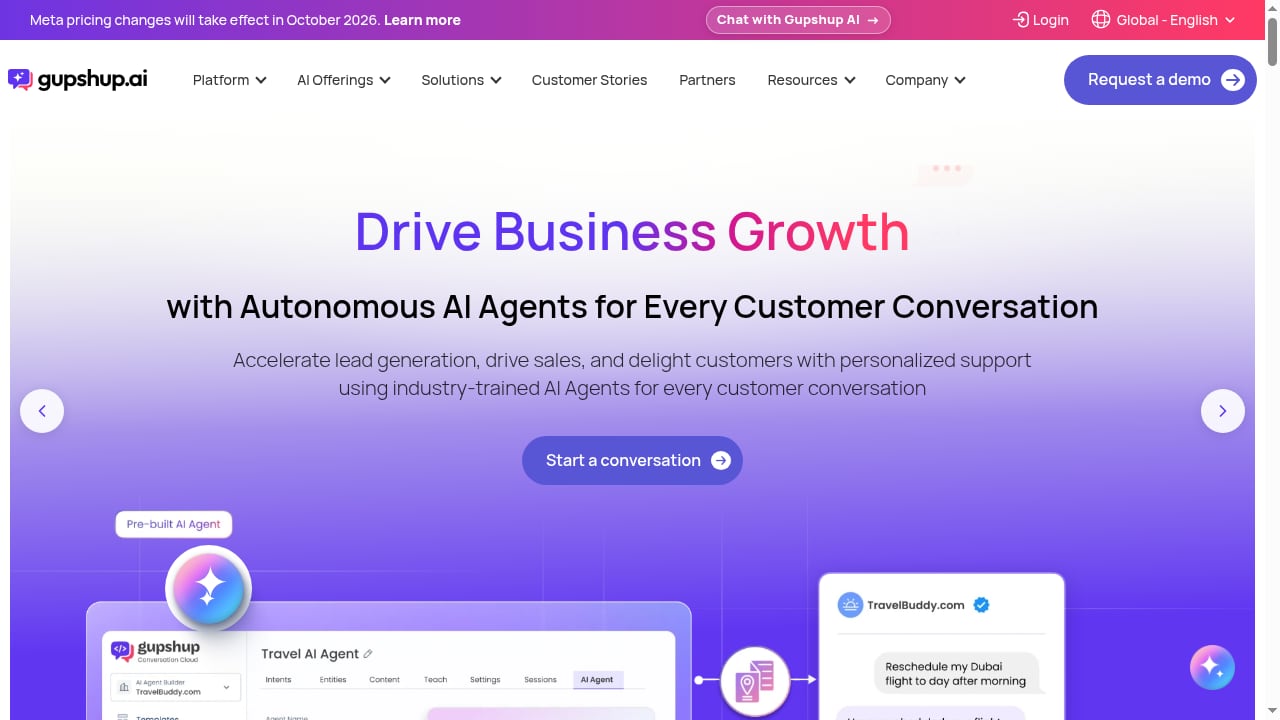
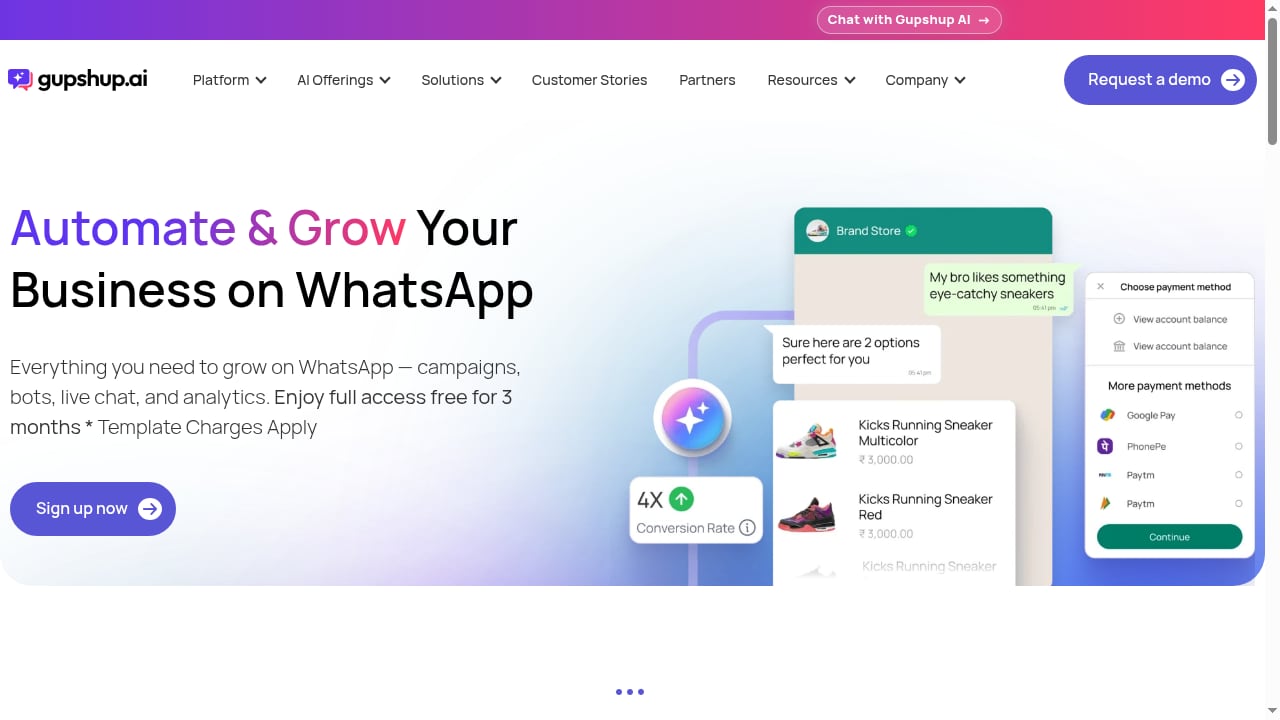
First viewport screenshot of Gupshup.ai | Autonomous AI Agents for Sales, Marketing & Customer Support.
UnifyPort: one API, every channel
UnifyPort connects your product to multiple messaging channels — WhatsApp, Telegram, LINE, TikTok, Zalo, and X (formerly Twitter) — through a single REST API and a standard webhook event stream. Instead of building and maintaining a separate integration for each provider, you send and receive messages through one interface.
The platform normalizes provider messages, status updates, and account events into a stable JSON shape. It also provides a webhook control plane for managing signatures, subscriptions, retry behavior, and failure tracking. Authentication covers API keys and HMAC-SHA256 signatures, and delivery runs through a reliable queue with rate limits, retries, idempotency, and failure isolation. Official SDKs exist for Node.js, PHP, Go, and Python.
Core use cases include sending and receiving messages programmatically, handling account authorization flows (QR code, code, password, Passkey, session import), managing account lifecycle, and processing inbound events via webhooks. Pricing is described as transparent graduated pricing for messaging accounts, with free messaging accounts available in every workspace.
Gupshup: conversational AI and messaging suite
Gupshup is an AI-powered conversational messaging platform that helps businesses deploy autonomous AI agents for sales, marketing, and customer support across channels like WhatsApp, voice, and more. Its suite includes WhatsApp Business API access, campaign management, bot building, live chat, and analytics.
The company says it serves enterprises, small businesses, and ISV partners, with industry-trained AI agents that can qualify leads, chase payments, recover carts, and handle customer support calls at scale. Key features include unlimited broadcast and retargeting campaigns, a campaign scheduler, link tracking, a bot studio, and free WhatsApp setup with blue tick verification assistance. Gupshup positions itself as enterprise-ready, secure, and scalable, and reports powering billions of customer conversations.
Pricing includes a self-serve plan with a standard $0.001 per message fee plus WhatsApp conversation charges, and a limited-time offer of $100/month (or ₹5,000/month in India) free for the first three months. Customer stories cite 4X clickthrough rates, 4.3X productivity boosts, and 5.8X ROAS increases.
Architecture and developer experience
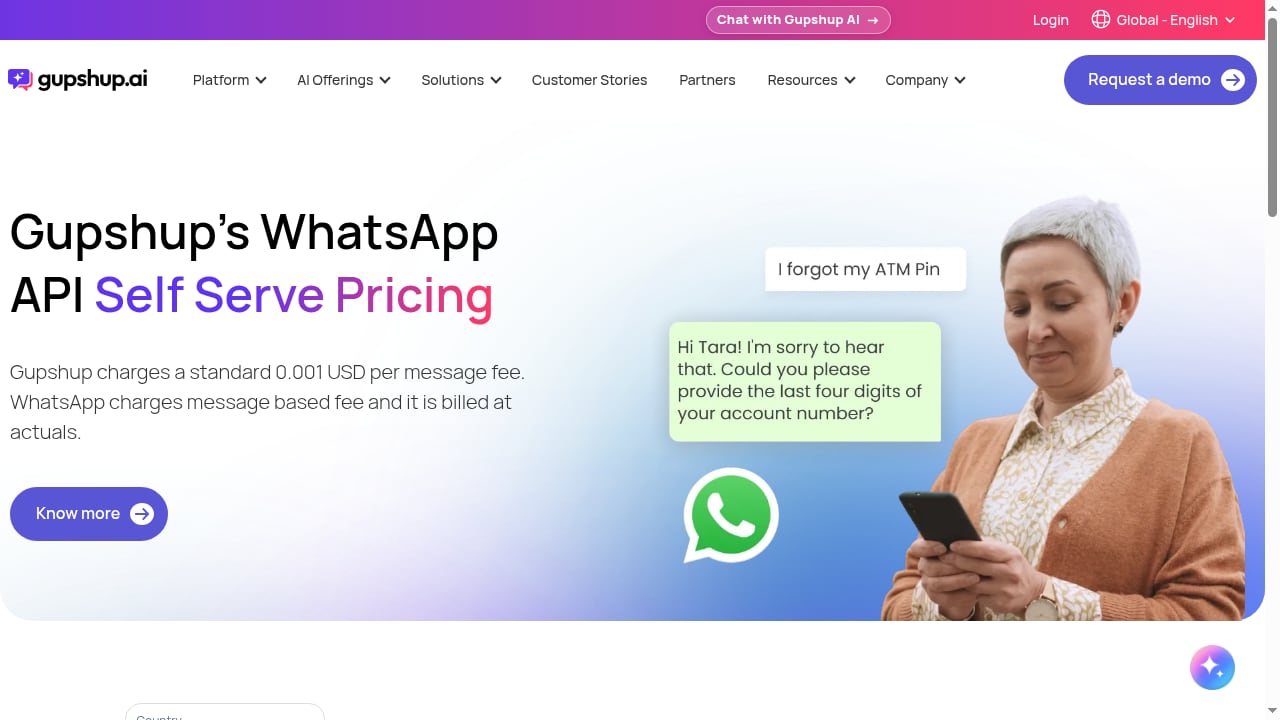
First viewport screenshot of WhatsApp API Pricing | Gupshup Self-Serve Plan.
The two platforms approach integration from different directions.
| Dimension | UnifyPort | Gupshup |
|---|---|---|
| Primary interface | One REST API plus standard webhook stream | Conversational AI suite with WhatsApp Business API and bot tooling |
| Channel model | Multiple channels behind one normalized API | WhatsApp, voice, and other channels via platform tools |
| Event handling | Webhook control plane: signatures, subscriptions, retries, failure tracking | Platform-managed conversation flows and campaign events |
| Authentication | API keys and HMAC-SHA256 signatures | Platform account and API credentials |
| SDKs | Node.js, PHP, Go, Python | Not detailed in cited sources |
| Delivery reliability | Queue with rate limits, retries, idempotency, failure isolation | Enterprise-scale infrastructure claims |
If your team writes code against an API and owns the messaging logic, UnifyPort's normalized event layer removes the per-provider parsing work. If your team wants prebuilt agents, campaign templates, and a bot studio, Gupshup's suite covers more of the workflow out of the box.
For a deeper look at how normalized events and retry semantics work in practice, see Webhook Event Processing: A Practical Guide for Developers.
Channel coverage and account management
UnifyPort's channel list is explicit: WhatsApp, Telegram, LINE, TikTok, Zalo, and X. It also handles account authorization flows such as QR code, code, password, Passkey, and session import, plus account lifecycle management. That matters if you operate multiple messaging accounts across channels and need programmatic control over how they connect and disconnect.
Gupshup's cited strengths center on WhatsApp, voice, Instagram, SMS, and RCS, with campaign and agent tooling layered on top. Its WhatsApp Business API access and blue tick verification assistance are practical advantages for businesses that want to run marketing and support conversations on WhatsApp without building that infrastructure themselves.
The trade-off: UnifyPort gives developers a broader multi-channel API surface with account-level control, while Gupshup gives business teams a deeper WhatsApp-and-AI workflow suite.
Webhooks, reliability, and failure handling
UnifyPort's webhook control plane is a differentiator for engineering teams. You manage signatures, subscriptions, retry behavior, and failure tracking from one place. Combined with idempotency and failure isolation, this reduces the risk of duplicate sends or silent event loss when a provider has a bad day.
Gupshup's cited material emphasizes AI agents, escalation to human support, and campaign orchestration rather than low-level webhook mechanics. That is not a weakness for every buyer — many teams want the platform to absorb that complexity. But if your product needs to react to raw provider events with your own logic, UnifyPort's event layer is more transparent.
Reliable delivery matters most when you are sending at volume. UnifyPort's queue handles rate limits and retries; Gupshup's enterprise positioning and 120 billion annual conversations suggest it operates at serious scale as well.
Pricing signals
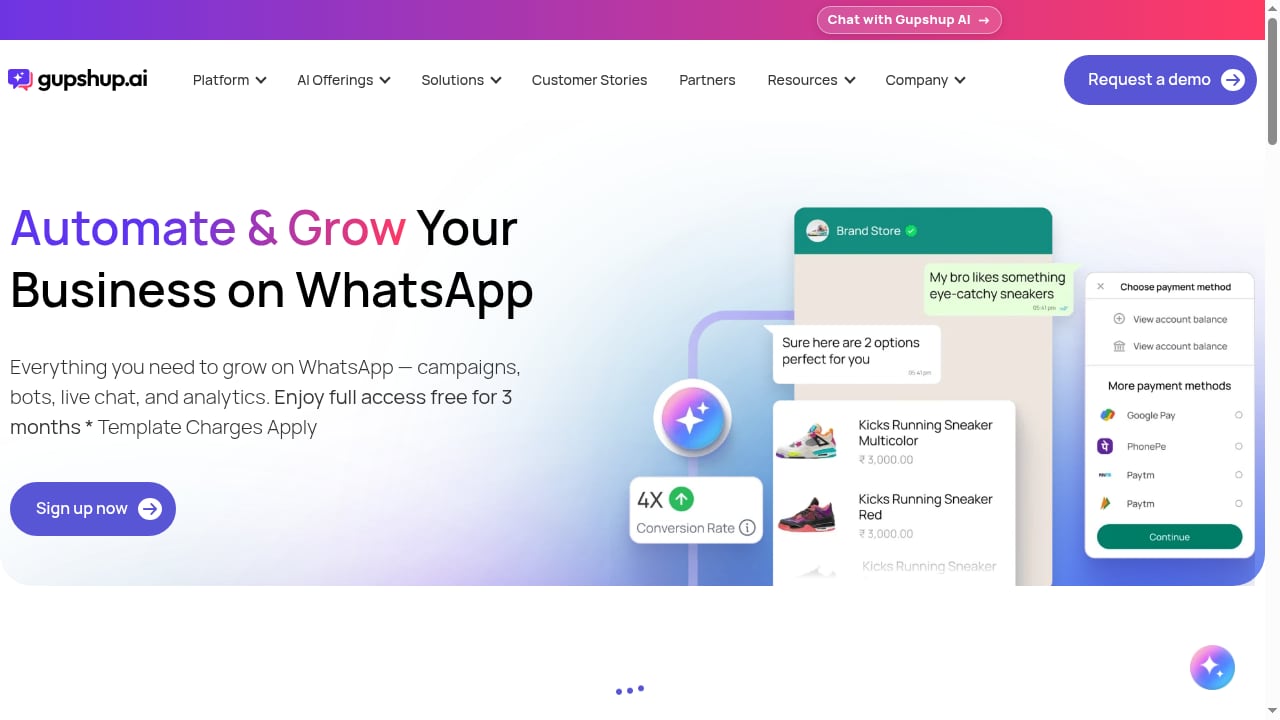
First viewport screenshot of CX Pricing global.
UnifyPort's pricing page indicates transparent graduated pricing for messaging accounts, with free messaging accounts available in every workspace. That structure suits teams that want to start small and scale account count as usage grows.
Gupshup's self-serve plan is listed at a standard $0.001 per message fee plus WhatsApp conversation charges, with a limited-time offer of $100/month (or ₹5,000/month in India) free for the first three months. WhatsApp conversation charges are set by WhatsApp, so they apply on top of platform fees regardless of vendor.
Neither pricing model is strictly cheaper without knowing your volume, channel mix, and whether you need AI agent features. Compare total cost against the work you would otherwise do in-house.
When UnifyPort is the better fit
- You are building messaging into your own product and want one REST API instead of six provider integrations.
- You need normalized webhook events with signature verification, retries, idempotency, and failure isolation.
- You want official SDKs for Node.js, PHP, Go, or Python.
- You manage multiple messaging accounts across channels and need programmatic authorization and lifecycle control.
- You prefer transparent graduated pricing with free messaging accounts to start.
When Gupshup is the better fit
First viewport screenshot of CX Pricing India.
- You want autonomous AI agents for lead qualification, payments, cart recovery, or support calls.
- Your primary channel is WhatsApp and you want Business API access plus blue tick verification assistance.
- You need campaign tooling: broadcast, retargeting, scheduler, link tracking, and a bot studio.
- You want live chat and analytics bundled with messaging.
- You are an enterprise or ISV partner looking for an established conversational AI vendor.
Can you use both?
Yes, and some teams do. Gupshup can run customer-facing AI conversations on WhatsApp, while UnifyPort handles programmatic messaging and event processing across additional channels such as Telegram, LINE, TikTok, Zalo, and X. The two are not mutually exclusive if your architecture separates conversation automation from messaging infrastructure.
If you are evaluating a broader set of options, see Top 10 Conversational Commerce & Engagement Platforms 2026 and UnifyPort vs Unipile vs Esendex: Which Messaging API Fits?.
Related reading
- Syniverse CPaaS Omni-Channel Messaging Review 2026 - Evidence-based Syniverse CPaaS Omni-Channel Messaging review: channels, unified API, Communication Assistant, pricing signals, setup, and who it fits.
Sources and further reading
- Gupshup vs. Unify CRM Comparison - Compare Gupshup vs. Unify CRM using this comparison chart. Compare price, features, and reviews of the software side-by-side to make the best choice for your business.
FAQ
Is UnifyPort a replacement for Gupshup?
Not exactly. UnifyPort replaces the multi-provider integration layer with one API and one webhook stream. Gupshup replaces or augments your conversational workflow with AI agents and campaign tools. If you only need messaging infrastructure, UnifyPort covers that. If you need AI agents and campaign management, Gupshup covers that.
Does UnifyPort support WhatsApp?
Yes. WhatsApp is one of the channels UnifyPort connects to, alongside Telegram, LINE, TikTok, Zalo, and X.
How does Gupshup handle webhooks?
Gupshup's cited material focuses on conversation flows, AI agents, and campaign events rather than publishing low-level webhook control details. Teams with strict event-processing requirements should evaluate this directly during a trial.
Which platform is cheaper?
UnifyPort lists transparent graduated pricing with free messaging accounts in every workspace. Gupshup lists $0.001 per message plus WhatsApp conversation charges, with a limited-time free period. Actual cost depends on volume, channels, and whether you need AI agent features.
Can I use UnifyPort with a conversational AI platform?
Yes. UnifyPort's API and webhook layer can sit alongside a conversational platform. For a worked example of connecting UnifyPort to another messaging tool, see How to Use UnifyPort with SleekFlow: Developer Setup Guide.
Conclusion
UnifyPort and Gupshup solve adjacent problems. UnifyPort is the infrastructure choice: one API, normalized events, webhook control, SDKs, and reliable delivery for developers who want to own the messaging layer. Gupshup is the workflow choice: AI agents, WhatsApp Business API access, campaigns, and analytics for teams that want conversations handled end to end.
Start with the job you need done. If it is "connect my product to many channels without maintaining six integrations," UnifyPort fits. If it is "automate customer conversations on WhatsApp and beyond," Gupshup fits. If it is both, the two can coexist.
For more context on Gupshup's positioning, see Gupshup's official site and Gupshup's about page.