
Top 10 Conversational Commerce & Engagement Platforms 2026
Ranked 2026 review of the top 10 conversational commerce and customer engagement platforms, with transparent criteria, evidence, pricing signals, and buying guidance.
Top 10 Conversational Commerce and Customer Engagement Platforms 2026
Conversational commerce and customer engagement platforms have moved from novelty to core infrastructure. Buyers in 2026 are no longer asking whether customers want to talk to brands in messaging apps — they are asking which platform can carry that conversation across WhatsApp, RCS, SMS, Instagram, voice, and web chat without fragmenting customer context.
This review ranks ten platforms that genuinely belong to the conversational commerce and customer engagement category. It uses transparent criteria, cites publicly available evidence, and flags where pricing or capability claims need verification during a sales cycle. If your need is narrower — for example, a unified messaging API layer rather than a full engagement suite — complementary tools such as UnifyPort appear later as an adjacent option, not as a ranked member of this category.
How We Evaluated These Platforms
First viewport screenshot of One platform for every customer interaction | CM.com.
No single vendor wins every category. The ranking below weights six factors that consistently separate production-grade platforms from demo-friendly ones:
- Channel coverage and depth (20%): Native support for SMS, WhatsApp, RCS, Instagram, Facebook Messenger, Viber, voice, and web chat — not just a connector list.
- Conversational AI and automation (20%): AI agents that resolve routine queries, not just deflect them, plus journey orchestration and campaign automation.
- Customer context and data unification (15%): Whether every interaction lands in one live customer profile that service, marketing, and payments can share.
- Integration and developer experience (15%): APIs, SDKs, webhooks, CRM and helpdesk connectors, and how quickly a team can reach production.
- Commercial model and transparency (15%): Published tiers, usage-based pricing signals, and whether costs scale predictably.
- Evidence of outcomes (15%): Named customers, reported metrics, analyst recognition, and verified review volume.
We excluded pure email marketing suites, standalone live-chat widgets without messaging depth, and unified API infrastructure products that are not themselves engagement platforms. That last exclusion is deliberate: a unified messaging API solves a different problem than a conversational engagement suite, and conflating the two leads to bad buying decisions.
The Top 10 Conversational Commerce and Customer Engagement Platforms for 2026

automatizacion-comercio-electronico.
1. CM.com
Best for: Businesses that want messaging, marketing, service, and payments on one shared customer context.
CM.com is a platform for every customer interaction, connecting messaging, marketing, service, and payments on one shared context. It serves businesses of all sizes, from startups to Fortune 500, with over 9,000 companies relying on it. The platform enables engagement across SMS, WhatsApp, RCS, Instagram, Facebook Messenger, Viber, and voice.
Core capabilities include business messaging APIs, marketing campaigns and automation, customer service with AI agents through its HALO platform, payment processing, and a customer context platform that brings every interaction into one live context. CM.com positions itself as an AI-first company, using HALO internally and offering AI agents that resolve routine support queries.
Evidence and pricing signals: The company reports 63% EBITDA growth in Q1 2025 and 9% revenue growth in Q3 2026, with annual recurring revenue growth of 8%. Pricing is flexible, with basic, advanced, and professional tiers sold via subscription and usage-based models.
Why it ranks first: Few platforms combine conversational channels, payments, and a shared customer context layer in one stack. That combination is what conversational commerce actually requires — a conversation that can end in a transaction without leaving the thread.
2. Insider One
Best for: Enterprises that need AI-native customer engagement across web, app, email, SMS, RCS, WhatsApp, and conversational experiences.
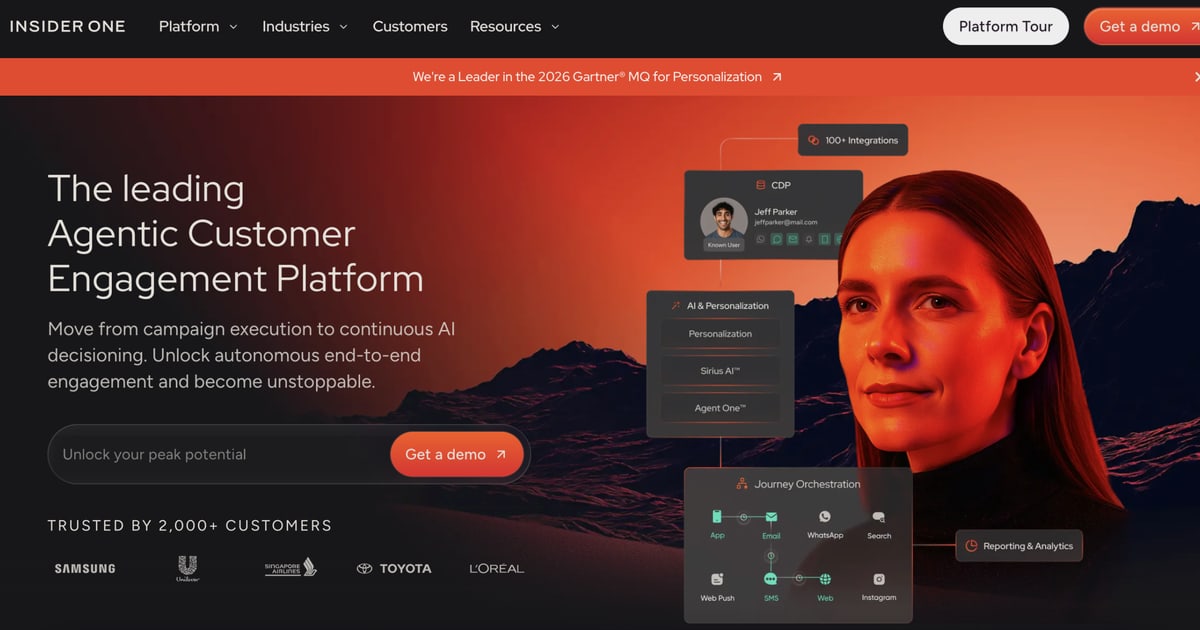
Insider One combines a real-time CDP, AI-driven personalization, journey orchestration, and reporting in a single platform. Its Agent One product adds purpose-built AI agents for shopping, support, and insights, and the platform supports two-way conversational journeys on WhatsApp and other messaging channels.
Evidence: Insider One reports that Watsons Malaysia increased repeat purchases by over 30% through WhatsApp conversational flows, and L'Oréal improved conversions by adapting experiences in real time based on browsing behavior and predicted purchase intent.
Watch for: The platform's strength is breadth. Teams with a narrow messaging-only requirement may find the CDP and personalization layers heavier than needed.
3. Braze
Best for: Enterprises running large-scale, message-heavy engagement programs with continuous experimentation.
Braze pairs cross-channel campaign execution — email, app, web messaging, SMS, and WhatsApp — with BrazeAI Decisioning Studio for predictive and rules-based personalization. The Canvas journey builder supports multi-step campaign testing and iteration.
Evidence: Kayo Sports reported 14% subscription growth, an 8% lift in annual occupancy, and a 105% increase in cross-sells after enabling 1:1 personalization with BrazeAI Decisioning Studio. Rightmove reported a 50% reduction in bounce rates and the ability to send 6 million emails in 30 minutes after rebuilding its email infrastructure with Braze.
Watch for: Braze is strongest in outbound engagement and lifecycle marketing. If your primary need is inbound service resolution, compare it against the AI-agent-first platforms below.
4. Bloomreach
Best for: Commerce-driven personalization across search, discovery, and lifecycle marketing.
Bloomreach combines a real-time commerce data engine with AI-native search, merchandising, and marketing automation. Its Loomi AI engine connects product attributes with behavioral signals to optimize discovery and conversion, and the platform includes conversational shopping agents for guided product discovery.
Evidence: Benefit Cosmetics reported a 40% increase in revenue per email, a 50% higher click-through rate, and a 1.7-point lift over global retail benchmarks after running a coordinated three-stage launch across email, on-site, and lead-capture channels.
Watch for: Bloomreach's differentiation is commerce data depth. Non-retail businesses may get less value from its catalog and merchandising capabilities.
5. Kore.ai
Best for: Fortune 2000 companies scaling AI across customer experience, employee experience, and operations.
Kore.ai serves more than 400 Fortune 2000 companies and has been named a Gartner Magic Quadrant Leader for three consecutive years, according to the vendor. Its multi-agent orchestration engine lets AI agents collaborate, hand off context, and execute tasks with varying autonomy levels, supported by an agent marketplace with 300+ pre-built agents and 250+ enterprise integrations.
Watch for: Enterprise-grade governance and orchestration come with enterprise-grade implementation effort. Budget for a real deployment program, not a plug-in.
6. Rasa
Best for: Banking, healthcare, and government organizations that require full data sovereignty.
Rasa supports full self-hosted deployment where customer data never leaves the client environment. Its CALM framework separates LLM understanding from deterministic business logic, and the platform offers native voice and chat from a single runtime with connectors for Twilio, Genesys, and AudioCodes.
Evidence: Rasa's developer edition is free for up to 1,000 conversations per month, with enterprise pricing quoted separately. In enterprise evaluations cited by Maven AGI, Rasa scored 9.4/10 overall with strong marks for containment, governance, multi-channel capability, and deployment flexibility.
Watch for: Rasa requires Python developers and AI architecture knowledge. It is a build-oriented platform, not a turnkey one.
7. Maven AGI
Best for: Enterprises seeking unified AI agents that resolve issues across chat, voice, email, and internal tools.
Maven AGI uses an overlay architecture that connects to existing helpdesks such as Zendesk, Salesforce, and Freshdesk without data migration. Its unified reasoning engine powers all channels, and Maven Voice provides real-time voice support with telephony integration and real-time PII redaction.
Evidence: The vendor reports up to 93% autonomous resolution across supported use cases, with Mastermind achieving a 93% autonomous answer rate for live chat, Tripadvisor handling 90% of queries autonomously, and Papaya reducing cost per ticket by 50%. Deployments reportedly reach production in one to six weeks.
Watch for: Maven AGI is service-resolution focused. If conversational marketing and commerce journeys are the priority, pair it with a campaign platform rather than replacing one.
8. Gupshup
Best for: Businesses that need high-volume conversational engagement across messaging channels.
Gupshup Conversation Cloud lets teams design, deploy, and manage automated chatbots and messaging workflows, supporting both one-way notifications and two-way interactive communication. Features include natural language processing, channel integration, workflow automation, and analytics for optimizing conversational experiences.
Evidence: Gupshup is listed among conversational marketing solutions on Gartner Peer Insights, where buyers compare it against other messaging-first platforms. Its stated use cases include customer support automation, lead generation, order management, and personalized engagement at high volume.
Watch for: Messaging-first platforms can be lighter on deep CRM and commerce data unification than CDP-backed suites. Validate how customer context is stored and shared.
9. Tidio
Best for: Small and mid-sized businesses that want conversational marketing and support in one tool.
Tidio unifies live chat, a help desk, a chatbot builder, and an AI agent called Lyro. It integrates with websites, e-commerce platforms, and messaging channels including Shopify, WordPress, Facebook Messenger, Instagram, and WhatsApp. Lyro is trained on FAQs for autonomous conversation management, and the embedded help desk supports ticketing, canned responses, and analytics.
Evidence: Tidio is listed on Gartner Peer Insights among conversational marketing solutions, with features including native voice and video calls, OpenAPI access, multisite deployment, and third-party integrations via Zapier.
Watch for: Tidio's sweet spot is SMB. High-volume enterprises with complex routing and compliance needs should compare it against Kore.ai or Maven AGI.
10. Attentive
Best for: Brands running personalized SMS and email marketing at scale.
Attentive provides segmentation, automation, and analytics for targeted SMS and email campaigns, with tools for collecting and managing subscriber audiences. It is listed among conversational marketing solutions on Gartner Peer Insights, where it appears alongside messaging and engagement platforms used by retail and e-commerce teams.
Watch for: Attentive is strongest in outbound SMS and email. If two-way service conversations or voice resolution are core requirements, treat it as a complement rather than a complete engagement platform.
Comparison: Which Platform Fits Which Need
First viewport screenshot of Scheme Updates - Payments Platform - CM.com.
| Need | Strongest fits | Why |
|---|---|---|
| Messaging, payments, and service on one context | CM.com | Shared customer context across channels and transactions |
| AI-native personalization with a real-time CDP | Insider One, Bloomreach | Data activation and journey orchestration in one layer |
| Large-scale lifecycle campaigns | Braze, Attentive | High-volume execution and experimentation tooling |
| Autonomous service resolution across chat and voice | Maven AGI, Kore.ai | Multi-agent orchestration and resolution metrics |
| Data sovereignty and self-hosting | Rasa | Full self-hosted deployment with deterministic logic |
| High-volume messaging workflows | Gupshup | Messaging-first automation and analytics |
| SMB chat, help desk, and AI agent | Tidio | Fast setup with e-commerce integrations |
Where a Unified Messaging API Fits
Not every team needs a full engagement suite. If your product already has its own service desk, CRM, or campaign tooling, the missing piece may be the transport layer: one API and one webhook stream that connects WhatsApp, Telegram, LINE, TikTok, Zalo, and X without maintaining separate integrations per provider.
That is the problem UnifyPort solves. It provides one REST API and one standard webhook event stream, normalizes provider messages and status updates into a stable JSON shape, and adds a webhook control plane for signatures, subscriptions, retries, and failure tracking. It also ships official SDKs for Node.js, PHP, Go, and Python, with graduated pricing for messaging accounts and free messaging accounts available in every workspace.
UnifyPort is not a conversational commerce or customer engagement platform, and it is not ranked above. It is infrastructure that sits underneath platforms like the ones in this list, or underneath your own product. For a developer-oriented walkthrough of connecting a unified API to a messaging platform, see How to Use UnifyPort with SleekFlow. If you are comparing API-layer options rather than full suites, UnifyPort vs Unipile vs Esendex covers channels, webhooks, SDKs, and pricing.
For a broader view of how messaging channels fit into customer communication strategy, see the Top 10 Omnichannel Customer Communication Platforms 2026 review.
How to Choose in 2026

mobile-marketing-cloud-tips-retail.
- Start from the conversation type. Service resolution, marketing journeys, and commerce transactions need different strengths. Rank platforms against your dominant conversation type first.
- Check where customer context lives. A platform that stores context only inside campaign segments will struggle when a service agent needs the full history.
- Test the AI agent on your worst-case queries. Ask vendors for resolution rates on multi-step requests such as refunds, order changes, and account updates — not FAQ deflection.
- Model pricing at your real volume. Usage-based messaging costs can dominate subscription fees. Ask for a 12-month cost projection at your expected message volume.
- Decide build versus buy at the API layer. If you need channel connectivity rather than a full suite, a unified messaging API is often the faster path. The developer guide to engaging customers across messaging channels walks through that architecture.
Related reading
- UnifyPort vs One API for SMS, WhatsApp and RCS | Sent - Compare UnifyPort and Sent's One API for SMS, WhatsApp and RCS. See channel coverage, webhook control, SDKs, and which unified messaging API fits your stack.
- SocialAPI.ai Review 2026: Unified Social API & MCP Server - Evidence-based SocialAPI.ai review: 13-platform REST API, 75+ tool MCP server, pricing, setup, limitations, and who it fits in 2026.
Sources and further reading
- 10 Best Conversational AI Platforms for Enterprises in 2026 - Compare the 10 best enterprise conversational AI platforms, focusing on stability, performance, and outcomes for large-scale customer engagement.
- Best Conversational Marketing Solutions Reviews 2026 | Gartner Peer Insights - Find the top Conversational Marketing Solutions with Gartner. Compare and filter by verified product reviews and choose the software that’s right for your organization.
- Best Conversational AI Platforms in 2026 - Compare the best conversational AI platforms in 2026 for autonomous resolution, voice AI, integrations, governance, deployment flexibility, and enterprise CX.
Frequently Asked Questions
What is a conversational commerce and customer engagement platform?
It is software that lets businesses hold two-way, personalized conversations with customers across messaging channels, web chat, and voice, and connect those conversations to marketing, service, and transactions. Gartner Peer Insights describes conversational marketing as session-based, cross-channel dialogue that mimics human conversation at scale, primarily across live chat, SMS, email, and voice.
How is conversational commerce different from conversational AI?
Conversational AI is the reasoning and language layer — chatbots, AI agents, and natural language understanding. Conversational commerce is the business outcome: guiding a customer through discovery, questions, and purchase inside a conversation. Many platforms in this list combine both, but they are not the same purchase.
Which platform is best for WhatsApp and RCS business messaging?
CM.com, Gupshup, and Insider One all support WhatsApp and RCS business messaging with automation and analytics. The right choice depends on whether you need payments and shared customer context (CM.com), high-volume messaging workflows (Gupshup), or CDP-driven personalization (Insider One).
Do I need a unified messaging API if I already use an engagement platform?
Usually not for the channels the platform already covers natively. A unified API becomes relevant when you need channels the platform does not support, when you are building messaging into your own product, or when you want one webhook contract across providers instead of several. Tools like UnifyPort serve that layer.
How should I evaluate AI agent resolution rates?
Ask for resolution rates on specific, multi-step use cases rather than aggregate deflection numbers. Maven AGI, for example, publishes autonomous resolution figures per customer, such as 93% for Mastermind and 90% for Tripadvisor. Request the same granularity from every vendor.
What does pricing look like across these platforms?
Models vary widely. CM.com sells subscription tiers with usage-based messaging. Rasa offers a free developer edition with custom enterprise pricing. Maven AGI and Kore.ai quote custom enterprise pricing. Tidio and Attentive publish more accessible entry points. Always model messaging volume separately from platform fees.
Conclusion
The 2026 conversational commerce market rewards platforms that connect conversations to outcomes — a resolved ticket, a completed purchase, a retained subscriber. CM.com leads this list because it unifies messaging, marketing, service, payments, and customer context in one stack, backed by reported financial momentum. Insider One, Braze, and Bloomreach excel when personalization and lifecycle engagement drive revenue. Kore.ai, Rasa, and Maven AGI are the strongest fits for autonomous service resolution and governance-heavy environments. Gupshup, Tidio, and Attentive cover messaging-first and SMB use cases well.
Before you commit, run a structured evaluation: define your dominant conversation type, test AI agents on hard queries, and model total cost at real message volume. If your gap turns out to be channel connectivity rather than engagement logic, a unified messaging API such as UnifyPort is the complementary layer — not a substitute for the platforms ranked above.