
Top 10 Unified Social Media API Platforms 2026
Ranked 2026 review of unified social media API platforms for posting, scheduling, analytics, and data access, with criteria, evidence, and buying guidance.
Top 10 Unified Social Media API Platforms 2026
A unified social media API lets one integration publish, schedule, read, or moderate across many networks through a single data model. In 2026 the category has split into two product families: posting APIs that push content out, and data APIs that pull public posts, comments, and profiles in. Most comparison pages blur the two, so developers end up evaluating tools that cannot return a single post. This review separates them, ranks ten platforms that genuinely belong to the unified social media API category, and states the criteria and evidence behind every placement.
How we evaluated these platforms
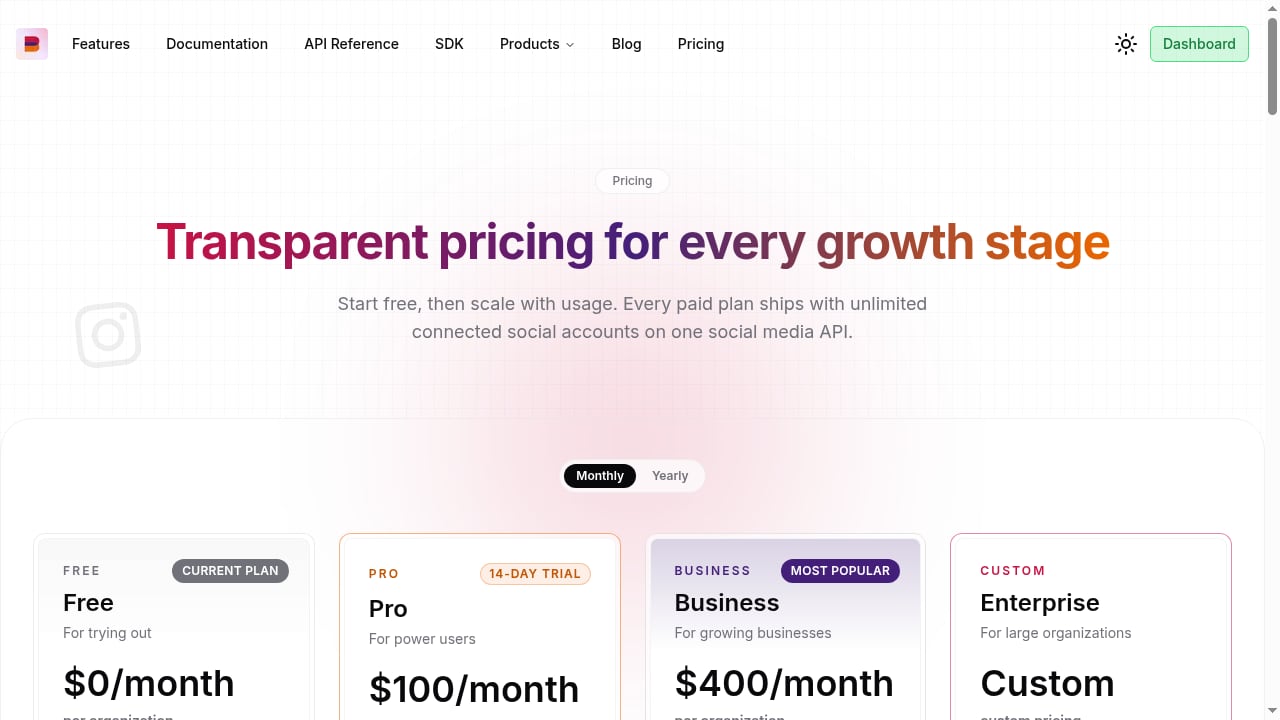
First viewport screenshot of Social media API pricing.
We scored each product on six criteria, weighted toward what breaks in production rather than what looks good on a pricing page:
- Platform coverage and depth: how many networks are live, and whether read, write, media, and analytics are all supported per network.
- API model and normalization: one schema, consistent auth, pagination, and error shapes across providers.
- Webhooks and events: post status, comment, and account events, with signatures, retries, and idempotency.
- Developer experience: documentation quality, SDKs, sandbox access, and time to first successful call.
- Pricing transparency: published rates, billing unit (post, profile, account, or credit), and free-tier honesty.
- AI agent readiness: MCP servers or agent tooling that expose the same API to autonomous workflows.
Evidence comes from vendor documentation, published pricing pages, and independent comparisons checked between July and October 2026. Where a vendor publishes a target rather than a guarantee, we say so. This is a ranked list, not a sponsored one; no vendor paid for placement.
The 2026 split: posting APIs vs data APIs
First viewport screenshot of Sign in.
Before the ranking, one distinction decides half the purchase. A posting API publishes and schedules content to accounts you own. A data API returns posts, comments, and profiles that already exist on the networks, searchable by keyword, author, hashtag, or date, without you owning the accounts involved. Several posting vendors rank for data-intent searches, and several data vendors now offer limited publishing. If your goal is monitoring, research, sentiment analysis, or feeding an AI agent live social context, you need the data family. If your goal is publishing and scheduling, you need the posting family. Some workflows need both, and running one of each is the normal 2026 architecture.
The top 10 unified social media API platforms
First viewport screenshot of Unified Social Media API, Unlimited Social Accounts.
1. Ayrshare — best for broad posting coverage
Ayrshare exposes one REST API across 14+ social platforms, with documented support for LinkedIn, Facebook, Instagram, X, TikTok, YouTube, Pinterest, Reddit, and Telegram. It handles awkward cases such as LinkedIn article publishing, Instagram carousels, and per-network video optimization, and ships SDKs plus webhook support for post status updates. Pricing is tier-based from $149 per month for one profile covering up to 14 connected social accounts, with scheduled posts unlimited on the Premium and Launch plans. Billing is per social profile rather than per action, so one customer posting to six networks still counts as a single profile. The trade-off: it publishes rather than searches, so monitoring use cases need a data API alongside it.
2. Outstand — best for usage-based pricing
Outstand targets developers who want to pay for what they use. It covers 12 networks including X, LinkedIn, Instagram, Facebook, TikTok, and YouTube through a consistent data model, with intelligent rate limiting, automatic retries, real-time webhooks for posts and comments, scheduling from a UTC timestamp, and media upload and hosting. Images publish as supplied; video can opt into per-network re-encoding with processMedia: true, billed per output by duration. OAuth is supported on 11 of 12 networks, with managed keys on eight, while X, Google Business Profile, Vimeo, and Reddit require your own OAuth app. The published 180ms average response time and 99.9% monthly uptime target are targets, not guarantees, and the terms say so. Usage-based billing with no fixed minimum suits fluctuating volumes and AI posting agents.
3. Zernio — best for free-tier experimentation
Zernio, formerly getlate.dev, covers 15 platforms and offers a free tier up to two accounts, then usage-based pricing per account. That combination makes it the cheapest way to validate a multi-network integration before committing budget. It exposes an MCP server, so agents can publish through the same surface developers use. Coverage is broad, but per-network depth varies, and teams with heavy media pipelines should test video handling on their target networks before standardizing.
4. Buffer API — best for established scheduling infrastructure
Buffer has run social scheduling since 2010, and its API exposes that posting engine along with analytics, profile management, and team permissions across Facebook, Instagram, X, LinkedIn, and Pinterest. API access is included on every plan, including the free one, and billing is per channel: Essentials at $5 per channel per month and Team at $10, with lower per-channel rates above ten channels. The strengths are operational history and team features. The limitation is network coverage: five core networks rather than fourteen, so it fits teams already inside the Buffer ecosystem more than greenfield multi-platform products.
5. Xpoz — best for reading Twitter/X, Instagram, Reddit, and TikTok
Xpoz is a data API, not a posting API, and it belongs on this list because reading is half the category. It queries Twitter/X, Instagram, Reddit, and TikTok through one API against a continuously collected index of billions of posts, with MCP-first design so agents can query all four platforms in natural language alongside REST, TypeScript and Python SDKs, and a CLI. Pricing is $20 per month for 7,500 credits and $200 for 120,000, charged per query rather than per row, with a one-time 500-credit free tier. Query costs differ by network: 2 credits for Twitter/X or Reddit, 5 for TikTok, 12 for Instagram. Teams needing one platform's full archive are better served by a specialist.
6. Data365 — best for per-network data depth
Data365 sells subscriptions to a read API covering up to seven networks: Facebook, Instagram, Twitter/X, TikTok, Reddit, Pinterest, and Threads. Basic is €300 per month for one network with 500,000 credits; Standard is €850 for three networks with 1 million credits; larger scopes are custom. Credits are spent per data item, with a post costing 1 credit and a search request 7, and a 14-day trial is available without payment details. Per-network pricing suits teams that need predictable enterprise billing and depth on one or two platforms rather than breadth.
7. SocialCrawl — best for pay-per-call breadth
SocialCrawl covers 44 platforms through 358 endpoints on pay-per-call credits with no subscription: 100 one-time free credits, then £15 for 2,500, £49 for 20,000, and £299 for 150,000, with credits that never expire. An MCP server is available on the Growth plan and above. The breadth-first, no-subscription model fits intermittent or exploratory workloads. Per-platform depth varies across those endpoints, so validate your specific networks before relying on it for production monitoring.
8. Bright Data — best for enterprise scraping infrastructure
Bright Data is web-data infrastructure rather than a single query endpoint: proxies, scraper APIs, and prebuilt datasets, with social media scrapers at $1.50 per 1,000 records pay-as-you-go, a 5,000-record monthly free allowance, and a $499 per month Scale plan. Datasets start at $250 per 100,000 records. It suits engineering teams that want scraping infrastructure and compliance tooling and are willing to build the normalization layer themselves. It is the heaviest option here and the least "unified" in the API-design sense.
9. Apify — best for long-tail scraping tasks
Apify is a marketplace of scraping actors rather than one unified API. Separate actors cover tweets at roughly $0.40 per 1,000, Instagram at about $1.50 per 1,000, and TikTok at about $1.70 per 1,000, on top of platform fees around $49 per month plus usage. The strength is coverage of niche and long-tail scraping tasks. The trade-off is that each actor has its own schema, quality level, and maintainer, so multi-platform work means integrating several actors instead of consuming one response format.
10. TwitterAPI.io — best for Twitter/X full-archive depth
TwitterAPI.io is a single-platform specialist, included because specialists usually beat unified APIs on depth and price for their network. It serves Twitter/X only, pay-per-call at $0.15 per 1,000 tweets with full-archive access and no subscription, plus a $1 trial credit. The cost of the specialist route is one integration, one billing relationship, and one schema per platform, which is exactly the overhead unified APIs exist to remove. Use it when Twitter/X is the only network that matters, or as a depth supplement to a broader data API.
Comparison at a glance
| Platform | Family | Networks | Pricing unit | Best for |
|---|---|---|---|---|
| Ayrshare | Posting | 14+ | Per profile | Broad posting coverage |
| Outstand | Posting | 12 | Per post | Usage-based volume |
| Zernio | Posting | 15 | Per account | Free-tier testing |
| Buffer API | Posting | 5 | Per channel | Existing Buffer teams |
| Xpoz | Data | 4 | Per query credit | Agent-ready social reading |
| Data365 | Data | Up to 7 | Per network credit | Enterprise data depth |
| SocialCrawl | Data | 44 | Pay-per-call credit | Intermittent breadth |
| Bright Data | Data | Major networks | Per record | Scraping infrastructure |
| Apify | Data | Per actor | Per 1,000 items | Long-tail tasks |
| TwitterAPI.io | Data | 1 | Per 1,000 tweets | Twitter/X archive |
How to choose in practice
Start with the direction of data flow, then narrow by network. Three worked scenarios:
- A social scheduler for SMBs: you need posting, scheduling, and post-status webhooks. Ayrshare or Zernio covers the network spread; Buffer API is the safe pick if your customers already live in Buffer.
- An AI agent that comments on trends: you need reading plus publishing. Pair a data API such as Xpoz with a posting API such as Outstand, and route both through MCP so the agent has one tool surface.
- A brand monitoring dashboard: you need read-only breadth with predictable costs. Data365 for depth on a few networks, SocialCrawl for occasional coverage across many.
One adjacent decision worth flagging: if your product also sends messages on WhatsApp, Telegram, LINE, or similar channels, that is a messaging API problem rather than a social media API problem. UnifyPort handles that side with one REST API and a standard webhook event stream across messaging channels, including normalized events, HMAC-SHA256 signatures, and SDKs for Node.js, PHP, Go, and Python. Teams building both social and messaging features often run one of each rather than forcing a single vendor to cover both categories. For the messaging comparison itself, see our CPaaS platform ranking and the UnifyPort vs Syniverse CPaaS vs Infobip comparison.
Build vs buy: when a unified API is the wrong layer
First viewport screenshot of How API automation saves content creators 10 hours per week.
Published estimates put a medium-complexity native integration at 60 to 100 developer hours per platform, or roughly $6,000 to $15,000 per network, rising to 80–160+ hours with media pipelines and production error handling. Maintenance adds 10 to 20 hours per month per API, and Meta shipped three Graph API versions during 2025 alone. Across ten integrations, staying current is a standing part-time job.
The break-even is roughly three networks. Below that, the abstraction layer costs more in indirection and vendor dependency than it saves. Build direct integrations anyway if social integration is your differentiator, if you need platform capabilities no abstraction exposes such as ad campaign management or commerce catalogs, or if you are single-platform by design. Use a unified layer if you need three or more networks, if social posting is a feature rather than the product, or if your scarcest resource is engineering attention. The decision is not permanent: many teams start unified to validate demand, then selectively replace individual integrations once they know which custom behavior they actually need. For the event-handling side of that architecture, our guide to real-time sync webhooks covers signatures, retries, and idempotency.
Related reading
- How to Use UnifyPort with Trengo: Unified Messaging Guide - Connect UnifyPort's unified messaging API to Trengo so WhatsApp, Telegram, LINE, and more land in one team inbox. Setup, webhook flow, and examples.
- UnifyPort vs Esendex: Unified Messaging API or SMS Platform? - Compare UnifyPort and Esendex on API model, channels, webhooks, SDKs, and pricing to choose the right messaging stack for your product.
- One API for SMS, WhatsApp & RCS: Sent Review 2026 - Evidence-based Sent review: unified API for SMS, WhatsApp, and RCS. Learn routing, pricing, setup, ideal users, and limitations for 2026.
Sources and further reading
- Best Unified API Platforms of 2026 - [object Object]
- 10 Best Unified Social Media APIs for Developers in 2026 - Ten unified social media APIs compared on pricing, platform coverage and developer experience, with the case where each one is the wrong tool for the job.
- Best Unified Social Media APIs in 2026 (Data Access Compared) - Compare unified social media APIs in 2026: which read Twitter/X, Reddit, Instagram and TikTok data and which only post. Start free with 500 credits.
FAQ
What is a unified social media API?
A single normalized interface for multiple social networks that abstracts differences in authentication, pagination, schemas, and rate limits. You integrate once and support every provider in the category, rather than maintaining one integration per network.
What is the difference between a posting API and a data API?
A posting API publishes and schedules content to accounts you own. A data API returns existing posts, comments, and profiles that you can search by keyword, author, hashtag, or date, without owning the accounts. Both families market themselves as unified social media APIs, but they solve different problems.
How many networks do I need before a unified API pays off?
The commonly cited break-even is about three networks. Below that, direct integrations are usually cheaper; at three or more, one integration surface wins on both time-to-ship and total cost.
Do unified social media APIs support AI agents?
Increasingly, yes. Zernio, Outstand, Xpoz, and SocialCrawl all expose MCP servers, letting agents publish or query through the same API developers use. If agent access matters, check whether MCP is included on your plan tier rather than sold separately.
Can one API both read and post across platforms?
No single vendor leads both families in 2026. The normal architecture is a posting API plus a data API, each chosen for its strength, with MCP or a thin internal service layer presenting one tool surface to your application.
How should I test a unified social media API before committing?
Run your five to ten most important networks through the vendor's sandbox, verify read and write coverage on the exact objects and fields you need, check custom field handling, and confirm webhook semantics for retries, duplicates, and partial failures. Connector counts alone do not show whether a platform supports your production behavior.
Conclusion
The unified social media API category in 2026 rewards a clear-eyed split: posting APIs for publishing and scheduling, data APIs for reading and monitoring, and specialists for depth on a single network. Ayrshare and Outstand lead the posting side on coverage and pricing flexibility respectively; Xpoz and Data365 lead the data side on agent readiness and enterprise depth. Pick by data direction first, network second, and billing unit third, then test your top integrations before signing. If your roadmap also includes messaging channels, treat that as a separate stack decision and keep the two layers cleanly separated.