
Top 10 CPaaS Products 2026: Ranked & Tested
Ranked 2026 CPaaS review: Twilio, Infobip, Vonage, Sinch, Webex Connect and more, with transparent criteria, evidence, and buying guidance.
Top 10 Communications Platform as a Service (CPaaS) Products 2026
Choosing a CPaaS in 2026 is harder than it used to be. The old pitch — "here are REST APIs for SMS and voice" — no longer separates vendors. The market is projected to grow from roughly $32 billion in 2025 toward as much as $100 billion by 2030, and providers are racing to layer AI, network APIs, and omnichannel orchestration on top of the same core messaging and voice rails. That means the real question is no longer whether a platform can send an SMS, but what else it does when your volumes scale, your channels multiply, and your compliance obligations tighten.
This review ranks ten products that genuinely belong to the CPaaS category. Every entry is evaluated on the same criteria, with evidence drawn from vendor documentation, analyst definitions, and published market research. One adjacent tool, UnifyPort, appears only where a complementary workflow makes it relevant — it is not ranked here because it is a unified messaging API layer rather than a full CPaaS.
How We Evaluated These CPaaS Products

Top 10 CPaaS Products 2026: Ranked & Tested - How to Choose a CPaaS in 2026.
We scored each platform on six dimensions, weighted toward what actually breaks in production:
- Channel breadth and depth — voice, SMS/MMS, RCS, WhatsApp, and messaging apps, plus how mature each channel's API really is.
- API and developer experience — REST design consistency, SDK coverage, sandbox quality, and documentation.
- Global reach and reliability — country coverage, carrier relationships, and published uptime or SLA commitments.
- AI and automation — native voice AI, chatbots, journey orchestration, and whether these are core or bolted on.
- Compliance and security — A2P 10DLC, sender registration, authentication APIs, and data handling.
- Total cost of ownership — pricing transparency, per-message and per-minute economics, and hidden engineering cost.
Gartner's definition frames CPaaS as a cloud platform for embedding voice, SMS, email, messaging apps, and video into applications, with conversational, security, and automation capabilities layered on top. We used that as the boundary: if a product is primarily a contact center suite or a pure messaging aggregator, it scored lower on category fit.
The Top 10 CPaaS Products for 2026
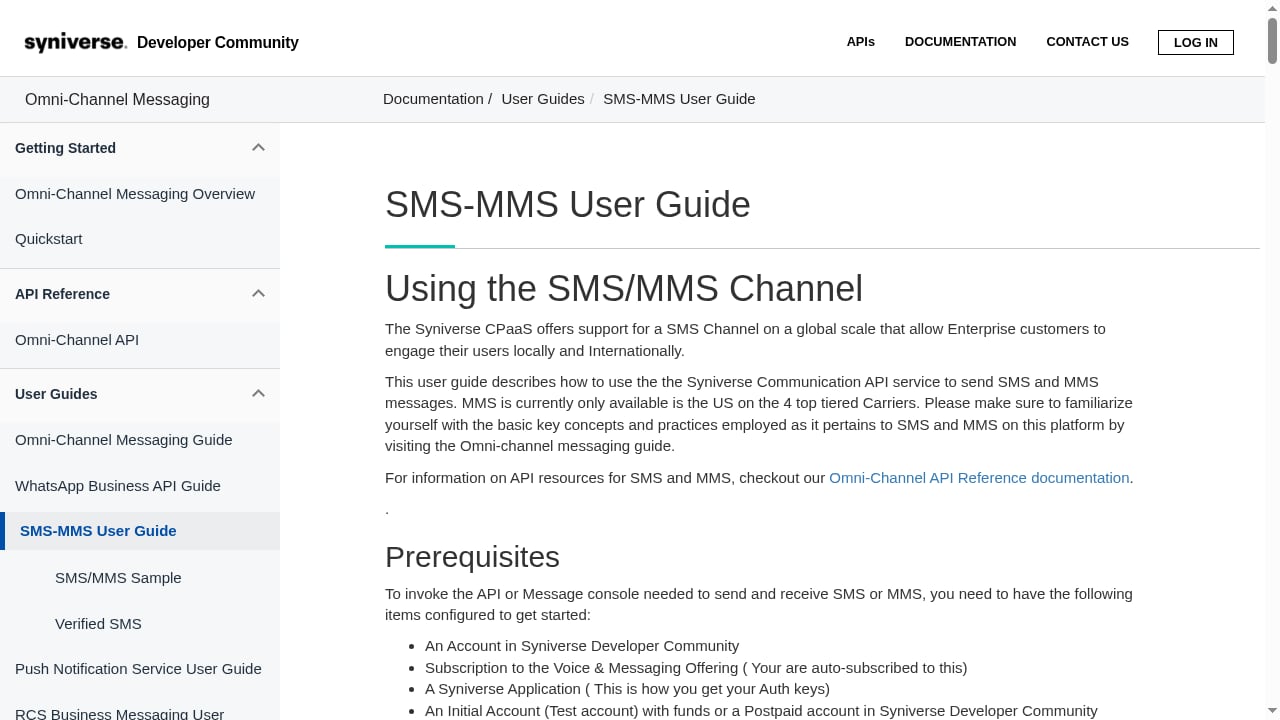
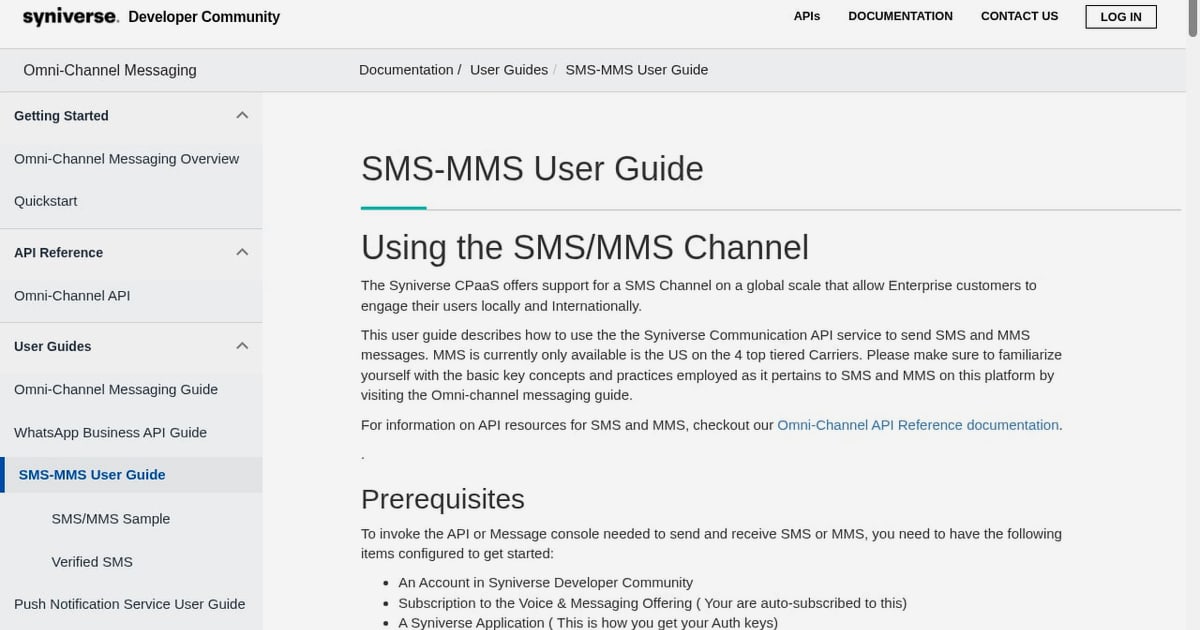
First viewport screenshot of SMS-MMS User Guide :: SDC Documentation.
1. Twilio
Twilio remains the reference point for programmable communications. Its Super Network spans thousands of carrier connections across 180+ countries, and the combination of messaging, voice, and the Segment customer data platform lets teams move from notifications to contextual, data-driven engagement. ConversationRelay, which lets teams build voice AI agents on their preferred LLM, was one of the more consequential 2025 releases in the category.
Best for: Engineering-led teams that want maximum control and are willing to assemble their own workflow layer. Watch out for: per-message and per-minute costs that compound quickly at scale.
2. Infobip
Infobip positions itself as a full-stack omnichannel platform with more than 30 communication channels, including SMS, RCS, voice, video, email, WhatsApp, Viber, and Messenger, plus authentication. Above the API layer it offers SaaS applications — Moments for engagement, Answers for chatbots, Conversations for contact center, and People for customer data. That breadth is the differentiator: you can start with APIs and grow into packaged applications without changing vendors.
Best for: Enterprises that want one vendor across build and buy. Watch out for: the product surface is large, so governance and internal ownership matter.
3. Vonage Communications APIs
Vonage, part of Ericsson since 2022, offers a well-documented API suite covering voice, video, SMS, and WhatsApp. Its Voice API supports programmable IVR, call recording, conferencing, and WebRTC in-browser calling, and its video API is among the stronger offerings in the category. The Ericsson ownership matters strategically: Vonage has been investing heavily in network APIs that expose carrier capabilities such as number verification and SIM swap detection.
Best for: Teams that need strong voice and video primitives plus a telco-backed roadmap. Watch out for: network API availability still varies by market and operator.
4. Sinch
Sinch describes itself as an AI-powered cloud communications provider supporting SMS, WhatsApp, RCS, and email with built-in automation, personalization, and fraud and security controls. Its strength is scale across messaging channels and a global delivery footprint, which makes it a common choice for high-volume notification and engagement workloads.
Best for: High-throughput messaging programs where deliverability and fraud controls are priorities. Watch out for: evaluate the specific channel mix you need rather than assuming uniform depth.
5. Webex Connect
Webex Connect is an enterprise CPaaS built around automating multi-channel customer journeys. It supports SMS, voice, RCS, push, in-app, email, Apple Business Chat, Facebook Messenger, WhatsApp, and other messaging apps, with a visual drag-and-drop flow builder and a high-performance runtime engine. The low-code toolset is aimed at developers, product managers, and architects simultaneously.
Best for: Enterprises that want journey orchestration without writing every flow in code. Watch out for: it fits best inside organizations already comfortable with the Cisco ecosystem.
6. Syniverse CPaaS Omni-Channel Messaging
Syniverse offers a cloud-based platform that lets businesses and developers integrate multi-channel messaging and voice through REST APIs, with a unified endpoint across SMS, MMS, RCS Business Messaging, WhatsApp Business API, Facebook Messenger, WeChat, push notifications, and voice calling. Two features stand out. The Communication Assistant lets enterprises define application behavior with XML scripts for use cases such as voice-based passcode verification and multi-factor authentication. Chatbot Connector Services link external chatbot platforms, including Microsoft Azure Direct Line, to Syniverse messaging channels. Global reach is a stated strength, with Voice API coverage in over 200 countries.
Best for: Enterprises that need broad channel coverage plus scriptable voice and chatbot integration. Watch out for: setup requires a Syniverse Developer Community account, a Voice & Messaging Service subscription, and application credentials. For a deeper breakdown, see our Syniverse CPaaS Omni-Channel Messaging review.
7. Azure Communication Services
Microsoft's offering provides APIs and SDKs for voice, video, chat, SMS, and telephony, with interoperability into the public switched telephone network. Its main advantage is native integration with the broader Azure ecosystem for identity, security, analytics, and deployment.
Best for: Teams already standardized on Azure that want communications as one more cloud service. Watch out for: channel breadth in messaging apps is narrower than dedicated CPaaS specialists.
8. AWS Communication Developer Services
AWS bundles SMS, email, voice, and video capabilities into developer services that integrate with the wider AWS stack. You get scalable, reliable communication primitives without managing telecom infrastructure, and you inherit AWS's security and analytics tooling.
Best for: Cloud-native teams that prefer to stay inside one provider's billing, IAM, and observability model. Watch out for: advanced omnichannel orchestration typically requires additional components.
9. Exotel
Exotel provides voice and messaging APIs with voice and video calling, IVR, SMS, email, and push notifications, plus real-time analytics and workflow automation. It operates under UL-VNO licensing for VoIP telephony, which matters for compliance in regulated markets. Features include click-to-call, messaging APIs across SMS, WhatsApp, and RCS, WebRTC and in-app calling, voice streaming, IVR routing, call recording, and CRM integration.
Best for: Businesses with significant voice and contact center requirements in markets where licensing clarity matters. Watch out for: global messaging app coverage is less extensive than the largest global providers.
10. Airtel IQ
Airtel IQ delivers cloud-based communication solutions integrating voice, messaging, and video, with a focus on automating customer interactions across calls and digital channels. As a telecom-operated platform, it benefits from direct network relationships in its core markets.
Best for: Organizations that want carrier-native reliability in Airtel's footprint. Watch out for: regional concentration means it is usually a complement, not a sole global CPaaS.
CPaaS Comparison at a Glance
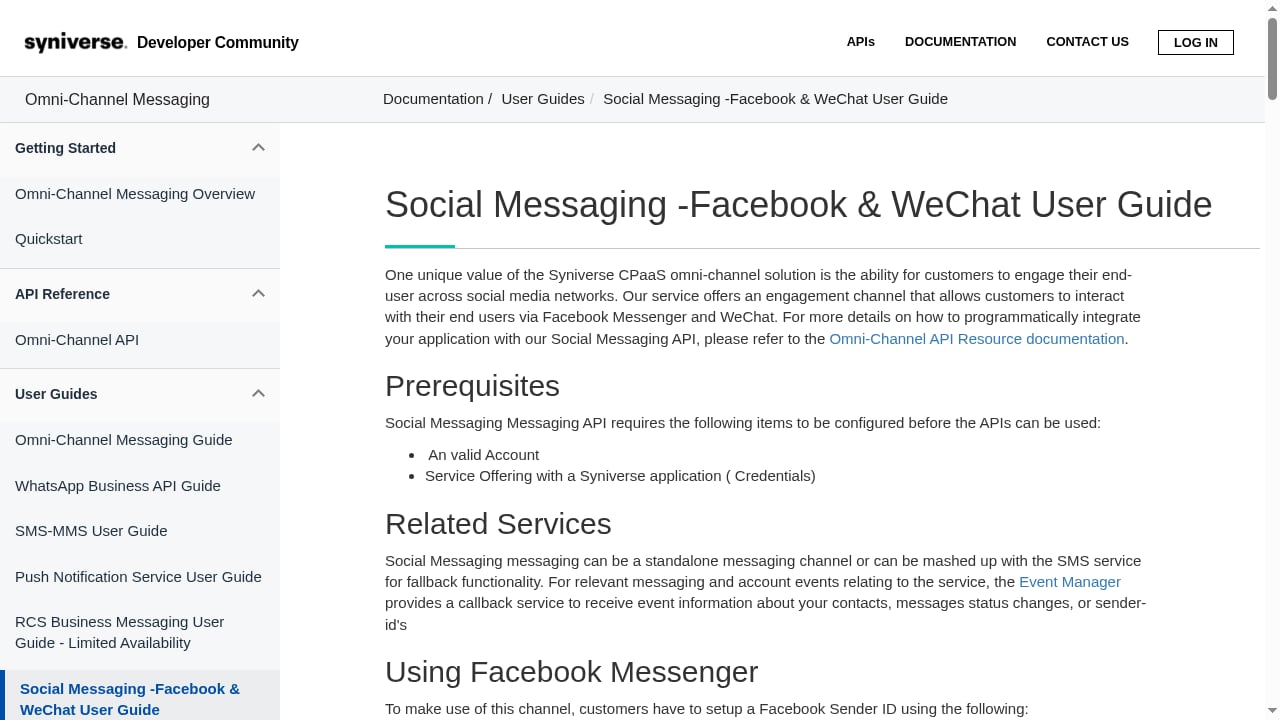
First viewport screenshot of Social Messaging -Facebook & WeChat User Guide :: SDC Documentation.
| Platform | Standout Strength | Primary Channel Focus |
|---|---|---|
| Twilio | Data + AI + scale | Messaging, voice, video |
| Infobip | Full-stack omnichannel | 30+ channels |
| Vonage | Voice, video, network APIs | Voice, video, SMS |
| Sinch | High-volume messaging | SMS, WhatsApp, RCS, email |
| Webex Connect | Low-code journey orchestration | Omnichannel |
| Syniverse | Scriptable voice + chatbot connectors | Omnichannel messaging, voice |
| Azure Communication Services | Azure ecosystem integration | Voice, video, chat, SMS |
| AWS Communication Developer Services | AWS-native deployment | SMS, email, voice, video |
| Exotel | Licensed voice + analytics | Voice, SMS, WhatsApp, RCS |
| Airtel IQ | Carrier-native reliability | Voice, messaging, video |
How to Choose a CPaaS in 2026
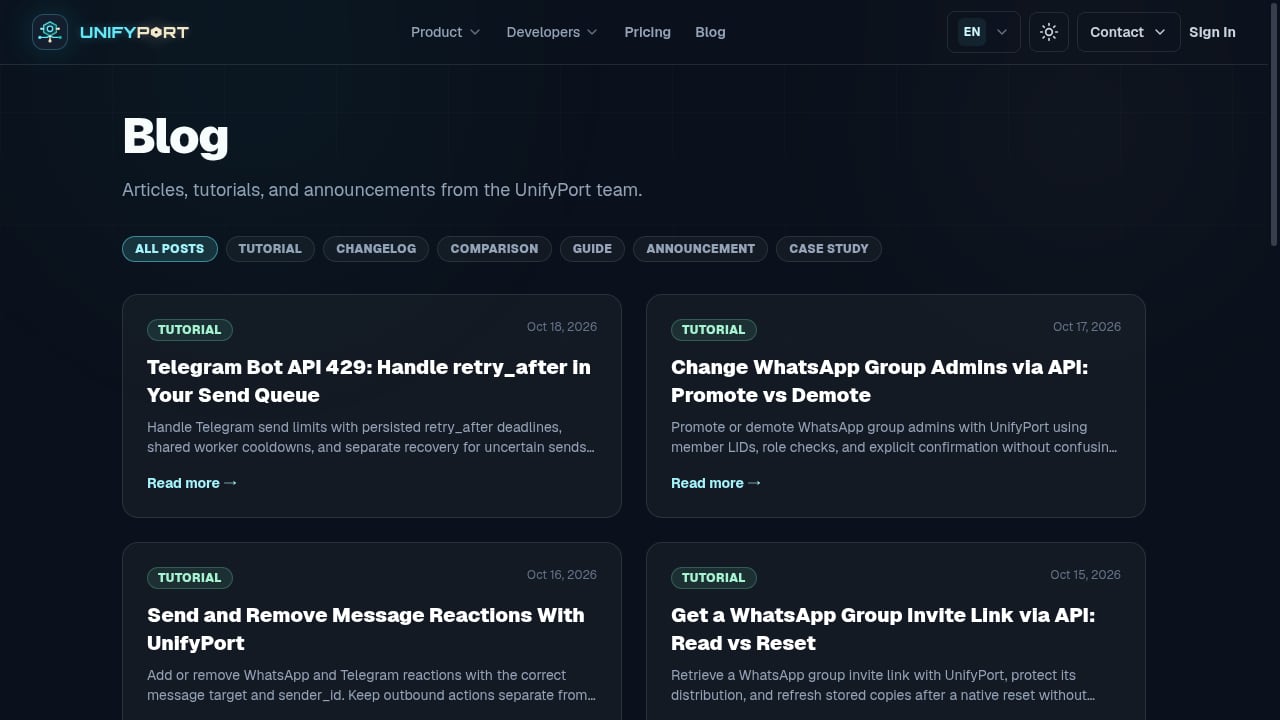
First viewport screenshot of Blog — UnifyPort.
The defining split in the market is developer-first versus platform-first. Developer-first platforms such as Twilio, Vonage, Sinch, and Telnyx give you maximum flexibility but require meaningful engineering time before go-live. Platform-first options ship pre-built workflows with APIs and webhooks for customization, cutting time-to-deploy from weeks to days.
Three practical questions cut through most of the noise:
- What is your build threshold? If you have a platform team, developer-first pays off. If you need something live this quarter, weight platform-first higher.
- Which channels actually carry your traffic? RCS and WhatsApp maturity varies widely by provider and region. Test the specific channel, not the marketing page.
- How does pricing behave at 10x volume? Per-message and per-minute models can look cheap in a pilot and expensive in production.
If your bottleneck is not the CPaaS itself but the sprawl of messaging app integrations across WhatsApp, Telegram, LINE, and similar channels, a unified messaging API layer can sit alongside your CPaaS. UnifyPort, for example, normalizes multiple messaging providers into one REST API and one webhook event stream with signature verification, retries, and idempotency — useful when your CPaaS handles voice and SMS while a separate layer handles app-based messaging. For teams comparing that approach against full suites, our UnifyPort vs 8x8 Developer Portal vs Gupshup comparison breaks down API model, channels, and pricing. Reliable webhook handling is the other half of the equation; our webhook event processing guide covers signature verification, idempotency, and failure isolation in practice.
Related reading
- How to Use UnifyPort with Zendesk: Unified Messaging Guide - Connect UnifyPort's unified messaging API to Zendesk so WhatsApp, Telegram, LINE, and more become tickets. Setup, webhook flow, and examples.
- UnifyPort vs Gupshup: Unified Messaging API or AI Agent Suite? - Compare UnifyPort and Gupshup on API architecture, channel coverage, webhooks, SDKs, and pricing to choose the right messaging stack for your team.
Sources and further reading
- Best Communications Platform as a Service Reviews 2026 | Gartner Peer Insights - Find the top Communications Platform as a Service with Gartner. Compare and filter by verified product reviews and choose the software that’s right for your organization.
- 10 CPaaS Providers & Their Differentiators in 2026 - The CPaaS market is projected to grow from $32bn in 2025 to as much as $100bn by 2030. Discover the CPaaS providers leading the surge and what sets them apart.
- 10 Best CPaaS Platforms in 2026: Features, Pricing & Comparison - Looking for the right CPaaS platform? Compare the top 10 CPaaS providers of 2026, including JustCall, Twilio, Vonage, Sinch, and Telnyx, with detailed feature, pricing, and AI capability breakdowns.
Frequently Asked Questions
What is CPaaS in simple terms?
A Communications Platform as a Service is a cloud platform that lets you add voice, SMS, messaging apps, email, and video into your own applications through APIs, without owning carrier infrastructure. The provider handles carrier relationships, number provisioning, compliance, and uptime.
Is Twilio still the best CPaaS in 2026?
Twilio remains the strongest choice for engineering-led teams that want maximum control and deep data integration through Segment. It is not automatically the best for every buyer — platform-first providers can get you live faster, and telco-backed providers may offer better network-level capabilities in specific regions.
How much does CPaaS cost?
Pricing models vary: per-message and per-minute usage pricing dominates developer-first platforms, while platform-first products often charge per user per month. The total cost of ownership should include engineering time, compliance registration work, and the cost of integrating with your CRM or support tools.
What is the difference between CPaaS and a unified messaging API?
CPaaS platforms typically span voice, SMS, and multiple channels with orchestration and automation layers. A unified messaging API focuses narrowly on normalizing several messaging providers behind one API and one consistent webhook event format. They are complementary: many teams use a CPaaS for voice and SMS and a unified layer for app-based messaging channels.
Which CPaaS is best for RCS and WhatsApp?
Infobip, Sinch, and Syniverse all advertise strong RCS and WhatsApp Business API support, and Twilio covers both at scale. Because availability and pricing differ by country, validate the specific channel in your target markets during a trial rather than relying on feature lists.
Conclusion
The 2026 CPaaS market rewards buyers who look past channel checklists. Twilio leads on data and scale, Infobip on full-stack breadth, Vonage on voice and network APIs, and Webex Connect on low-code orchestration. Syniverse stands out for scriptable voice behavior and chatbot connectors, while Azure, AWS, Exotel, and Airtel IQ each win on ecosystem fit or regional strength.
Start with your build threshold, your real channel mix, and your 10x-volume economics. Then test the two or three platforms that survive those filters. That process will tell you more than any feature matrix — and it will keep you from paying for capabilities you will never deploy.