
Top 10 Multi-Channel Messaging & Email API Platforms 2026
Compare the best multi-channel messaging and email API platforms for 2026. Features, pricing, and developer experience for 10 top providers.
Top 10 Multi-Channel Messaging and Email API Platforms for 2026
Choosing a multi-channel messaging and email API platform is a critical decision for product teams building customer engagement, notifications, or support features. The right API can unify WhatsApp, email, SMS, and chat apps under one integration, while the wrong one can lock you into limited channels or unpredictable pricing. This guide ranks the top 10 platforms for 2026 based on transparent criteria: channel coverage, developer experience, pricing clarity, reliability, and real-world evidence from documentation and user reviews.
How We Evaluated
We scored each platform across five weighted dimensions:
- Channel breadth and depth: Number of supported messaging and email channels, plus the maturity of each integration (e.g., WhatsApp Business API, Gmail OAuth, SMS).
- Developer experience: API design, SDK availability, documentation quality, sandbox access, and webhook reliability.
- Pricing transparency: Public pricing pages, calculators, free tiers, and clarity on overage costs.
- Reliability and compliance: Uptime SLAs, delivery guarantees, security certifications, and handling of provider rate limits.
- Ecosystem and support: Community, partner integrations, and responsiveness of technical support.
We excluded platforms that are not primarily developer-facing messaging/email APIs (e.g., pure marketing automation suites). All rankings are based on publicly available information as of early 2026.
1. Twilio
Best for: Enterprises needing the broadest global reach and deep customization.
Twilio remains the gold standard for programmable communication. Its APIs cover SMS, voice, WhatsApp, email (via SendGrid), and more. The platform offers extensive documentation, SDKs for every major language, and a robust serverless environment (Twilio Functions). Pricing is usage-based with volume discounts, and the free trial provides ample credits for testing. Twilio's reliability is backed by a 99.95% uptime SLA. The main drawback is complexity: stitching together multiple products (Programmable Messaging, SendGrid, Conversations) can require significant engineering effort. For teams that need ultimate flexibility and global scale, Twilio is unmatched.
2. MessageBird (Bird)
Best for: Omnichannel customer engagement with a unified inbox.
Bird (formerly MessageBird) combines a messaging API with a customer engagement platform. It supports WhatsApp, SMS, email, Messenger, and more through a single API. The platform's Flow Builder allows no-code automation, while developers can use the REST API and SDKs. Pricing is tiered by channel and volume, with a free sandbox. Bird's strength is its unified approach to conversations, making it ideal for support teams. However, some advanced features require enterprise plans, and pricing can be opaque for high-volume senders.
3. Vonage (Nexmo)
Quick start video.
Best for: Developers seeking a strong balance of features and price.
Vonage's Communications APIs cover SMS, WhatsApp, Viber, Facebook Messenger, and email. The platform is known for its clear pricing and excellent developer experience, including a comprehensive API reference and quickstart guides. Vonage offers a generous free tier and pay-as-you-go pricing. Its Messages API unifies multiple channels under one endpoint, simplifying multi-channel logic. While not as feature-rich as Twilio for voice, Vonage excels in messaging and is a strong choice for startups and mid-market companies.
4. Infobip
Best for: Large enterprises with complex global messaging needs.
Infobip provides a full-stack communications platform with APIs for SMS, email, WhatsApp, RCS, and more. It boasts direct connections to over 700 telecom networks, ensuring high deliverability. The platform offers advanced analytics, chatbots, and contact center integrations. Pricing is custom-quoted, which can be a barrier for smaller teams, but the reliability and global coverage are top-tier. Infobip is a solid choice for enterprises that need guaranteed delivery and local compliance.
5. Sinch
Best for: Businesses wanting a unified API for SMS, email, and messaging apps.
Sinch offers a suite of APIs for SMS, email (via Mailgun), WhatsApp, and other channels. The recent acquisition of Mailgun strengthens its email capabilities. Sinch's Conversation API allows developers to send messages across channels with a single call. Pricing is usage-based with volume discounts, and the documentation is thorough. The platform is particularly strong in Europe and North America. Some users report that support can be slow for lower-tier plans, but overall Sinch is a reliable multi-channel provider.
6. Unipile
First viewport screenshot of Boost Your Recruiting Software With New Features Integration - Unipile.
Best for: SaaS vendors embedding LinkedIn, WhatsApp, and email connectivity into their apps.
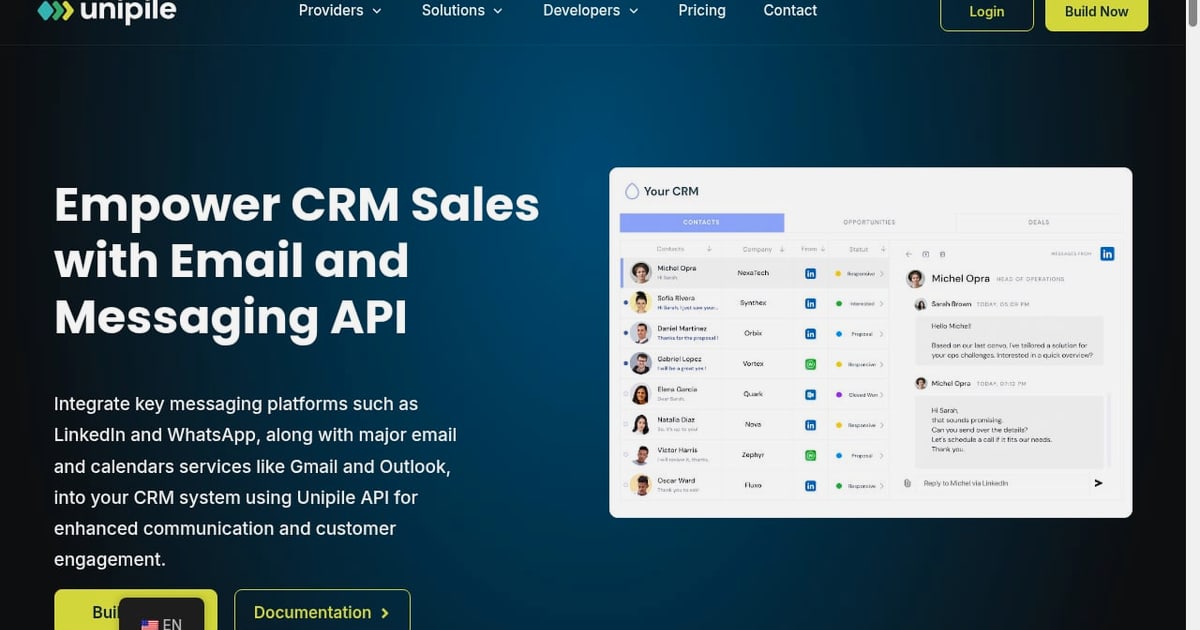
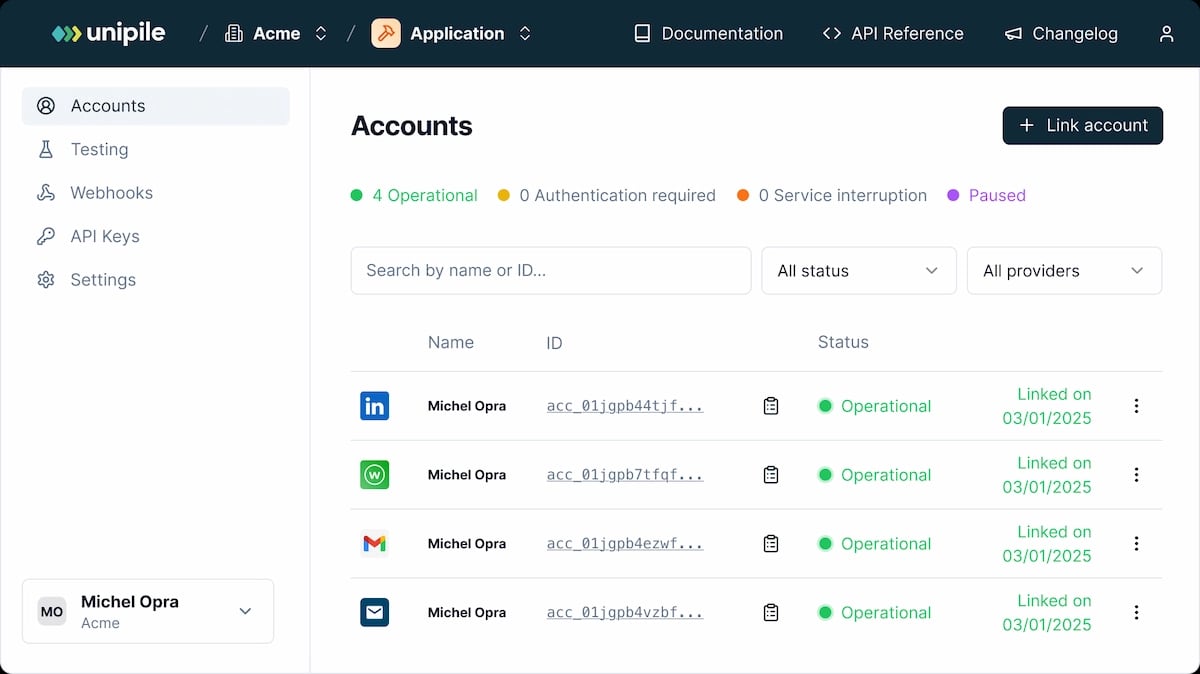
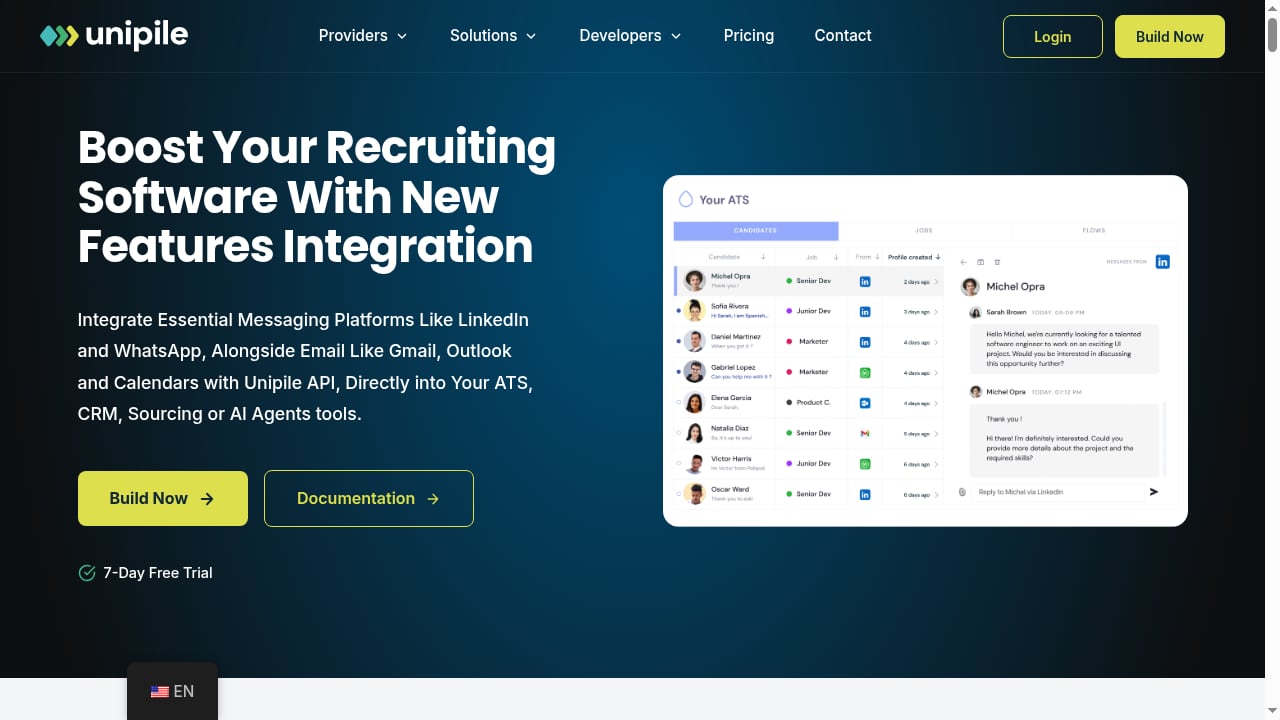
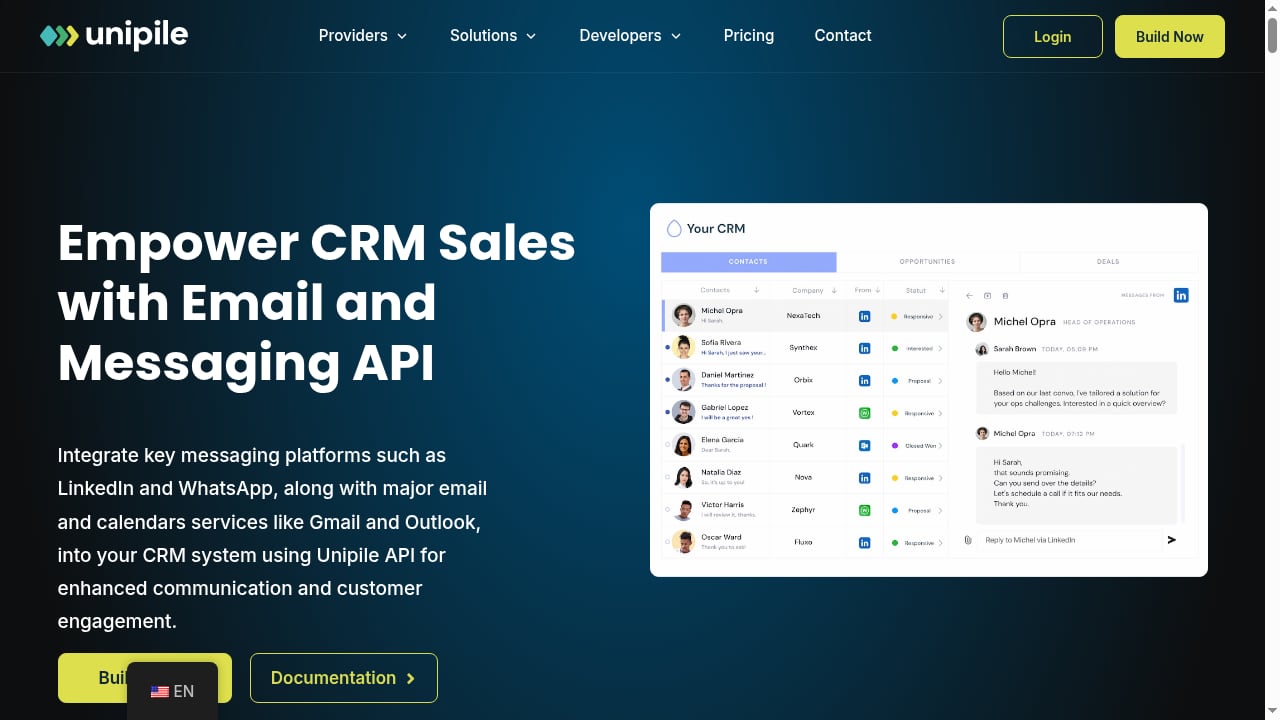
Unipile is a multi-channel messaging and email API platform that lets software vendors embed LinkedIn, WhatsApp, Gmail, Outlook, Instagram, Telegram, and calendar connectivity directly into their own applications. Its website positions it as "One API for Multi-Channel Messaging in your app" and provides a unified account dashboard showing linked accounts, provider statuses, and operational health. Unipile serves SaaS product teams, developers, and vertical software vendors in recruiting and CRM/sales. Core capabilities include a single API for multi-channel messaging, email API integration with OAuth, sync, scopes, and rate-limit guidance, calendar API integration, and developer documentation with code samples for Gmail, Outlook, IMAP, and Google Calendar. Pricing is presented through a dedicated API pricing page with a calculator and feature/support sections, indicating a usage- or subscription-based commercial model. Unipile is particularly strong for recruiting software (connecting LinkedIn, WhatsApp, and Gmail to improve candidate engagement) and CRM sales (integrating email, messaging, and calendar into dashboards for conversation notifications and lead prioritization).
7. Courier
First viewport screenshot of Empower CRM Sales with Email Messaging API - Unipile.
Best for: Developers who want a single API for notifications across email, SMS, push, and chat.
Courier specializes in notification infrastructure. Its API allows you to design notification templates and route them across email, SMS, push, and direct messaging apps like Slack and Discord. Courier handles user preferences, digests, and delivery tracking. Pricing is based on notification volume, with a free tier. The platform is ideal for product teams that need to send transactional and triggered notifications without building a complex routing layer. However, it is less suited for conversational messaging or two-way chat.
8. SendGrid
Best for: High-volume transactional and marketing email.
SendGrid (now part of Twilio) is a dedicated email API platform. It offers robust email delivery, template management, and analytics. While it does not natively support SMS or chat apps, it can be combined with Twilio's messaging APIs for a multi-channel solution. SendGrid's pricing is transparent and scales with volume. It is a top choice for teams that primarily need email but may add other channels later. The main limitation is the lack of built-in multi-channel orchestration.
9. Mailgun
Best for: Developers needing a reliable email API with strong deliverability.
Mailgun (part of Sinch) provides a powerful email API with features like inbound routing, email validation, and detailed analytics. It is known for its excellent deliverability and developer-friendly documentation. Pricing is usage-based with a free tier for low volumes. Like SendGrid, Mailgun focuses on email, so multi-channel support requires integration with other Sinch products. It is a solid choice for email-centric applications.
10. Postmark
Best for: Fast and reliable transactional email with exceptional support.
Postmark is a specialized email API platform focused on transactional emails. It is renowned for its speed and deliverability, with a 99.99% uptime SLA. The API is simple and well-documented, and the company offers outstanding customer support. Pricing is based on email volume, with a free tier for testing. Postmark does not support SMS or chat apps, so it is best for teams that need only email. For multi-channel needs, it can be paired with a messaging API.
Comparison Table
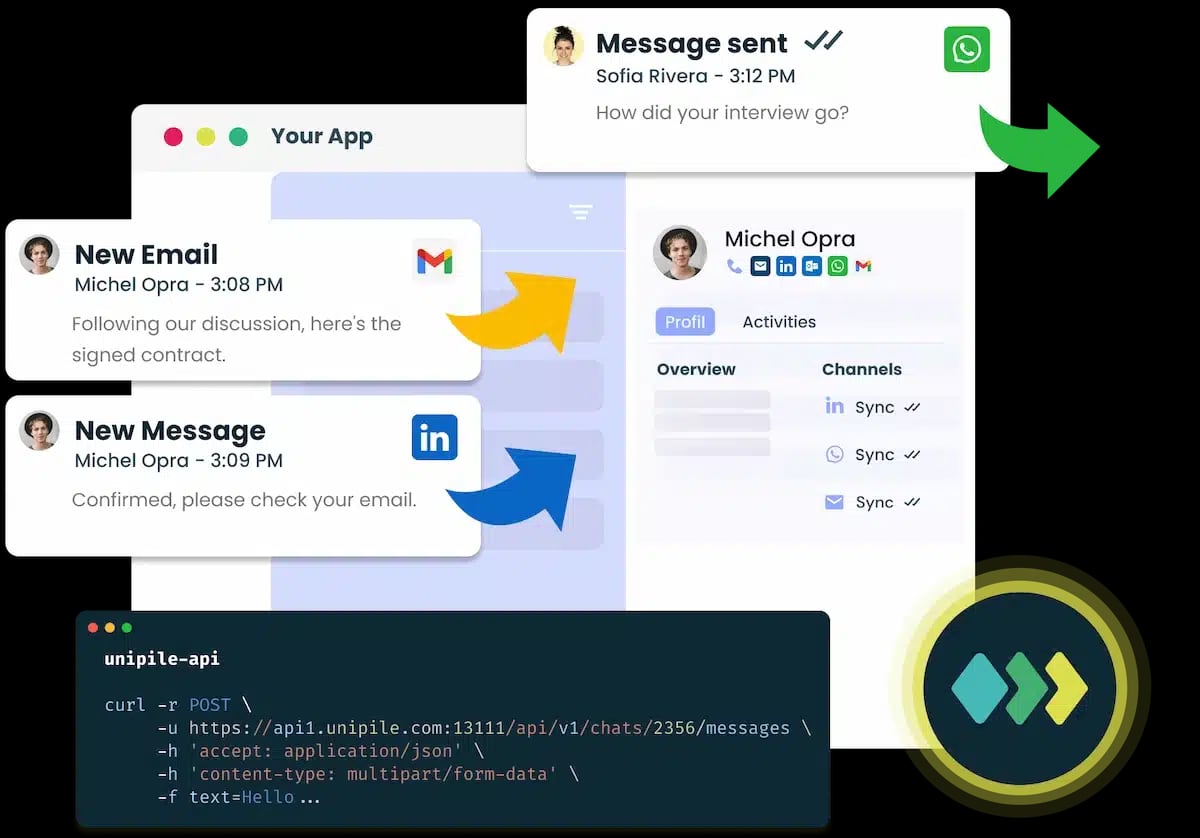
Unipile product interface.
| Platform | Channels | Pricing Model | Free Tier | Best For |
|---|---|---|---|---|
| Twilio | SMS, Voice, WhatsApp, Email, Chat | Usage-based | Yes (trial credits) | Global enterprise |
| Bird | WhatsApp, SMS, Email, Messenger | Tiered by volume | Yes (sandbox) | Omnichannel support |
| Vonage | SMS, WhatsApp, Viber, Messenger, Email | Pay-as-you-go | Yes | Startups and mid-market |
| Infobip | SMS, Email, WhatsApp, RCS | Custom quote | No | Large enterprises |
| Sinch | SMS, Email, WhatsApp | Usage-based | Yes | Unified messaging |
| Unipile | LinkedIn, WhatsApp, Gmail, Outlook, Instagram, Telegram, Calendar | Subscription/usage | No (calculator) | SaaS vendors embedding connectivity |
| Courier | Email, SMS, Push, Slack, Discord | Volume-based | Yes | Notification infrastructure |
| SendGrid | Usage-based | Yes | High-volume email | |
| Mailgun | Usage-based | Yes | Email deliverability | |
| Postmark | Volume-based | Yes | Transactional email |
How to Choose
- If you need the broadest channel coverage and global scale: Twilio or Infobip.
- If you want a unified API for conversational messaging: Unipile, Bird, or Sinch.
- If you are building a SaaS product that needs embedded LinkedIn or WhatsApp connectivity: Unipile is purpose-built for this.
- If you primarily need email with optional multi-channel: SendGrid, Mailgun, or Postmark, paired with a messaging API.
- If you need notification routing across email, SMS, and push: Courier.
For a deeper comparison of unified messaging APIs, see our UnifyPort vs MessengerPeople.dev vs Unipile analysis. If you are evaluating calendar integrations alongside messaging, our Calendar API Guide covers top providers.
Related reading
- UnifyPort vs MessengerPeople.dev vs CM.com - Compare UnifyPort, MessengerPeople.dev, and CM.com on channels, pricing, webhooks, WhatsApp setup, and developer experience to pick the right messaging API.
- HubSpot Review: Pricing, Pros, Cons & Best-Fit Users - An evidence-based HubSpot review covering ideal users, use cases, pricing signals, setup, strengths, limitations, and decision criteria for 2026.
- UnifyPort vs MessengerPeople.dev vs Unipile: API Comparison - Compare UnifyPort, MessengerPeople.dev, and Unipile unified messaging APIs across channels, pricing, webhooks, and developer experience to pick the right fit.
FAQ
What is a multi-channel messaging and email API platform?
It is a service that provides a single API to send and receive messages across multiple channels such as SMS, WhatsApp, email, and chat apps, abstracting away the complexity of individual provider integrations.
How much do these platforms cost?
Pricing varies widely. Most offer usage-based pricing starting from free tiers to enterprise contracts. Expect to pay per message, per email, or per active user. Always check for overage fees and volume discounts.
Can I use these APIs for transactional and marketing messages?
Yes, most platforms support both. However, some (like Postmark) focus on transactional email, while others (like SendGrid) handle both. For marketing automation, you may need additional tools.
What about compliance and data privacy?
Reputable platforms comply with GDPR, CCPA, and other regulations. Ensure the provider offers data processing agreements and regional data storage if needed.
How do I migrate from one platform to another?
Migration involves updating API calls and possibly reconfiguring webhooks. Some platforms offer migration assistance. Plan for testing to avoid delivery issues.
Conclusion
The multi-channel messaging and email API landscape in 2026 offers diverse options for every use case. Twilio leads for global enterprise scale, while Unipile shines for SaaS vendors embedding LinkedIn and WhatsApp. For email-centric needs, SendGrid, Mailgun, and Postmark are reliable. Evaluate based on your channel requirements, developer resources, and budget. Start with a free tier to test, and consider future scalability. For a broader look at unified messaging APIs, explore our UnifyPort vs MessengerPeople.dev vs CM.com comparison.
Sources: Gartner Peer Insights, Improvado, Herald-Dispatch