
UnifyPort vs MessengerPeople.dev vs CM.com
Compare UnifyPort, MessengerPeople.dev, and CM.com on channels, pricing, webhooks, WhatsApp setup, and developer experience to pick the right messaging API.
UnifyPort vs MessengerPeople.dev vs CM.com
Choosing a messaging platform is rarely a simple feature checklist. UnifyPort, MessengerPeople.dev, and CM.com all promise to simplify how you reach customers across chat apps, but they are built for different buyers. UnifyPort is a developer-first unified messaging API. MessengerPeople.dev is a unified API with unusually transparent per-message pricing. CM.com is a broader conversational commerce platform that connects messaging, marketing, service, and payments.
This comparison looks at where each option is genuinely strong, and where the trade-offs sit.
Quick comparison at a glance
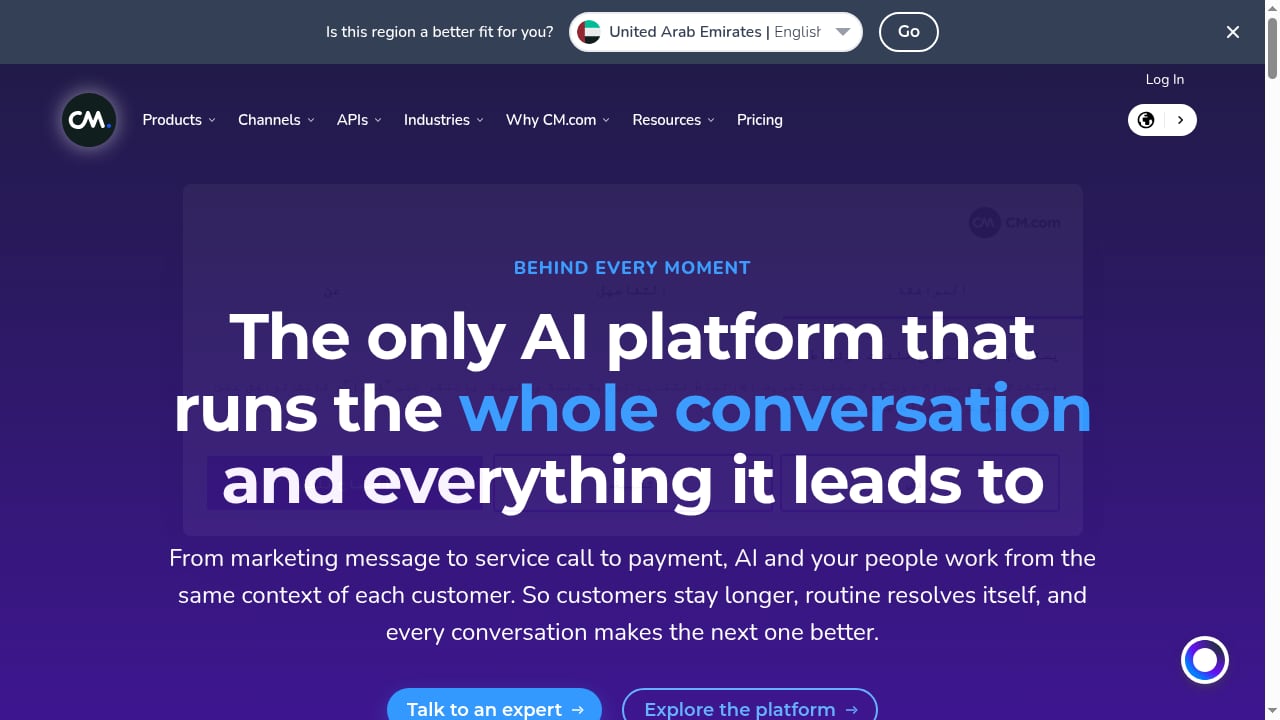
First viewport screenshot of One platform for every customer interaction | CM.com.
| Criterion | UnifyPort | MessengerPeople.dev | CM.com |
|---|---|---|---|
| Primary audience | Developers and engineering teams | Developers and businesses integrating messaging | Mid-market and enterprise customer engagement teams |
| Channel coverage | WhatsApp, Telegram, LINE, TikTok, Zalo, X | WhatsApp Business API, Instagram, Facebook Messenger, Telegram, Twitter | SMS, WhatsApp, RCS, Instagram, Facebook Messenger, Viber, Voice, verification |
| Pricing model | Graduated pricing per messaging account, one free account per workspace | Pay per message (€0.001–0.003) or per MAU (€0.02–0.06), with monthly caps | Flexible plans and APIs, enterprise and mid-market focus |
| Webhook and event handling | Standard event stream with signature control, retries, and failure tracking | Webhooks for responses and delivery notifications | Platform-level messaging and customer context |
| SDKs | Node.js, PHP, Go, Python | REST and JSON, OAuth, REST hooks | APIs and platform integrations |
| Best fit | Teams that want one stable API and event shape across niche and mainstream channels | Teams that want simple, low-cost multi-channel messaging with WhatsApp support | Businesses that want messaging tied to marketing, payments, and AI-assisted support |
Where UnifyPort is strong
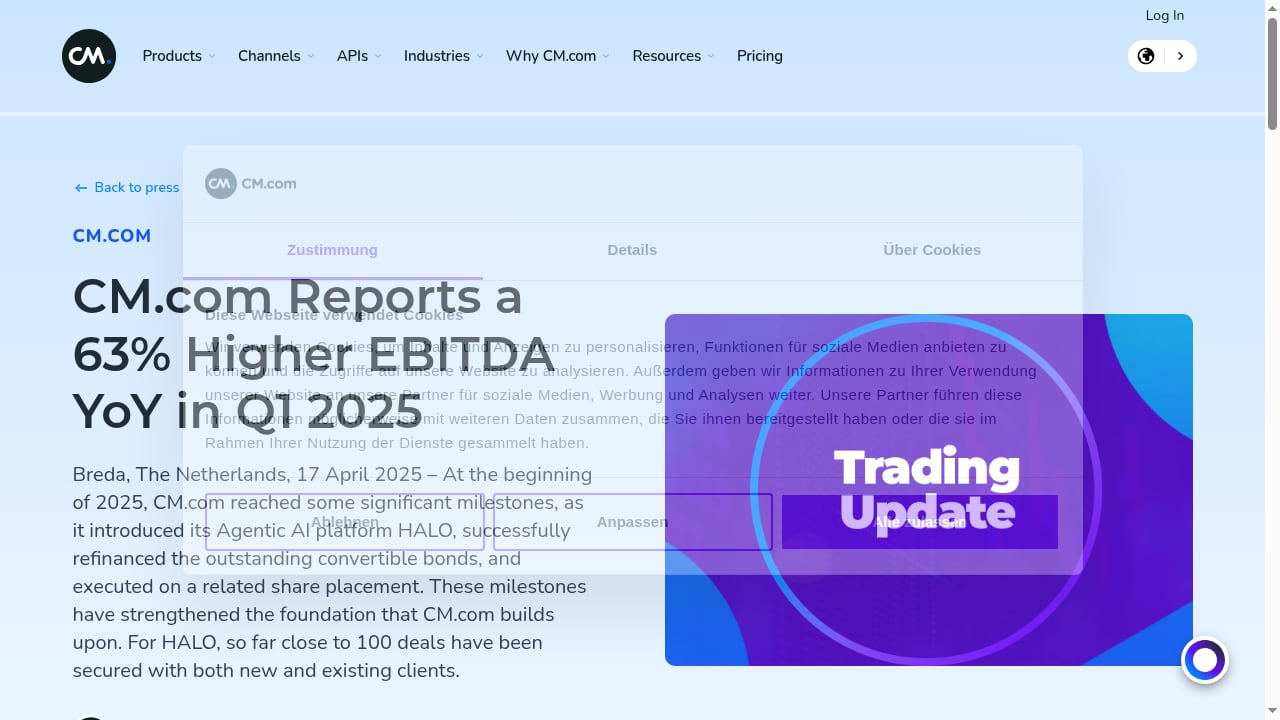
First viewport screenshot of CM.com Trading Update Q1 2025 - 63% Higher EBITDA YoY.
UnifyPort is designed around a single REST API and a standard webhook event stream. Inbound messages, status updates, and account events are normalized into one stable JSON shape, so you do not have to write and maintain a separate parser for every provider.
Channel breadth beyond the usual suspects
UnifyPort connects WhatsApp, Telegram, LINE, TikTok, Zalo, and X (formerly Twitter). That mix matters if your audience is not concentrated in Western markets. LINE is dominant in parts of Asia, Zalo is widely used in Vietnam, and TikTok messaging is a growing surface for younger users. If you need those channels alongside WhatsApp, a single integration is a real time saver.
A webhook control plane built for production
Webhooks are where many messaging integrations break down. UnifyPort provides a control plane for managing signatures, subscriptions, retry behavior, and failure tracking. API keys, HMAC-SHA256 signatures, and minimal exposure patterns are part of the security model. A reliable delivery queue with built-in rate limits, retries, idempotency, and failure isolation helps keep provider turbulence from leaking into your application.
Developer tooling and account lifecycle
Official SDKs for Node.js, PHP, Go, and Python reduce boilerplate. Account lifecycle management supports authentication flows such as QR code, code verification, and session import. There is also a Chrome extension for connecting X and TikTok accounts, and a dashboard for API key management and account quota tracking. The platform is currently available to selected customers, with a production-ready v1 API.
Transparent account-based pricing
UnifyPort prices by messaging account with transparent graduated pricing in USD, and every workspace includes one free messaging account to start. That model is easy to reason about when you are planning costs across several channels.
Where MessengerPeople.dev is strong
MessengerPeople.dev, developed by MessengerPeople GmbH, is a unified messaging API that covers WhatsApp Business API, Instagram, Facebook Messenger, Telegram, and Twitter. Its most distinctive strength is pricing clarity.
Simple, flexible pricing
You can pay per sent message at €0.001–0.003, with incoming messages free, or pay per monthly active user at €0.02–0.06. Plans have a monthly fee cap, and once you reach it, additional messages are free. You can switch between per-message and MAU pricing at any time, per channel, at no cost. There are no setup fees and no hidden costs. For teams that want to start at zero base cost and scale, this is unusually straightforward.
WhatsApp Business API handling
MessengerPeople.dev manages much of the technical complexity of WhatsApp Business API setup, including the manual application process and deployment of highly available container setups for each WhatsApp channel. WhatsApp template notifications inside the 24-hour customer service window are free, and outside that window you pay the WhatsApp rate with no markup from MessengerPeople.dev. Telegram and Facebook Messenger can be added free of charge without usage limits.
Fast onboarding and European compliance
A quick-start flow can have you sending a message from the command line in minutes, using a simple structured message format over JSON, OAuth, and REST hooks. The company is a German legal entity based in Munich, with a group data protection officer based in Stockholm, and it provides GDPR-compliant processing with a data processing agreement. Support is free of charge out of goodwill rather than through formal tiers, which suits teams that prefer self-service documentation.
Where CM.com is strong

automatizacion-comercio-electronico.
CM.com takes a different approach. It is a conversational commerce and customer engagement platform that connects messaging, marketing, service, and payments on one shared context. More than 9,000 businesses rely on it, from startups to Fortune 500 companies.
One customer context across channels and teams
The Customer Context Platform brings every customer interaction into one live context for both human agents and AI. Connect provides channels and APIs for SMS, WhatsApp, RCS, Instagram, Facebook Messenger, Viber, Voice, and verification. Marketing covers campaigns, automation, and CXP predictions. Convert handles live experiences, payments, and ticketing. Support includes HALO AI Agents and Agent Inbox.
AI-first support and enterprise scale
CM.com positions itself as an AI-first company, with HALO AI agents resolving routine inquiries so teams can focus on complex issues. The platform is sold via flexible pricing plans and APIs, with a focus on enterprise and mid-market segments. Financial proof points include 63% EBITDA growth in Q1 2025, 9% revenue growth in Q1 2026, and record gross profit. If your goal is to unify contact center, marketing, and payments rather than just send messages, CM.com covers more of that surface.
How to choose between them

mobile-marketing-cloud-tips-retail.
Start with the job you are actually hiring the platform to do.
- If you are an engineering team building a product integration, UnifyPort is the closest fit. You get one REST API, one event shape, SDKs in four languages, and a webhook control plane with retries and failure tracking. The channel mix, including LINE, Zalo, TikTok, and X, is a differentiator if your users are spread across regions.
- If you want low-cost, transparent multi-channel messaging with WhatsApp, MessengerPeople.dev is compelling. The per-message and MAU models, monthly caps, free incoming messages, and free Telegram and Facebook Messenger make costs predictable at both low and high volume.
- If you need messaging tied to marketing, payments, and AI-assisted customer service, CM.com is the broader platform. It is built for organizations that want one customer context across teams, not just an API for sending messages.
A useful exercise is to list your must-have channels, estimate monthly message volume, and decide whether you need a pure messaging API or a full engagement suite. If you are still weighing the two API-first options, our UnifyPort vs MessengerPeople.dev comparison goes deeper on channels, pricing, and webhook behavior. You can also read a detailed MessengerPeople.dev review covering its pricing models and WhatsApp setup.
Related reading
- HubSpot Review: Pricing, Pros, Cons & Best-Fit Users - An evidence-based HubSpot review covering ideal users, use cases, pricing signals, setup, strengths, limitations, and decision criteria for 2026.
- UnifyPort vs MessengerPeople.dev vs Unipile: API Comparison - Compare UnifyPort, MessengerPeople.dev, and Unipile unified messaging APIs across channels, pricing, webhooks, and developer experience to pick the right fit.
Sources and further reading
- MessengerPeople.dev – Unified Messaging API - Pricing
- UnifyPort — One API. Every Channel. - Connect WhatsApp, Telegram, LINE, TikTok, Zalo, and X through one API for messages and events, without rebuilding the integration for every platform.
- Chaport vs. MessengerPeople vs. Smart Field CMMS Comparison - SourceForge - Compare Chaport vs. Sinch Engage vs. Smart Field CMMS using this comparison chart. Compare price, features, and reviews of the software side-by-side to make the best choice for your business.
FAQ
Is UnifyPort a replacement for MessengerPeople.dev?
They overlap on unified messaging APIs, but they optimize for different things. UnifyPort focuses on a stable event stream, webhook control, SDKs, and channels such as LINE, Zalo, TikTok, and X. MessengerPeople.dev focuses on simple per-message or MAU pricing and WhatsApp Business API setup. Some teams could use either; the decision usually comes down to channel mix and pricing model.
Does CM.com compete with UnifyPort and MessengerPeople.dev?
Partly. CM.com offers messaging APIs and channels, but it also bundles marketing, payments, ticketing, and AI-assisted support. It competes more directly with full customer engagement suites than with a focused messaging API.
Which platform is cheapest?
MessengerPeople.dev publishes the clearest per-unit pricing: €0.001–0.003 per sent message or €0.02–0.06 per MAU, with monthly caps and free incoming messages. UnifyPort uses graduated pricing per messaging account in USD with one free account per workspace. CM.com uses flexible plans and APIs aimed at mid-market and enterprise buyers, so exact costs depend on scope.
Which platform is best for WhatsApp Business API?
MessengerPeople.dev handles the WhatsApp Business API application process and container deployment for you, which reduces setup effort. UnifyPort supports WhatsApp as one of its channels through its unified API. CM.com also offers WhatsApp among a wider channel set. The right choice depends on whether WhatsApp is your only channel or one of many.
Do these platforms support webhooks?
Yes. UnifyPort provides a standard webhook event stream with signature management, retries, and failure tracking. MessengerPeople.dev supports webhooks for responses and delivery notifications. CM.com handles messaging events within its broader customer context platform.
Conclusion
UnifyPort, MessengerPeople.dev, and CM.com are not interchangeable. UnifyPort is the strongest fit for developers who want one API, one event shape, and production-grade webhook handling across a broad and regionally diverse channel set. MessengerPeople.dev stands out for transparent, flexible pricing and hands-off WhatsApp Business API setup. CM.com is the broadest option, connecting messaging to marketing, payments, and AI-driven support for larger organizations.
Match the platform to your team, your channels, and your billing model, and the decision becomes much clearer.