
UnifyPort vs MessengerPeople.dev: Unified Messaging API Compared
Compare UnifyPort and MessengerPeople.dev unified messaging APIs: channels, pricing, webhooks, WhatsApp setup, and which fits your integration.
UnifyPort vs MessengerPeople.dev: Unified Messaging API Compared
Choosing a unified messaging API usually comes down to two questions: which channels you can reach, and how much operational work the platform removes from your team. UnifyPort and MessengerPeople.dev both promise one API across multiple messengers, but they differ in channel coverage, webhook design, pricing model, and how much of the WhatsApp setup burden they carry.
This comparison uses only what each vendor publishes, so you can match the trade-offs to your own integration.
Quick comparison at a glance
| Dimension | UnifyPort | MessengerPeople.dev |
|---|---|---|
| Channels | WhatsApp, Telegram, LINE, TikTok, Zalo, X | WhatsApp Business API, Instagram, Facebook Messenger, Telegram, Twitter |
| Core API | Single REST API with /v1/messages |
Unified API with POST /messages |
| Events | Standard webhook event stream for inbound messages, status updates, account events | Webhooks for responses and delivery notifications |
| Pricing | Graduated per messaging account, USD, one free account per workspace | Per sent message (0.001–0.003 €) or per MAU (0.02–0.06 €), with monthly fee caps |
| WhatsApp setup | Account lifecycle flows including QR code, code verification, session import | Manual WhatsApp Business API application plus highly available container deployment per channel |
| SDKs | Node.js, PHP, Go, Python | Not listed on the pricing page |
| Support model | Webhook control plane, failure tracking, retry queue | Free support out of goodwill, no formal tiers |
Channel coverage: where each platform reaches users
First viewport screenshot of Terms and Conditions – MessengerPeople.dev.
UnifyPort connects WhatsApp, Telegram, LINE, TikTok, Zalo, and X through one API. That mix matters if your audience is spread across Asia-Pacific and Western social platforms, since LINE, Zalo, and TikTok are not interchangeable with Messenger or Instagram.
MessengerPeople.dev covers WhatsApp Business API, Instagram, Facebook Messenger, Telegram, and Twitter. It is strongest when your customer base lives inside Meta's ecosystem and you want a single provider for WhatsApp, Instagram, and Messenger.
The practical difference: if your roadmap includes LINE, Zalo, or TikTok, UnifyPort lists those channels natively, while MessengerPeople.dev does not. If your roadmap is Meta-first, both platforms overlap heavily on WhatsApp and Telegram.
API and webhook design
UnifyPort vs MessengerPeople.dev: Unified Messaging API Compared - API and webhook design.
UnifyPort normalizes inbound messages, status updates, and account events into one stable JSON shape. Its webhook control plane manages signatures, subscriptions, retry behavior, and failure tracking, with HMAC-SHA256 signatures and API keys for production access. A delivery queue adds rate limits, retries, idempotency, and failure isolation so provider turbulence does not spill into your application.
MessengerPeople.dev uses a structured message format and sticks to web standards such as JSON, OAuth authorization, and REST hooks. Its quick start shows a single HTTP call to POST https://api.messengerpeople.dev/messages with a bearer token, sender channel ID, recipient, and text payload, followed by a webhook for responses and delivery notifications.
Both approaches reduce per-channel code. UnifyPort's differentiator is the control plane around webhooks: signature verification, subscription management, and failure tracking are first-class features rather than something you assemble yourself.
Pricing models compared
MessengerPeople.dev publishes transparent pricing with no setup fee. You choose per sent message at 0.001–0.003 € (incoming free) or per monthly active user at 0.02–0.06 €, and you can switch models at any time, per channel, free of charge. Monthly fee caps make additional messages free once you reach the cap. Telegram and Facebook Messenger can be added free of charge without usage limits, while WhatsApp Business channels and template notifications are billed, with WhatsApp's own per-country template rate passed through without markup.
UnifyPort prices by messaging account with graduated tiers in USD, and every workspace includes one free messaging account. That model is easier to forecast when you run a fixed set of connected accounts, while MessengerPeople.dev's model scales with message volume or active users.
Which is cheaper depends on your traffic shape. High-volume, low-account-count teams may prefer per-message or MAU billing with caps. Teams with many low-traffic accounts may prefer account-based pricing. If you want a deeper breakdown of the per-message and MAU mechanics, see this MessengerPeople.dev review.
WhatsApp setup and operational burden
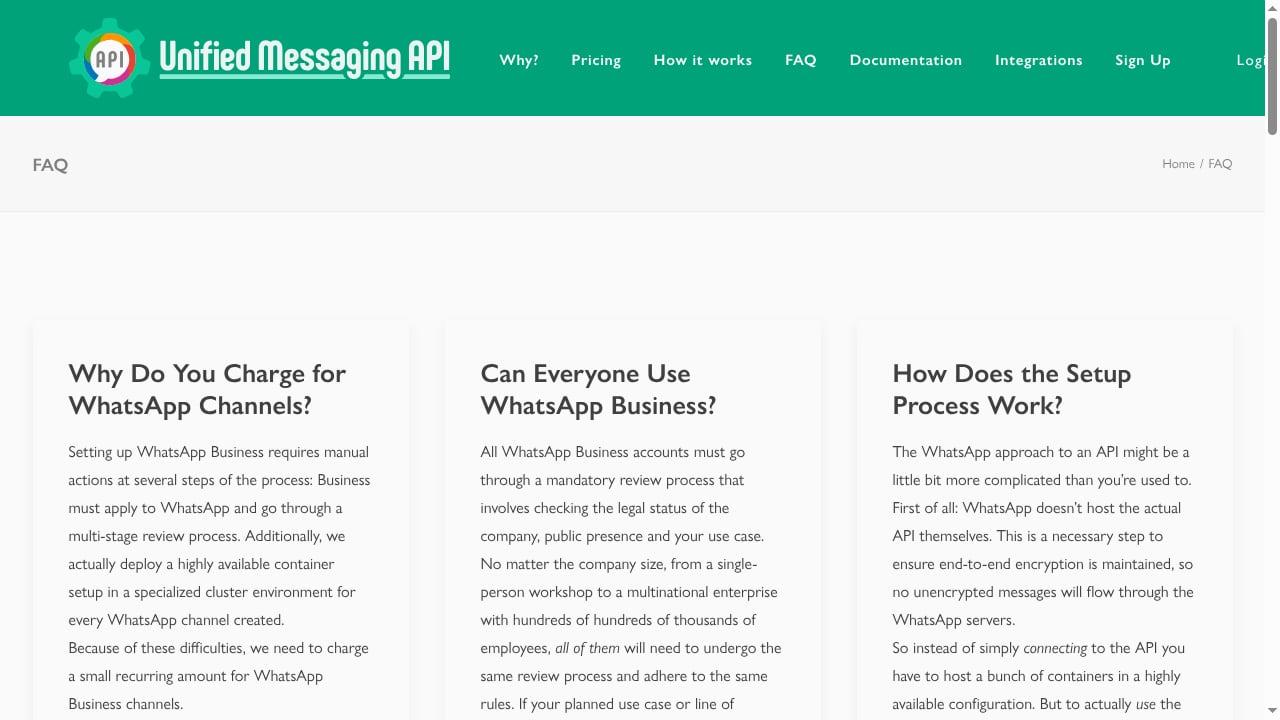
First viewport screenshot of FAQs – MessengerPeople.dev.
MessengerPeople.dev handles the technical complexity of WhatsApp Business API setup, including the manual application process and deployment of highly available container setups for each WhatsApp channel. That is real work removed from your team, but it also means WhatsApp onboarding depends on an external approval process.
UnifyPort approaches account connection through lifecycle management with authentication flows such as QR code, code verification, and session import, plus a Chrome extension for connecting X and TikTok accounts. The dashboard covers API key management and account quota tracking.
If WhatsApp is your only channel and you want the provider to manage container infrastructure, MessengerPeople.dev's model is appealing. If you need multiple channels with a consistent account lifecycle, UnifyPort's flow is more uniform across providers.
Reliability, observability, and support
UnifyPort exposes a reliability surface: monitored routes, a retry queue, verified webhook signatures, and adaptive rate limits. Combined with failure isolation and idempotency, this is aimed at teams that need to debug delivery issues without reading provider-specific logs.
MessengerPeople.dev emphasizes multi-location data centers for low latency and high availability, GDPR-compliant processing with a data processing agreement, and a range of SLAs. Support is free of charge out of goodwill, with no formal support tiers, so escalation paths are less defined than a tiered support contract.
For teams that need contractual support guarantees, that difference matters. For teams that mainly need the integration to work and are comfortable with community-style support, MessengerPeople.dev's approach may be sufficient.
Developer experience and SDKs
UnifyPort offers official SDKs for Node.js, PHP, Go, and Python, and documents a production-ready v1 API with technical guides and changelogs. That shortens setup for teams working in those languages.
MessengerPeople.dev provides extensive documentation and a quick start that gets a first message sent in minutes, but its public pricing page does not list official SDKs. If your stack is outside the languages UnifyPort supports, both platforms still work over plain REST and JSON.
When you are wiring multiple channels into one application, the patterns in this group chat apps and APIs developer guide are a useful complement to either platform's docs.
When to choose UnifyPort
- You need LINE, Zalo, or TikTok alongside WhatsApp and Telegram.
- You want a standard webhook event stream with signatures, retries, and failure tracking built in.
- You prefer account-based pricing in USD with a free account to start.
- You want official SDKs for Node.js, PHP, Go, or Python.
When to choose MessengerPeople.dev
- Your channels are WhatsApp, Instagram, Facebook Messenger, Telegram, and Twitter.
- You want per-message or MAU pricing with monthly caps and free Telegram and Facebook Messenger usage.
- You prefer a provider that manages WhatsApp Business API container infrastructure for you.
- You value published SLAs and GDPR documentation.
Related reading
- Calendar API Guide: Best Providers, Features & Use Cases - Compare the best calendar APIs for scheduling, availability, and sync across Google, Microsoft, and Apple. Learn features, pricing, and how to build integrations.
- Free Calls Explained: VoIP, Apps, and Developer APIs - Learn how free calls work over VoIP, what limits and trade-offs to expect, and how developers build reliable calling and messaging with APIs.
Sources and further reading
- UnifyPort — DEV Community Profile - One API and one standard webhook for global messaging platforms.
FAQ
Does UnifyPort support WhatsApp like MessengerPeople.dev does?
Yes. UnifyPort lists WhatsApp among its supported channels and provides account lifecycle flows such as QR code, code verification, and session import. MessengerPeople.dev handles the WhatsApp Business API application and container deployment for each channel.
Can I switch pricing models on MessengerPeople.dev?
Yes. You can switch between per-message and per-MAU billing at any time, per channel, free of charge, according to its published pricing.
Which platform has better webhook tooling?
UnifyPort publishes a webhook control plane with signatures, subscriptions, retry behavior, and failure tracking. MessengerPeople.dev supports webhooks for responses and delivery notifications but does not describe an equivalent control plane on its pricing page.
Is there a free tier?
UnifyPort includes one free messaging account per workspace. MessengerPeople.dev starts at a 0 € base price with no setup fee, and Telegram and Facebook Messenger can be added free of charge without usage limits.
Which is better for high-volume messaging?
MessengerPeople.dev states it scales up to and beyond 1 million monthly messages, with fee caps that make additional messages free after the cap. UnifyPort's graduated account pricing is easier to model when account count, not message volume, is your main cost driver.
Conclusion
UnifyPort and MessengerPeople.dev solve the same core problem from different angles. MessengerPeople.dev is a strong fit for Meta-centric messaging with transparent per-message or MAU pricing and managed WhatsApp infrastructure. UnifyPort is built for teams that need broader channel coverage, a standardized webhook event stream, and account-based pricing with SDKs across four languages.
Map your channel list, expected volume, and support requirements against the table above. If you need LINE, Zalo, or TikTok, or you want webhook reliability handled as a platform feature, UnifyPort is the more direct path. If WhatsApp and Meta channels dominate your roadmap, MessengerPeople.dev's pricing flexibility and managed setup are worth evaluating. You can start with UnifyPort's unified messaging API or review MessengerPeople.dev's pricing directly.