
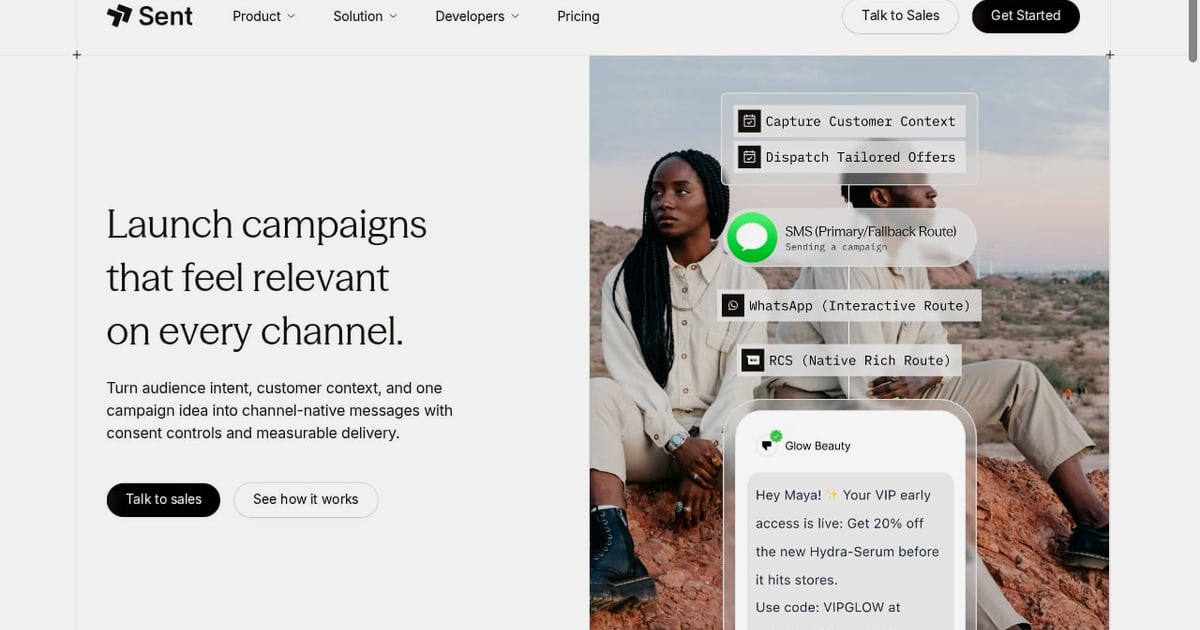
Sent Review 2026: One API for SMS, WhatsApp & RCS
Evidence-based Sent review: one API for SMS, WhatsApp, and RCS, automatic routing, pricing, setup, limitations, and who should use it in 2026.
Sent Review 2026: One API for SMS, WhatsApp, and RCS
Sent is a business messaging API that lets developers send SMS, WhatsApp, and RCS messages through a single integration. It handles channel selection, formatting, fallback, and delivery tracking so product teams can avoid building separate integrations for each telecom channel. This review examines Sent's strengths, limitations, pricing model, setup process, and ideal users based on available evidence.
What Sent does
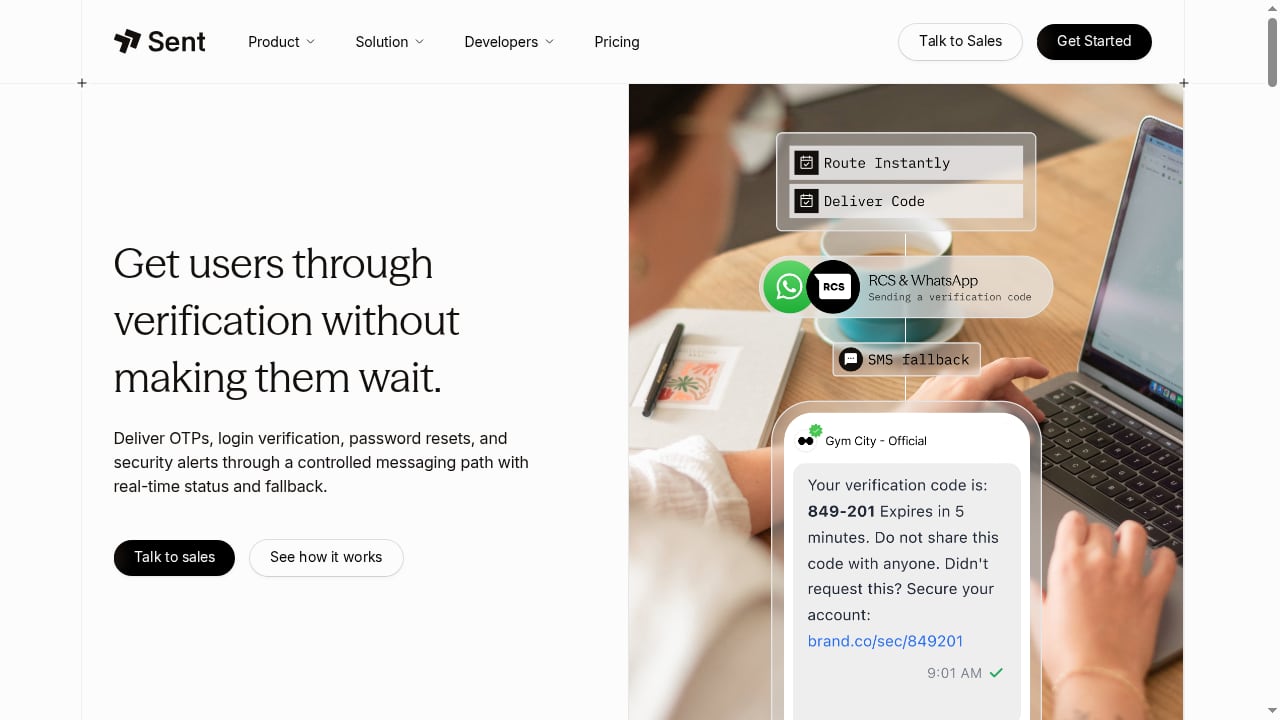
First viewport screenshot of Authentication | Sent.
Sent provides one API endpoint for sending messages across multiple channels. When you omit the channel field, Sent evaluates the destination country, message content, per-channel routing rates, and the recipient phone's supported protocols to pick the best delivery path for each recipient. The same API call might become a WhatsApp message for one customer and an SMS for the next.
If the chosen channel fails to deliver, Sent automatically retries through alternative routes and finishes with SMS as a fallback. This fallback only works when Sent chooses the channel; if you pin a specific channel for compliance reasons, a failed delivery will not fall back.
Sent also handles template formatting: you write a message once with dynamic variables, and Sent renders it appropriately for each channel. For example, an order status update appears as plain text on SMS but as a structured card with a tracking button on WhatsApp. Sent submits WhatsApp templates to Meta, monitors approval progress, and resubmits rejected templates. While a WhatsApp template awaits review, you can send the same template over SMS immediately.
Other capabilities include:
- Sender Profiles for multi-tenant SaaS: each profile isolates contacts, templates, phone numbers, and API tokens for a different business customer.
- Webhooks for delivery confirmations and incoming replies.
- Unified consent handling: a STOP keyword on any channel blocks that contact across SMS, WhatsApp, and RCS.
- Regional quiet hours enforced per country.
- Official SDKs for TypeScript, Python, Go, Java, C#, PHP, and Ruby.
- MCP server with 19 tools for AI coding agents like Cursor and Claude Code.
- Sandbox mode for testing without sending real messages.
Sent does not provide email delivery, so password resets and invoices still require a separate email API such as Resend or SendGrid. Voice calling is available but must be enabled by Sent's support team.
Who Sent is for

Footer Background.
Sent is built for developers and product teams adding messaging directly into software. Typical use cases include:
- SaaS platforms sending OTPs, verification codes, and password resets.
- E-commerce stores sending order notifications and cart recovery messages.
- Fintech and healthcare apps sending appointment reminders and transactional alerts.
- AI assistants conversing with customers on WhatsApp.
- Multi-tenant platforms where each client business needs its own sender identity.
Sent is especially useful when your application serves many client businesses that each require their own sender identity, such as a booking tool where every salon sends reminders under its own brand name. Sender Profiles provide the tenancy separation needed for this scenario.
Sent is not a good fit for marketing teams that primarily send email campaigns or newsletters, since it lacks email. Support teams needing ready-to-use agent seats and call queues should look at contact center products like Twilio Flex. Teams that immediately need RCS rich cards or carousels will find those features are still on Sent's roadmap.
Strengths
- Single API for multiple channels: One send call routes to SMS, WhatsApp, or RCS per recipient, eliminating separate dispatch code for each telecom network.
- Automatic fallback: Undelivered messages fall back to SMS automatically when Sent picks the channel, improving deliverability without extra code.
- Template management: Sent handles WhatsApp template submission, approval monitoring, and resubmission, reducing operational overhead.
- Multi-tenancy: Sender Profiles keep each customer's contacts, templates, and credentials strictly separate, with flexible billing options.
- Fast onboarding: Verifying an email address and mobile phone number grants immediate API access, six pre-configured OTP templates, and an allowance of 500 sends per day per template. Business verification (KYC) is only required for custom templates or dedicated sender numbers.
- Developer tooling: Official SDKs for seven languages, an MCP server for AI coding agents, and a sandbox mode for testing.
- Compliance features: Unified consent handling and regional quiet hours help meet regulatory requirements.
Limitations and risks
- No email: Sent does not send email, so password resets and invoices require a separate email API.
- Consent and registration burden: You still handle your own consent gathering and US sender registration.
- RCS rich content not yet available: RCS rich cards and carousels are listed as roadmap features, not current capabilities.
- Pinned channels lose fallback: If you pin a channel for compliance, a failed delivery will not fall back to SMS.
- Voice requires activation: Calling features are not enabled by default; Sent's support team must activate voice on your account.
- Support and reliability concerns: User reviews on Product Hunt and Trustpilot are sparse and mixed. One reviewer reported templates being deleted without explanation and difficulty reaching support, while another noted a lack of onboarding for solo indie developers. These are individual experiences, not necessarily representative, but they highlight the importance of testing support responsiveness during evaluation.
- No public status page: One reviewer noted the absence of a status page for tracking platform health, which may matter for mission-critical deployments.
Pricing
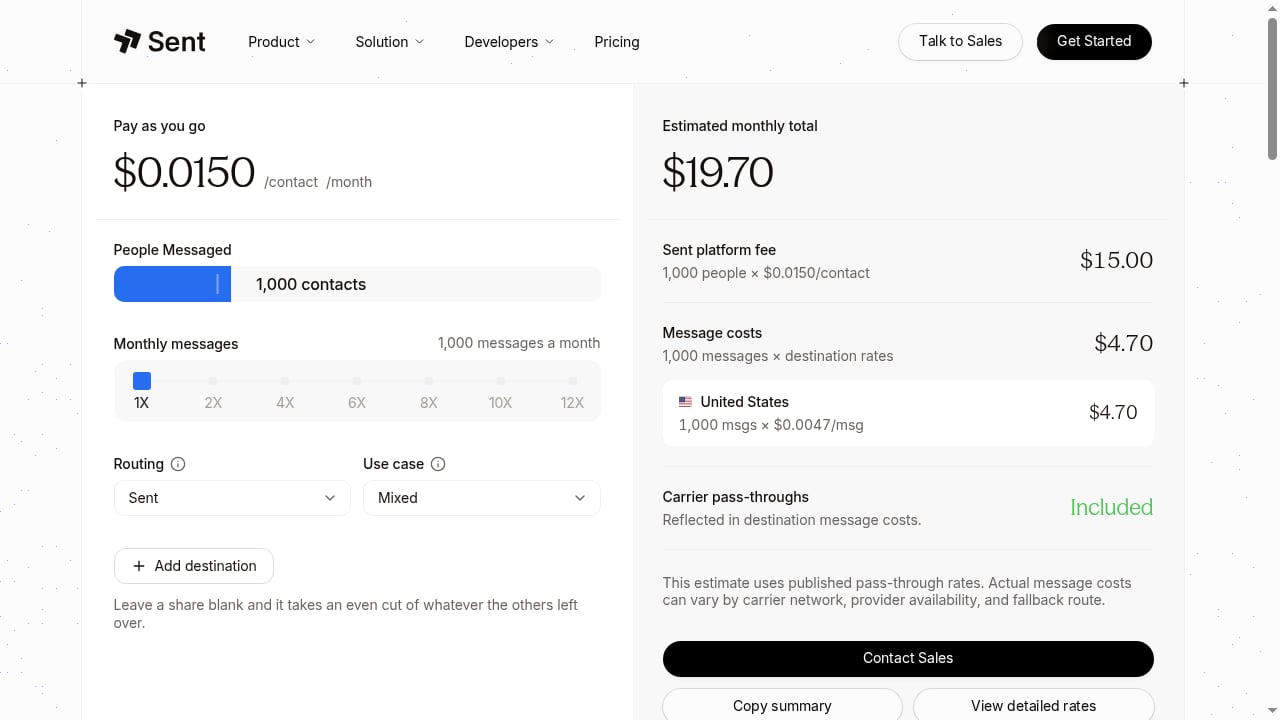
First viewport screenshot of www.sent.dm.
Sent uses a pay-as-you-go model with two components:
- Platform fee: $0.0150 per contact per month. This fee applies to each distinct person you message during the billing cycle.
- Carrier pass-through fees: Billed at cost for each dispatched message, varying by destination country, selected channel, SMS segment count, leased phone numbers, and fallback frequency.
For example, messaging 10,000 distinct individuals in a month produces a $150 platform fee, plus carrier delivery expenses for SMS, WhatsApp, or RCS. Sent provides a pricing calculator on its website where you can enter recipient totals, monthly message volumes, and destination regions to project costs. Enterprise arrangements require contacting sales.
This per-contact fee structure is advantageous when each user receives multiple messages per month, such as daily fitness reminders or ongoing order milestones. It is less favorable if you broadcast occasional single messages to a large subscriber list. When comparing Sent against traditional per-message providers, calculate a typical month of your historical traffic on both pricing models before deciding.
Setup and onboarding
Sent's onboarding is lightweight. Verifying an email address and mobile phone number grants immediate API access, six pre-configured OTP templates, and an allowance of 500 sends per day for each template. This lets you test the API thoroughly before submitting corporate paperwork for business verification (KYC), which is only required when you request custom templates or a dedicated sender number.
The platform provides a sandbox mode so automated test suites can run API calls without dispatching real messages over telecom networks. For developers using AI coding agents, the MCP server at mcp.sent.dm supplies 19 tools that let agents in Cursor and Claude Code trigger test dispatches, query phone numbers, organize contacts and templates, and inspect deliverability.
If you need to integrate messaging into no-code workflows, a Zapier integration for messaging APIs can complement Sent's developer-first approach, though Sent itself is API-centric.
How Sent compares to alternatives
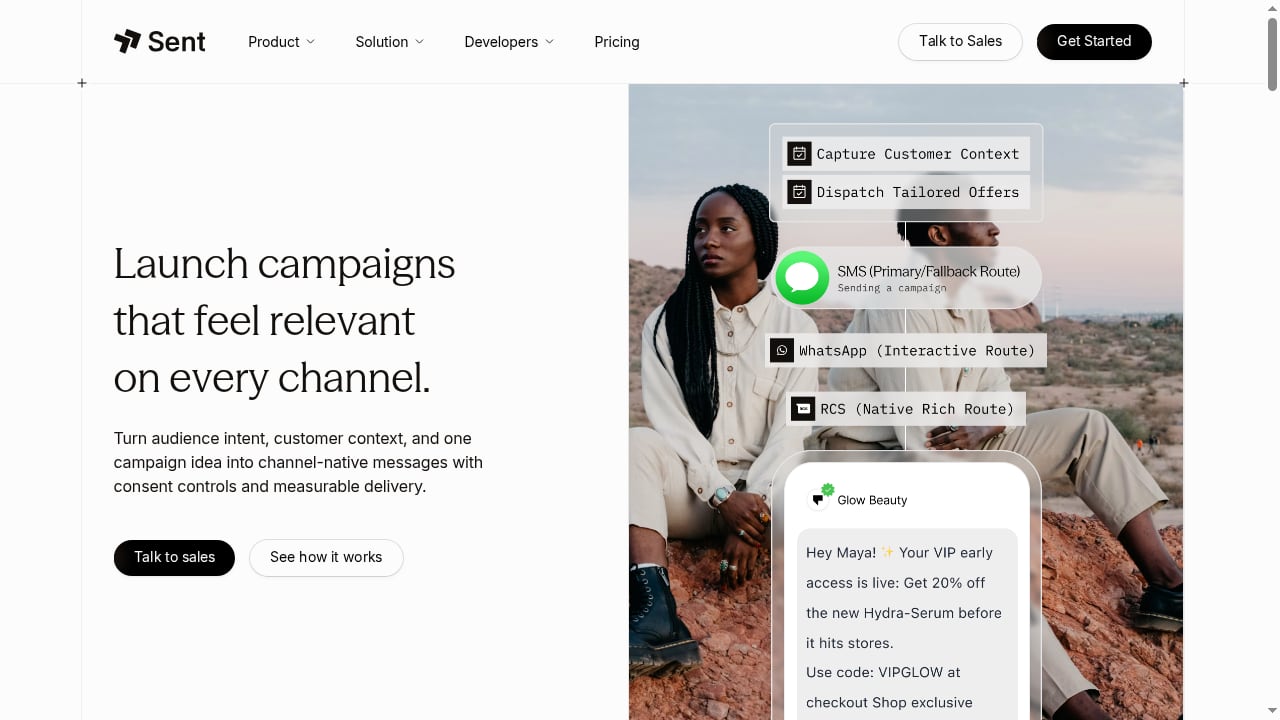
First viewport screenshot of www.sent.dm.
Sent's main alternatives include Twilio and Bird (formerly MessageBird). Twilio offers established telecom infrastructure with email, full voice calling, hosted identity verification, and contact center suites, plus immediate support for interactive RCS rich cards. Bird provides email, SMS, WhatsApp, and Apple Messages for Business, paired with contact audiences and visual marketing automations, though RCS is currently limited to a private beta.
Sent's differentiator is its per-recipient channel selection with automatic fallback, which simplifies code for teams that want one send call across SMS, WhatsApp, and RCS. However, teams that need email, advanced RCS content, or a full contact center will likely need a broader platform. For a wider comparison, see our top 10 unified communication API platforms and our UnifyPort vs Vonage comparison for another angle on unified messaging.
Decision criteria: is Sent right for you?
Consider Sent if:
- You are a developer or product team building messaging into a SaaS, e-commerce, fintech, or healthcare application.
- You want one API to send SMS, WhatsApp, and RCS with automatic routing and fallback.
- You need multi-tenant support with isolated sender profiles for each client business.
- You value fast onboarding and developer tooling like SDKs and an MCP server.
- Your use case involves OTPs, transactional notifications, or conversational messaging where per-contact pricing aligns with your volume.
Look elsewhere if:
- You need email delivery as part of the same platform.
- You require RCS rich cards or carousels today.
- You need a full contact center with agent seats and queues.
- You are a marketing team focused on email campaigns.
- You need proven enterprise-grade support with a public status page and live help, based on reported user experiences.
Related reading
- Top 10 Omnichannel Communication Platforms 2026 - Ranked review of the top 10 omnichannel communication platforms in 2026, with transparent criteria, evidence, pricing, and decision guidance.
- UnifyPort vs UIB vs bundle.social: Which API Fits? - Compare UnifyPort, UIB, and bundle.social on channels, messaging APIs, webhooks, SDKs, and pricing to pick the right integration for your product.
- UnifyPort vs Vonage: Unified Messaging API Comparison - Compare UnifyPort and Vonage for social messaging APIs. See how UnifyPort unifies WhatsApp, LINE, and more versus Vonage's broader CPaaS and UCaaS suite.
Sources and further reading
- Sent Reviews | Read Customer Service Reviews of sent.dm - Trustpilot - 2 people have already reviewed Sent. Read about their experiences and share your own!
- Sent Review (2026): One API for SMS, WhatsApp, and RCS - Sent is a messaging API that picks SMS, WhatsApp, or RCS per recipient. Built for SaaS teams sending OTPs, notifications, and customer messages.
- Sent.dm Reviews (2026) | Product Hunt - Read reviews and experiences from users of Sent.dm. Get comprehensive feedback about features, pros, cons, and alternatives.
FAQ
How much does Sent cost?
Sent charges a platform fee of $0.0150 per person you message each month, plus carrier pass-through costs for the messages themselves. Messaging 10,000 people in a month costs $150 in platform fees before delivery costs. Enterprise pricing goes through sales.
Can I try Sent for free?
Sent's docs describe a light onboarding: a verified email and phone number give you API access, six pre-built OTP templates, and 500 sends per day per template. Custom templates and your own sender number require business verification (KYC) and billing.
Which channels does Sent support?
Sent sends SMS, MMS, WhatsApp, and RCS messages. When you leave out the channel field, Sent picks a channel per recipient and falls back to SMS when the first choice can't deliver. Phone calls are available too, but Sent has to enable them for your account.
Does Sent support RCS rich cards and carousels?
Not yet. Sent's Channels guide lists RCS rich cards and carousels as roadmap features. Twilio documents both today.
Is Sent a good Twilio alternative?
Sent works for teams that want one send call for SMS, WhatsApp, and RCS, with the channel picked per recipient. Twilio is the better pick for teams that also want email, managed verification, a contact center, or advanced RCS content.
What do user reviews say about Sent?
Public reviews are limited. On Trustpilot, Sent has only a handful of reviews. On Product Hunt, one reviewer reported templates being deleted without explanation and difficulty reaching support, while another noted a lack of onboarding for solo indie developers. These are individual experiences; evaluate support responsiveness during your trial.
Conclusion
Sent offers a compelling value proposition for developer teams that want to send messages across SMS, WhatsApp, and RCS without building separate integrations. Its automatic routing and fallback, multi-tenant Sender Profiles, and fast onboarding make it well-suited for SaaS and e-commerce applications. However, the lack of email, pending RCS rich content, and mixed user reports on support and reliability mean you should test thoroughly before committing to production. Use the pricing calculator, run a pilot with your actual traffic, and confirm that Sent's current capabilities align with your roadmap.
For further reading, see our respond.io review for a different approach to unified messaging, and our guide to LINE social plugins vs messaging APIs for channel-specific considerations.