
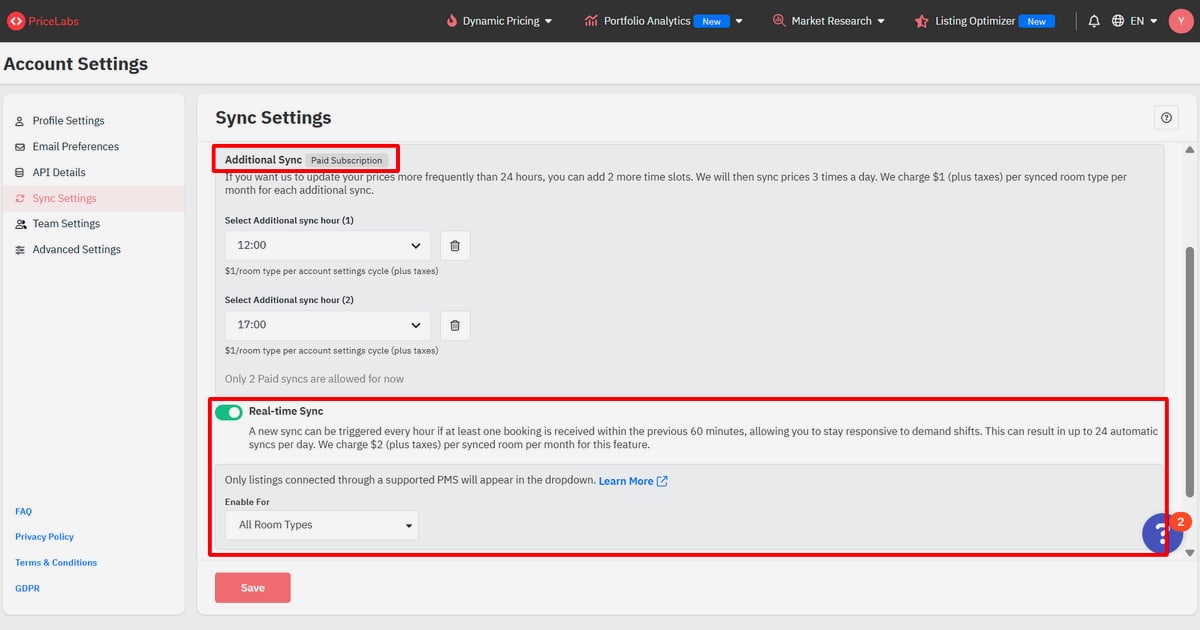
Real-Time Sync Webhooks: A Developer's Architecture Guide
Learn how real-time sync webhooks work, why webhooks alone miss data, and how to combine events with polling, signatures, retries, and idempotency.
Real-Time Sync Webhooks: A Developer's Architecture Guide
Real-time sync webhooks are the fastest way to learn that something changed in an external system — and the fastest way to lose that change if your receiver is offline. This guide explains how event-driven syncs actually work, where they break, and how to combine webhooks with reconciliation polling so your data stays correct instead of merely fresh.
What "real-time sync webhooks" actually means
A real-time sync is a pipeline: an external platform fires an HTTP POST when something changes, your endpoint verifies and parses it, and your system updates its own store. The word sync is doing heavy lifting here — receiving an event is not the same as having consistent state.
Three properties matter, and they are independent:
- Latency — how quickly you learn about a change. Webhooks win; polling loses.
- Completeness — whether you eventually learn about every change. Webhooks alone cannot promise this.
- Consistency — whether your stored state matches the source after out-of-order or duplicate events. This is your job, not the provider's.
Most production incidents blamed on "webhooks" are actually completeness or consistency failures, not latency failures.
Webhooks vs polling: the honest comparison
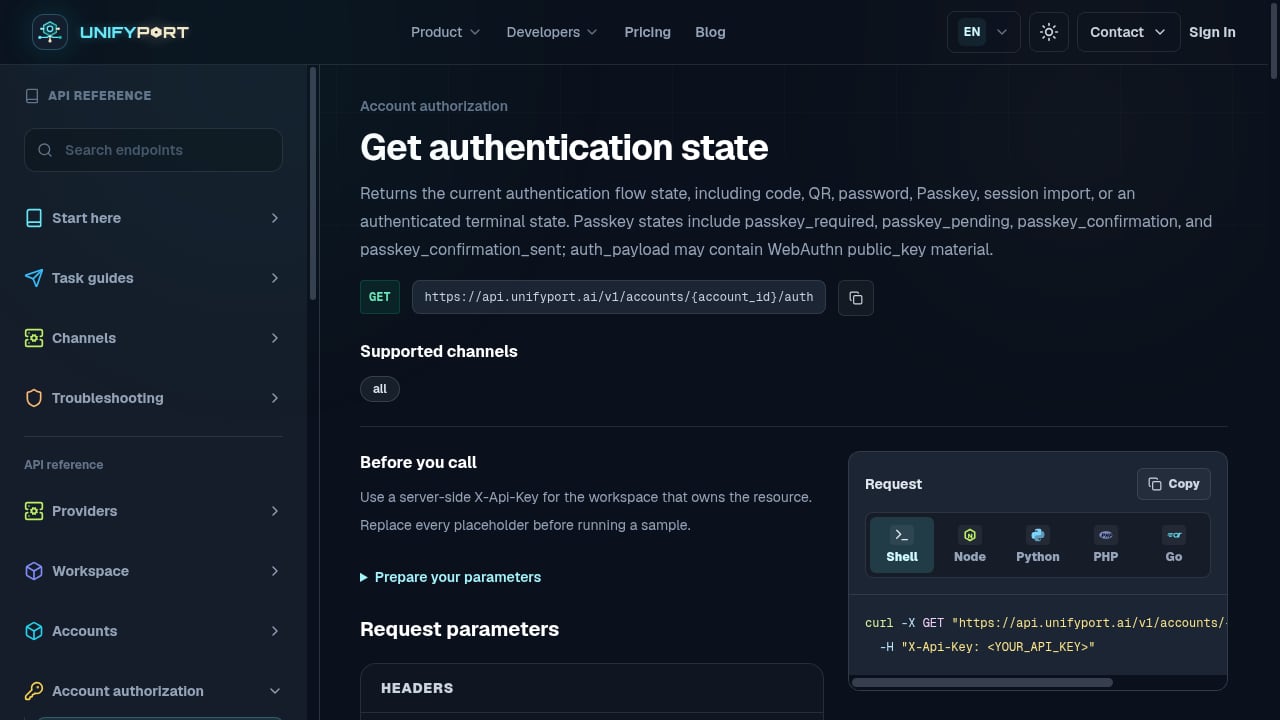
First viewport screenshot of Get authentication state — API Reference — UnifyPort.
| Dimension | Webhooks | Polling |
|---|---|---|
| Latency | Near-instant | Bounded by interval |
| API cost | Only on change | Constant, even when nothing changed |
| Failure mode | Silent drops during outages | Self-healing by design |
| Ordering | Not guaranteed | Naturally ordered per run |
| Complexity | Signature, retries, dedupe | Simple loop, rate-limit math |
Polling burns requests asking "anything new?" regardless of the answer. Webhooks invert that: the platform tells you. But a webhook delivery is best-effort in most APIs — if your endpoint is unreachable or returns a non-2xx response, the event can be lost. Sync Labs' webhook documentation is unusually candid about this, noting that generation webhooks are not automatically retried and that consumers should poll as a fallback.
That single sentence is the whole argument for hybrid syncs.
The hybrid pattern: webhooks for speed, polling for truth
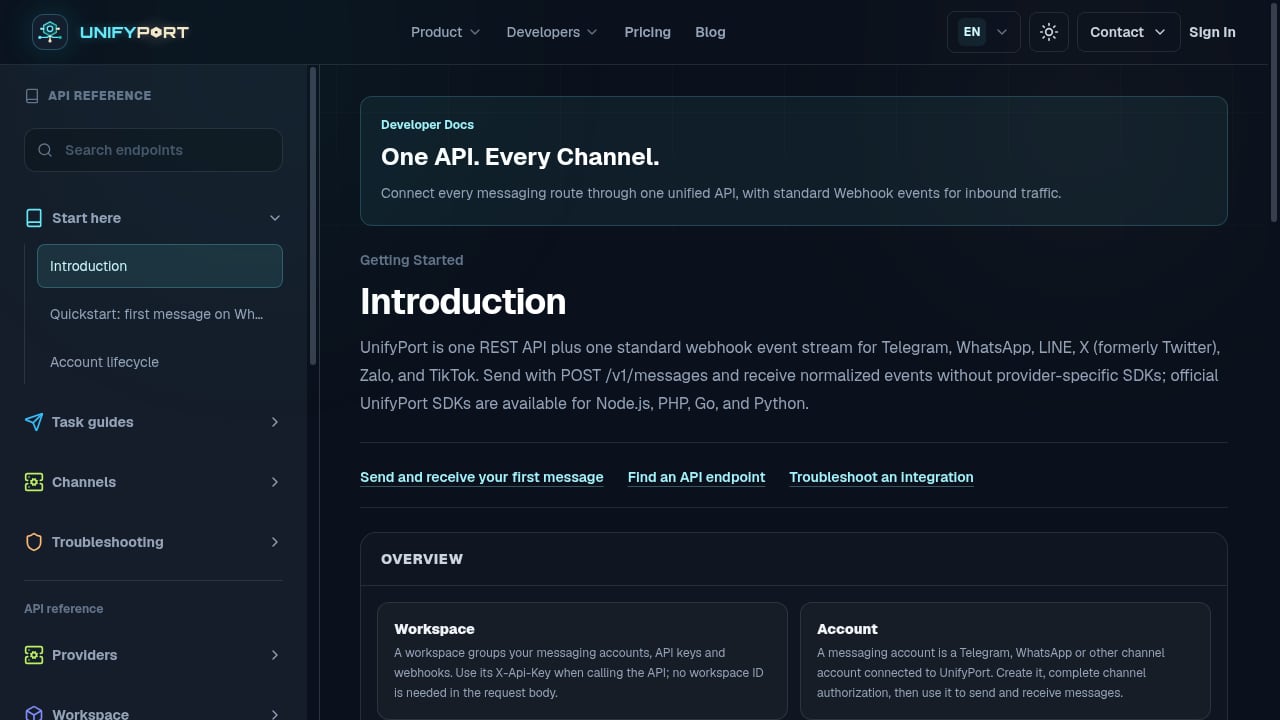
First viewport screenshot of Introduction — API Reference — UnifyPort.
Nango's real-time sync guide frames the pattern well: combine webhooks from external APIs with periodic polling for a reliable stream of changes. The webhook gives you immediacy; the polling run reconciles whatever the webhook missed.
A workable architecture:
- Webhook path — receive the event, verify the signature, enqueue it, and return
2xxfast. Do the heavy work asynchronously. - Polling path — on a schedule, fetch the changed set since your last cursor and upsert it.
- Merge layer — resolve conflicts between the two paths with an explicit rule, not "last write wins by accident."
The race condition nobody plans for
When a polling run and a webhook update the same record concurrently, the later write wins by default — which means stale polled data can overwrite a fresher webhook update. Nango addresses this with a merge strategy: override applies updates regardless of modification time, while ignore_if_modified_after preserves records modified after the current batch was fetched.
If you are building this yourself, the equivalent is a monotonic version or updated_at check at write time. Persist promptly after fetching, and run batch writes sequentially rather than in parallel — concurrent batch operations can race against each other.
Near-real-time as a middle ground
If you only sync a handful of connections, aggressive polling every 30 seconds can be simpler than a full webhook pipeline. It is more resource-intensive but far easier to reason about. Choose it deliberately, not by default.
Making the webhook path trustworthy
Verify every request
A publicly reachable webhook endpoint is an open door. Sign each request and verify it with a shared secret before parsing the body. Sync Labs signs requests with a Sync-Signature header and a whsec_... signing secret — and explicitly warns that a masked secret value is display-only and must never be used for verification. Store the real secret in your secret manager, compare signatures in constant time, and reject anything that fails.
HMAC-SHA256 over the raw request body is the common convention. Verify against the raw bytes, not a re-serialized JSON object — key ordering will break the comparison.
Assume duplicates
Batch deliveries are frequently retried until acknowledged, so consumers must safely handle duplicate notifications for the same batch ID. Idempotency keys, unique constraints on (provider, event_id), or an upsert with a dedupe window all work. Pick one and enforce it in the database, not in application code that can be bypassed.
Return fast, process later
A slow endpoint is a failing endpoint. Accept the payload, push it to a queue, acknowledge, and process out of band. This also gives you a natural place to implement retry and dead-letter handling on your side.
For a deeper treatment of these mechanics, see our webhook event processing guide, which walks through signature verification, idempotency, retries, and failure isolation with code patterns.
The multi-provider problem
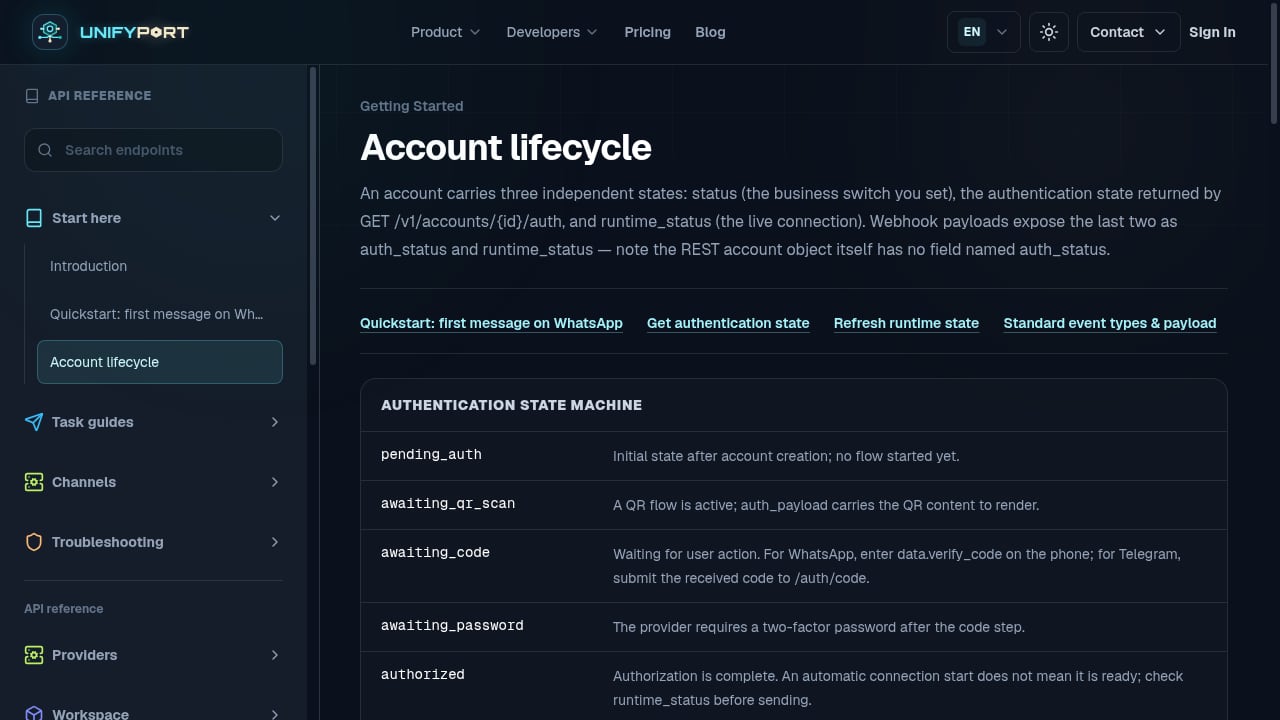
First viewport screenshot of Account lifecycle — API Reference — UnifyPort.
Everything above gets harder when you integrate five messaging platforms instead of one. Each provider has its own payload shape, its own signature scheme, its own retry semantics, and its own idea of what an "account event" is. You end up maintaining five receivers and five merge strategies.
A unified messaging API collapses that surface. UnifyPort provides one REST API and one standard webhook event stream across WhatsApp, Telegram, LINE, TikTok, Zalo, and X, normalizing provider messages, status updates, and account events into a stable JSON shape. The webhook control plane handles signatures, subscriptions, retry behavior, and failure tracking in one place, with API key and HMAC-SHA256 signature authentication and a delivery queue that applies rate limits, retries, idempotency, and failure isolation. Official SDKs exist for Node.js, PHP, Go, and Python.
The practical benefit is architectural: instead of five reconciliation jobs, you write one. If you are evaluating how that compares to building channel-by-channel, our UnifyPort vs Gupshup comparison breaks down API architecture, channel coverage, webhook behavior, and pricing.
Decision guide: which sync model fits
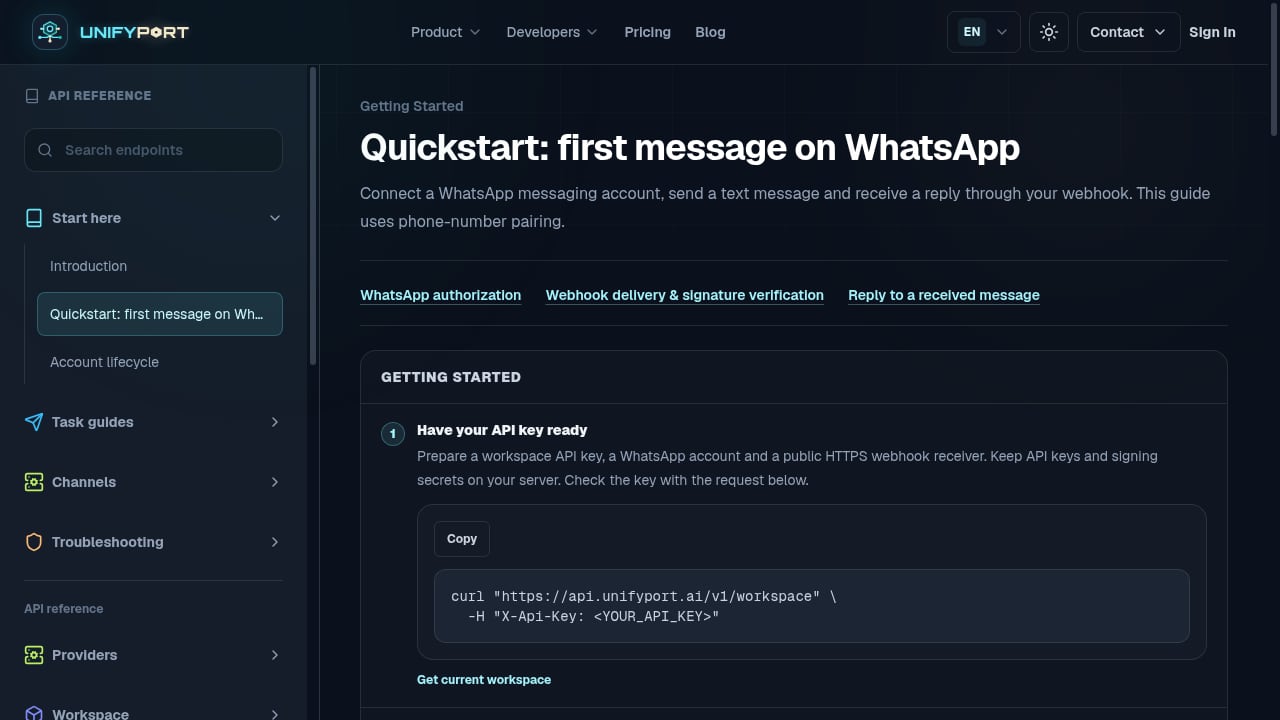
First viewport screenshot of Quickstart: first message on WhatsApp — API Reference — UnifyPort.
- Webhooks only — acceptable when the provider guarantees delivery and you can tolerate gaps. Rare in practice.
- Polling only — fine for low-frequency data, small connection counts, or when real-time genuinely does not matter.
- Hybrid webhooks + polling — the default for anything user-facing where correctness matters. This is what Nango, Apideck, and most mature integration platforms converge on.
- Unified event layer — the right choice when you are integrating multiple providers and do not want to rebuild the same receiver logic repeatedly.
Apideck's approach is instructive: it delivers native webhooks where platforms support them and virtualizes webhooks via a polling engine where they do not, then normalizes both into one format. That is the same architectural bet UnifyPort makes for messaging channels — consistency at the event layer, regardless of what the underlying provider offers.
Related reading
- Top 10 CPaaS Products 2026: Ranked & Tested - Ranked 2026 CPaaS review: Twilio, Infobip, Vonage, Sinch, Webex Connect and more, with transparent criteria, evidence, and buying guidance.
- How to Use UnifyPort with Zendesk: Unified Messaging Guide - Connect UnifyPort's unified messaging API to Zendesk so WhatsApp, Telegram, LINE, and more become tickets. Setup, webhook flow, and examples.
- UnifyPort vs 8x8 Developer Portal vs Gupshup - Compare UnifyPort, 8x8 Developer Portal, and Gupshup on API model, channels, webhooks, SDKs, and pricing to pick the right messaging stack.
Sources and further reading
- Real-time syncs with webhooks - Nango Docs - Combine webhooks from external APIs with periodic polling for a reliable, real-time stream of changes.
- Webhooks - Real-time Data Synchronization Across All Integrations - Stay in sync with native and virtual webhooks. Get real-time notifications when data changes in any of your integrated platforms. No polling required.
FAQ
Are webhooks reliable enough for real-time sync on their own?
No. Delivery is best-effort in most APIs, and events can be dropped during outages or rejected by your endpoint. Treat webhooks as the fast path and polling as the correctness path.
How do I stop a polling run from overwriting a newer webhook update?
Use an explicit merge strategy — for example, skip writes for records modified after the current batch was fetched, or gate writes on a version or updated_at comparison.
Do I need signature verification if my endpoint URL is secret?
Yes. URLs leak through logs, proxies, and misconfiguration. Verify an HMAC signature on every request and reject anything that fails.
How should I handle duplicate webhook deliveries?
Enforce idempotency at the storage layer with a unique constraint on the provider event identifier, or use an idempotency key. Application-level checks alone are not sufficient under concurrency.
What should my webhook endpoint return?
A 2xx response as quickly as possible. Enqueue the payload and process it asynchronously so a slow downstream dependency never causes the provider to mark delivery as failed.
Conclusion
Real-time sync webhooks give you speed; they do not give you guarantees. The teams that get this right treat webhooks as one input into a reconciliation system rather than the system itself — verifying signatures, deduplicating aggressively, resolving races explicitly, and always keeping a polling path open. When you are syncing across multiple messaging channels, a unified event stream removes most of the per-provider plumbing so you can spend your effort on the merge logic that actually determines whether your data is correct.