
MessengerPeople.dev Review: Unified Messaging API Tested
An evidence-based MessengerPeople.dev review covering its unified messaging API, per-message and MAU pricing, WhatsApp setup, strengths, limits, and best-fit users.
MessengerPeople.dev Review: A Unified Messaging API Under the Microscope
Most teams that want to message customers on WhatsApp, Instagram, Telegram, and Facebook Messenger quickly discover the same problem: every channel has its own onboarding, its own tokens, and its own quirks. MessengerPeople.dev, built by Munich-based MessengerPeople GmbH, tries to collapse that complexity into one API. This review looks at what the platform actually does, who gets the most value from it, where it falls short, and how to decide whether it belongs in your stack.
What MessengerPeople.dev actually is
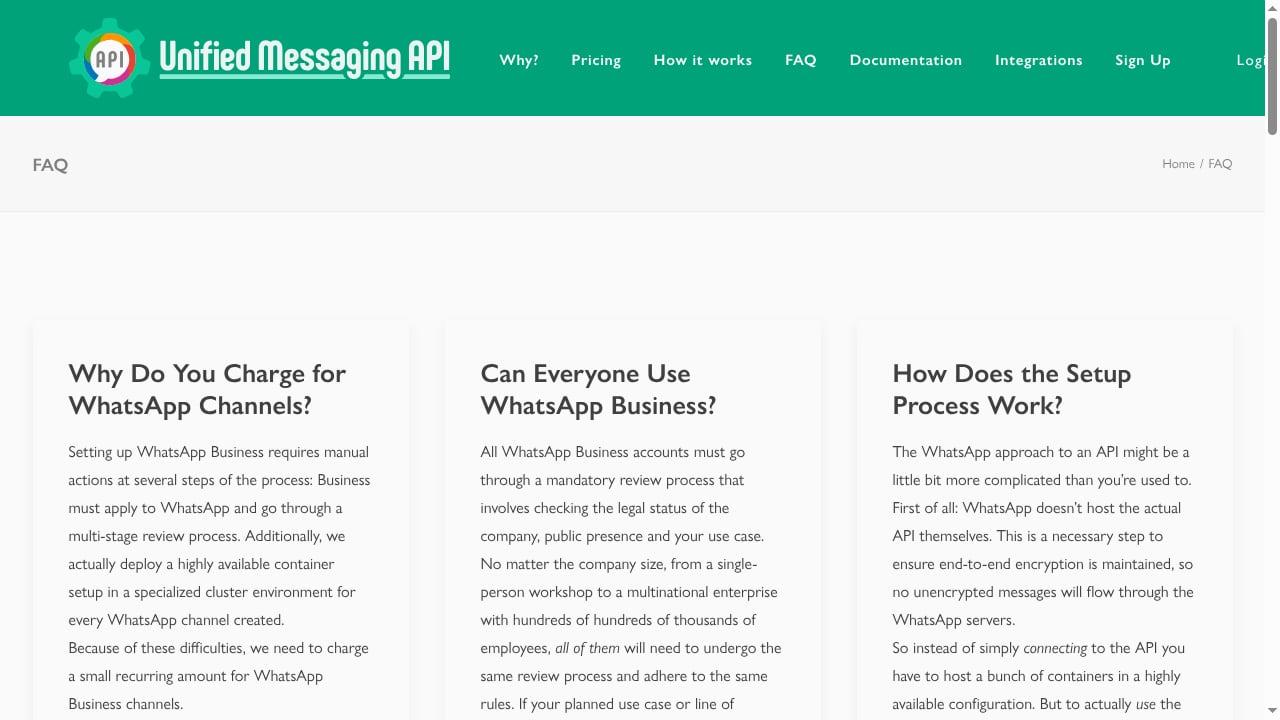
First viewport screenshot of FAQs – MessengerPeople.dev.
MessengerPeople.dev is a unified messaging API platform. Instead of integrating WhatsApp Business API, Instagram, Facebook Messenger, Telegram, and Twitter one by one, you connect once and send or receive messages across channels through a single interface.
The company positions itself primarily for developers and businesses that need messaging inside their own applications or workflows. That is a different audience from teams shopping for a ready-made shared inbox with agent seats and a visual conversation UI. If you want a support cockpit, this is not it. If you want messaging as infrastructure, it is squarely in scope.
Channels and core capabilities
- A unified API for sending and receiving messages across supported messenger channels
- Native integrations plus Zapier support for no-code automation
- Managed WhatsApp Business API onboarding, including the manual application process
- Highly available container deployments per WhatsApp channel
- Transparent pricing with no setup fees or hidden costs
Who MessengerPeople.dev is built for
First viewport screenshot of Terms and Conditions – MessengerPeople.dev.
The platform fits a fairly specific profile. It is strongest when messaging is a feature of your product or an automated part of your operations, not the whole product.
Good fits:
- SaaS teams adding WhatsApp or Telegram notifications to an existing app
- Developers who want one integration instead of five separate channel SDKs
- Operations teams automating alerts, confirmations, and reminders through Zapier
- Businesses scaling from a few hundred messages a month toward a million or more
Weaker fits:
- Teams that need a polished agent inbox with email, web chat, and review management in one place
- Organizations that require contractual SLAs and tiered enterprise support
- Companies whose messaging is almost entirely email-based
A useful comparison point: a competitor comparison published by Superchat notes that MessengerPeople covers the major messengers well but does not include email integration, and that its Capterra rating sits around 4.3 versus Superchat's 4.8. That framing comes from a competing vendor, so treat it as directional rather than neutral, but the email gap is consistent with the product's messenger-first design.
Pricing signals: two models, switchable per channel
MessengerPeople.dev Review: Unified Messaging API Tested - Pricing signals: two models, switchable per channel.
Pricing is one of the more interesting parts of this platform because it avoids the usual "contact sales" wall.
| Model | Rate | Notes |
|---|---|---|
| Pay per message | €0.001–0.003 per sent message | Incoming messages are free |
| Pay per monthly active user | €0.02–0.06 per MAU | Monthly fee caps apply |
Two details matter more than the headline rates:
- Monthly fee caps. Once you reach the cap, additional messages become free. That changes the economics dramatically at high volume and makes the platform viable well beyond one million monthly messages.
- You can switch models at any time, per channel, at no cost. This is unusual and genuinely useful. A channel with steady one-to-one conversations may favor MAU pricing, while a broadcast-heavy channel may favor per-message pricing. You are not locked into a guess you made during onboarding.
There are no setup fees, and the company states there are no hidden costs. Support is provided free of charge out of goodwill rather than through formal paid tiers, which is a real consideration if you need guaranteed response times.
Setup and developer experience
MessengerPeople.dev Review: Unified Messaging API Tested - Setup and developer experience.
The honest answer on setup is: WhatsApp is the hard part, and that is true everywhere, not just here.
WhatsApp Business API access requires a manual application and approval process. MessengerPeople.dev handles that process for you and deploys highly available container setups per WhatsApp channel, which removes a meaningful amount of infrastructure work. The other channels are comparatively straightforward to connect.
For teams automating workflows rather than writing code, Zapier support means you can trigger messages from calendar events, CRM updates, or form submissions without touching the API. A calendar integration example illustrates the pattern well: an event created in one tool can trigger a message in MessengerPeople.dev, and an inbound reply can trigger a record update elsewhere. If you are designing that kind of flow, our Calendar API guide covers the scheduling side in more depth.
If you are weighing which channels to support at all, the Messaging App Guide is a useful companion for comparing where your customers actually are, and the Telegram app overview is worth reading if Telegram is on your shortlist.
A practical example
A mid-sized e-commerce team wants order confirmations on WhatsApp, delivery updates on Telegram for a niche audience, and Instagram DM replies routed into their helpdesk.
- One API handles outbound sends across all three channels
- Incoming messages arrive through the same unified interface
- Zapier pushes new conversations into the helpdesk without custom code
- Pricing is set per channel, so the high-volume WhatsApp channel can use the capped model while the low-volume Telegram channel uses MAU pricing
That is the core value proposition in one scenario: fewer integrations, one billing relationship, and per-channel flexibility.
Strengths
- One integration instead of many. The multi-channel abstraction is the whole point, and it holds up.
- Transparent, switchable pricing. Per-channel model switching at no cost is rare and reduces commitment risk.
- Managed WhatsApp complexity. Application handling and high-availability container deployment are real work removed from your plate.
- Scales both directions. The model works for low-volume pilots and for volumes above a million messages per month.
- European legal footing. A German entity (MessengerPeople GmbH) in Munich and a group data protection officer based in Stockholm, Sweden, which matters for teams with EU data protection requirements.
- They use their own product. The company runs its own customer support on WhatsApp, which is a modest but meaningful signal.
Limitations to weigh
- No email channel. If your customer communication strategy includes email, you will need a second vendor.
- No formal support tiers. Free support offered out of goodwill is generous, but it is not a contractual SLA. Regulated or mission-critical deployments should plan accordingly.
- Developer-oriented, not agent-oriented. There is no rich shared inbox experience for support teams that live in a conversation UI all day.
- WhatsApp approval is still WhatsApp approval. The platform manages the process, but it cannot make Meta's review instant.
- Public review volume is modest. Ratings exist but the independent review corpus is thinner than for larger contact-center suites, so do your own pilot.
How to decide: a short checklist
Run through these before committing:
- Is messaging a feature or the product? Feature or infrastructure use case: strong fit. Full contact-center replacement: weak fit.
- Do you need email in the same inbox? If yes, plan for a second tool.
- What is your volume shape? Steady conversational traffic favors MAU pricing; bursty broadcast traffic favors per-message pricing with the cap.
- Do you need contractual SLAs? If yes, the goodwill-based support model is a risk.
- Is WhatsApp central? If so, the managed onboarding and container deployment are a genuine advantage.
- Do you want no-code automation? Zapier support covers a lot of ground without engineering time.
If you are also evaluating adjacent infrastructure, our group chat apps and APIs guide covers the multi-channel architecture patterns that apply here.
Related reading
- Free Calls Explained: VoIP, Apps, and Developer APIs - Learn how free calls work over VoIP, what limits and trade-offs to expect, and how developers build reliable calling and messaging with APIs.
Sources and further reading
- Ist Superchat eine gute SinchEngage Alternative? Superchat vs. MessengerPeople - Superchat vs. MessengerPeople: What is the best solution for small and medium-sized businesses? We compared prices and functions for you.
- FAQs – MessengerPeople.dev - FAQ
- MessengerPeople.dev Add to Calendar Integration - Seamlessly integrate CalGet with MessengerPeople.dev to enhance your scheduling workflow. This powerful combination allows you to streamline your calendar management, boost productivity, and provide a superior experience for your clients and team members
FAQ
Is MessengerPeople.dev the same as MessengerPeople?
MessengerPeople.dev is the developer-focused API product from MessengerPeople GmbH. The broader MessengerPeople brand also serves businesses with messaging software. The .dev domain signals the API and integration audience.
Which channels does it support?
WhatsApp Business API, Instagram, Facebook Messenger, Telegram, and Twitter, all reachable through a single unified API.
How much does it cost?
Two models: €0.001–0.003 per sent message with incoming messages free, or €0.02–0.06 per monthly active user. Monthly fee caps make additional messages free once reached, and you can switch models per channel at no cost.
Is there a setup fee?
No. The company states there are no setup fees and no hidden costs.
Does it work without writing code?
Yes, through native integrations and Zapier. You can build trigger-and-action workflows without custom development.
Is support included?
Support is provided free of charge out of goodwill. There are no formal support tiers, so guaranteed response times are not part of the offering.
Can it handle high volume?
Yes. The pricing and infrastructure are designed to scale from low volume to beyond one million monthly messages.
Conclusion
MessengerPeople.dev earns its place as a pragmatic unified messaging API. The single-API abstraction across WhatsApp, Instagram, Facebook Messenger, Telegram, and Twitter removes real integration work, the managed WhatsApp onboarding removes real operational work, and the switchable per-channel pricing removes real financial risk. The trade-offs are equally clear: no email channel, no contractual support tiers, and a developer-first design that will not satisfy teams wanting a full agent inbox.
If your goal is to embed multi-channel messaging into an application or automate it through Zapier, and you value transparent pricing you can change your mind about later, this platform is worth a serious pilot. If you need a complete customer communication suite with email and guaranteed SLAs, keep looking — or plan to pair it with something else.