
UnifyPort vs Unified Social Media API (PostPeer) for Developers
Compare UnifyPort and PostPeer's Unified Social Media API for developers and AI agents: channels, webhooks, SDKs, pricing, and which fits your stack.
UnifyPort vs Unified Social Media API (PostPeer) for Developers
If you are building multi-channel messaging or social features, you have two common architectural paths: a unified messaging API built around real-time conversations, or a unified social media API built around publishing, scheduling, analytics, and comment management. UnifyPort and PostPeer's Unified Social Media API sit on opposite sides of that split. This comparison maps what each product actually covers so you can pick the one that matches your product, not just the marketing page.
What each product is
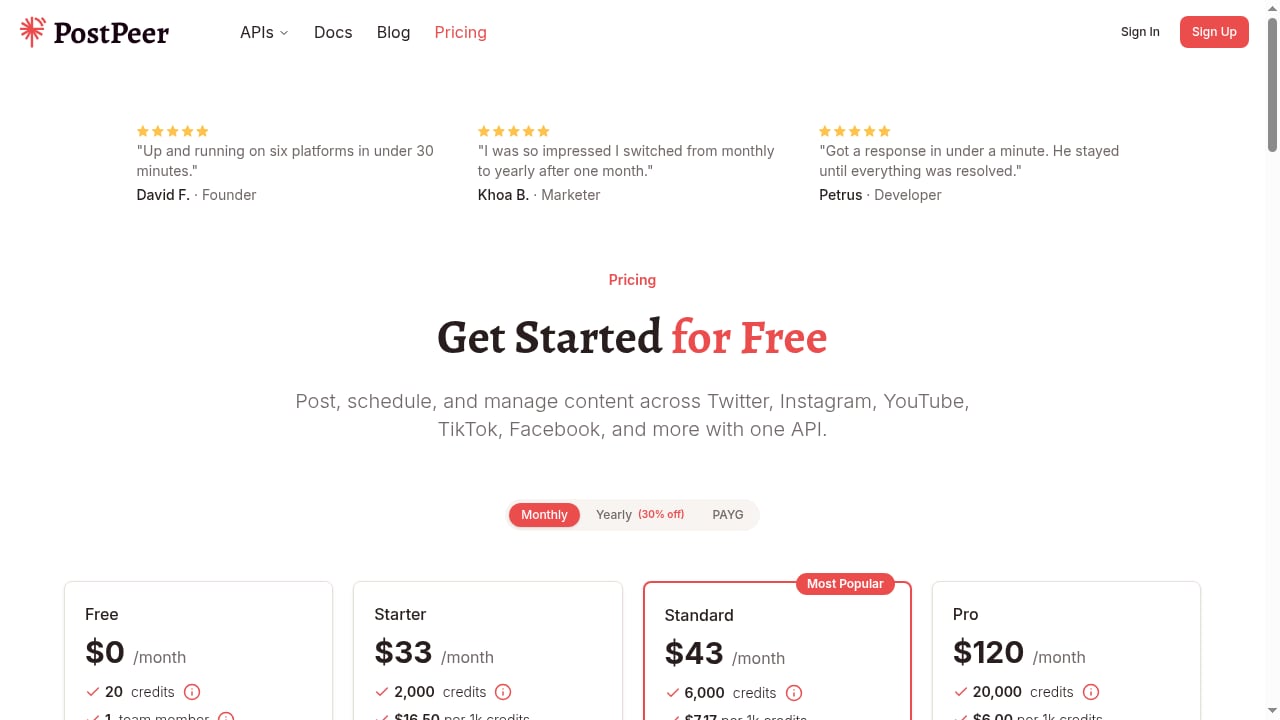
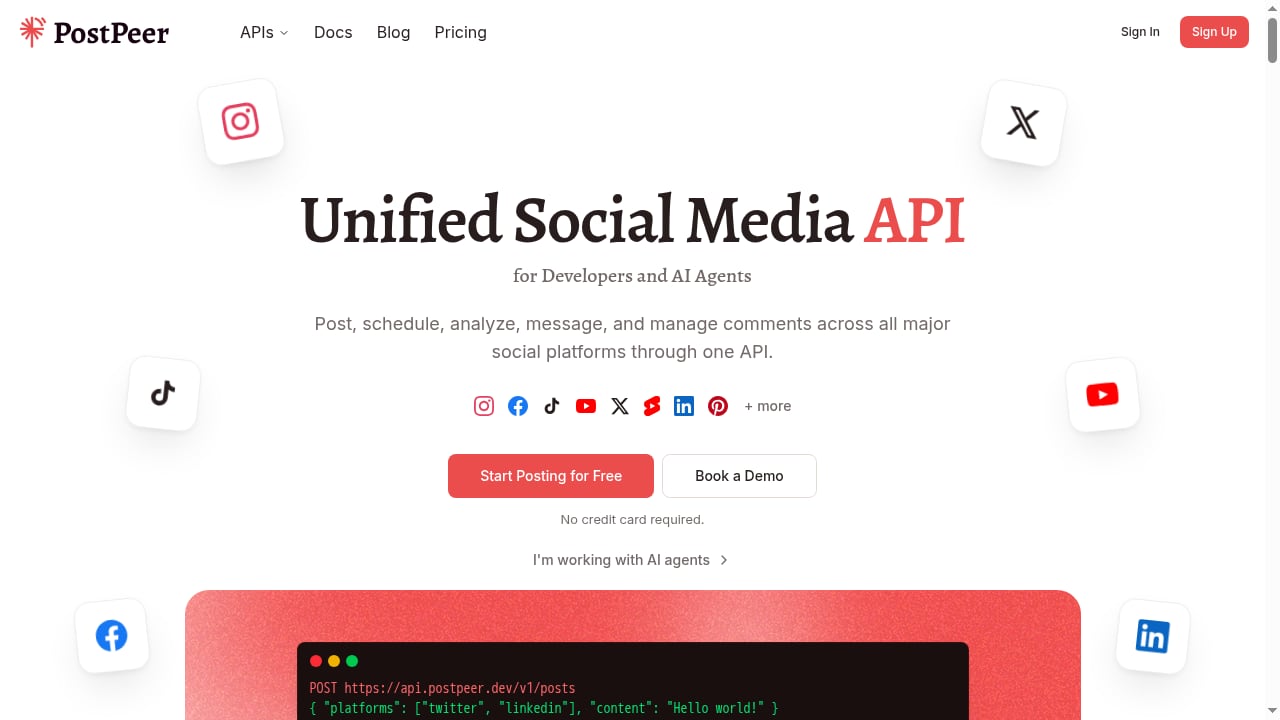
First viewport screenshot of Unified Social Media API for Developers and AI Agents | PostPeer.
UnifyPort
UnifyPort is a unified messaging API platform. It connects WhatsApp, Telegram, LINE, TikTok, Zalo, and X (formerly Twitter) through one REST API and one standard webhook event stream. Teams send messages with a single POST /v1/messages endpoint and receive normalized inbound events without provider-specific SDKs. Official SDKs exist for Node.js, PHP, Go, and Python.
The platform provides a standard event layer that converts every provider message, status update, and account event into one stable JSON shape. A webhook control plane manages signatures, subscriptions, retry behavior, and failure tracking. A reliable delivery queue adds built-in rate limits, retries, idempotency, and failure isolation. Security uses workspace API keys, HMAC-SHA256 signatures, and minimal exposure patterns. Resources are organized around workspaces, messaging accounts, and connection runtime states, with a documented account lifecycle covering QR code, verification code, password, Passkey, and session import. Pricing is based on messaging-account costs in USD with graduated pricing, unified API access, and free messaging accounts in every workspace.
PostPeer's Unified Social Media API
PostPeer's Unified Social Media API is positioned around posting, scheduling, analyzing, messaging, and managing comments across major social platforms through one API. The public offer includes 20 free credits with no credit card required. That framing points to a social publishing and engagement workflow rather than a real-time messaging transport layer.
Channel coverage: messaging-first vs social-first
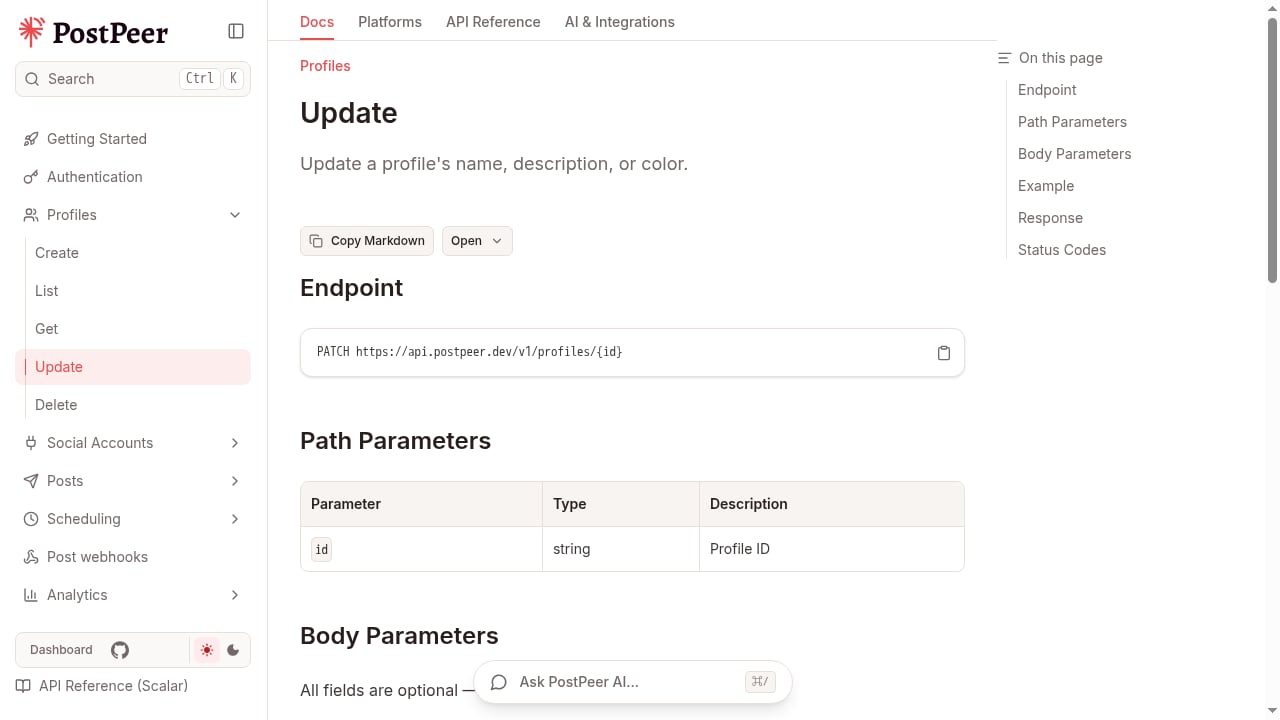
First viewport screenshot of Unified Social Media API for Developers and AI Agents | PostPeer.
UnifyPort's channel list is explicit: WhatsApp, Telegram, LINE, TikTok, Zalo, and X. These are messaging surfaces where a conversation thread, a delivery status, and an account session all matter. The API is designed so that an inbound WhatsApp message and an inbound X message arrive in the same normalized event shape.
PostPeer's description covers "all major social platforms" for posting, scheduling, analyzing, messaging, and comment management. That is a broader social graph surface, but the public description does not enumerate the same messaging-specific channels or account lifecycle states that UnifyPort documents. If your product needs WhatsApp or Telegram as a first-class conversational channel, UnifyPort's scope is the more direct match.
API model: one endpoint vs many social actions
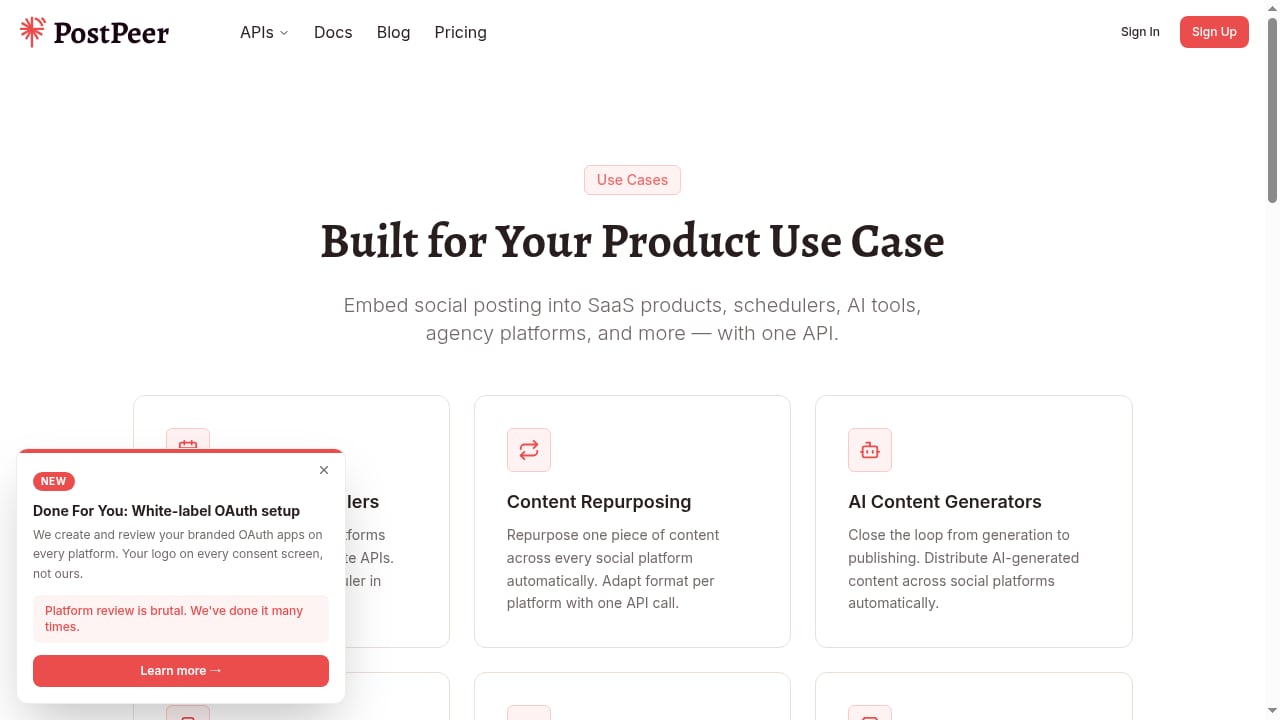
First viewport screenshot of Unified Social Media API for Developers and AI Agents | PostPeer.
UnifyPort centers on one messaging endpoint and one webhook stream. You send with POST /v1/messages, and you receive provider events through a normalized JSON shape. That reduces the branching logic in your application because you do not need to write a different parser for each provider's payload.
PostPeer's model appears to be organized around social actions: post, schedule, analyze, message, and manage comments. That is useful if your product is a social media management tool, a content calendar, or an analytics dashboard. It is less direct if your core loop is a two-way conversation with delivery guarantees.
Webhooks, retries, and delivery reliability
UnifyPort treats webhook handling as a control plane. Signatures, subscriptions, retry behavior, and failure tracking are managed centrally. The delivery queue includes rate limits, retries, idempotency, and failure isolation. For teams building notification systems or customer engagement tools, that means a provider outage or a rate-limit spike does not have to cascade into your application logic.
PostPeer's public description does not detail webhook signature management, retry semantics, idempotency, or failure isolation. Those details may exist in its documentation, but they are not part of the public positioning. If delivery reliability is a hard requirement, ask for specifics before committing.
SDKs and developer experience
UnifyPort ships official SDKs for Node.js, PHP, Go, and Python. That matters for teams that want typed clients and idiomatic error handling rather than raw HTTP calls. The account lifecycle is also documented, including QR code, verification code, password, Passkey, and session import flows. That is unusual and useful because account connection is often the hardest part of messaging integrations.
PostPeer's public offer emphasizes low-friction onboarding: 20 free credits and no credit card required. That is a real advantage for prototyping. The trade-off is that the public description does not list SDK languages or account lifecycle documentation, so you may need to evaluate the raw API surface yourself.
Security and account management
UnifyPort uses workspace API keys, HMAC-SHA256 signatures, and minimal exposure patterns. Resources are organized around workspaces, messaging accounts, and connection runtime states. This structure supports multi-tenant products where each customer has their own messaging accounts and connection state.
PostPeer's public description does not detail workspace-level key management, signature schemes, or account runtime states. If you are building a multi-tenant platform, confirm how PostPeer isolates accounts and secrets before you design your data model around it.
Pricing signals
UnifyPort prices on messaging-account costs in USD with graduated pricing, unified API access, and free messaging accounts in every workspace. That model aligns cost with the number of connected accounts rather than per-message markups, which is easier to forecast for products with steady conversation volume.
PostPeer offers 20 free credits with no credit card required. That is helpful for a proof of concept, but the public description does not explain how credits map to posts, messages, or API calls after the free tier. Ask for a clear unit-economics breakdown before scaling.
When to choose UnifyPort
Choose UnifyPort if your product needs:
- Real-time, two-way messaging across WhatsApp, Telegram, LINE, TikTok, Zalo, and X through one REST API.
- A normalized webhook event stream for messages, status updates, and account events.
- Built-in retries, idempotency, rate limits, and failure isolation.
- Official SDKs for Node.js, PHP, Go, and Python.
- A documented account lifecycle covering QR code, verification code, password, Passkey, and session import.
- Workspace-based security with HMAC-SHA256 signatures.
A practical example: a support platform that routes WhatsApp and Telegram conversations into a ticketing system. UnifyPort's normalized events and webhook control plane reduce the integration work, and the workspace model keeps each customer's accounts separate. For a concrete setup path, see How to Use UnifyPort with Zendesk: Unified Messaging Setup.
For AI agent builders, a single REST API plus a native MCP server means an agent can send and receive messages across channels without provider-specific tooling. That pattern is covered in One REST API and a Native MCP Server for Messaging.
When to choose PostPeer's Unified Social Media API
First viewport screenshot of Unified Social Media API for Developers and AI Agents | PostPeer.
Choose PostPeer if your product is primarily a social media management or publishing tool:
- You need to post, schedule, and analyze content across major social platforms.
- Comment management and engagement workflows are central to your product.
- You want to prototype quickly with 20 free credits and no credit card.
- Your messaging needs are secondary to publishing and analytics.
If your roadmap later shifts toward real-time conversational messaging, you may find yourself evaluating a messaging-first API like UnifyPort alongside your social publishing stack.
A note on comparison research
The top search results for this topic are not all directly comparable. One result is a logistics technology development company page, another is a ports cheat sheet on GitHub, and a third is a current affairs compilation. None of these are API product comparisons. That gap is exactly why a direct, evidence-based comparison matters: the search intent is about developer API choice, not logistics or exam prep.
For a broader view of how unified messaging APIs compare across vendors, see UnifyPort vs SocialAPI.ai vs Unipile: 2026 API Comparison.
Related reading
- Vonage API Developer Review: CPaaS Fit, Pricing & Limits - Evidence-based Vonage API Developer review: voice, video, Messages API, pricing signals, setup effort, limitations, and who it fits in 2026.
- Top 10 Omnichannel CPaaS Products 2026: Ranked Review - Ranked 2026 review of the top 10 omnichannel CPaaS products, with transparent criteria, evidence, channel coverage, developer fit, and buying guidance.
FAQ
Is UnifyPort a social media posting API?
No. UnifyPort is a unified messaging API platform. It focuses on sending and receiving messages across WhatsApp, Telegram, LINE, TikTok, Zalo, and X through one REST API and one normalized webhook event stream. Posting and scheduling are not its primary positioning.
Does PostPeer support WhatsApp and Telegram messaging?
PostPeer's public description says it supports messaging across major social platforms, but it does not enumerate WhatsApp, Telegram, LINE, TikTok, Zalo, or X specifically. If those channels are required, verify coverage directly with PostPeer before committing.
Which product is better for AI agents?
UnifyPort is designed for AI agents that need a single REST API and a native MCP server for messaging across channels. PostPeer's public positioning is around social posting, scheduling, analytics, and comment management, which is a different agent use case.
Does UnifyPort offer free usage?
Yes. UnifyPort includes free messaging accounts in every workspace, with pricing based on messaging-account costs in USD and graduated pricing.
Does PostPeer require a credit card to start?
No. PostPeer offers 20 free credits with no credit card required, according to its public description.
Can I use both UnifyPort and PostPeer?
Yes. Some teams use a social publishing API for content distribution and a messaging API for real-time conversations. The two cover different jobs, so they can coexist in one product stack.
Conclusion
UnifyPort and PostPeer's Unified Social Media API are not direct substitutes for every use case. UnifyPort is the stronger fit when your product depends on real-time, two-way messaging across WhatsApp, Telegram, LINE, TikTok, Zalo, and X, with normalized webhooks, retries, idempotency, SDKs, and workspace-level security. PostPeer is the stronger fit when your product is centered on social publishing, scheduling, analytics, and comment management, and you want a low-friction free tier to start.
Match the API to your core loop. If conversations are the product, start with UnifyPort. If content distribution is the product, start with PostPeer. If you need both, plan for two integrations rather than forcing one API to do both jobs.