
UnifyPort vs UIB vs bundle.social: Which API Fits?
Compare UnifyPort, UIB, and bundle.social on channels, messaging APIs, webhooks, SDKs, and pricing to pick the right integration for your product.
UnifyPort vs UIB vs bundle.social: Which API Fits Your Product?
Choosing between UnifyPort, UIB, and bundle.social is not a matter of finding the "best" platform. Each one solves a different integration problem: UnifyPort focuses on two-way messaging across global social channels, UIB combines omnichannel communication with AI automation, and bundle.social concentrates on social publishing, scheduling, and analytics. This comparison breaks down where each platform is strong so you can match the tool to your actual workflow.
Search intent and how to read this comparison
People searching for "UnifyPort vs UIB vs bundle.social" are usually developers, integration engineers, or product leads evaluating APIs before committing engineering time. They want a side-by-side view of channel coverage, API design, webhook behavior, SDK support, and pricing model. This article answers those questions directly and flags where each product is the better fit.
Quick verdict
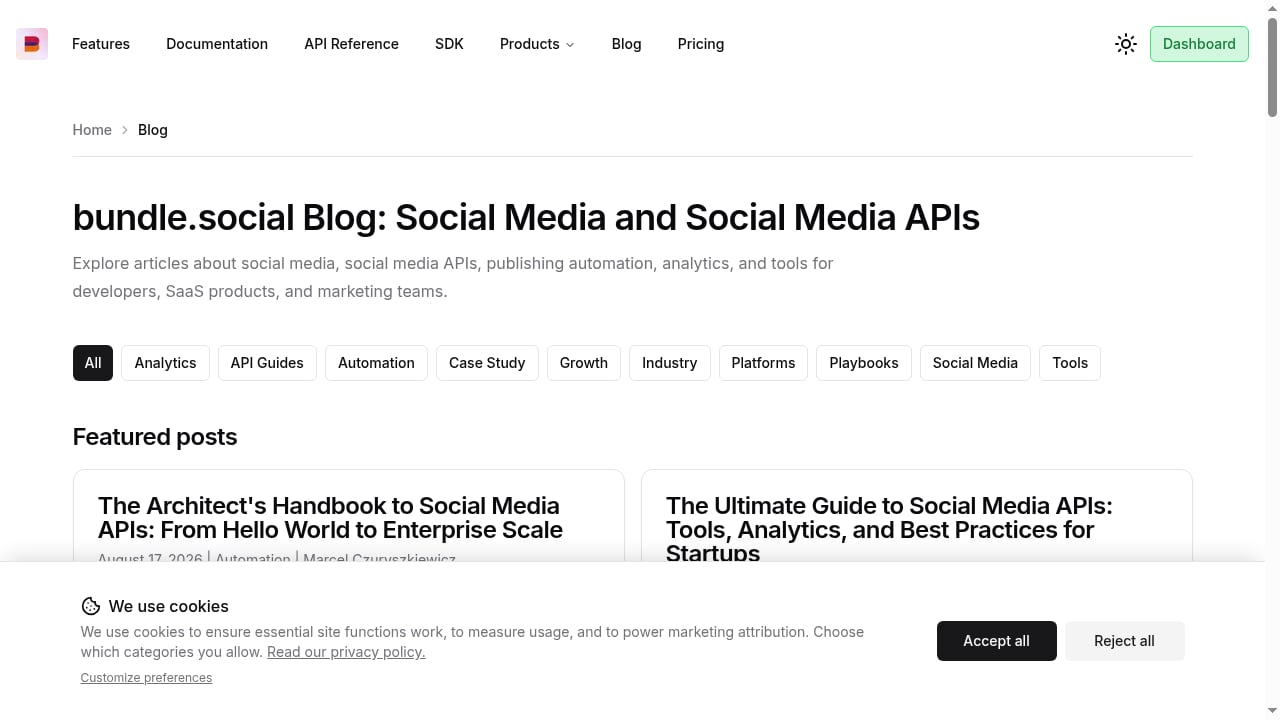
First viewport screenshot of bundle.social.
| Criterion | UnifyPort | UIB | bundle.social |
|---|---|---|---|
| Primary focus | Unified two-way messaging API | Omnichannel communication + AI automation | Unified social media publishing API |
| Channel coverage | WhatsApp, Telegram, LINE, TikTok, Zalo, X | WhatsApp, SMS, Messenger, Instagram, LINE, email, voice, video | 15 social platforms for publishing; DMs on Instagram, Facebook, TikTok comments |
| Webhook model | Standardized event stream (e.g., message.received) |
Real-time events and analytics | Webhooks for post status, comments, analytics |
| SDKs | Node.js, PHP, Go, Python | Developer-friendly APIs | REST API |
| Pricing signal | Graduated monthly messaging-account costs, free messaging accounts per workspace | From $79/month, 14-day free trial | Free tier; Pro at $100/month per organization |
| Best for | Two-way messaging in Asia-Pacific and global social channels | Contact center automation and conversational AI | Social publishing, scheduling, and analytics at scale |
Where UnifyPort stands out
One REST API for two-way messaging
UnifyPort's core promise is "One API. Every Channel." Instead of maintaining a separate integration for WhatsApp, Telegram, LINE, TikTok, Zalo, and X, teams send messages with a single POST /v1/messages call. Inbound messages arrive as normalized events such as message.received, with provider, account, conversation, sender, and message data in a consistent schema. That consistency matters when your support or notification workflow needs to treat every channel the same way.
Standardized webhook event stream
Webhook normalization is where many integration projects stall. Each provider has its own payload shape, retry behavior, and signature scheme. UnifyPort routes inbound messages and account status changes back to your webhook as standard events, which reduces provider-specific branching in your codebase. If webhook reliability is a priority, the UnifyPort vs Vonage comparison covers how this plays out against a broader CPaaS suite.
Asia-Pacific channel depth
LINE, Zalo, and TikTok are prominent in Asia-Pacific markets, and UnifyPort treats them as first-class channels rather than add-ons. For teams building customer support or engagement workflows in those markets, this coverage is a practical advantage over platforms that focus mainly on Western social networks. The LINE Social Plugins vs Messaging APIs article explains when a messaging API is the right layer instead of web plugins.
Account lifecycle and interaction features
UnifyPort supports account lifecycle management, including QR-code, code, session, and Passkey authentication flows. On the interaction side, it handles text and media captions, mentions, message pinning, revocation, and emoji reactions. These are the details that determine whether a messaging integration feels complete or requires constant workarounds.
Where UIB is strong
UnifyPort vs UIB vs bundle.social: Which API Fits? - Where UIB is strong.
UIB is an AI-powered omnichannel communication platform that combines messaging APIs with chatbots, conversational AI agents, and voice assistants. Its strengths are clear:
- Broad channel mix including voice and video. UIB connects WhatsApp, SMS, Facebook Messenger, Instagram DMs, LINE, email, voice, and video through a unified dashboard and APIs. Teams that need voice alongside messaging get that in one platform.
- AI automation built in. Chatbots and conversational AI agents help automate routine queries, which suits contact center automation, lead capture, and conversational commerce.
- Enterprise features. Real-time analytics, CRM and helpdesk integrations, and enterprise-grade security and compliance are part of the offering.
- Accessible entry point. A 14-day free trial with no credit card and plans starting at $79/month for small teams lower the barrier to evaluation.
If your roadmap centers on automating customer conversations with AI and you need voice and video in the same stack, UIB is a credible choice. For a broader look at how AI workflows pair with messaging APIs, see UnifyPort + Conversational AI.
Where bundle.social is strong
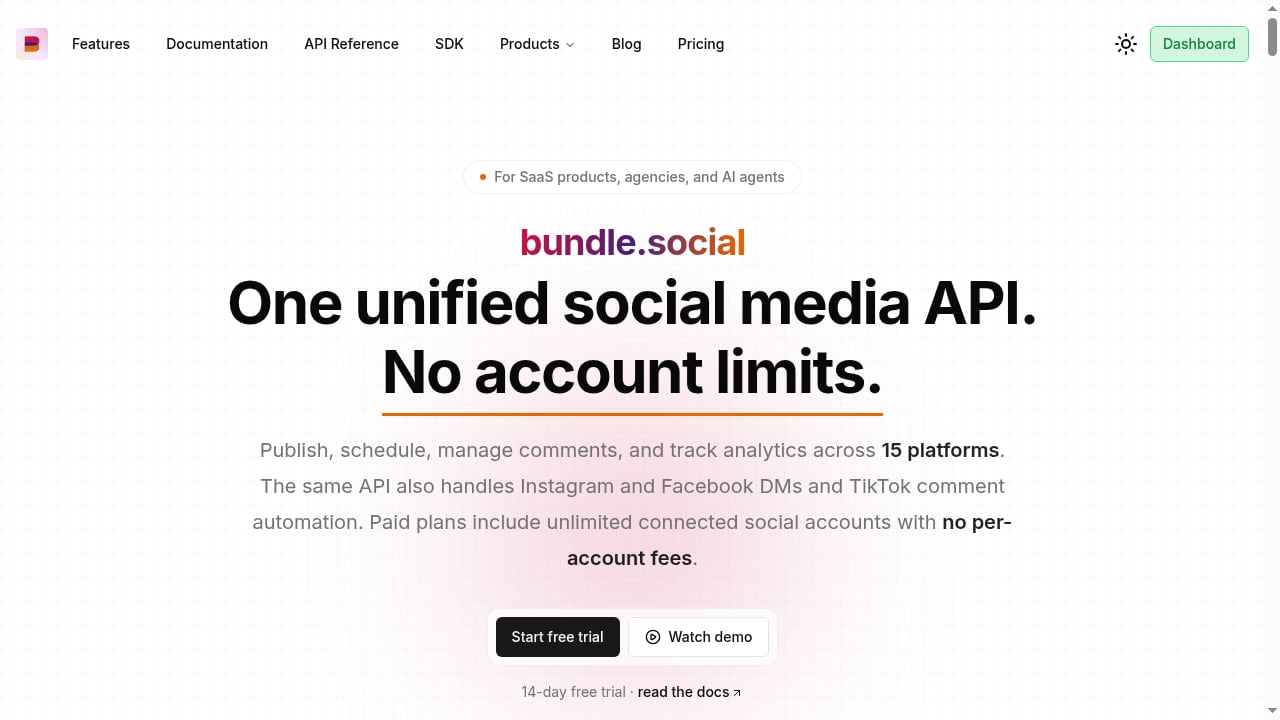
First viewport screenshot of bundle.social.
bundle.social is a unified social media API built for publishing, scheduling, comment management, and analytics across 15 platforms, including Facebook, Instagram, X, TikTok, LinkedIn, Pinterest, Reddit, Discord, Slack, Mastodon, Threads, YouTube, Bluesky, Google Business Profile, and Snapchat.
- Publishing and scheduling depth. The API handles post creation, scheduling, bulk campaigns, media uploads, and status tracking, plus platform-specific error surfacing that operators can act on.
- Multi-tenant by design. Organizations, teams, connected accounts, channels, and API keys are modeled for products managing many brands or clients. Paid plans include unlimited connected social accounts and unlimited teams.
- Proven scale. Published proof points include 11,000+ customers, 600k+ connected accounts, 99.981% uptime, and a 4.7/5 Trustpilot rating.
- Transparent entry pricing. A free tier supports testing, paid plans include a 14-day trial, and the Pro plan is $100/month per organization with 10,000 posts, 5,000 comments, and per-account messaging and automation allowances.
If your product is a social media management tool, agency dashboard, or AI publishing workflow, bundle.social's publishing and analytics surface is a strong match. Its own documentation is candid that it is not an ads API, not a mass-DM tool, and not a bypass for platform rules.
How the three differ on key criteria
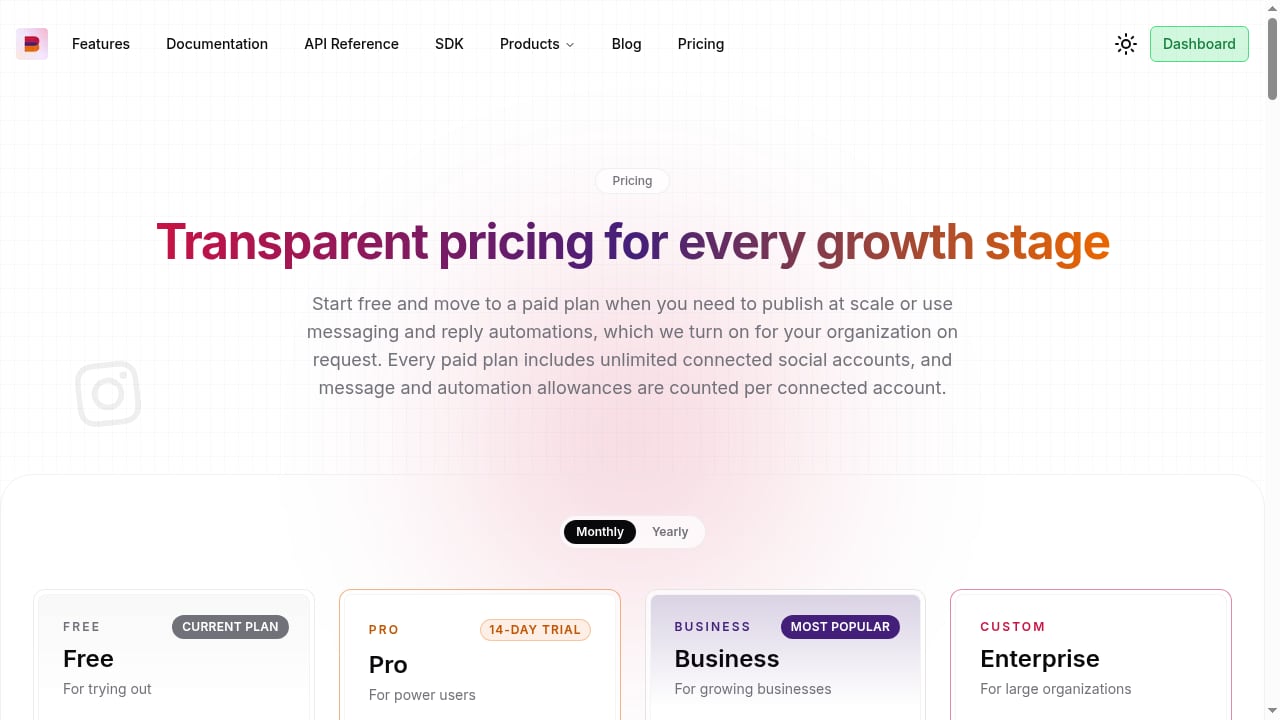
First viewport screenshot of bundle.social.
Channel coverage and use case
UnifyPort and UIB both target two-way customer conversations, but UIB extends into voice and video while UnifyPort emphasizes social messaging channels common in Asia-Pacific. bundle.social targets outbound publishing and analytics across a wider set of social networks, with limited DM support on Instagram and Facebook and TikTok comment automation.
API and webhook design
UnifyPort's standardized event stream is designed so inbound messages look the same regardless of provider. bundle.social normalizes authentication, post creation, scheduling, media, analytics, and error handling while preserving platform-specific fields where needed. UIB offers a single API for communication needs alongside AI agent tooling. Each approach reflects its core use case: conversations, publishing, or automated engagement.
SDKs and developer experience
UnifyPort offers official SDKs for Node.js, PHP, Go, and Python. bundle.social is REST-first with documentation aimed at developers building multi-account products. UIB markets developer-friendly APIs alongside its dashboard. Teams should test documentation quality and error clarity during a trial, since that is where integration time is won or lost.
Pricing models
UnifyPort uses transparent graduated monthly messaging-account costs in USD, with unified API access and free messaging accounts in every workspace, plus wallet-mode and quota-based account billing operations. UIB starts at $79/month with a 14-day free trial. bundle.social offers a free tier and a $100/month Pro plan per organization. The right model depends on whether you scale by messaging accounts, seats, or post volume.
Decision guide
- Choose UnifyPort if you need two-way messaging across WhatsApp, Telegram, LINE, TikTok, Zalo, and X through one REST API and a standardized webhook stream, especially for Asia-Pacific customer support, notifications, or engagement workflows.
- Choose UIB if AI-driven contact center automation, chatbots, and voice or video channels are central to your customer engagement strategy.
- Choose bundle.social if your product publishes, schedules, and analyzes social content across many platforms and needs multi-tenant account management with unlimited connected accounts.
For a wider field of options, the Top 10 Unified Communication API Platforms 2026 review compares channels, webhooks, SDKs, and pricing across the market.
Related reading
- respond.io Review 2026: Pricing, Pros & Ideal Users - Evidence-based respond.io review: unified inbox, AI Agents, WhatsApp API costs, pricing from $79/mo, setup, limitations, and who should use it in 2026.
Sources and further reading
- About - Learn why bundle.social exists, who it is built for, and how the product helps developers, agencies, SaaS tools, AI products, and internal teams ship social media workflows faster.
- UnifyPort — One API. Every Channel. - Connect WhatsApp, Telegram, LINE, TikTok, Zalo, and X through one API for messages and events, without rebuilding the integration for every platform.
- The 8 Best Bundle.Social Alternatives - Faster, Cheaper and Better Social Media APIs - Looking for a good Bundle.social alternative? We compare 8 unified social media APIs like WoopSocial, Postiz, Upload-Post, Outstand and others on pricing and features.
FAQ
Is UnifyPort a replacement for bundle.social?
Not exactly. UnifyPort focuses on two-way messaging and normalized webhook events across channels like WhatsApp, LINE, Zalo, and TikTok. bundle.social focuses on social publishing, scheduling, and analytics. Some teams use both: one for conversations, one for content distribution.
Does UIB support the same channels as UnifyPort?
UIB covers WhatsApp, SMS, Messenger, Instagram, LINE, email, voice, and video. UnifyPort covers WhatsApp, Telegram, LINE, TikTok, Zalo, and X with a standardized messaging API. The overlap is WhatsApp and LINE; the difference is UIB's voice and video breadth versus UnifyPort's Asia-Pacific social messaging depth.
Which platform has the simplest webhook model?
UnifyPort normalizes inbound messages into standard events such as message.received with a consistent schema across providers. That design reduces per-provider handling, which is a meaningful advantage for teams maintaining multiple channel integrations.
Can I try these platforms before committing?
UIB offers a 14-day free trial with no credit card. bundle.social has a free tier and a 14-day trial on paid plans. UnifyPort includes free messaging accounts in every workspace, which lets teams test the API before scaling.
Which is best for a SaaS product managing many client accounts?
bundle.social is explicitly designed for multi-tenant products with unlimited connected accounts and teams on paid plans. UnifyPort is a better fit when the product's core value is two-way messaging rather than publishing.
Conclusion
UnifyPort, UIB, and bundle.social are complementary rather than interchangeable. UnifyPort wins on unified two-way messaging with a standardized webhook stream and strong Asia-Pacific channel coverage. UIB wins on AI-powered omnichannel engagement with voice and video. bundle.social wins on social publishing, scheduling, and analytics at multi-tenant scale. Start with the workflow you need most, test the API surface during a trial, and choose the platform whose core strength matches your product's core job.