
UnifyPort vs MSG91: Unified Messaging API or CPaaS Suite?
UnifyPort vs MSG91 compared: unified messaging API for WhatsApp, Telegram, LINE, TikTok, Zalo and X versus MSG91's SMS, OTP and CPaaS suite.
UnifyPort vs MSG91: Unified Messaging API or CPaaS Suite?
UnifyPort and MSG91 both promise "one API, many channels," but they solve different problems. UnifyPort is a unified messaging API that normalizes WhatsApp, Telegram, LINE, TikTok, Zalo, and X (formerly Twitter) into a single REST endpoint and one standard webhook event stream. MSG91 is a broader business communication and customer engagement suite built around SMS, OTP, email, WhatsApp, voice, and push, with support apps like Ticketing, Campaign, and Segment layered on top.
This comparison breaks down where each platform fits, what the public evidence actually supports, and which one to pick for your use case.
What each platform is built for
First viewport screenshot of Customer Service Software For Small Business - Customer Support.
UnifyPort: one API, one event stream, many messaging providers
UnifyPort's homepage frames the product as production infrastructure rather than a channel aggregator. The core ideas:
- One send endpoint. A single
POST /v1/messageshandles text, images, files, and operational notifications across every connected provider. - Standard events. Inbound messages, status updates, and account events are normalized into one stable JSON shape, so your webhook handler doesn't branch per provider.
- Webhook control plane. Signatures, subscriptions, retry behavior, and failure tracking are managed centrally.
- Reliable delivery queue. Built-in rate limits, retries, idempotency, and failure isolation keep provider turbulence inside the platform layer.
- Official SDKs. Node.js, PHP, Go, and Python are supported.
- Account lifecycle. Authentication flows include QR code, verification code, password, Passkey, and session import.
- Security. Workspace API keys, HMAC-SHA256 signatures, and minimal exposure patterns.
Pricing is based on messaging-account costs in USD with transparent graduated tiers, and every workspace includes free messaging accounts.
MSG91: a customer communication and engagement suite
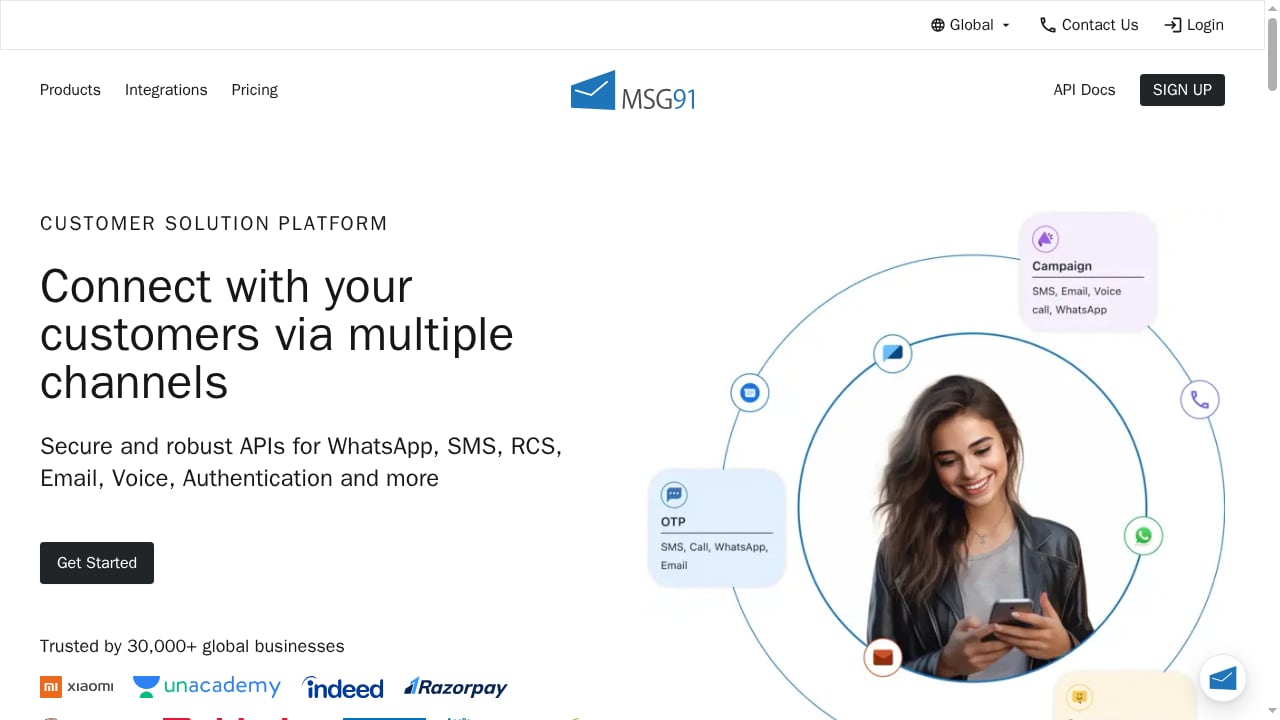
MSG91 positions itself as a customer solution platform with a unified suite of communication and engagement tools. Its public materials describe:
- Channels: SMS, RCS, Email, WhatsApp, Voice, and Push Notifications through a single API.
- Applications: Hello (transactional messaging), Ticketing and Chat (customer support), Campaign (bulk messaging), Segment (contact management), Event-based Automation, and a Simplified OTP Platform.
- Utilities: URL Shortener, KnowledgeBase, File Hosting, and centralized Reports.
- Reach: small businesses and enterprises globally, with localized pricing and support for the United States, India, Brazil, UAE, Philippines, Singapore, Spain, and the United Kingdom.
- Positioning: reliable, high-quality services at fair and affordable prices, emphasized by its Fair Pricing Policy.
For an India-focused view of MSG91's OTP strengths, the CallerDesk OTP provider comparison notes publicly listed India-to-India OTP pricing from ₹0.25 at 5,000 OTPs, dropping to around ₹0.18 at higher volumes, plus an OTP Widget with SMS, Voice, WhatsApp, and Email options. That same guide also flags a practical caveat: OTP pricing can shift with volume, route, channel, taxes, and commercial agreements, so confirm current rates before committing.
Head-to-head comparison
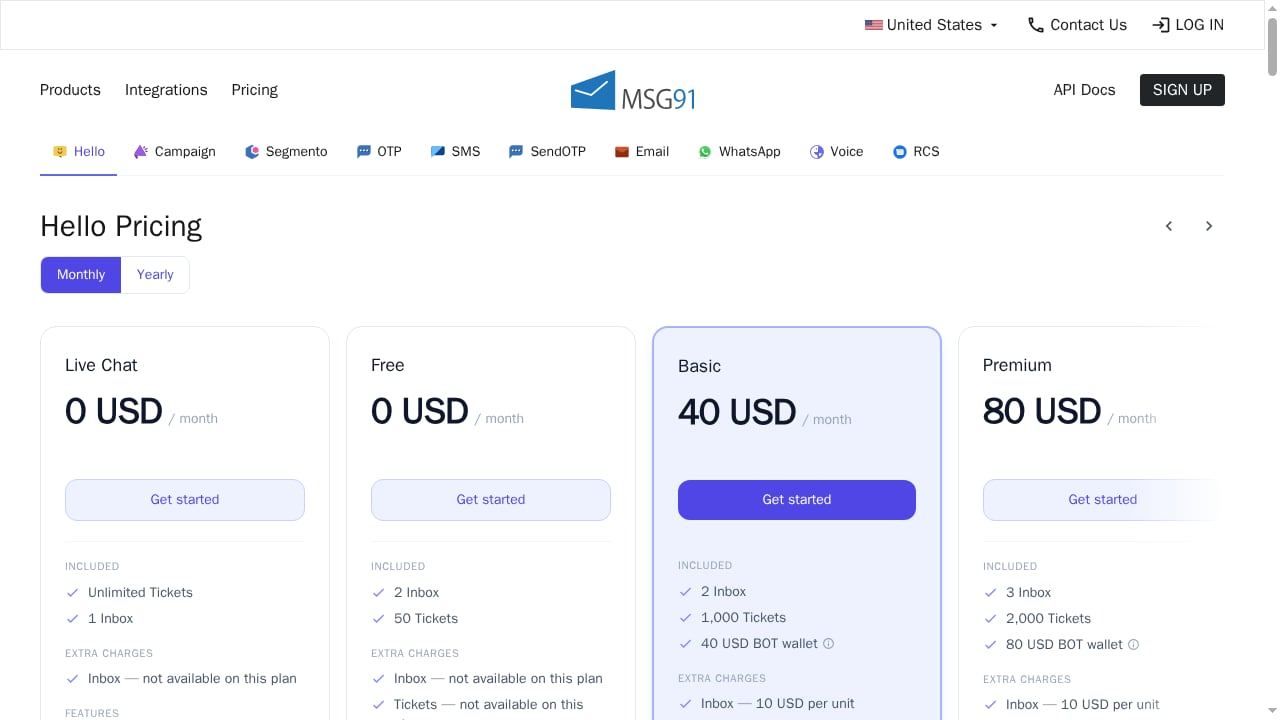
First viewport screenshot of Hello Pricing in United States | MSG91-United States.
| Dimension | UnifyPort | MSG91 |
|---|---|---|
| Core model | Unified messaging API + standard event stream | CPaaS suite with messaging apps and utilities |
| Primary channels | WhatsApp, Telegram, LINE, TikTok, Zalo, X | SMS, RCS, Email, WhatsApp, Voice, Push |
| Send interface | Single POST /v1/messages |
Single API across its channel set |
| Inbound events | Normalized JSON for every provider | Event-based automation and app-level events |
| Webhooks | Signature control, subscriptions, retries, failure tracking | Not detailed in the cited sources |
| SDKs | Node.js, PHP, Go, Python | Developer-focused APIs (SDK list not specified in sources) |
| OTP | Not a stated focus | Dedicated OTP platform with SMS, Voice, WhatsApp, Email |
| Support/ticketing apps | Not offered | Ticketing and Chat, KnowledgeBase |
| Marketing apps | Not offered | Campaign, Segment, URL Shortener |
| Pricing model | Messaging-account costs in USD, graduated tiers, free accounts | Localized pricing; public OTP rates cited from ₹0.25 |
| Geographic emphasis | Not specified in sources | US, India, Brazil, UAE, Philippines, Singapore, Spain, UK |
Where UnifyPort has the clearer advantage
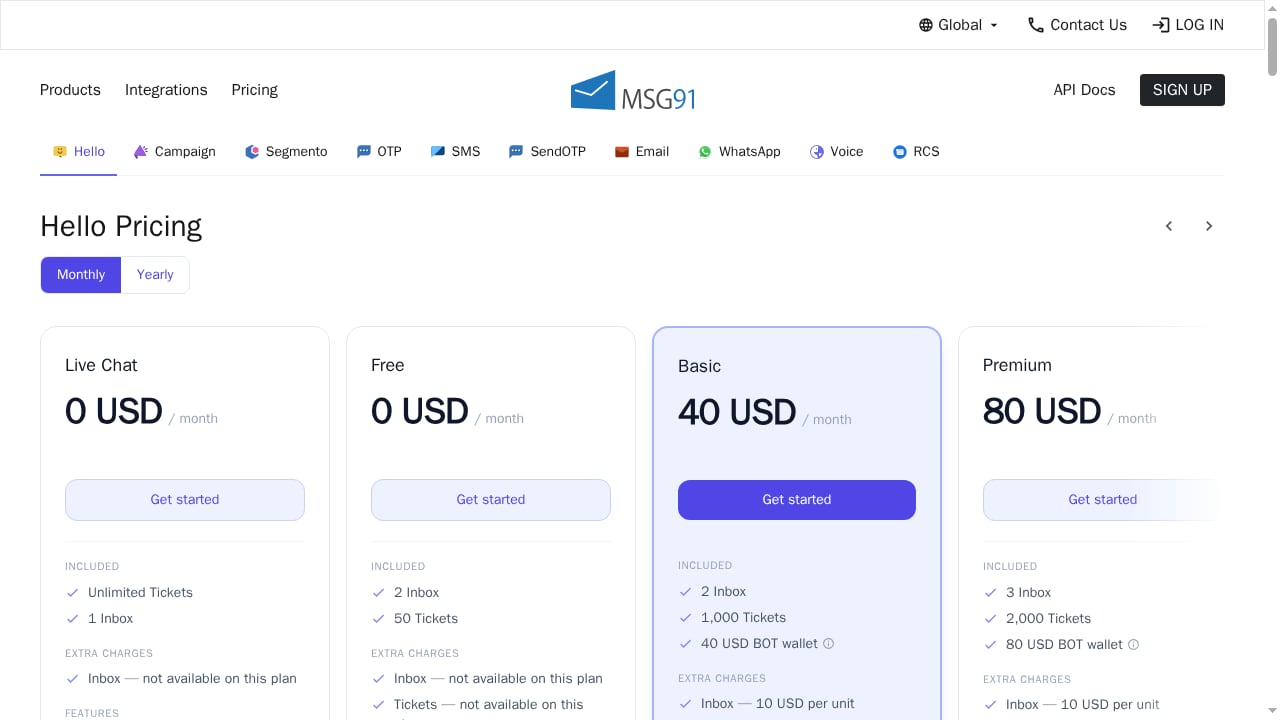
First viewport screenshot of Hello Pricing in United States | MSG91-United States.
Provider-agnostic messaging beyond the usual CPaaS channels
Most CPaaS platforms, including MSG91, center on SMS, WhatsApp, email, voice, and push. UnifyPort's channel list goes further into social and consumer messaging networks: Telegram, LINE, TikTok, Zalo, and X. If your product needs to reach users on those platforms, MSG91's documented channel set doesn't cover them.
A standard event layer instead of per-provider parsing
The hardest part of multi-provider messaging is rarely sending. It's handling inbound messages and status updates consistently. UnifyPort converts every provider message, status update, and account event into one stable JSON shape. That means one webhook handler, one set of retry semantics, and one place to debug. If you're fanning events out to customer endpoints, see How to Use UnifyPort with Svix: Unified Messaging Webhooks.
Webhook reliability as a first-class feature
UnifyPort's webhook control plane covers signatures, subscriptions, retry behavior, and failure tracking. Combined with HMAC-SHA256 signatures and workspace API keys, this is the kind of infrastructure detail that matters when a delivery silently fails at 3 a.m. For a broader look at how platforms handle this, the omni-channel messaging platform buyer's guide covers what separates real orchestration from multichannel sprawl.
Transparent, account-based pricing in USD
UnifyPort prices by messaging account with graduated tiers and includes free messaging accounts in every workspace. For teams budgeting in USD, that's easier to model than region-by-region rate cards.
Where MSG91 has the clearer advantage
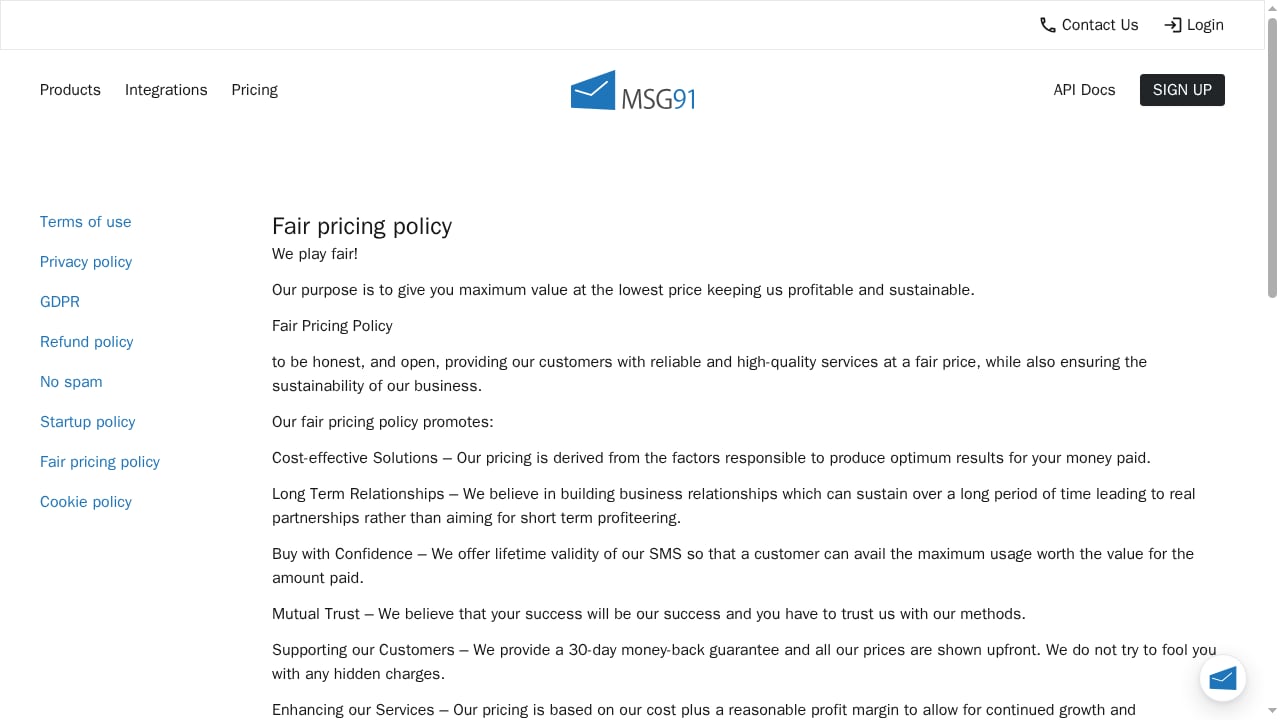
First viewport screenshot of Fair pricing policy.
OTP and verification depth
MSG91's Simplified OTP Platform is a genuine strength. It supports SMS, Voice, WhatsApp, and Email OTP options, and its India pricing is publicly listed. If verification is your primary use case, MSG91 is purpose-built for it in a way UnifyPort is not.
A wider application suite
MSG91 bundles Ticketing and Chat, Campaign, Segment, Event-based Automation, URL Shortener, KnowledgeBase, and File Hosting. If you want a single vendor for customer support tooling and bulk campaigns alongside messaging, MSG91 covers more surface area out of the box.
Localized pricing and regional support
MSG91 explicitly supports multiple countries with localized pricing and support, including India, Brazil, UAE, Philippines, Singapore, Spain, the UK, and the US. For businesses whose cost model depends on local SMS routes and DLT-style compliance, that regional focus is a real advantage.
Established SMS and voice infrastructure
For high-volume transactional SMS and voice, MSG91's channel maturity and public pricing make it a practical default in markets where SMS remains the primary verification channel.
Which one should you choose?
Choose UnifyPort if:
- You need WhatsApp, Telegram, LINE, TikTok, Zalo, or X in one integration.
- You want a single
POST /v1/messagesendpoint and one normalized webhook stream. - You care about webhook signatures, retries, idempotency, and failure isolation as product requirements.
- You want official SDKs in Node.js, PHP, Go, or Python.
- You prefer USD account-based pricing with free accounts to start.
Choose MSG91 if:
- OTP and verification are your primary use case.
- You need SMS, RCS, email, voice, and push alongside WhatsApp.
- You want bundled support, campaign, and contact-management apps.
- You operate in regions where MSG91 offers localized pricing and support.
- You want publicly listed OTP rates to benchmark against.
Consider both if: you run OTP through MSG91 for SMS/voice verification while using UnifyPort for social and consumer messaging channels. The two aren't mutually exclusive, and the split often maps cleanly to different teams and budgets.
For a wider field of options, see the Top 10 CPaaS omni-channel messaging platforms for 2026 or the Chat API review.
Common integration pitfalls to plan for
- Account lifecycle friction. UnifyPort supports QR code, verification code, password, Passkey, and session import flows. Passkey-based flows can stall if WebAuthn challenges aren't handled correctly; see passkey_required WhatsApp QR: Fix Stuck Pairing.
- Webhook signature verification. Both platforms expect you to verify inbound requests. Skipping this step is the fastest way to accept forged events.
- Idempotency. Retries are a feature, not a bug. Design your handlers to tolerate duplicate deliveries.
- Rate limits. Provider limits differ. UnifyPort's adaptive rate limits absorb some of this, but your own downstream systems still need backpressure.
- Pricing drift. OTP and messaging rates change with volume, route, and taxes. Re-verify before signing annual commitments.
Sources and further reading
- 10 Best MSG91 Alternatives & Competitors (2026) - Explore the best MSG91 alternatives and competitors in 2026. Compare features, pricing, ratings, and verified reviews to find the right software.
FAQ
Is UnifyPort a replacement for MSG91?
Not exactly. UnifyPort replaces the multi-provider integration work for social and consumer messaging channels. MSG91 covers SMS, OTP, voice, email, and push plus support and campaign apps. Many teams use both for different jobs.
Does UnifyPort support OTP?
UnifyPort's documented focus is unified messaging and event handling across WhatsApp, Telegram, LINE, TikTok, Zalo, and X. OTP is not a stated product focus, so if verification is your primary need, MSG91's Simplified OTP Platform is the more direct fit.
Does MSG91 support Telegram, LINE, TikTok, Zalo, or X?
MSG91's documented channels are SMS, RCS, Email, WhatsApp, Voice, and Push Notifications. The cited sources do not list Telegram, LINE, TikTok, Zalo, or X, so treat those as out of scope unless MSG91 confirms otherwise.
How does pricing compare?
UnifyPort prices by messaging account in USD with graduated tiers and free accounts in every workspace. MSG91 uses localized pricing; its publicly listed India-to-India OTP rate starts at ₹0.25 at 5,000 OTPs and drops to around ₹0.18 at higher volumes. Rates vary by route, channel, and taxes.
Which has better webhook tooling?
Based on the cited sources, UnifyPort documents a webhook control plane with signatures, subscriptions, retry behavior, and failure tracking, plus HMAC-SHA256 signing. MSG91's cited materials describe event-based automation but do not detail webhook signature management.
Can I migrate from MSG91 to UnifyPort?
If your use case is social and consumer messaging, yes. If you rely on MSG91's OTP, voice, or support apps, plan a phased approach rather than a full replacement.
Conclusion
UnifyPort and MSG91 overlap on the phrase "one API, many channels," but the overlap is thin. UnifyPort is the stronger choice when your problem is integrating many messaging providers, normalizing inbound events, and running reliable webhooks without per-provider code. MSG91 is the stronger choice when your problem is OTP, SMS, voice, and a bundled customer engagement suite with localized pricing.
The practical answer for most teams: pick the platform that matches your primary workload, and don't force one tool to do both jobs. If social and consumer messaging is your bottleneck, UnifyPort's unified API and standard event stream remove the most work. If verification and regional SMS delivery are your bottleneck, MSG91's OTP platform and channel maturity are hard to beat.