
UnifyPort vs Gupshup.ai: Autonomous AI Agents for Sales, Marketing & Customer Support
Compare UnifyPort's unified messaging API with Gupshup.ai's autonomous AI agents for sales, marketing, and support. Evaluate channels, webhooks, SDKs, and pricing.
UnifyPort vs Gupshup.ai: Autonomous AI Agents for Sales, Marketing & Customer Support
When evaluating platforms for customer engagement, teams often face a choice between a unified messaging API that standardizes channel integrations and a conversational AI platform that provides autonomous agents for sales, marketing, and support. UnifyPort and Gupshup.ai represent these two approaches. This comparison examines their strengths, limitations, and ideal use cases to help you decide which fits your stack.
Understanding the Two Approaches
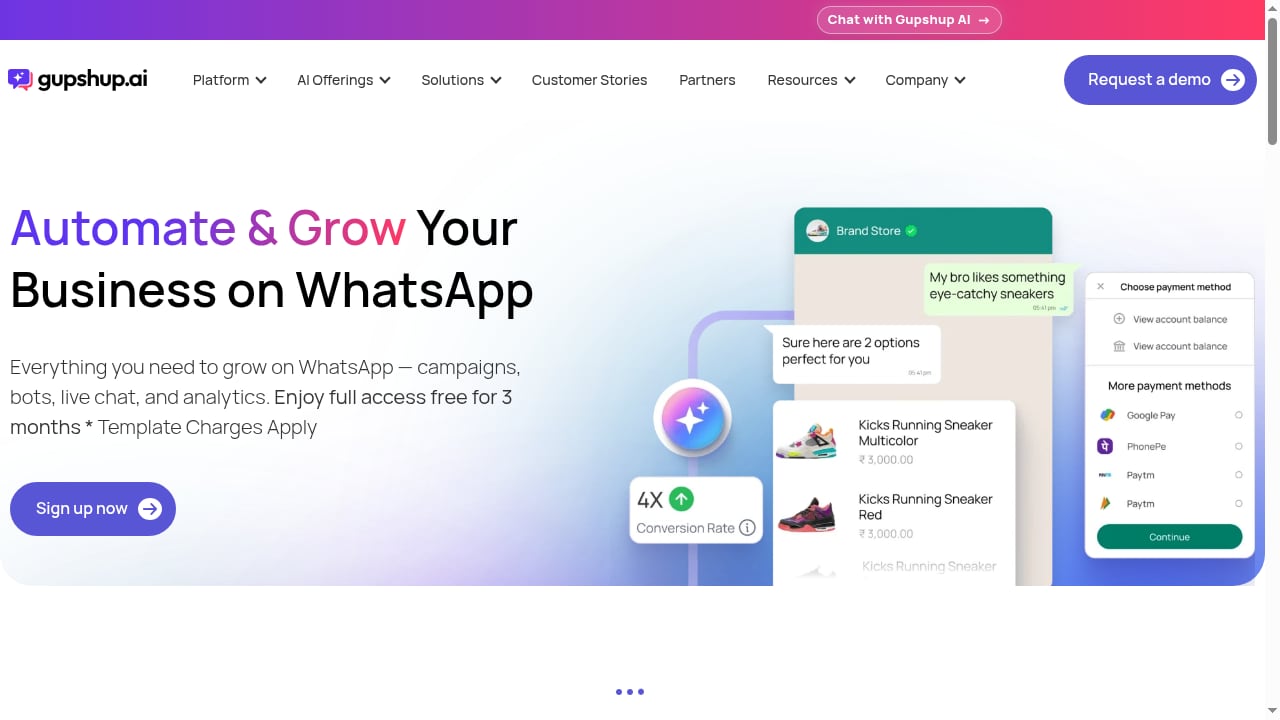
First viewport screenshot of www.gupshup.ai.
UnifyPort: One API for Every Channel
UnifyPort is a unified messaging API platform that connects WhatsApp, Telegram, LINE, TikTok, Zalo, and X (formerly Twitter) through a single REST API and a standardized webhook event stream. Instead of building and maintaining separate integrations for each social channel, developers send messages with one POST /v1/messages call and receive normalized events such as message.received, with provider, account, conversation, sender, and message data in a consistent schema. The platform supports two-way messaging, text and media captions, mentions, message pinning, revocation, emoji reactions, and account lifecycle management including QR-code, code, session, and Passkey authentication flows. Official SDKs are available for Node.js, PHP, Go, and Python. UnifyPort targets developers, integration engineers, and product teams building customer support, notification, and engagement workflows across global social channels, especially in Asia-Pacific markets where LINE, Zalo, and TikTok are prominent. The website positions the product as "One API. Every Channel." and emphasizes avoiding per-platform integration rebuilds. Pricing is described as transparent graduated monthly messaging-account costs in USD with unified API access and free messaging accounts in every workspace, with wallet-mode and quota-based account billing operations.
Gupshup.ai: Autonomous AI Agents for Sales, Marketing & Customer Support
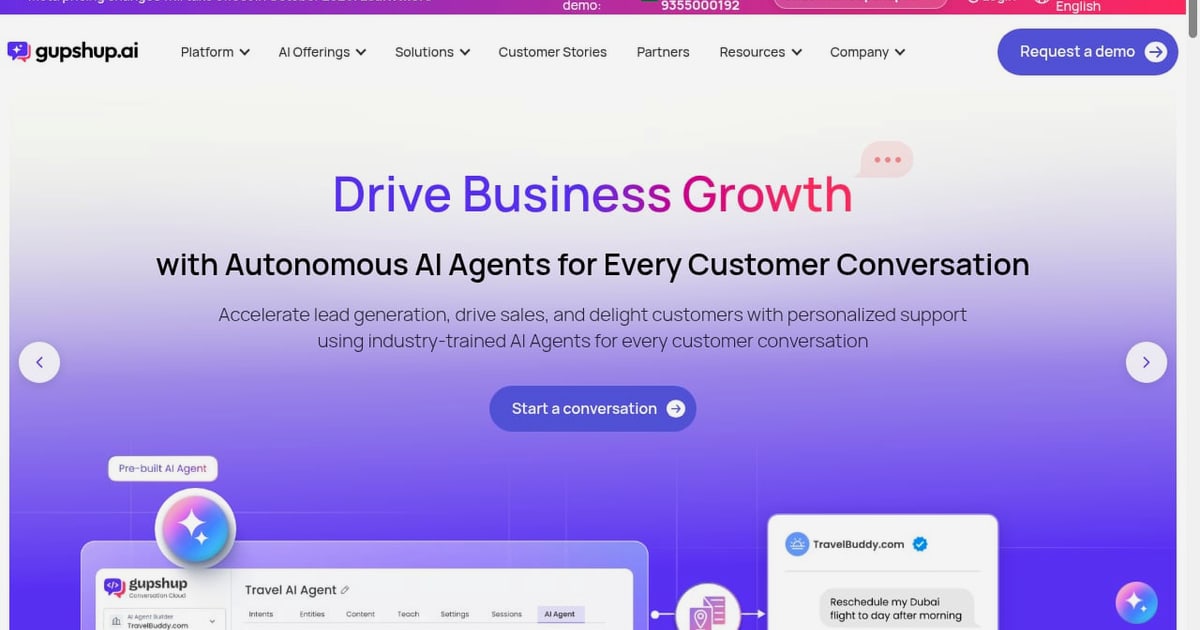
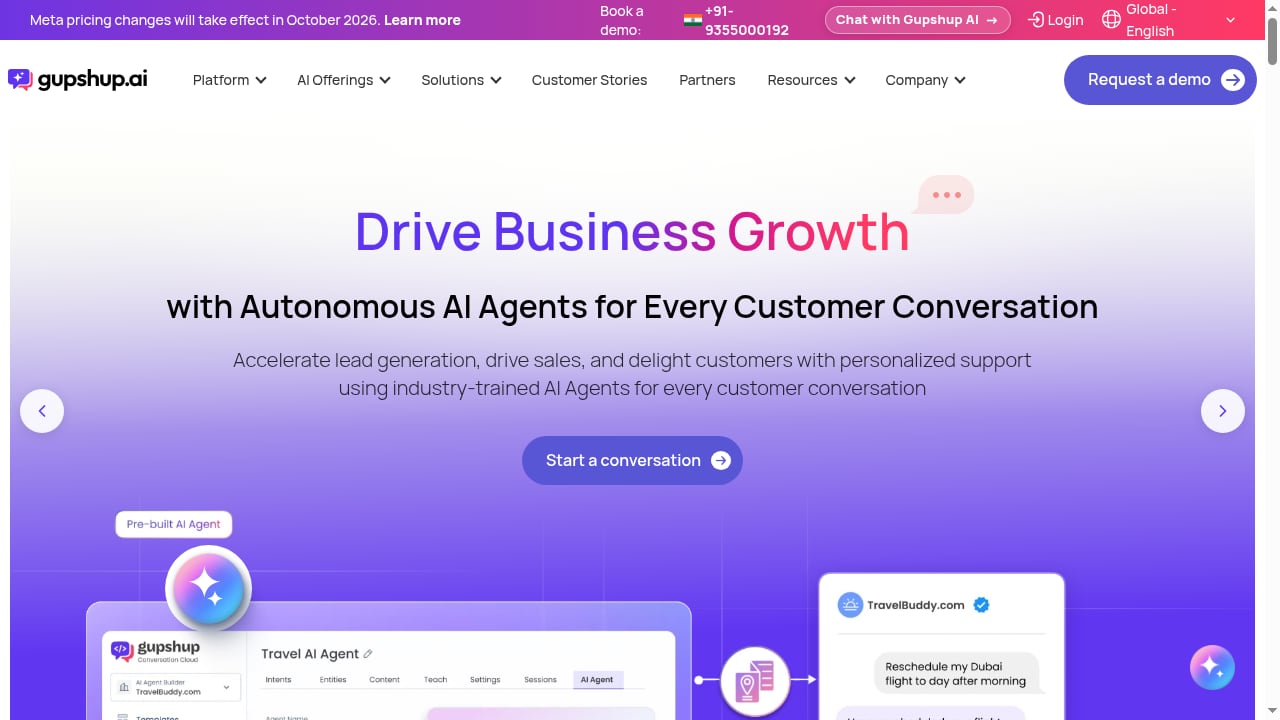
Gupshup.ai is a conversational AI and messaging platform that enables businesses to deploy secure, scalable AI agents with enterprise-ready infrastructure. According to its description, Gupshup powers billions of customer conversations across channels and industries. Its focus is on providing autonomous AI agents that can handle sales, marketing, and customer support interactions, leveraging conversational AI to automate engagement at scale.
Channel Coverage and Integration Model
UnifyPort's core strength is its unified API abstraction. Developers integrate once and gain access to multiple social messaging channels, with a consistent event schema that simplifies handling incoming messages and events. This reduces the engineering overhead of maintaining separate connectors for each platform. The supported channels include WhatsApp, Telegram, LINE, TikTok, Zalo, and X, with a particular emphasis on Asia-Pacific markets where LINE, Zalo, and TikTok are widely used.
Gupshup.ai, as a conversational AI platform, likely offers integration with major messaging channels, but its primary value proposition is the AI agent layer rather than a unified API for developers. Teams looking to build custom integrations or normalize events across channels may find UnifyPort's developer-first approach more straightforward. However, Gupshup's platform may provide out-of-the-box AI capabilities that reduce the need for custom development if autonomous agents are the primary requirement.
Developer Experience and SDKs
UnifyPort provides official SDKs for Node.js, PHP, Go, and Python, along with a standardized webhook event stream. The API design emphasizes simplicity: one endpoint for sending messages, normalized events for receiving, and consistent data structures. This makes it easier for developers to build and maintain messaging workflows without deep platform-specific knowledge.
Gupshup.ai's developer offerings are less detailed in the provided context, but as an AI agent platform, it may offer APIs and SDKs for integrating its agents into applications. The key difference is that UnifyPort focuses on providing the messaging infrastructure, while Gupshup focuses on the AI layer that sits on top of messaging channels. Developers who want full control over message handling and event processing may prefer UnifyPort's transparent API model.
AI Agent Capabilities
First viewport screenshot of www.gupshup.ai.
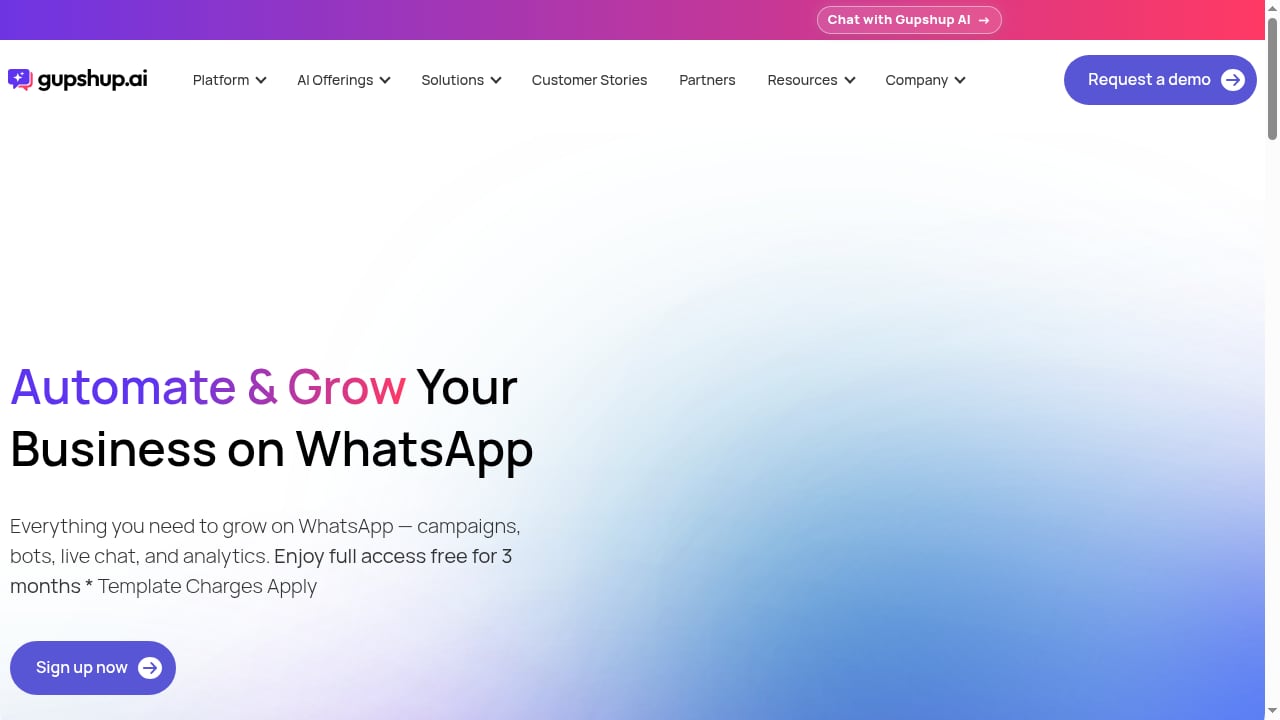
Gupshup.ai's main differentiator is its autonomous AI agents designed for sales, marketing, and customer support. These agents can automate conversations, qualify leads, provide support, and execute marketing campaigns without human intervention. The platform claims to power billions of conversations, suggesting scalability and enterprise readiness.
UnifyPort does not position itself as an AI agent platform; its focus is on unified messaging APIs. However, UnifyPort's normalized event stream and two-way messaging capabilities provide the foundation for building or integrating AI agents. Teams can use UnifyPort to handle channel integrations and then connect their own AI models or third-party AI services via webhooks. This modular approach gives developers flexibility to choose the AI stack that best fits their needs, rather than being locked into a single vendor's AI agents.
Pricing and Billing Transparency
First viewport screenshot of unifyport.ai.
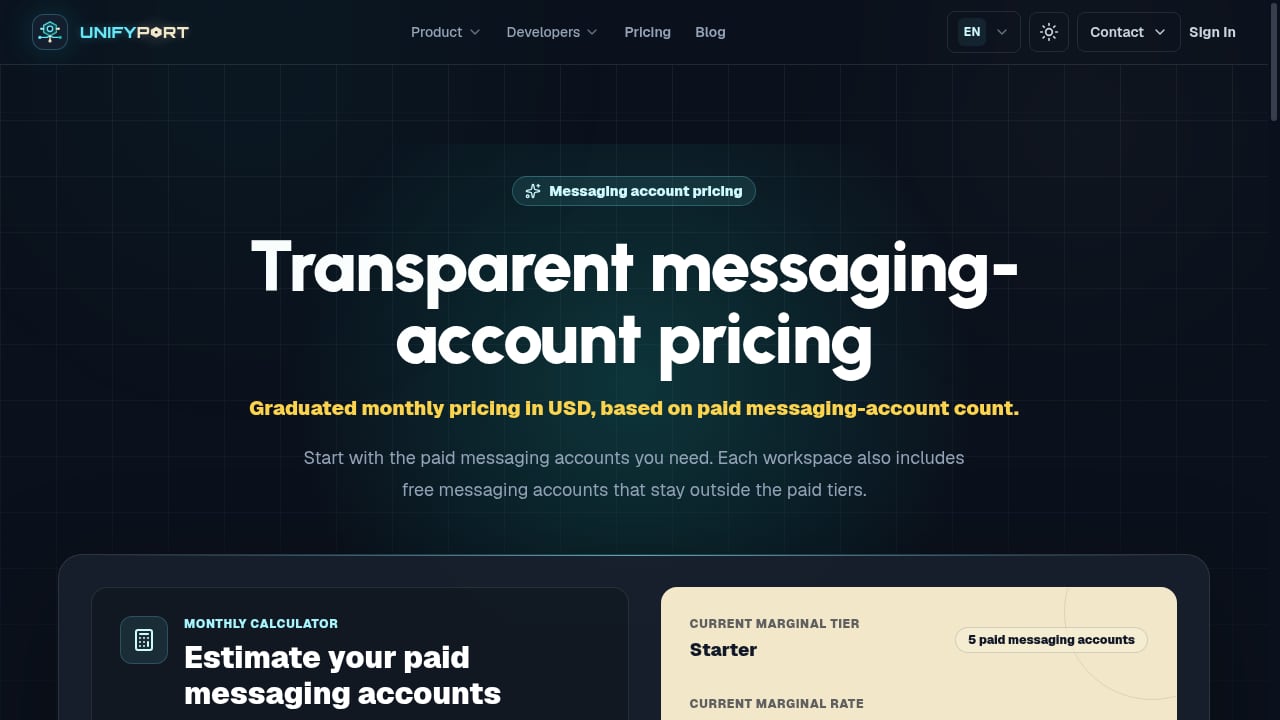
UnifyPort describes its pricing as transparent graduated monthly messaging-account costs in USD, with unified API access and free messaging accounts in every workspace. It also mentions wallet-mode and quota-based account billing operations. This model is designed to be predictable and developer-friendly, with costs tied to messaging accounts rather than conversation volumes or AI agent usage.
Gupshup.ai's pricing is not detailed in the provided context, but as an AI agent platform, it likely charges based on conversation volumes, agent usage, or enterprise agreements. Teams should request a quote and compare the total cost of ownership, especially if they plan to handle high volumes of conversations or require custom AI agent development.
Ideal Use Cases
First viewport screenshot of www.gupshup.ai.
When UnifyPort Fits Best
- You need a unified API to connect multiple social messaging channels, especially in Asia-Pacific markets.
- Your team wants to build custom messaging workflows, notifications, or support systems with full control over the event handling.
- You prefer to integrate your own AI models or third-party AI services rather than adopting a bundled AI agent platform.
- You value transparent, account-based pricing and official SDKs for popular programming languages.
When Gupshup.ai Fits Best
- Your primary goal is to deploy autonomous AI agents for sales, marketing, and customer support without building the AI layer yourself.
- You want an enterprise-ready platform with proven scalability for billions of conversations.
- You are comfortable with a more bundled approach where messaging and AI are provided together.
- You may not need deep customization of channel integrations or event schemas.
Decision Guidance
Choose UnifyPort if you are a developer or product team that needs a reliable, unified messaging API with normalized events and SDKs, and you plan to build or integrate your own AI capabilities. UnifyPort's strength lies in simplifying multi-channel integrations and providing a consistent developer experience.
Choose Gupshup.ai if you want to quickly deploy AI agents for sales, marketing, and support and prefer a platform that handles both messaging and AI in one package. Gupshup's focus on autonomous agents may reduce development time if you do not require custom messaging infrastructure.
For a broader comparison of messaging API platforms, see our Top 10 Social Media & Messaging API Platforms 2026. If you are evaluating other alternatives, our UnifyPort vs Infobip comparison provides additional insights.
Related reading
- Sinch Review 2026: CPaaS Strengths, Pricing & Fit - Evidence-based Sinch review covering messaging, voice, email, verification APIs, pricing signals, setup, limitations, and ideal users for 2026.
- Account_id Path Parameter: Design, Test & Secure REST APIs - Learn how to design, validate, test, and secure the account_id path parameter in REST APIs. Includes examples, common pitfalls, and best practices.
Sources and further reading
- INSIGHTS CURRENT AFFAIRS - Feb 1, 2025 ... ... Supports command and control systems, sensor integration, and AI-based ... o Financial & Technical Support for conservation efforts in range and ...
- Parcham 6 Monthly Raftaar CA Headliner (Jan-June 2025) - The document is a comprehensive guide for CA Raftaar from January to June 2025, detailing various topics such as important days, appointments, awards, books, obituaries, science and technology, environment, defense, and state news across India. It includes a structured table of contents that organizes information by month and category, facilitating easy navigation. The document serves as a resource for current events and updates relevant to the CA curriculum.
- Customs and Excise: Trade, Production, and Consumption in England 1640-1845 [New ed.] 0199259216, 9780199259212 - DOKUMEN.PUB - Asis book traces the growth of customs and excise, and their integral role in shaping the framework of industrial Englan...
FAQ
What is the main difference between UnifyPort and Gupshup.ai?
UnifyPort is a unified messaging API platform that standardizes channel integrations and event handling, while Gupshup.ai is a conversational AI platform focused on autonomous AI agents for sales, marketing, and customer support.
Does UnifyPort offer AI agents?
UnifyPort does not position itself as an AI agent platform. It provides the messaging infrastructure and normalized events that developers can use to integrate their own AI models or third-party AI services.
Which platform is better for developers?
Developers who need full control over messaging workflows and prefer a transparent API with SDKs may find UnifyPort more suitable. Gupshup.ai may be better for teams that want pre-built AI agents and are less concerned with custom messaging infrastructure.
Can I use UnifyPort and Gupshup.ai together?
It is possible to use UnifyPort for channel integrations and connect Gupshup.ai's AI agents via webhooks, but this would require custom integration work. Evaluate whether the combined approach meets your technical and business requirements.
How does pricing compare?
UnifyPort offers transparent graduated monthly messaging-account costs in USD with free messaging accounts. Gupshup.ai's pricing is not publicly detailed in the provided context; you should request a quote and compare total cost of ownership based on your expected conversation volumes and AI usage.
Conclusion
UnifyPort and Gupshup.ai serve different needs. UnifyPort excels as a developer-first unified messaging API, simplifying multi-channel integrations and providing a consistent event stream for building custom workflows. Gupshup.ai offers autonomous AI agents that can accelerate sales, marketing, and support automation for teams that prefer a bundled solution. Assess your technical resources, customization needs, and AI strategy to choose the platform that aligns with your goals. For practical automation examples with UnifyPort, explore our Latenode integration guide.