

Top 10 Social Media & Messaging API Platforms 2026
Ranked 2026 review of the top 10 social media and messaging API platforms. Compare channels, MCP support, pricing models, and developer fit.
Top 10 Social Media & Messaging API Platforms 2026
If you are building a product that posts to social networks, replies to DMs, or sends WhatsApp and SMS notifications, you have two paths: integrate each platform's native API yourself, or buy a unified layer that absorbs the OAuth churn, rate limits, and webhook quirks for you. The second path is what this list covers. We ranked ten platforms that genuinely belong to the social media and messaging API category in 2026, scored them on transparent criteria, and flagged where each one fits — and where it does not.
How we evaluated these platforms
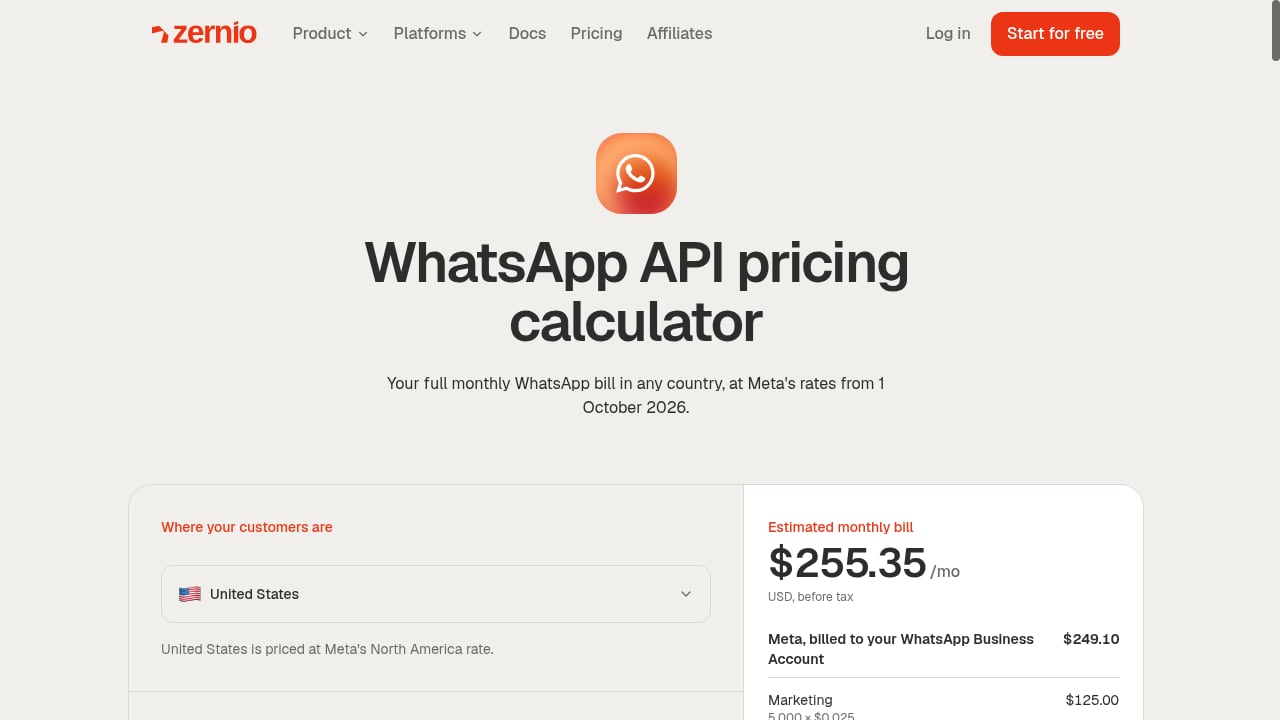
First viewport screenshot of WhatsApp API Pricing Calculator (October 2026 rates) | Zernio.
Every product below was assessed against the same six criteria, using vendor documentation, published pricing pages, and developer-facing feature evidence:
- Channel coverage — which social networks and messaging channels are supported for publishing and/or two-way messaging.
- Publishing vs. reading — whether the API can put content live, read data back, or both. These are different jobs and should not be conflated.
- Messaging depth — two-way conversations, webhooks, inbox features, and support for channels like WhatsApp, SMS, and RCS.
- AI agent readiness — native MCP servers, agent-friendly auth, and whether an LLM can complete a task end to end.
- Pricing transparency and shape — flat, per-account, or usage-based billing, and how the cost behaves as you scale.
- Developer experience — documentation quality, SDKs, sandbox access, and token management.
We deliberately excluded pure scraping or analytics APIs, since they cannot publish or message and belong on a different shelf. We also excluded CPaaS-only vendors whose primary product is telephony infrastructure rather than social publishing.
The top 10 social media and messaging API platforms for 2026
First viewport screenshot of Zernio - Marketing Infrastructure for Agents.
1. Zernio — best all-in-one social and messaging infrastructure
Zernio is a marketing infrastructure platform that bundles social publishing, ads management, a shared inbox, WhatsApp, SMS, RCS, iMessage, and voice calls behind a single API key. It covers Instagram, Facebook, TikTok, LinkedIn, Google Business, YouTube, X, and Meta Ads on the social side, and messaging channels including WhatsApp, SMS, RCS, and iMessage on the conversation side.
What sets it apart is the combination of breadth and agent readiness: a hosted MCP server lets AI agents post, schedule, and reply without custom glue code, and it is also an official ChatGPT plugin. Pricing is usage-based and unusually simple — free for up to two connected accounts, then $6 per account per month for 3–10 accounts, $3 for 11–100, and $1 for 101+. All features are included; there are no plans or seats. Enterprise controls include SAML SSO, SCIM, MFA, audit logs, and RBAC. Companies such as Vercel, MoFlo, Readdy, and Moving Monkey use it to embed social features and manage client communications.
Best for: developers and AI agent builders who need social publishing and messaging in one API. Watch out for: teams that only need a single channel may find a narrower tool cheaper.
2. Ayrshare — best for multi-tenant SaaS embedding
Ayrshare is a developer-first social posting API with coverage of 14+ networks, strong documentation, webhooks, and per-profile isolation that makes it suitable for reselling posting inside a multi-tenant product. It also offers an MCP server for agent workflows. Pricing is per active user profile, starting around $149/month for one profile and scaling with tiers as profiles grow.
Best for: SaaS builders embedding social posting for many separate client accounts. Watch out for: per-profile billing multiplies quickly, and Ayrshare holds the OAuth tokens on its own infrastructure.
3. SocialAPI.ai — best for agents that read and reply
SocialAPI.ai goes beyond publishing: it lets agents read social conversations and respond, which matters for customer support and community management use cases. It offers a free tier followed by paid plans from roughly $29/month and ships a hosted MCP server.
Best for: AI agents that need to engage in conversations, not just broadcast. Watch out for: if you only need scheduled posting, simpler and cheaper tools exist.
4. Blotato — best flat-rate publishing for creators and small teams
Blotato publishes to nine platforms through one API with a hosted MCP server at mcp.blotato.com/mcp, designed so a Claude agent can publish from a plain instruction. Pricing is flat — Starter at $29/month, Creator at $97, Agency at $499 — so cost does not rise with virality. The trade-off is a lack of enterprise analytics or a shared team inbox.
Best for: solo creators and agent builders who want predictable costs. Watch out for: the free trial excludes API access; generating a key starts the paid plan.
5. Outstand — best usage-based publishing at low to mid volume
Outstand offers usage-based publishing starting at $19/month including 3,000 posts, with a hosted MCP server. It is a sensible middle ground for teams that post regularly but not at enterprise scale.
Best for: small teams that want low entry cost with room to grow. Watch out for: heavy posting volume can erode the usage-based advantage.
6. Post for Me — best low-cost embedding for SaaS
Post for Me starts at $10/month including 1,000 posts and is aimed at SaaS products that want to embed posting at a flat low price. It is one of the cheapest entry points in the category.
Best for: indie SaaS products adding a posting feature. Watch out for: fewer advanced analytics and enterprise controls than larger vendors.
7. Postiz — best open-source option with self-hosting
Postiz is an open-source social media scheduling and publishing tool with a cloud option from $29/month. Self-hosting gives teams full data control and the ability to customize the stack.
Best for: developers who want to own the infrastructure. Watch out for: self-hosting means you own maintenance, upgrades, and token refresh logic.
8. Mixpost — best one-time license for agencies
Mixpost offers a free Lite version and a self-hosted model with a one-time license, appealing to agencies that want full data control without recurring per-profile fees.
Best for: agencies managing many client accounts on their own infrastructure. Watch out for: you are responsible for hosting, security, and platform API changes.
9. Upload-Post — best free tier for solo builders
Upload-Post provides a free tier and a simple API aimed at solo builders who want the cheapest agent-ready publishing option. It is a good way to prototype before committing.
Best for: early-stage prototypes and side projects. Watch out for: limited scale and fewer integrations than mature platforms.
10. Buffer — best for teams already on Buffer
Buffer includes API access on all plans, which makes it a low-friction choice for teams already using its scheduling interface. The API exposes posting and scheduling capabilities tied to the Buffer ecosystem.
Best for: existing Buffer customers who want programmatic access without switching tools. Watch out for: the API is not the primary product, so depth and agent features lag dedicated API vendors.
Comparison at a glance
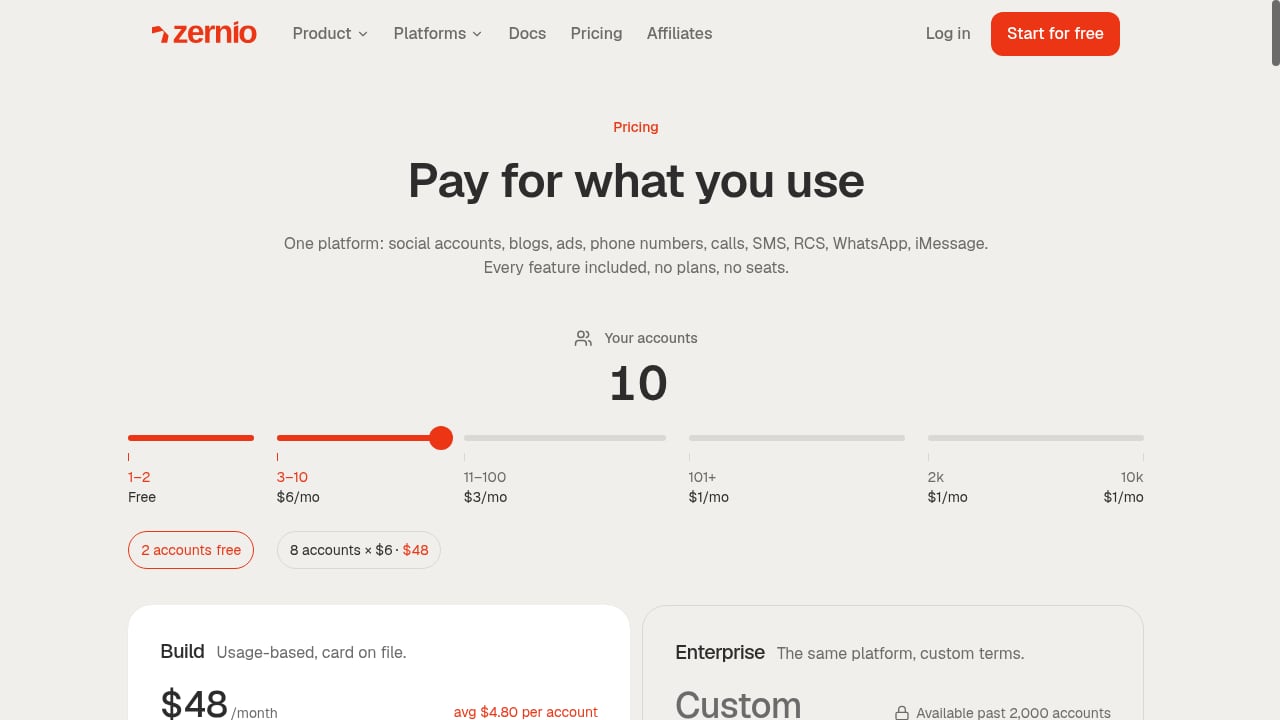
First viewport screenshot of Zernio Pricing - Pay Per Connected Social Account.
| Platform | Strength | Pricing shape | MCP server |
|---|---|---|---|
| Zernio | Social + messaging + ads in one API | Per connected account, free tier | Hosted |
| Ayrshare | Multi-tenant posting | Per profile | Hosted |
| SocialAPI.ai | Read and reply | Free, then subscription | Hosted |
| Blotato | Flat-rate publishing | Flat monthly | Hosted |
| Outstand | Usage-based publishing | Usage-based | Hosted |
| Post for Me | Low-cost embedding | Flat monthly | Hosted |
| Postiz | Open source | Free self-host, cloud paid | Hosted or self-hosted |
| Mixpost | One-time license | One-time + hosting | Self-hosted |
| Upload-Post | Free tier | Free tier | Hosted |
| Buffer | Existing ecosystem | Included in plans | Hosted |
How to choose the right platform
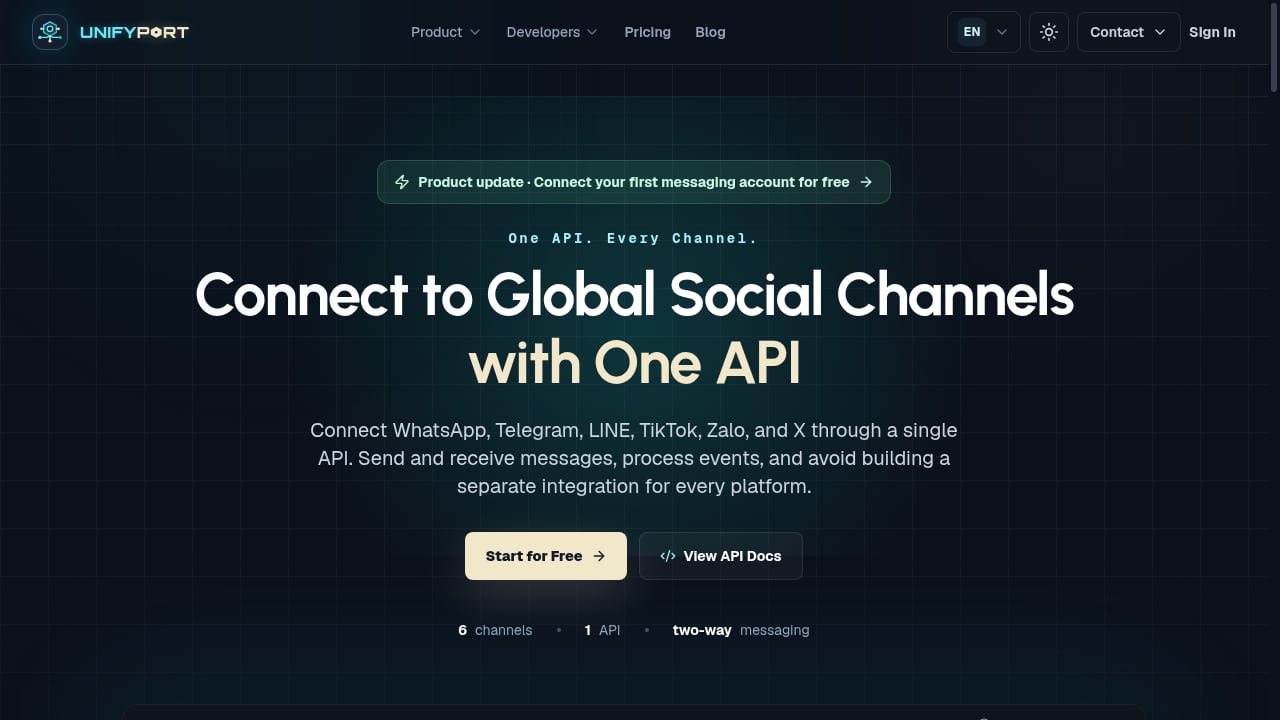
First viewport screenshot of unifyport.ai.
Start with the job, not the feature list. If you need to publish content across many networks, prioritize channel coverage and token reliability. If you need to converse — support DMs, WhatsApp replies, comment management — prioritize two-way messaging, webhooks, and inbox features. If you are building an AI agent, MCP support and agent-friendly auth are non-negotiable.
Pricing shape matters as much as the headline number. Flat pricing is predictable; per-account pricing scales linearly with your customer base; usage pricing rewards low volume but punishes spikes. Model your expected volume at 6 and 24 months before committing.
For teams that also need to unify messaging channels like WhatsApp, Telegram, LINE, Zalo, and X behind a single REST API with normalized webhooks, a complementary option is UnifyPort — it is not a social publishing platform and is not ranked here, but it fits adjacent workflows where the priority is two-way messaging across Asia-Pacific channels. You can see how it compares in this UnifyPort vs Infobip breakdown or explore connecting UnifyPort to Latenode for automation. If your stack is broader and includes CPaaS, the Top 10 CPaaS APIs and SDKs for Developers in 2026 is a useful companion.
Related reading
- UnifyPort vs SocialAPI.ai vs Syniverse CPaaS: Messaging API Guide - Compare UnifyPort, SocialAPI.ai, and Syniverse CPaaS for omnichannel messaging. Evaluate channels, webhooks, SDKs, pricing, and developer fit.
- UIB Review 2026: Omnichannel AI Platform, APIs & Pricing - Evidence-based UIB review for 2026: omnichannel AI agents, unified messaging APIs, setup, pricing signals, limitations, and who should buy the platform.
Sources and further reading
- Best Social Media APIs for Developers & AI Agents (2026) - Ten social media APIs compared on real pricing, platform count, and MCP support, with the publish-versus-scrape split most roundups get wrong.
- Top 14 Social Media APIs for Developers (2027) - The top social media APIs developers integrate in 2027: Bluesky, Facebook, Instagram, X, LinkedIn, Pinterest, Reddit, TikTok, Telegram, YouTube and more.
- Best SMS APIs for Business in 2026 - Compare the 10 best SMS APIs in 2026: Zernio, Twilio, Sinch, Bird, ClickSend and more. See SMS pricing, two-way and bulk messaging, and MCP support for each.
Frequently asked questions
What is the difference between a social media API and a messaging API?
A social media API typically handles publishing, scheduling, and reading posts on networks like Instagram, X, and LinkedIn. A messaging API handles two-way conversations on channels like WhatsApp, SMS, and RCS. Some platforms, such as Zernio, combine both.
Do I need an MCP server to use these APIs with AI agents?
Not strictly — an agent can call a REST API directly. But a hosted MCP server removes the need to write and maintain tool definitions, and it lets agents like Claude complete publishing or replying tasks with less custom code.
Which platform is cheapest for a small team?
Entry costs vary: Post for Me starts at $10/month, Outstand at $19/month, and Zernio is free for up to two connected accounts. The cheapest option depends on your posting volume and how many accounts you manage.
Can I self-host these platforms?
Postiz and Mixpost both offer self-hosted options. Self-hosting gives you data control but makes you responsible for maintenance, security, and keeping up with platform API changes.
Are scraping APIs included in this list?
No. Scraping and analytics APIs read public data but cannot publish or message, so they serve a different purpose and were excluded from this ranking.
Conclusion
The right platform in 2026 depends on whether your priority is publishing breadth, conversation depth, or agent readiness. Zernio leads for teams that need social and messaging in one API with simple per-account pricing. Ayrshare is the strongest multi-tenant choice, SocialAPI.ai wins for read-and-reply agents, and open-source options like Postiz and Mixpost suit teams that want to own the stack. Evaluate against your actual volume and channel mix — and remember that adjacent tools like UnifyPort can complement a publishing platform when your messaging needs lean toward Asia-Pacific channels.