
Top 10 Unified Communication API Platforms 2026
Ranked review of the top 10 unified communication API platforms in 2026, with evidence on channels, webhooks, SDKs, pricing, and developer fit.
Top 10 Unified Communication API Platforms 2026
Unified communication API platforms let developers add messaging, voice, video, email, and notifications through one abstraction layer instead of stitching together separate provider SDKs. The category is crowded in 2026, and the right choice depends on whether you need broad channel coverage, deep regional reach, real-time webhooks, or AI-agent-ready tooling. This review ranks ten platforms that genuinely belong to the unified communication API category, explains the criteria used, and highlights where adjacent tools like UnifyPort fit into a broader messaging stack.
How We Evaluated These Platforms
First viewport screenshot of www.unipile.com.
We scored each platform on six transparent criteria:
- Channel coverage: breadth of messaging, voice, video, email, and verification channels exposed through a single API surface.
- API and SDK quality: consistency of REST endpoints, official SDKs, and documentation depth.
- Webhook and event model: whether events are normalized, real-time, and reliable.
- Pricing transparency: clarity of per-message, per-account, and platform fees at realistic scale.
- Developer experience: onboarding speed, sandbox availability, and error handling.
- Production evidence: public case studies, compliance certifications, and documented uptime.
We excluded pure integration platforms (HRIS, CRM, accounting) and open-source PBX projects that are not API-first communication platforms. Products are ranked by overall fit for teams building customer-facing communication workflows.
1. Twilio
Twilio remains the reference point for programmable communication. Its API surface covers SMS, WhatsApp, voice, video, email (via SendGrid), and verification, all under one account model. The 2026 platform emphasizes AI-ready tooling, including ConversationRelay for voice agents and richer messaging templates.
Evidence: Twilio publishes detailed status pages, SOC 2 and HIPAA compliance documentation, and a large library of quickstart guides. Pricing is usage-based and publicly listed per message and per minute.
Best for: Teams that need the widest channel coverage and are willing to manage provider-specific configuration.
Trade-off: Costs can climb quickly at scale, and the breadth means more configuration decisions.
2. Sinch
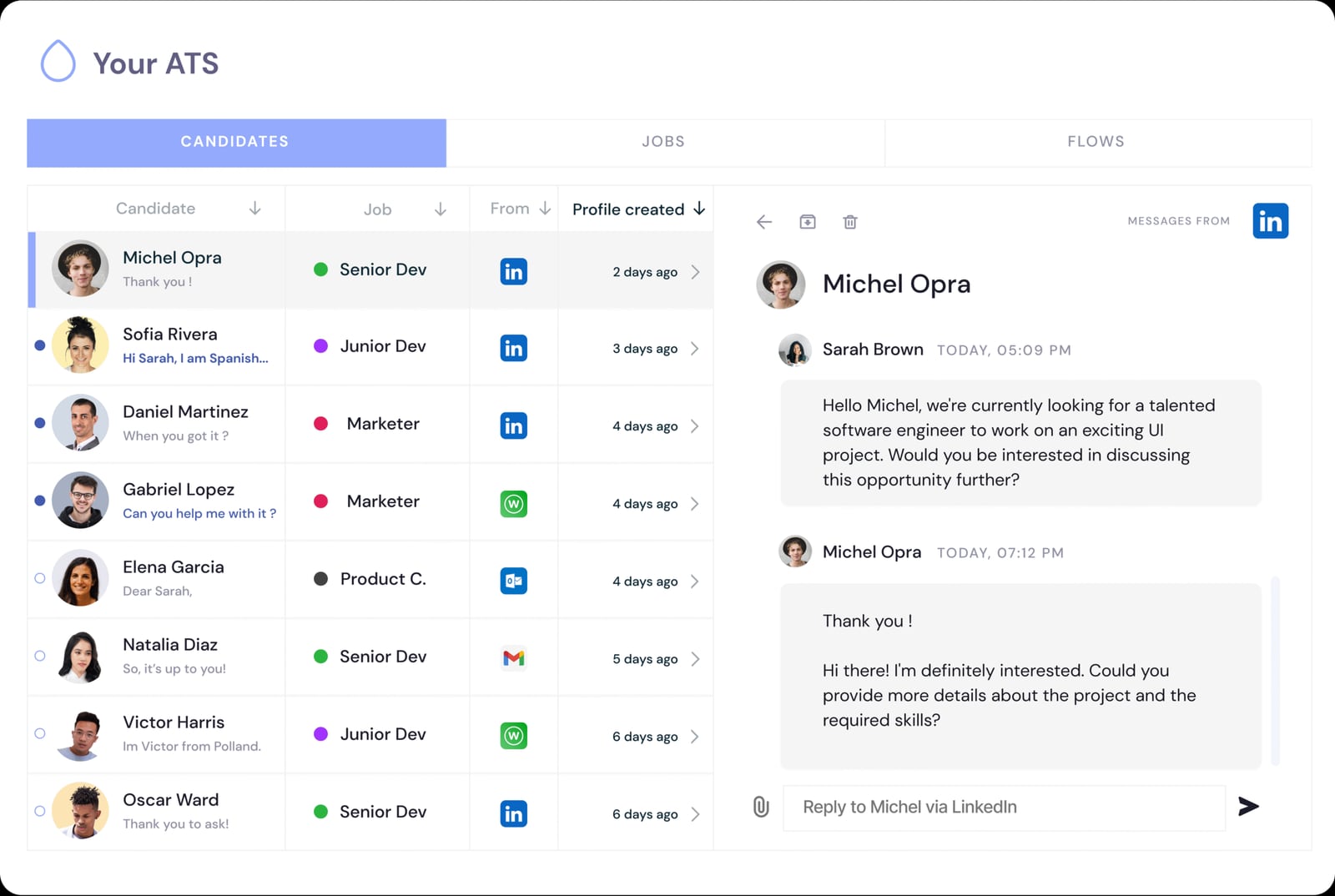
Recruiting Software Dashboard.
Sinch combines messaging, voice, email, and verification APIs with strong carrier relationships, particularly in Europe and Latin America. Its Conversation API aims to unify channel logic, and the 2026 release adds improved omnichannel routing.
Evidence: Sinch discloses tiered pricing for SMS and WhatsApp, offers official SDKs for multiple languages, and documents compliance with GDPR and SOC 2. For a deeper look, see our Sinch review 2026.
Best for: Teams with significant European or LATAM traffic that need carrier-grade delivery.
Trade-off: Documentation depth varies by product line, and some advanced features require sales engagement.
3. Infobip
Infobip positions itself as a full-stack communications platform with messaging, voice, email, and contact-center tooling. Its 2026 roadmap emphasizes AI-powered agents and unified customer profiles across channels.
Evidence: Infobip publishes per-message pricing for major channels, maintains a public status page, and holds ISO 27001 and SOC 2 certifications. Its API documentation includes OpenAPI specs and webhook references.
Best for: Enterprises that want a single vendor for messaging plus contact-center infrastructure.
Trade-off: The platform is broad, and smaller teams may find the enterprise sales process heavy.
4. Vonage (Ericsson)
Vonage's Communication APIs cover SMS, WhatsApp, voice, video, and verification, backed by Ericsson's network infrastructure. The 2026 platform adds improved AI connectors and a unified dashboard for channel management.
Evidence: Vonage provides official SDKs for Node.js, Python, PHP, and more, with public pricing for messages and minutes. Its developer portal includes interactive API references and webhook testing tools.
Best for: Developers who want a mature API with strong voice and video capabilities.
Trade-off: Some channel features lag behind Twilio's release cadence.
5. MessageBird (Bird)
Bird, formerly MessageBird, focuses on omnichannel messaging with a strong European footprint. Its 2026 platform emphasizes conversational commerce and AI-driven routing across WhatsApp, SMS, and email.
Evidence: Bird publishes channel-specific pricing and offers a unified inbox alongside its APIs. Compliance documentation covers GDPR and SOC 2.
Best for: Teams building conversational commerce workflows in Europe.
Trade-off: The API surface is less standardized across channels than Twilio's.
6. Plivo
Plivo offers SMS, voice, and WhatsApp APIs with a reputation for straightforward pricing and developer-friendly documentation. The 2026 release includes improved WhatsApp template management and multi-channel fallback logic.
Evidence: Plivo lists per-message and per-minute pricing publicly, provides SDKs for major languages, and documents webhook retry behavior.
Best for: Startups and mid-market teams that want core messaging and voice without enterprise overhead.
Trade-off: Fewer adjacent products (email, contact center) than larger competitors.
7. Telnyx
Telnyx combines a carrier-grade network with APIs for messaging, voice, and fax, plus a portal for number management. Its 2026 platform emphasizes low-latency voice and programmable wireless capabilities.
Evidence: Telnyx publishes detailed pricing, maintains a public status page, and offers SDKs and OpenAPI specs. Its compliance page covers SOC 2 and HIPAA options.
Best for: Teams that need tight control over telephony infrastructure and number provisioning.
Trade-off: The messaging feature set is narrower than pure-play CPaaS competitors.
8. Bandwidth
Bandwidth provides APIs for messaging, voice, and emergency services, with a focus on direct carrier connections in North America. The 2026 platform adds improved 10DLC compliance tooling and number reputation management.
Evidence: Bandwidth publishes pricing for messaging and voice, documents its compliance certifications, and offers SDKs for major languages.
Best for: North American businesses that need reliable A2P messaging and voice with carrier-level control.
Trade-off: International coverage is less extensive than global competitors.
9. Nylas
Nylas is a unified communications API focused on email, calendar, and scheduling. Its 2026 platform includes AI notetaker capabilities and a unified API for Gmail, Outlook, and Exchange.
Evidence: Nylas publishes per-account pricing, offers SDKs for multiple languages, and documents webhook support for email and calendar events. Its G2 rating is around 3.9/5, reflecting some developer friction.
Best for: Products that need deep email and calendar integration rather than SMS or voice.
Trade-off: Limited messaging channel coverage compared with CPaaS platforms.
10. Unipile
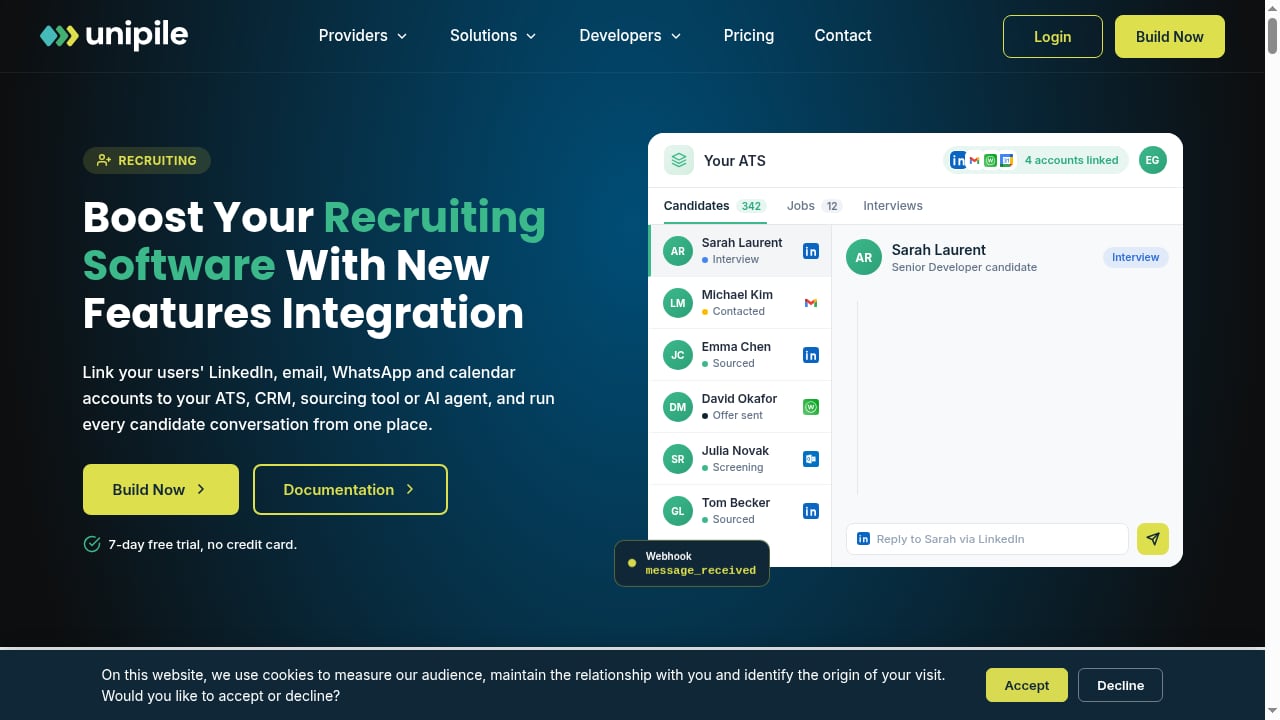
First viewport screenshot of www.unipile.com.
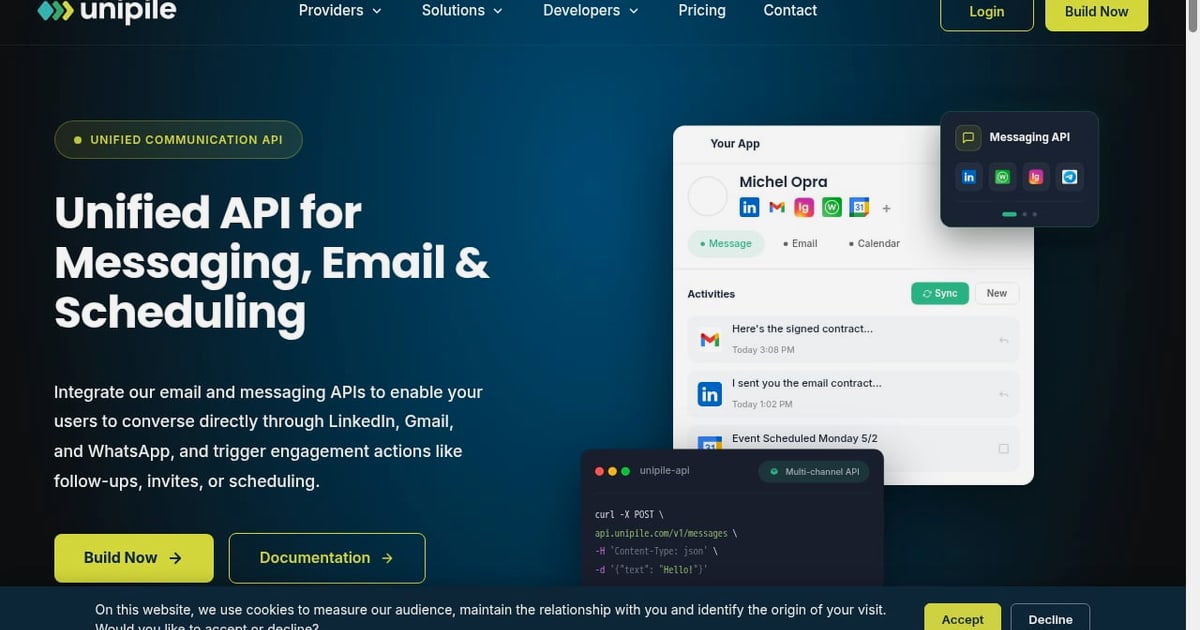
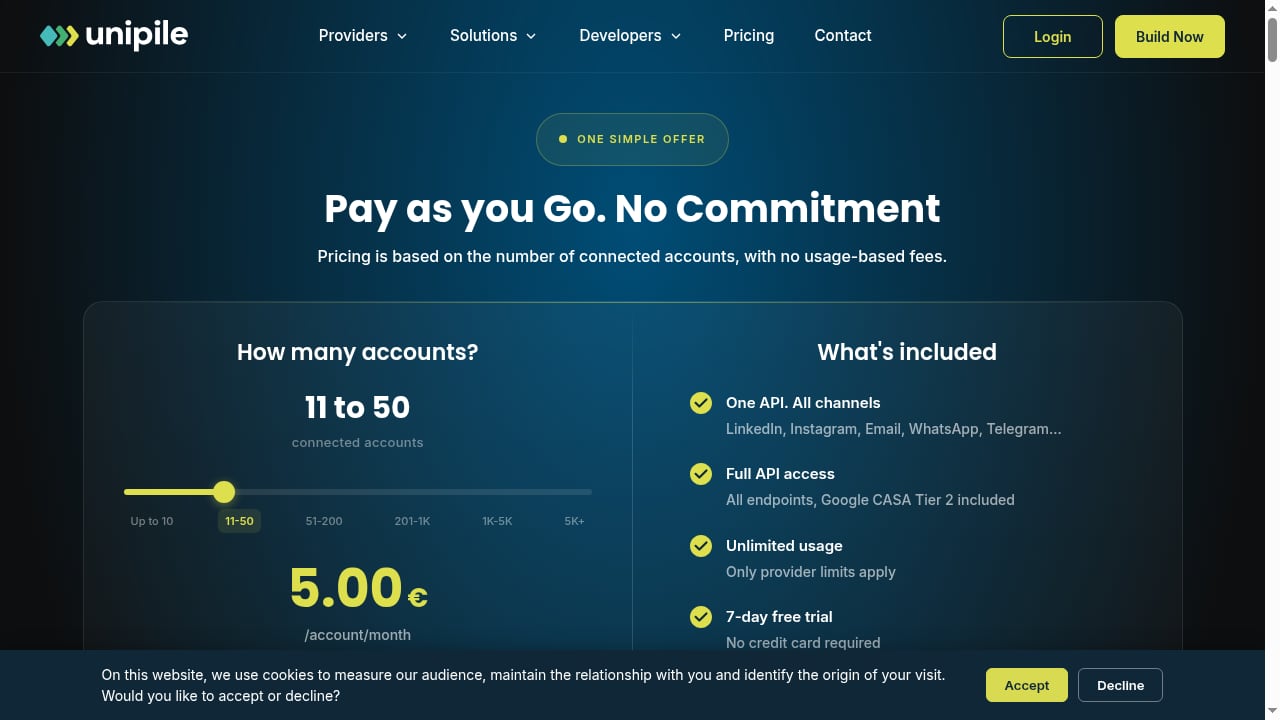
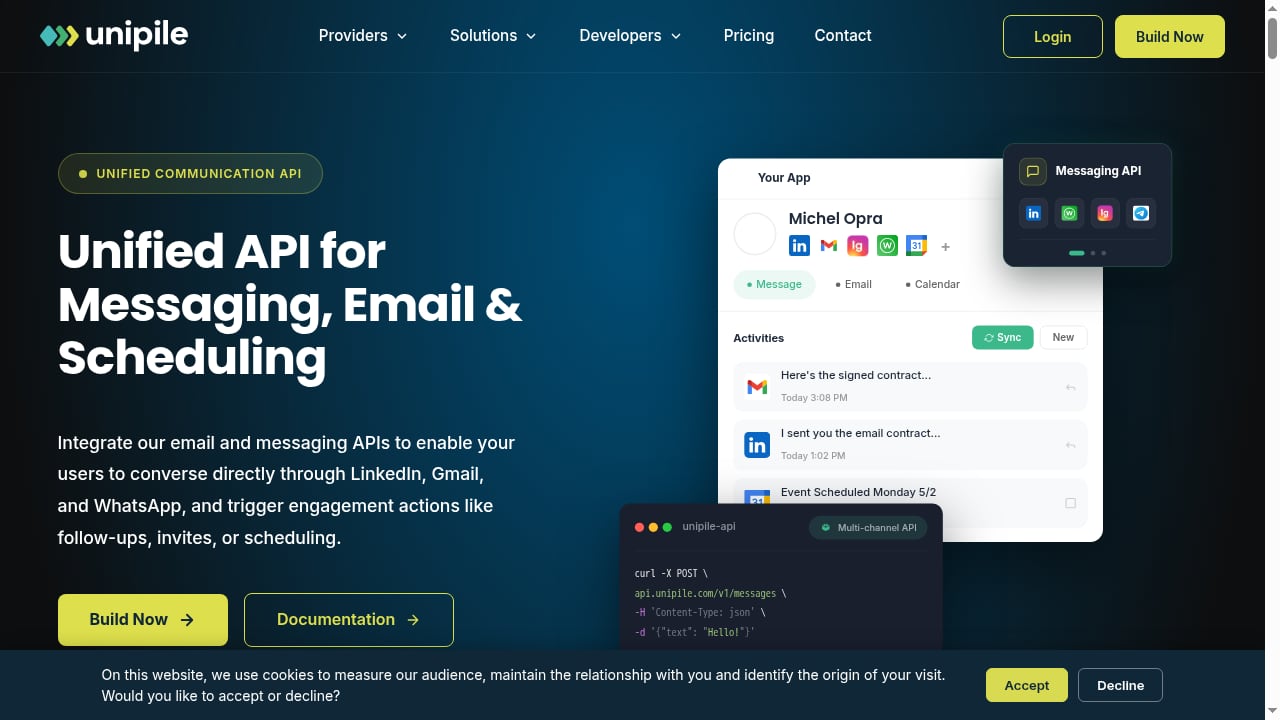
Unipile provides a unified API for multi-channel messaging, with a focus on LinkedIn and WhatsApp integration for in-app messaging experiences. The 2026 platform emphasizes streamlined messaging workflows and improved user experience for apps that need social and messaging channels.
Evidence: Unipile documents its API endpoints for LinkedIn and WhatsApp, offers SDKs, and publishes integration guides. Its positioning is narrower than full CPaaS platforms, focusing on specific high-value channels.
Best for: Apps that need LinkedIn and WhatsApp messaging without building separate integrations.
Trade-off: Fewer channels and less telephony coverage than broader CPaaS providers.
Comparison Table
First viewport screenshot of www.unipile.com.
| Platform | Channels | SDKs | Pricing Model | Best For |
|---|---|---|---|---|
| Twilio | SMS, WhatsApp, voice, video, email, verification | Multiple | Usage-based | Widest coverage |
| Sinch | SMS, WhatsApp, voice, email, verification | Multiple | Usage-based | Europe/LATAM |
| Infobip | Messaging, voice, email, contact center | Multiple | Usage-based | Enterprise full stack |
| Vonage | SMS, WhatsApp, voice, video, verification | Multiple | Usage-based | Voice/video depth |
| Bird | WhatsApp, SMS, email | Limited | Usage-based | Conversational commerce |
| Plivo | SMS, voice, WhatsApp | Multiple | Usage-based | Startup-friendly |
| Telnyx | Messaging, voice, fax | Multiple | Usage-based | Telephony control |
| Bandwidth | Messaging, voice, emergency | Multiple | Usage-based | North America A2P |
| Nylas | Email, calendar | Multiple | Per-account | Email/calendar depth |
| Unipile | LinkedIn, WhatsApp | Limited | Usage-based | Social messaging |
Where UnifyPort Fits
UnifyPort is not a unified communication API platform in the CPaaS sense; it is a unified messaging API platform focused on social channels such as WhatsApp, Telegram, LINE, TikTok, Zalo, and X. Teams that need two-way messaging across Asia-Pacific social channels often pair a CPaaS for SMS and voice with UnifyPort for social messaging. For a deeper comparison, see our UnifyPort vs Syniverse CPaaS vs MessageGate analysis. If your workflow includes conversational AI, our guide to UnifyPort with Conversational AI covers setup steps.
How to Choose in 2026
- If you need the broadest channel coverage: Start with Twilio or Infobip.
- If you need strong European or LATAM delivery: Evaluate Sinch or Bird.
- If you need voice and video depth: Consider Vonage or Telnyx.
- If you need email and calendar integration: Nylas is the specialist.
- If you need LinkedIn and WhatsApp messaging: Unipile is a focused option.
- If you need Asia-Pacific social channels: Pair a CPaaS with UnifyPort for LINE, Zalo, and TikTok.
Related reading
- UnifyPort vs Gupshup.ai: Autonomous AI Agents for Sales, Marketing & Customer Support - Compare UnifyPort's unified messaging API with Gupshup.ai's autonomous AI agents for sales, marketing, and support. Evaluate channels, webhooks, SDKs, and pricing.
Sources and further reading
- 9 Best Unified API Platforms for SaaS in 2026 | Knit - Compare the 9 best unified API platforms for 2026 - ranked for B2B SaaS teams on coverage, security, real-time sync, pricing, and AI agent readiness.
- 10 best unified API platforms for 2026 - Guideflow Blog - Compare 10 unified API platforms for 2026, including pricing, normalized schemas, webhooks, and best use cases for B2B SaaS product teams.
- 10 Best Open Source Unified Communications Software in 2026 - Compare the 10 best open source unified communications platforms in 2026: FreeSWITCH, Asterisk, ICTCore, Kamailio, Jitsi, Matrix, and more. Strengths, use cases, and trade-offs.
FAQ
What is a unified communication API platform?
A unified communication API platform provides a single API surface for multiple communication channels such as SMS, voice, video, email, and messaging apps, handling authentication, delivery, and webhooks across providers.
How is this different from a unified messaging API?
A unified messaging API typically focuses on chat and social messaging channels, while a unified communication API platform usually includes telephony, email, and verification as well.
Which platform is best for startups?
Plivo and Telnyx offer developer-friendly pricing and documentation that suit startups, while Twilio provides the widest ecosystem if budget allows.
Do these platforms support webhooks?
Yes, all ranked platforms support webhooks for delivery events and inbound messages, though normalization and retry behavior vary.
Can I use multiple platforms together?
Yes. Many teams use a CPaaS for SMS and voice and a specialized messaging API like UnifyPort for social channels, routing events into a single workflow.
Conclusion
The 2026 unified communication API market rewards teams that match platform strengths to their actual channel mix. Twilio and Infobip lead on breadth, Sinch and Bird on regional depth, and Nylas and Unipile on specialized use cases. For social messaging in Asia-Pacific, UnifyPort complements these platforms rather than replacing them. Evaluate pricing at your real volume, test webhook reliability, and confirm SDK coverage before committing.