
Top 10 Omnichannel Communication Platforms 2026
Ranked review of the top 10 omnichannel communication platforms in 2026, with transparent criteria, evidence, pricing, and decision guidance.
Top 10 Omnichannel Communication Platforms 2026
Choosing an omnichannel communication platform in 2026 means more than counting channels. The real test is whether a customer's history follows them across email, chat, voice, social messaging, and WhatsApp without gaps, and whether your teams can act on that context without stitching together five separate tools. This review ranks ten platforms that genuinely deliver omnichannel communication, explains the criteria behind each ranking, and highlights where an adjacent developer tool such as UnifyPort fits into the broader stack.
How We Evaluated These Platforms
Top 10 Omnichannel Communication Platforms 2026 - How We Evaluated These Platforms.
We assessed each platform against six criteria, using vendor documentation, published pricing, and verified review data where available:
- Channel breadth and depth: Native support for at least four communication channels, including messaging apps and social channels, not just email and chat.
- Unified customer context: A single profile or timeline that persists across channels, distinguishing true omnichannel from multichannel queues.
- AI and automation: Practical use of AI for routing, deflection, agent assistance, or journey orchestration.
- Integration ecosystem: CRM, helpdesk, ecommerce, and developer APIs that support real workflows.
- Pricing transparency: Public pricing or a standard demo path, with clear add-on costs.
- Evidence of outcomes: Published case studies, review ratings, or documented results from real deployments.
We excluded platforms that are primarily single-channel tools, pure marketing email suites without unified conversation history, or developer-only messaging APIs that do not provide an omnichannel communication layer for end teams. That last distinction matters: a unified messaging API like UnifyPort can sit underneath a platform or alongside it, but it is not itself an omnichannel communication platform in the sense ranked here.
The Top 10 Omnichannel Communication Platforms for 2026
Top 10 Omnichannel Communication Platforms 2026 - The Top 10 Omnichannel Communication Platforms for 2026.
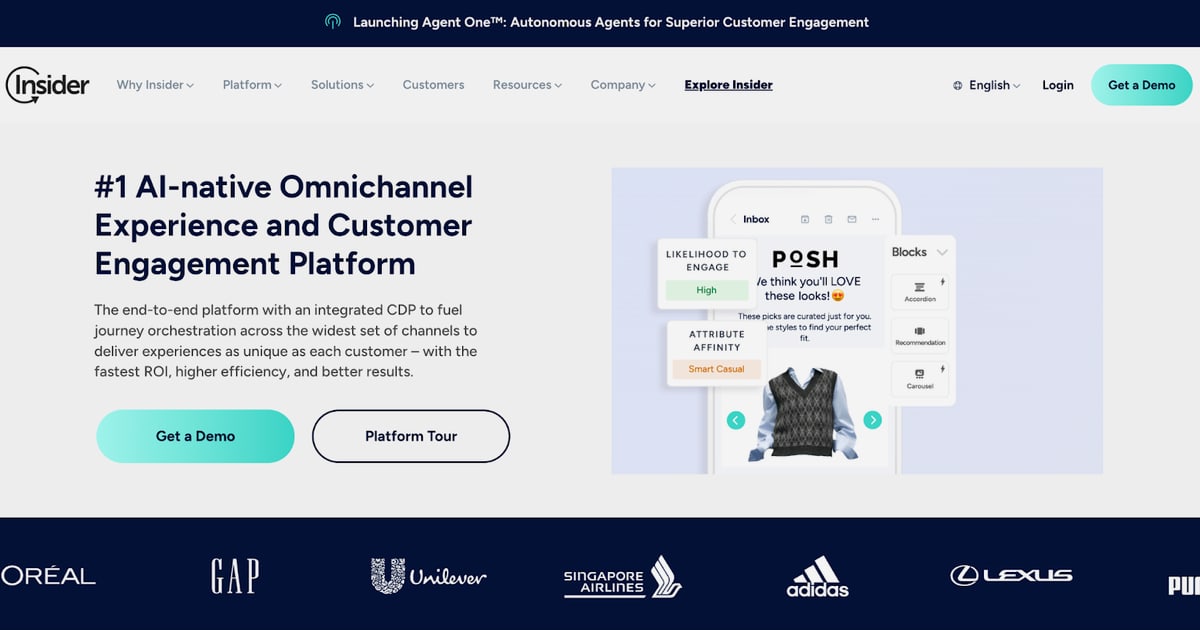
1. Insider One
Best for: Enterprises that want AI-native orchestration across many channels.
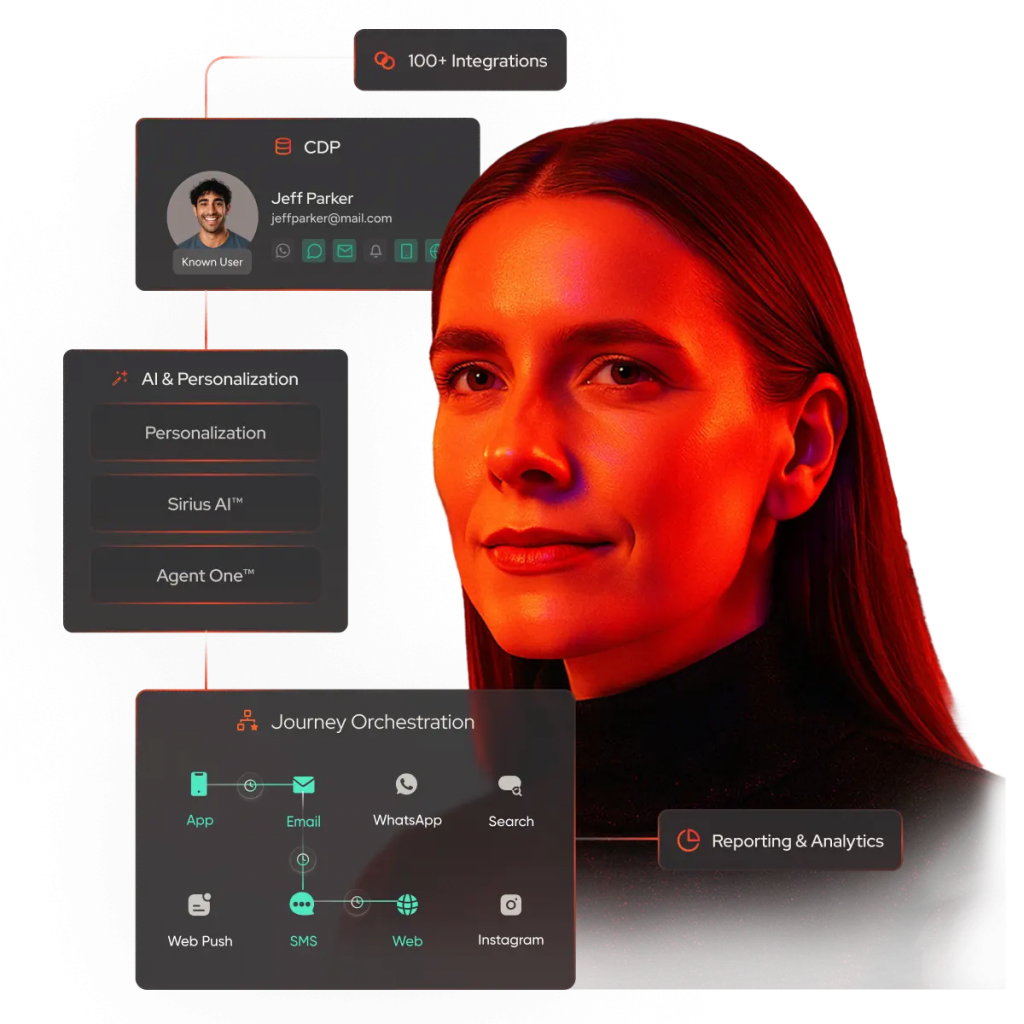
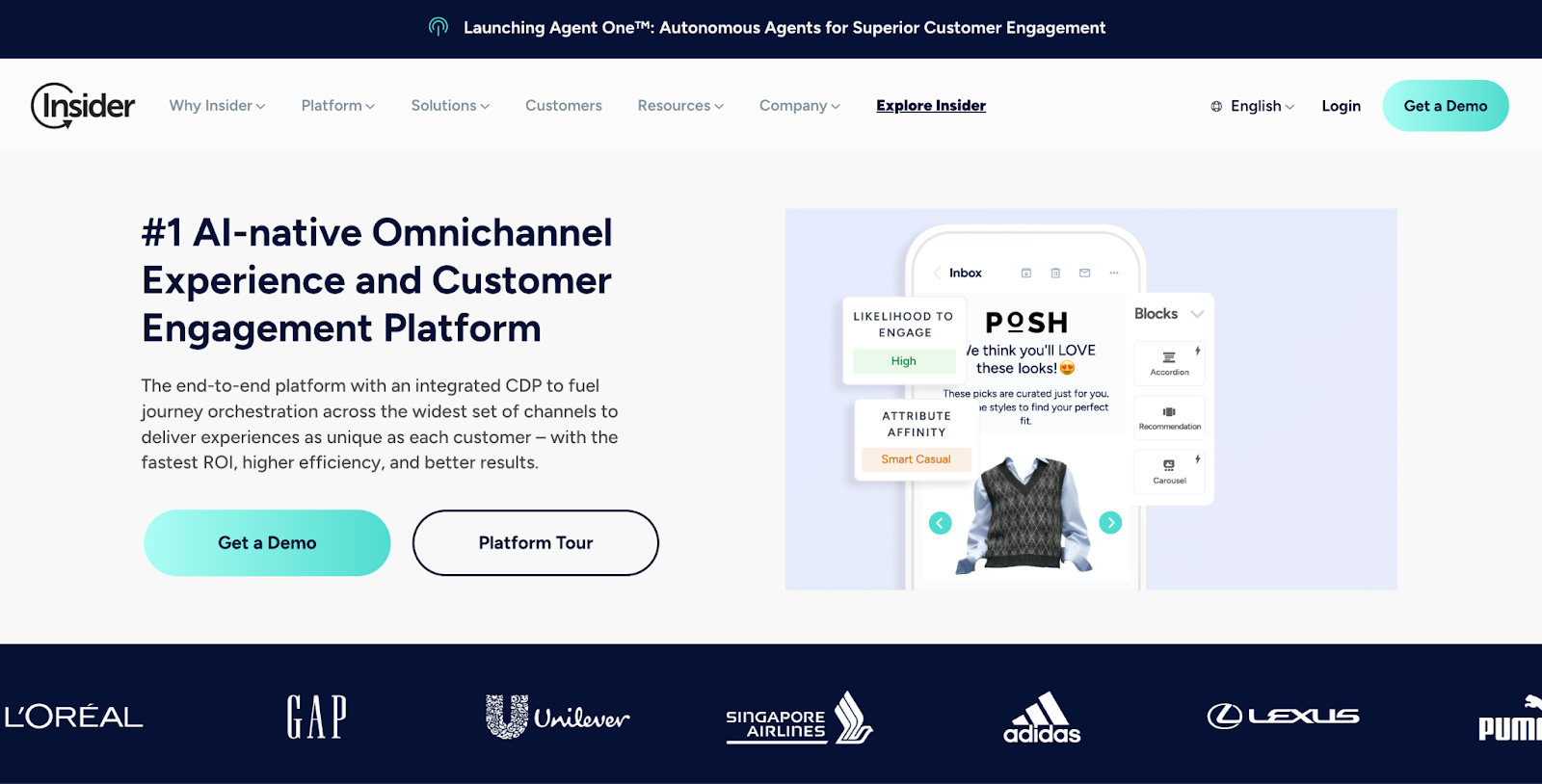
Insider One combines a real-time customer data platform with journey orchestration across web, app, email, SMS, WhatsApp, and more than a dozen channels. Its Agent One suite adds autonomous AI agents for shopping, support, and insights, while predictive models handle next-best-channel and purchase intent.
Evidence: Insider One reports that Samsung increased conversion rates by 275% during a Galaxy Note launch using tailored web push and personalized search, and that Adidas raised average order value by 259% in one month with AI-backed personalization tools.
Considerations: The platform is built for enterprise scale, so smaller teams may find the implementation and cost structure heavy. Pricing is quote-based.
2. Salesforce Marketing Cloud and Service Cloud
Best for: Organizations already standardized on Salesforce.
Salesforce pairs Data Cloud, which unifies CRM, transaction, and behavioral data, with Journey Builder and Agentforce for autonomous marketing and service actions. Service Cloud adds a unified agent console across email, chat, voice, social, and SMS.
Evidence: Salesforce reports that Grupo Falabella achieved a 60% autonomous resolution rate on WhatsApp with Agentforce while tripling conversations in three months, and that Pandora deflected 60% of service cases while raising its Net Promoter Score by 10 points.
Considerations: The strength is ecosystem depth; the tradeoff is cost and configuration complexity. Teams outside the Salesforce stack should weigh integration effort carefully.
3. Adobe Experience Cloud
Best for: Content-rich enterprises that need experience management and personalization at scale.
Adobe Experience Platform centralizes customer data, while Journey Optimizer and Adobe Campaign orchestrate cross-channel journeys. Adobe Target adds AI-driven personalization and testing, and the Creative Cloud connection helps teams move from asset production to activation.
Evidence: Adobe reports that Real Madrid unified data from stadium turnstiles, web, and app to send 500 million targeted emails annually, and that Virgin Atlantic generated £1.2 million in revenue within 12 weeks through an abandoned-browse use case.
Considerations: Adobe excels when content and data must work together, but it is a substantial platform investment rather than a quick-start support tool.
4. HubSpot
Best for: Inbound-led teams that want marketing, sales, and service in one CRM.
HubSpot's Smart CRM underpins Marketing Hub, Service Hub, and Sales Hub, with Breeze AI agents handling content, prospecting, and service tasks. The omnichannel help desk covers email, live chat, WhatsApp, and Facebook Messenger, and the workflow builder orchestrates journeys across email, SMS, social, and ads.
Evidence: HubSpot reports that Crunch Fitness enabled more than 500 franchise locations to send over 15 million monthly emails and collect 2 million leads per year through a decentralized personalization model.
Considerations: HubSpot is easiest to justify when you adopt multiple hubs. Advanced omnichannel support and AI features scale in price with contacts and seats.
5. Zendesk
Best for: Established support organizations that need breadth and integration depth.
Zendesk provides native omnichannel across voice, email, chat, social, SMS, and messaging apps, backed by more than 1,300 integrations and mature automation. Its Copilot AI assists agents across tiers.
Evidence: Zendesk holds a 4.3/5 G2 rating and serves over 100,000 customers. Reviewers consistently praise integration breadth and reporting while flagging per-seat costs and setup complexity at scale.
Considerations: A 100-agent team on Suite Professional can exceed $20,000 per month before AI add-ons, so cost modeling is essential.
6. Freshdesk
Best for: Mid-market teams seeking strong omnichannel features at a lower entry price.
Freshdesk covers email, live chat, voice, social, and WhatsApp, with Freddy AI handling categorization and response drafting. Full omnichannel capability is delivered through the Freshdesk Omni product.
Evidence: Freshdesk reports a 95% omnichannel first-contact resolution rate and up to 80% AI resolution rates based on G2-verified data. Its free tier supports up to 10 agents for email-only support.
Considerations: True omnichannel and AI Copilot are add-ons, so the effective price for a 10-person team on Pro with Copilot and Omni can approach $780 per month.
7. Intercom
Best for: Product-led SaaS companies where most support happens in-app.
Intercom's Fin AI agent is widely regarded as one of the strongest autonomous support agents, capable of resolution, workflow execution, and clean handoff to humans. Channels include in-app messaging, email, live chat, WhatsApp, SMS, and phone.
Evidence: Intercom holds a 4.5/5 G2 rating across more than 3,600 reviews, with consistent praise for the product and recurring friction around pricing predictability.
Considerations: Pricing scales with seats and AI resolution volume, so forecast volume carefully before committing.
8. Gorgias
Best for: Ecommerce and Shopify merchants.
Gorgias unifies email, chat, social, SMS, and voice around order data, making it easy for agents to resolve pre- and post-purchase questions in context. Ticket-based pricing starts at $10 per month.
Evidence: Gorgias holds a 4.6/5 G2 rating, and its Shopify-native workflow is a common reason merchants choose it over general-purpose helpdesks.
Considerations: The platform is optimized for ecommerce; B2B or regulated industries may find the feature set narrower.
9. Front
Best for: B2B teams that live in a shared inbox.
Front combines email, chat, SMS, social, and voice in a collaborative inbox with strong routing and internal collaboration features. It starts at $19 per seat per month with a 7-day trial.
Evidence: Front holds a 4.7/5 G2 rating, the highest among the support platforms compared here, reflecting strong satisfaction with its collaboration model.
Considerations: Front is strongest for conversation-heavy B2B workflows; teams needing deep ecommerce or marketing automation may need complementary tools.
10. Sprinklr Service
Best for: Social-first large enterprises with high channel volume.
Sprinklr supports more than 30 channels, including social, email, and voice, with AI-driven routing and analytics. It starts at $199 per seat per month.
Evidence: Sprinklr holds a 4.3/5 G2 rating and is frequently cited for social listening and engagement depth at enterprise scale.
Considerations: The price point and implementation scope suit large contact centers rather than small teams.
Comparison at a Glance
Top 10 Omnichannel Communication Platforms 2026 - Comparison at a Glance.
| Platform | Best for | Standout strength | Entry pricing signal |
|---|---|---|---|
| Insider One | Enterprise AI orchestration | Real-time CDP plus autonomous agents | Quote-based |
| Salesforce | Salesforce-native enterprises | Data Cloud and Agentforce | Quote-based |
| Adobe Experience Cloud | Content-led enterprises | Journey Optimizer and AEP | Quote-based |
| HubSpot | Inbound CRM teams | Unified CRM and Breeze AI | Free tier available |
| Zendesk | Established support orgs | 1,300+ integrations | $19/agent/mo |
| Freshdesk | Mid-market value | Freddy AI and free tier | Free tier / $15/agent/mo |
| Intercom | Product-led SaaS | Fin AI agent | $29/seat/mo |
| Gorgias | Ecommerce | Shopify-native workflows | $10/mo |
| Front | B2B shared inbox | Collaboration and routing | $19/seat/mo |
| Sprinklr | Social-first enterprise | 30+ channels | $199/seat/mo |
Where a Unified Messaging API Fits
Top 10 Omnichannel Communication Platforms 2026 - Where a Unified Messaging API Fits.
Not every omnichannel need is a full platform decision. If your product team is building customer support, notification, or engagement workflows directly into an application, a unified messaging API can reduce integration overhead. UnifyPort, for example, connects WhatsApp, Telegram, LINE, TikTok, Zalo, and X through a single REST API and normalized webhook events, with SDKs for Node.js, PHP, Go, and Python. It is a complementary layer rather than a replacement for the platforms above, and it is particularly relevant for teams operating in Asia-Pacific markets where LINE, Zalo, and TikTok are prominent. For a deeper comparison of developer-facing options, see our UnifyPort vs UIB vs bundle.social analysis and the Top 10 Unified Communication API Platforms 2026 review.
How to Choose the Right Platform
Start with the channel mix your customers actually use, then test whether the platform preserves context across those channels. For support-led teams, prioritize unified inbox depth and AI resolution rates. For marketing-led teams, prioritize journey orchestration and data unification. For developer-led teams, prioritize API quality and webhook reliability. If you are evaluating a specific support tool, our respond.io review 2026 offers a detailed pricing and fit breakdown.
Related reading
- UnifyPort vs UIB vs bundle.social: Which API Fits? - Compare UnifyPort, UIB, and bundle.social on channels, messaging APIs, webhooks, SDKs, and pricing to pick the right integration for your product.
- UnifyPort vs Vonage: Unified Messaging API Comparison - Compare UnifyPort and Vonage for social messaging APIs. See how UnifyPort unifies WhatsApp, LINE, and more versus Vonage's broader CPaaS and UCaaS suite.
- respond.io Review 2026: Pricing, Pros & Ideal Users - Evidence-based respond.io review: unified inbox, AI Agents, WhatsApp API costs, pricing from $79/mo, setup, limitations, and who should use it in 2026.
Sources and further reading
- 11 Best Omnichannel Platforms for Growing Sales (2026) - Compare 11 omnichannel platforms for e-commerce. Features, pricing, and support for Maestra, Klaviyo, HubSpot, Omnisend, and more for 2026.
- 7 Best Omnichannel Marketing Platforms for Enterprises 2026 - Compare the best omnichannel marketing platforms for 2026, including Insider One, Salesforce, Adobe, HubSpot, Klaviyo, ActiveCampaign, and Omnisend.
- 12 Best Omnichannel Customer Support Platforms in 2026 - A ranked comparison of the 12 best omnichannel customer support platforms for 2026, with G2 ratings, pricing, channel coverage, real user reviews, and a decision framework by team size and industry.
Frequently Asked Questions
What is the difference between omnichannel and multichannel communication?
Multichannel means offering multiple contact points, but each channel may operate in its own queue with separate data. Omnichannel means the customer's history and context follow them across channels, so the next agent sees the full interaction record regardless of where the conversation started.
Which omnichannel platform is best for small teams?
Freshdesk and HubSpot offer free tiers that suit small teams testing omnichannel workflows. Gorgias is a strong fit for small ecommerce merchants, and Front works well for small B2B teams that need a shared inbox.
Do I need a unified messaging API if I already use an omnichannel platform?
Not always. A unified messaging API is most useful when you are building messaging into your own product or need to connect social channels that your platform does not natively support. It can complement a platform rather than replace it.
How much do omnichannel communication platforms cost in 2026?
Entry pricing ranges from free tiers to about $199 per seat per month for enterprise social-first platforms. Costs scale with seats, contacts, AI resolution volume, and add-ons, so model your expected volume before committing.
Conclusion
The best omnichannel communication platform in 2026 depends on whether your priority is enterprise AI orchestration, CRM alignment, support efficiency, or ecommerce context. Insider One, Salesforce, and Adobe lead for enterprise breadth; HubSpot and Freshdesk offer strong value for mid-market teams; Zendesk and Intercom suit established support operations; and Gorgias, Front, and Sprinklr serve focused use cases well. Evaluate channel depth, unified context, AI practicality, and total cost against your own workflow before choosing.
For related comparisons, see our UnifyPort vs Vonage analysis and the UnifyPort vs Gupshup.ai comparison.