

What Is a Customer Engagement Platform? A 2026 Guide
Learn what a customer engagement platform is, key features to compare, top platforms, and how unified messaging APIs fit into your engagement stack.
What Is a Customer Engagement Platform? A 2026 Guide
Customer engagement platforms have moved from a nice-to-have marketing tool to the operational backbone of how modern brands communicate. At their core, these platforms help businesses manage and improve every customer interaction across email, SMS, WhatsApp, push notifications, in-app messages, and social channels from a single system.
The real value comes from unification: pulling customer data, automation, and cross-channel messaging into one place so teams can deliver consistent, personalized experiences without juggling disconnected tools. This guide breaks down what these platforms actually do, the features that matter most, how the major options compare, and where developer-focused messaging infrastructure fits into the picture.
What Is a Customer Engagement Platform?
What Is a Customer Engagement Platform? A 2026 Guide - What Is a Customer Engagement Platform?.
A customer engagement platform is software that helps businesses manage, automate, and optimize interactions with customers across multiple channels. It typically combines three capabilities:
- Customer data unification — bringing behavioral, transactional, and profile data into a single customer view
- Cross-channel messaging — sending and receiving messages across email, SMS, WhatsApp, push, in-app, and social channels
- Journey orchestration and automation — triggering personalized messages based on customer behavior, lifecycle stage, or business rules
Unlike a basic email marketing tool, a true engagement platform is built around behavioral triggers and real-time data. When a user abandons a cart, completes onboarding, or shows signs of churn, the platform can respond automatically with contextually relevant messages.
Why Businesses Are Moving to Unified Engagement Platforms

What Is a Customer Engagement Platform? A 2026 Guide - Why Businesses Are Moving to Unified Engagement Platforms.
The shift toward unified platforms is driven by a simple problem: fragmented tools create fragmented customer experiences. When marketing uses one system, support uses another, and product teams rely on a third, customers receive inconsistent messaging and teams lose the full context of each relationship.
A unified customer engagement platform addresses this by:
- Giving marketing, sales, and support teams a shared customer view
- Eliminating duplicate or conflicting outreach
- Enabling consistent messaging across every touchpoint
- Reducing the operational overhead of managing separate integrations
For engineering teams, this same logic extends to messaging infrastructure. Instead of building and maintaining separate integrations for each channel, a unified messaging API provides one interface for sending and receiving messages across platforms like Telegram, WhatsApp, and LINE.
Key Features to Look For
What Is a Customer Engagement Platform? A 2026 Guide - Key Features to Look For.
Not all customer engagement platforms are built the same. When evaluating options, focus on these capabilities:
1. Cross-Channel Orchestration
The platform should let you build journeys that span multiple channels without manual handoffs. A welcome flow might start with an email, follow up with a push notification, and escalate to WhatsApp if the user doesn't respond. Look for visual journey builders and support for the channels your audience actually uses.
2. Real-Time Customer Data
Effective engagement depends on fresh data. The best platforms ingest behavioral events in real time and make them available for segmentation and triggering. This is what allows a platform to respond to a cart abandonment minutes after it happens, rather than hours later.
3. AI-Powered Personalization
AI has become a standard component of modern engagement platforms. Common use cases include:
- Predicting the best send time for each recipient
- Optimizing channel selection based on engagement history
- Generating personalized content variations
- Identifying at-risk customers before they churn
4. Developer-Friendly APIs and Webhooks
Even the most capable platform needs to connect with your existing stack. Strong APIs, webhooks, and SDKs let engineering teams sync data, trigger messages, and build custom integrations without relying on manual exports or brittle workarounds.
5. Analytics and Reporting
You need visibility into what's working. Look for platform-level metrics on deliverability, open rates, click-through rates, and conversion, as well as journey-level analytics that show where customers drop off or convert.
Top Customer Engagement Platforms Compared

What Is a Customer Engagement Platform? A 2026 Guide - Top Customer Engagement Platforms Compared.
Several platforms dominate the customer engagement space, each with distinct strengths and trade-offs.
Braze
Braze is a developer-friendly platform known for cross-channel messaging and journey orchestration. It excels at campaign automation and custom integrations, with strong support for email, SMS, WhatsApp, push, and in-app messaging. Its AI capabilities help brands launch smarter campaigns and optimize performance over time. Braze is a strong fit for mid-market and enterprise companies with dedicated engineering resources.
Customer.io
Customer.io focuses on behavioral messaging and lifecycle automation. It unifies data, messaging, and AI into a single platform, with particular strength in activation, retention, and onboarding journeys. Its emphasis on working with AI agents through MCP, CLI, API, or webhooks makes it appealing to modern product-led teams.
Twilio
Twilio takes a developer-first approach, offering APIs for SMS, WhatsApp, RCS, voice, and email. Through Segment and SendGrid, it unifies customer data across channels. Twilio offers maximum flexibility but requires significant technical expertise to implement and manage. It's best suited for teams that want to build custom engagement experiences from the ground up.
HubSpot
HubSpot combines CRM, marketing, sales, and customer service in one platform. It supports email, SMS, social, chat, and AI tools, making it a practical choice for B2B and service businesses. While it offers less advanced personalization than specialized engagement platforms, its all-in-one approach reduces tool sprawl.
Salesforce Marketing Cloud
Salesforce Marketing Cloud is an enterprise-grade platform that combines marketing, CRM, customer service, and AI insights. It supports complex workflows and large-scale operations but requires significant investment, implementation time, and IT resources. It's best suited for large enterprises already invested in the Salesforce ecosystem.
Insider One
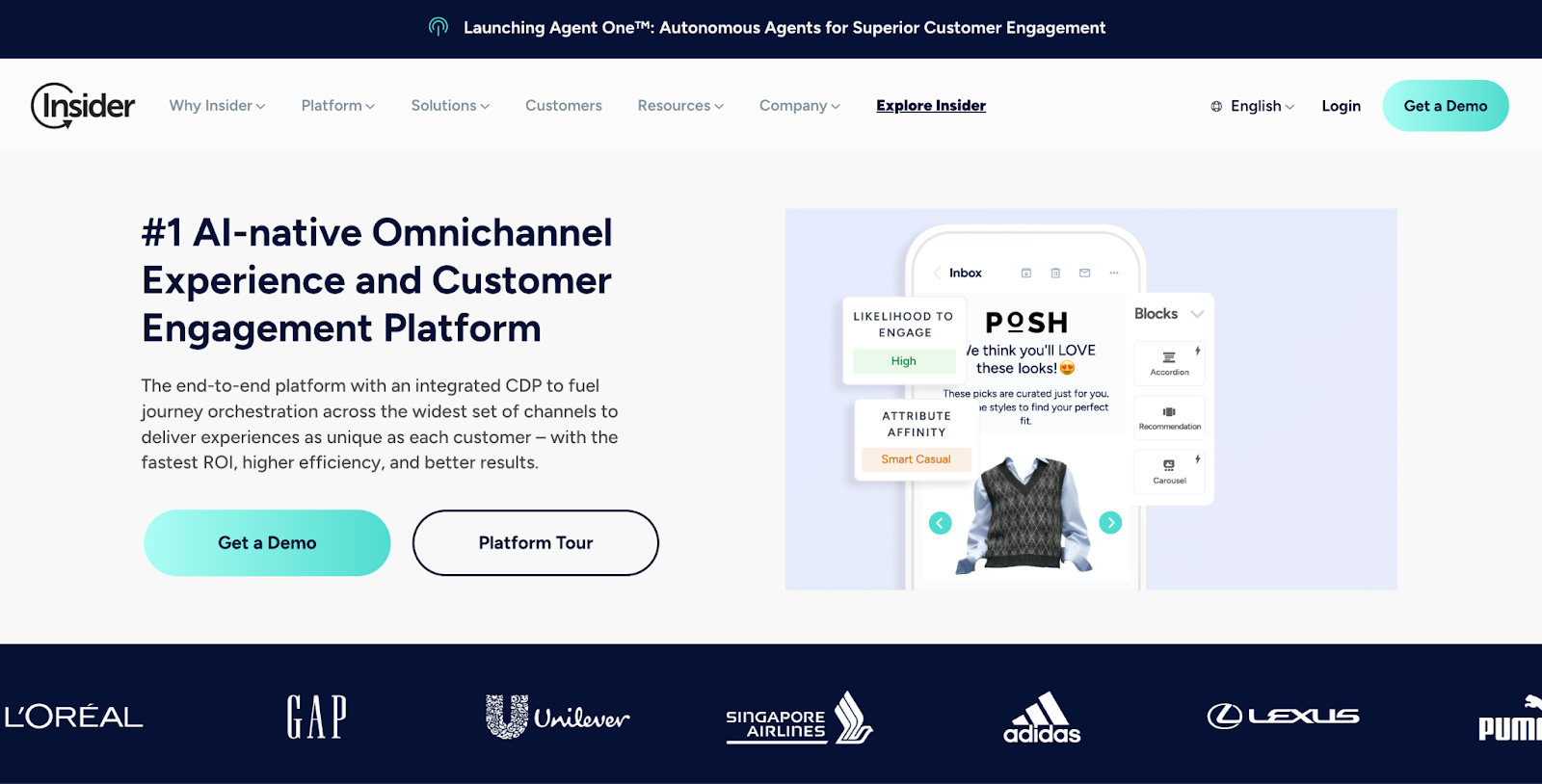
Insider One positions itself as an all-in-one platform that connects 12+ channels including web, mobile app, email, SMS, WhatsApp, push notifications, and social messaging. It emphasizes unified customer profiles, cross-channel journey building, and AI-driven optimization for marketing, sales, and support teams.
Where Messaging Infrastructure Fits In
Customer engagement platforms typically focus on the marketing and lifecycle layer: segmentation, journey building, and campaign analytics. But beneath that layer sits the actual messaging infrastructure that delivers messages reliably across channels.
For engineering teams building custom engagement experiences, AI agents, or operations tools, a unified messaging API solves a different problem. Instead of integrating separately with each messaging provider's SDK and webhook format, developers use one REST API and one standardized event layer.
UnifyPort is an example of this approach. It's a unified messaging API platform that lets developers send and receive messages across Telegram, WhatsApp, LINE, X (Twitter), Zalo, and TikTok through a single REST API. Rather than managing provider-specific SDKs, teams work with a normalized interface for message delivery and event ingestion.
Key capabilities include:
- A standard event layer that converts all provider messages into a consistent JSON shape
- A webhook control plane for managing signatures, subscriptions, and retries
- Built-in rate limiting, retries with idempotency, and failure isolation
- Secure integration via API keys and HMAC-SHA256 signatures
- Official SDKs for Node.js, PHP, and Go
This developer-focused layer complements customer engagement platforms. A marketing team might use Braze or Customer.io for campaign orchestration, while the engineering team uses UnifyPort to power AI agents, notification systems, or custom CRM integrations that need direct, programmatic access to multiple messaging channels. For teams evaluating options in this space, a comparison of UnifyPort alternatives can help clarify the landscape.
How to Choose the Right Platform
The right choice depends on your team structure, use cases, and technical resources.
Choose a marketing-led engagement platform (Braze, Customer.io, Insider One) if:
- Your primary need is lifecycle marketing, onboarding, and retention campaigns
- You want non-technical teams to build and manage journeys
- You need built-in analytics for campaign performance
Choose a developer-first messaging API (Twilio, UnifyPort) if:
- You're building custom engagement experiences or AI agents
- Your engineering team wants programmatic control over messaging
- You need to integrate messaging into existing products or internal tools
Choose an all-in-one CRM platform (HubSpot, Salesforce) if:
- You need CRM, sales, and support capabilities alongside marketing
- Your engagement needs are relatively straightforward
- You want to consolidate tools rather than integrate best-of-breed solutions
Many organizations end up with a hybrid approach: a customer engagement platform for marketing orchestration, plus a messaging API layer for custom engineering use cases.
Common Implementation Challenges
Even the best platform won't deliver results without proper implementation. Common pitfalls include:
- Data quality issues — incomplete or inconsistent customer data undermines personalization
- Channel overload — messaging customers on every channel without respecting preferences leads to opt-outs
- Integration gaps — failing to connect the platform with your CRM, product analytics, or data warehouse limits its value
- Team silos — marketing, support, and product teams need shared access and aligned goals
Successful implementations typically start with a clear use case, clean data, and cross-functional buy-in.
Related reading
- CM.com Ticketing: Features, Pricing & How It Works - Explore CM.com ticketing for festivals, venues, and events. Learn about ticket shops, pricing, resale control, real-time insights, and messaging integrations.
- CM.com Logo: Official Brand Assets, Colors & Usage Rules - Find the official CM.com logo in SVG, PNG, and vector formats, plus brand colors, fonts, spacing rules, and practical usage guidance.
FAQ
What is the difference between a customer engagement platform and a CRM?
A CRM focuses on managing customer relationships and sales pipelines, while a customer engagement platform focuses on delivering personalized, automated messages across channels. Many platforms now blur the line — HubSpot and Salesforce combine both, while specialized engagement platforms like Braze and Customer.io focus on messaging and journey orchestration.
How much does a customer engagement platform cost?
Pricing varies widely. Some platforms offer free tiers or trials, while enterprise deployments can cost thousands of dollars per month. Factors include contact volume, message volume, number of channels, and advanced features like AI optimization. Developer-focused messaging APIs typically use usage-based pricing tied to message volume or active accounts.
Can small businesses benefit from a customer engagement platform?
Yes. Many platforms offer entry-level tiers suitable for small teams. Even basic behavioral triggers — like a welcome series or abandoned cart reminder — can meaningfully improve engagement and revenue. The key is starting with one or two high-impact journeys rather than trying to automate everything at once.
What channels should a customer engagement platform support?
The answer depends on your audience. Email and push notifications are table stakes for most digital products. WhatsApp is essential for many international markets, while Telegram and LINE matter in specific regions. Social messaging channels are increasingly important for consumer brands. A guide to Telegram groups can help if you're evaluating community-focused channels.
Do I need a developer to use a customer engagement platform?
Marketing-led platforms like Braze and Customer.io are designed for non-technical users to build journeys and campaigns. However, initial setup, data integration, and custom event tracking typically require some engineering support. Developer-focused messaging APIs require programming skills by design.
Conclusion
A customer engagement platform is no longer a luxury for growing businesses — it's the foundation for delivering consistent, personalized experiences at scale. The right platform unifies customer data, automates cross-channel messaging, and gives teams the insights they need to improve over time.
For marketing and lifecycle teams, platforms like Braze, Customer.io, and Insider One offer powerful orchestration and AI capabilities. For engineering teams building custom experiences, a unified messaging API like UnifyPort provides the programmatic foundation to connect with multiple messaging channels through a single interface.
The best approach is often complementary: use a customer engagement platform for campaign orchestration and analytics, and a messaging API layer for custom integrations, AI agents, and operational tools. Start with clear use cases, invest in data quality, and build incrementally — the platform should serve your customer relationships, not the other way around.