

Conversational Commerce: How Messaging Drives Sales
Learn what conversational commerce is, how it works across messaging apps, chatbots, and voice assistants, plus strategies and tools to implement it.
Conversational Commerce: How Messaging Drives Sales
Conversational commerce turns everyday chat into a revenue channel. Instead of forcing shoppers through a traditional checkout flow, brands meet customers inside the messaging apps they already use—WhatsApp, Telegram, LINE, Facebook Messenger, or a live chat widget—and guide them from question to purchase in one continuous conversation.
The shift is significant. Research from the IBM Institute for Business Value found that only 14% of consumers describe themselves as satisfied with the online shopping experience, while more than half say they want to use new technology like virtual assistants while they shop. That gap between expectation and reality is exactly where conversational commerce operates.
This guide explains what conversational commerce is, how it works, the channels and technologies behind it, the benefits it delivers, and how to implement it without drowning in integration complexity.
What Is Conversational Commerce?

Conversational Commerce: How Messaging Drives Sales - What Is Conversational Commerce?.
Conversational commerce is the intersection of e-commerce and messaging. It uses chat-based tools—AI chatbots, voice assistants, SMS, and messaging apps—to create an interactive shopping experience where customers can browse, ask questions, receive recommendations, and complete purchases without leaving the conversation.
The term has broadened considerably since it first appeared. Today it covers:
- Chat widgets embedded on product pages for real-time questions
- Click-to-message ads that open a WhatsApp or Messenger thread from social media
- In-app purchases completed directly inside third-party messaging platforms
- Voice shopping through Alexa, Google Assistant, or Siri
- SMS campaigns that send order updates, offers, and payment confirmations
- AI agents that handle product discovery, support, and checkout end-to-end
What unites these formats is a simple principle: the conversation is the storefront. The customer never has to switch contexts, open a separate app, or navigate a multi-step checkout page.
How Conversational Commerce Works
Behind a smooth chat-to-checkout experience sits a stack of technologies working together.
Natural Language Processing and AI
When a customer types "show me waterproof running shoes under $120," the system must parse intent, extract constraints, and map them to catalog data. Natural language processing (NLP) handles tokenization, part-of-speech tagging, and semantic analysis. Machine learning models then draw on historical interactions, purchase history, and product data to generate a relevant response.
Messaging Channels
The conversation happens on channels the customer already trusts. That might be a brand's own app, or it might be WhatsApp, WeChat, Facebook Messenger, Telegram, or LINE. Each channel has its own API, message format, and delivery rules—which is why multi-channel orchestration becomes a core technical challenge.
Commerce and Payment Integration
For the conversation to end in a sale, the messaging layer must connect to product catalogs, inventory systems, payment processors, and order management platforms. In advanced implementations, payment authentication happens inside the chat thread itself, removing the final reason a shopper might abandon the cart.
Post-Purchase Support
The conversation doesn't end at checkout. Order tracking, returns, feedback collection, and re-engagement all happen in the same thread, turning a single transaction into an ongoing relationship.
Key Channels for Conversational Commerce

Conversational Commerce: How Messaging Drives Sales - Key Channels for Conversational Commerce.
Messaging and Chat Apps
WhatsApp, WeChat, Facebook Messenger, Telegram, and LINE are the dominant platforms. Each offers business APIs that let brands send proactive notifications, run chatbots, and complete transactions. A single agent can handle multiple conversations simultaneously—a clear efficiency advantage over phone support.
Chatbots and AI Assistants
AI-powered bots handle FAQs, guide product selection, qualify leads, and process orders around the clock. Modern bots recognize customer preferences, track purchase history, and offer personalized suggestions. They also escalate to human agents when the conversation exceeds their confidence threshold.
Voice Assistants
"Hey Alexa, reorder my usual coffee" is conversational commerce in its purest form. Voice interfaces enable hands-free browsing, ordering, and order tracking. While voice commerce remains a smaller slice of total e-commerce, it's growing as smart speaker adoption rises.
SMS Commerce
SMS remains a powerful channel for order updates, promotional offers, and two-factor authentication. Its strength is reach: nearly every mobile phone can receive a text message, with no app installation required.
Benefits of Conversational Commerce
Conversational Commerce: How Messaging Drives Sales - Benefits of Conversational Commerce.
Reduced Cart Abandonment
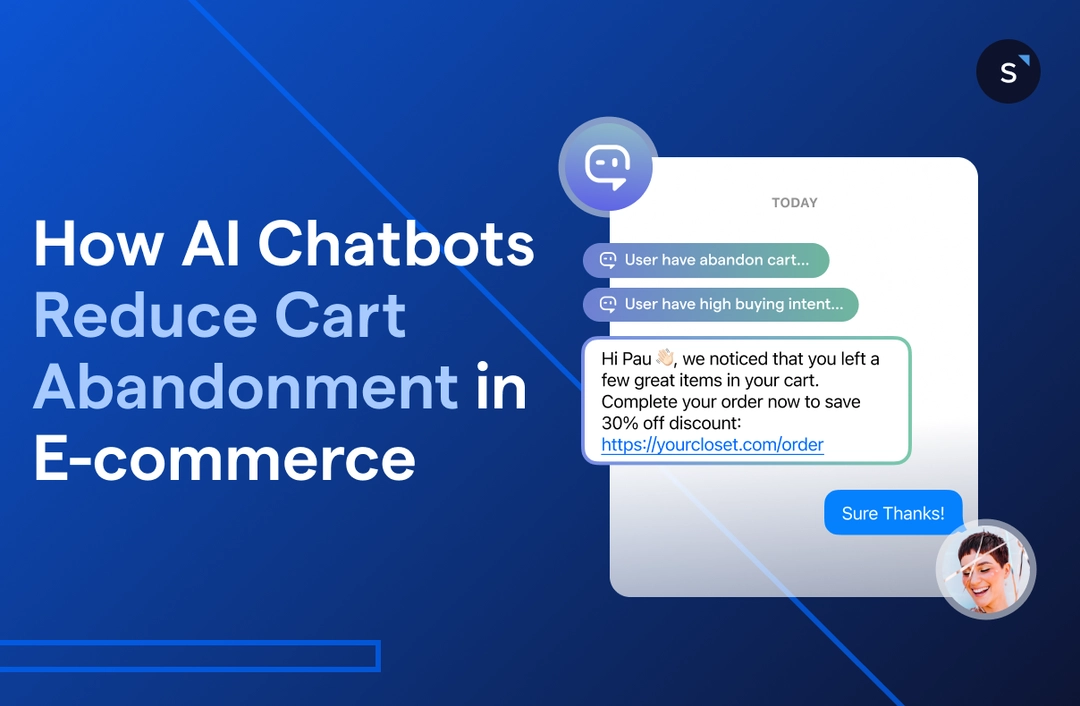
Cart abandonment is one of the most persistent problems in e-commerce. Conversational interventions—proactive messages, rapid initial response times, and in-chat checkout—directly address the friction points that cause shoppers to leave. When a customer can complete a purchase inside the messaging thread, the barrier to conversion drops sharply.
Higher Customer Retention
Customers want interactions that feel personal and continuous. A conversation thread that remembers past purchases, preferences, and open issues creates continuity that a series of disconnected support tickets cannot. Roughly 90% of shoppers say good customer service is a direct reason they buy again.
Upselling and Cross-Selling Opportunities
A strategically timed message—"Customers who bought this also added a matching case"—works better in conversation than in a static product page. Bots can surface discounts, complementary products, and special offers at the exact moment of purchase intent.
Rich Customer Data
Every conversation is a source of structured insight: product questions, objections, preferences, and behavior patterns. This data can train better chatbots, refine product offerings, and sharpen marketing segmentation.
Qualified Lead Generation
Modern conversational platforms include ready-made automation for lead qualification. Bots ask qualifying questions, collect contact information, authenticate returning customers, and route prospects to the right human agent—without requiring specialized engineering resources.
Conversational Commerce Examples
Proactive chat on product pages. A visitor lingers on a high-ticket item. A chat widget opens: "Need help choosing a size? Our team can check stock in real time." The conversation answers the objection and moves the shopper toward purchase.
Click-to-message ads. A social media ad includes a "Send Message" button. Tapping it opens a WhatsApp thread with the brand, where a bot presents product options and collects payment details—all without leaving the app.
In-chat checkout on WhatsApp. A customer asks about a product, confirms the order, and authenticates payment inside the WhatsApp conversation. The order confirmation and tracking updates arrive in the same thread.
Voice reordering. A customer says, "Alexa, reorder laundry detergent." The assistant confirms the previous order, processes payment from the stored card, and schedules delivery.
SMS cart recovery. A shopper abandons a cart. Within minutes, an SMS arrives: "Your cart is waiting—complete your order in the next hour for free shipping." The link opens a mobile-optimized checkout pre-filled with the cart contents.
How to Implement Conversational Commerce
1. Choose Your Channels Strategically
Don't try to be everywhere at once. Identify where your customers already spend time. For many brands, that's WhatsApp and Instagram. For others, Telegram or LINE dominate. Start with one or two channels, prove the model, then expand.
2. Design the Conversation Flow
Map the customer journey from first message to completed order. What questions will the bot ask? When does it escalate to a human? Where does payment happen? A well-designed flow feels natural, not like a phone tree.
3. Integrate Messaging with Commerce Systems
Your messaging layer needs access to product data, inventory, pricing, and order management. This is where a unified messaging API becomes valuable: instead of building separate integrations for WhatsApp, Telegram, and LINE, a single normalized interface handles message delivery and event ingestion across all channels.
Platforms like UnifyPort abstract away provider-specific SDKs and differences, giving developers one REST API and standardized webhook events for Telegram, WhatsApp, LINE, X (Twitter), Zalo, and TikTok. For engineering teams building conversational commerce features, this removes a significant chunk of integration overhead.
4. Combine Automation with Human Escalation
Bots handle the repetitive 80%—FAQs, order status, product recommendations. Humans handle the complex 20%—negotiations, complaints, high-value sales. The handoff must be seamless, with full conversation context passed to the agent.
5. Measure and Iterate
Track conversion rate per channel, average order value, response time, escalation rate, and customer satisfaction. Use conversation data to retrain bots and refine flows continuously.
Conversational Commerce vs. Traditional E-Commerce
| Aspect | Traditional E-Commerce | Conversational Commerce |
|---|---|---|
| Discovery | Search, browse, filter | Guided questions, recommendations |
| Support | Separate help center, email tickets | In-thread, real-time |
| Checkout | Multi-step form, separate page | In-conversation, often one tap |
| Personalization | Based on browsing history | Based on conversation context and history |
| Abandonment recovery | Email sequences | Proactive chat and SMS |
| Customer relationship | Transactional | Ongoing dialogue |
Traditional e-commerce optimizes for self-service browsing. Conversational commerce optimizes for guided, relationship-driven selling. The two aren't mutually exclusive—most successful brands blend them, using conversational touchpoints at high-intent moments.
The Technical Layer: Messaging APIs for Conversational Commerce
Building conversational commerce across multiple channels presents a real engineering challenge. Each messaging platform has its own API, authentication scheme, webhook format, and rate limits. Supporting WhatsApp, Telegram, and LINE simultaneously can mean maintaining three separate codebases.
A unified messaging API solves this by providing:
- One REST API for sending and receiving messages across all channels
- Standardized webhook events that normalize provider-specific payloads into a consistent JSON shape
- Built-in retries and idempotency for reliable delivery
- Rate limiting and failure isolation so one channel's outage doesn't take down the others
- Webhook control plane for managing signatures, subscriptions, and retries
UnifyPort's documentation shows how this works in practice: developers register accounts as virtual devices per channel, receive normalized events, and send messages through a single endpoint. For AI agents, CRMs, and notification systems that need to converse across multiple messaging platforms, this architecture eliminates redundant integration work.
This matters for conversational commerce because the quality of the conversation depends on reliable, low-latency message delivery. A bot that takes 10 seconds to respond because of API retries feels broken. A bot that responds instantly across WhatsApp, Telegram, and LINE feels like magic.
Common Challenges and How to Solve Them
Channel Fragmentation
Challenge: Each messaging platform has unique capabilities, message types, and limitations.
Solution: Use a unified messaging layer that normalizes differences. Design conversation flows that work within the lowest common denominator, then enhance per-channel where possible.
Bot Accuracy
Challenge: Customers get frustrated when bots misunderstand requests or give wrong answers.
Solution: Start with a narrow scope—handle the top 20 questions that drive 80% of volume. Escalate confidently to humans. Retrain continuously on real conversation data.
Payment Security
Challenge: Processing payments inside chat threads raises security and compliance concerns.
Solution: Use platform-native payment features where available (WhatsApp Pay, WeChat Pay) or tokenized payment links that open secure checkout. Never handle raw card data in chat messages.
Scaling Human Agents
Challenge: As conversation volume grows, human agent capacity becomes the bottleneck.
Solution: Invest in bot deflection for repetitive queries, build a knowledge base the bot can reference, and use conversation routing to match complex queries with specialized agents.
The Future of Conversational Commerce
Conversational commerce is converging with broader AI trends. Large language models are making chatbots dramatically more capable at understanding context, handling multi-turn conversations, and generating natural responses. Voice interfaces are improving. And messaging platforms are adding native commerce features—catalogs, payments, order tracking—that make in-chat purchasing increasingly seamless.
The brands that win will be those that treat conversation as a first-class channel, not an afterthought. That means investing in the messaging infrastructure, AI capabilities, and human workflows that make every conversation feel effortless.
For developers, the practical starting point is often the integration layer. Before you can build a great conversational experience, you need reliable, normalized access to the messaging channels your customers use. That's the foundation everything else builds on.
Related reading
- LinkedIn Messaging API: How It Works, Limits & Alternatives - Learn how the LinkedIn Pages messaging API works, which partner platforms support it, its limitations, and how unified messaging APIs compare for multi-channel teams.
Sources and further reading
- Conversational Commerce - Conversational commerce is a type of ecommerce that creates a seamless and interactive shopping experience for consumers through conversation tools.
- What Is Conversational Commerce? - Salesforce - Conversational commerce — with the help of AI — is changing the digital shopping experience. Learn everything you need to know here.
- What is conversational commerce? Examples, types, + benefits - Conversational commerce is the intersection between e-commerce and messaging. Find out how live representatives and AI can improve customer engagement.
FAQ
What is conversational commerce in simple terms?
Conversational commerce is buying and selling through chat. Customers interact with a brand via messaging apps, chatbots, voice assistants, or SMS—asking questions, getting recommendations, and completing purchases without leaving the conversation.
Which platforms are best for conversational commerce?
The best platform depends on your audience. WhatsApp dominates in Europe, Latin America, and parts of Asia. WeChat is essential in China. LINE leads in Japan, Thailand, and Taiwan. Telegram is strong in Eastern Europe and tech-savvy communities. Facebook Messenger remains relevant in North America. Most brands choose based on where their customers already are.
Do I need AI to implement conversational commerce?
No. You can start with human agents on live chat or messaging apps. However, AI chatbots dramatically improve scalability by handling repetitive queries 24/7. Most implementations combine both: bots for common questions, humans for complex ones.
How does conversational commerce reduce cart abandonment?
It addresses the main causes of abandonment: unanswered questions, unexpected friction, and lack of trust. Proactive chat answers objections in real time, in-chat checkout removes navigation steps, and follow-up SMS messages recover carts that would otherwise be lost.
What's the difference between a chatbot and conversational commerce?
A chatbot is a technology—a software program that simulates conversation. Conversational commerce is a strategy—using conversation tools (including chatbots, but also human agents, voice assistants, and SMS) to drive sales and support across the customer journey.
Can small businesses use conversational commerce?
Yes. Modern platforms offer out-of-the-box automation, pre-built chatbot templates, and no-code flow builders. A small business can start with a WhatsApp Business account and a simple FAQ bot, then expand as volume grows.
Conclusion
Conversational commerce is not a futuristic concept—it's the current reality of digital retail. Customers expect to message brands the same way they message friends: instantly, casually, and with full context. The businesses that meet that expectation see higher conversion, better retention, and richer customer data.
The path to implementation runs through channel selection, conversation design, and technical integration. For teams building multi-channel conversational experiences, a unified messaging API like UnifyPort removes the most tedious part of the work—maintaining separate integrations for every platform—so you can focus on the conversation itself.
Start with one channel, design a flow that feels natural, and measure relentlessly. The conversation is the new storefront. Make it a good one.
For a deeper look at how messaging platforms compare and how unified APIs work, see our guides on instant messaging and LINE's business features.