
UnifyPort vs CM.com: Multi-Channel Messaging API Comparison
Compare UnifyPort and CM.com for multi-channel messaging. See API features, channel coverage, pricing, and which platform fits developers and businesses.
UnifyPort vs CM.com: Which Multi-Channel Messaging API Fits Your Stack?
Modern applications rely on messaging to reach users where they are—on WhatsApp, Telegram, LINE, X (Twitter), Zalo, or TikTok. Two platforms promise to unify this chaos: UnifyPort, a developer-first messaging API, and CM.com, an AI-powered conversational commerce suite. This comparison unpacks their architectures, channel coverage, and real-world strengths to help you decide which one belongs in your tech stack.
What Is UnifyPort?
UnifyPort vs CM.com: Multi-Channel Messaging API Comparison product interface and feature overview.
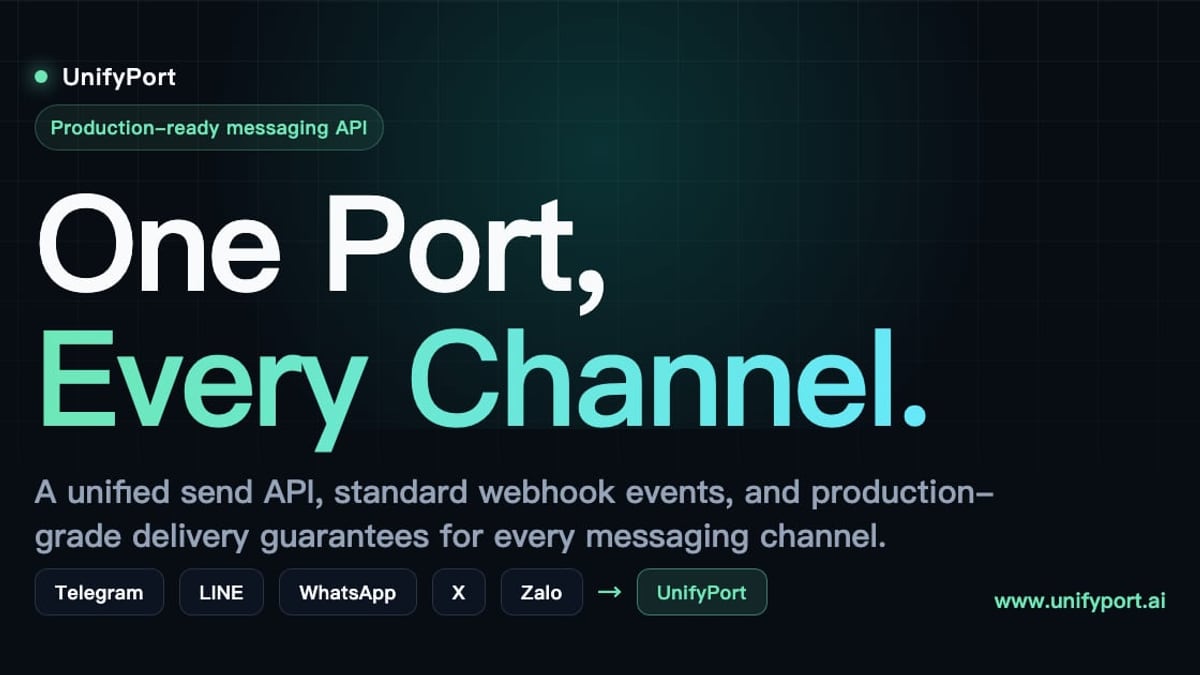
UnifyPort is a unified multi-channel messaging API built for developers who need reliable, observable access to top messaging platforms without juggling multiple provider SDKs. It exposes a single REST API and standardized webhook event stream to send and receive messages across WhatsApp, Telegram, LINE, X, Zalo, and TikTok. Under the hood, it abstracts away connection management and provider quirks, offering production-grade delivery guarantees, built-in rate limiting, retries, idempotency, and failure isolation.
Crucially, UnifyPort normalizes all provider events into one JSON shape, provides a webhook control plane for signature and retry management, and secures API keys with HMAC-SHA256 signatures. It also handles the full lifecycle of virtual messaging accounts—creation, authentication (QR, code, or session import), runtime monitoring, and teardown—with fine-grained status tracking. Pricing is transparent and graduated based on paid accounts per month, and every workspace includes a free tier. UnifyPort is currently available to selected customers.
What Is CM.com?

UnifyPort vs CM.com: Multi-Channel Messaging API Comparison product interface and feature overview.
CM.com positions itself as a conversational commerce platform that unifies messaging, marketing, service, and payments on a shared customer context. It serves over 9,000 businesses, from startups to Fortune 500 companies, across retail, travel, healthcare, and logistics. Core capabilities include automated support via HALO AI agents, omnichannel marketing campaigns, transactional messaging APIs, and integrated payment processing.
CM.com’s channel mix includes RCS, WhatsApp, Voice, SMS, and various social messengers. It bundles a Customer Context Platform, Service Cloud, Marketing Cloud, and developer APIs under one roof. The value proposition is eliminating channel silos so that every interaction remains consistent and personalized. Its simple pricing tiers (Basic, Advanced, Pro) and local market adaptations (e.g., same-day SMS setup in Japan) aim to make omnichannel outreach accessible to all business sizes.
UnifyPort vs CM.com: Key Differences at a Glance
UnifyPort vs CM.com: Multi-Channel Messaging API Comparison product interface and feature overview.
| Feature | UnifyPort | CM.com |
|---|---|---|
| Primary focus | Developer API for multi-channel messaging | Conversational commerce with marketing, service & payments |
| Channels | WhatsApp, Telegram, LINE, X (Twitter), Zalo, TikTok | RCS, WhatsApp, Voice, SMS, social messengers (specific list not enumerated) |
| API abstraction | Single REST API & standardized webhook event stream across all channels | APIs per channel, plus higher-level marketing/service SDKs |
| Delivery guarantees | Built-in rate limiting, retries, idempotency, failure isolation | Provider-dependent; platform-level monitoring |
| Event normalization | All provider events transformed into one JSON shape | Events likely remain channel-specific |
| Account lifecycle management | Full virtual account creation, auth (QR/code/session import), monitoring, teardown | Not a primary feature; account setup managed through platform |
| Security | HMAC-SHA256 signatures on all requests | Standard API key management; platform security |
| Pricing | Graduated based on paid messaging accounts per month, free tier included | Tiered plans (Basic, Advanced, Pro) for platform services |
| Best for | Dev teams needing a lean, observable, unified API for global messaging | Marketing and support teams wanting an all-in-one AI‑powered conversational platform |
UnifyPort Advantages: Why Developers Prefer It
True Multi-Channel Coverage with Asian Messengers
UnifyPort was designed for a world where LINE, Zalo, and TikTok are mission-critical. It natively supports these channels—often overlooked by Western-first platforms—alongside global staples like WhatsApp and Telegram. With one integration, your AI agents or notification systems can reach users on any of the six supported platforms, each with consistent formatting for text, images, video, audio, documents, and channel-specific extensions like reply_to and parse_mode.
To see how easy it is to bring LINE into your app, check out our step-by-step guide How to Use UnifyPort with LINE for Multi-Channel Messaging.
Developer-First Architecture with Guaranteed Delivery
UnifyPort treats messaging infrastructure as a reliability engineering problem. It bakes in retries, idempotency keys, rate limiting, and circuit breakers so that your application never has to worry about transient provider failures. A normalized event layer ensures every webhook looks the same, whether it originates from Zalo or X. The webhook control plane lets you manage signatures, subscriptions, and retry policies declaratively, cutting down integration time and operational toil.
Secure, Transparent API Management
Every request to UnifyPort must carry a valid HMAC-SHA256 signature, providing strong authenticity and tamper-proofing out of the box. Combined with fine-grained workspace and key management, this gives teams total control over who can send messages and from which accounts. The transparent graduated pricing model means you pay only for the number of active messaging accounts, with a free tier to get started.
Full Lifecycle Automation for Virtual Accounts
UnifyPort doesn’t just pass messages; it handles the entire life of a virtual messaging account. From QR-code authentication to session imports, runtime health checks, and teardown, everything is exposed via REST endpoints and webhooks. This turns account management into code—a critical advantage for platforms that must spin up or retire channels dynamically.
Where CM.com Falls Short for Developers

UnifyPort vs CM.com: Multi-Channel Messaging API Comparison product interface and feature overview.
Limited Coverage of Key Messaging Channels
CM.com’s channel palette focuses on RCS, WhatsApp, Voice, SMS, and “social messengers.” It does not publicly document support for Telegram, LINE, X, Zalo, or TikTok as discrete, fully integrated channels. For businesses whose customers live on those platforms, CM.com either requires separate integrations or simply cannot deliver messages there, creating a significant coverage gap.
Less Granular API Abstraction
While CM.com offers developer APIs, its historical emphasis on its own Service Cloud and Marketing Cloud means the API experience often involves higher-level abstractions designed for marketing workflows. The underlying messaging APIs may not offer the same level of fine-grained control—such as per-request idempotency, universal retry policies, or a normalized event stream across all channels. Developers who need a pure messaging layer with predictable, programmable guarantees may find themselves fighting the abstraction rather than leveraging it.
Overkill for API-Only Messaging Needs
CM.com is a full conversational commerce suite: AI agents, campaigns, payment links, and a shared customer context. For a team that only needs to send and receive multi-channel messages at scale, the additional marketing and service features add unnecessary complexity and cost. You may end up paying for a platform you only use a fraction of, and the developer experience can become muddied by feature bloat.
When CM.com Might Still Be a Better Fit
Despite the advantages of UnifyPort, CM.com remains a powerful choice for businesses that need a complete conversational commerce package. Its HALO AI agents, Service Cloud, Marketing Cloud, and integrated payments allow a support or marketing team to manage the entire customer journey without separate tools. For a retailer wanting to automate order confirmations over WhatsApp, run a promotional SMS campaign, and handle returns via a shared inbox, CM.com’s all-in-one approach is compelling. It also boasts a proven track record with over 9,000 customers and localized go-to-market in markets like Japan.
If your primary goal is to wrap a multi-channel messaging API into an existing CRM, AI agent, or notification system—without any marketing or payment add-ons—UnifyPort is the sharper tool. For a broader omnichannel customer engagement platform, CM.com still warrants evaluation.
Use Case Scenarios
AI Agent Startup Launching a Telegram–LINE–WhatsApp Bot
A startup building an AI travel assistant needs to answer flight queries on Telegram, LINE, and WhatsApp. With UnifyPort, the team can authenticate virtual accounts for all three channels, send text and boarding passes via a single REST call, and receive normalized webhook events. Idempotency prevents duplicate messages, and automatic retries handle network hiccups. The startup pays only for the three paid accounts per month, staying within budget.
Enterprise Retailer Consolidating Customer Service & Marketing
A large retailer already uses CM.com’s Service Cloud and Marketing Cloud. They want to add SMS order updates and WhatsApp promotional flows. CM.com’s shared customer context ensures a service agent sees the same conversation history as the marketing engine. The payment integration lets customers complete a purchase inside a messaging thread. UnifyPort’s developer-grade API is unnecessary here; the retailer values the turnkey suite.
SaaS Platform Adding In-App Messaging Across Multiple Asian Channels
A SaaS product for logistics providers adds in-app notifications over LINE, Zalo, and TikTok. UnifyPort’s API handles account creation and monitoring for each tenant, while the normalized event stream feeds into the platform’s analytics. CM.com’s lack of documented support for Zalo and TikTok would force the provider to cobble together separate connectors, defeating the purpose of a unified solution.
How to Choose Between UnifyPort and CM.com
Choose UnifyPort if:
- Your system is developer-centric and needs a reliable, observable, multi-channel messaging API.
- You require support for LINE, Telegram, X, Zalo, or TikTok alongside WhatsApp.
- You value production-hardened delivery guarantees (retries, idempotency, rate limiting) out of the box.
- You want transparent, account-based pricing with a free tier.
Choose CM.com if:
- You need a full conversational commerce platform with built-in AI agents, campaign management, and payments.
- Your channels are predominantly SMS, RCS, or WhatsApp, and you can live without deep API-level control over less common messengers.
- You prefer a turnkey platform that handles marketing and service workflows in one console.
Still exploring options? Our three-way comparison UnifyPort vs Unipile vs CM.com: Which Multi-Channel API Wins? adds another developer-friendly alternative into the mix. For an in-depth look at Unipile, read our Unipile Review 2025: Is the Multi-Channel API Worth It?.
Related reading
- Top 10 Cloud-Based Messaging Apps in 2026 Ranked - Discover the 10 best cloud-based messaging apps for 2026. We rank Telegram, Discord, LINE, Viber, and more based on sync, features, and security. Find your ideal messenger.
Sources and further reading
- Difference between unify.ui.com and unifi.ui.com : r/Ubiquiti - Web resultsDifference between unify.ui.com and unifi.ui.com : r/UbiquitiReddit · r/Ubiquiti10+ comments · 3 months agoReddit · r/Ubiquiti10+ comments · 3 months agoMy two questions: Are these two domains apart of Ubiquiti? Should I just change my password to be more on the secure side?Difference bet
- Top Unify AI GTM Platform Alternatives & Competitors 2026 | Gartner Peer Insights - Learn more about the top Unify AI GTM Platform alternatives. Easily compare competitors and read verified real user reviews on Gartner Peer Insights.
- 3 Tried and Tested UnifyGTM Alternatives For Lead Generation - Looking for a UnifyGTM alternative? Discover 3 better tools for lead generation with flexible pricing, CRM integrations, and multi-channel outreach.
Frequently Asked Questions
Can UnifyPort handle WhatsApp Business API?
Yes. UnifyPort abstracts the WhatsApp channel along with Telegram, LINE, X, Zalo, and TikTok behind its unified REST API, so WhatsApp messaging is included with the same delivery guarantees and event normalization.
Does CM.com support Telegram or LINE?
CM.com’s publicly documented channels emphasize RCS, WhatsApp, Voice, SMS, and “social messengers,” but specific support for Telegram, LINE, X, Zalo, or TikTok is not detailed. If these channels are critical, verify with CM.com’s sales team.
Is UnifyPort suitable for high-volume transactional notifications?
Absolutely. With built-in rate limiting, retries, and failure isolation, UnifyPort is built for production workloads where delivery reliability matters.
What security methods does UnifyPort use?
UnifyPort employs HMAC-SHA256 request signatures, secure API key management, and a webhook control plane with signature verification, ensuring message authenticity and integrity.
Conclusion: UnifyPort vs CM.com — The Right Tool for the Right Job
UnifyPort and CM.com occupy different ends of the unified communication spectrum. If you are a developer or an engineering team building a product that must speak to users on WhatsApp, Telegram, LINE, X, Zalo, and TikTok through a single, reliable API, UnifyPort delivers exactly that—no marketing fluff, just battle-tested messaging infrastructure. CM.com excels when you need an AI-powered conversational commerce suite that combines service, marketing, and payments into one customer context, but it might leave you wanting more control or broader channel support if your use case is purely API-driven and spans modern social messengers.
For teams that value simplicity, coverage, and developer ergonomics, UnifyPort is the clear winner.