
UnifyPort vs Unipile vs CM.com: Which Multi-Channel API Wins?
Compare UnifyPort, Unipile, and CM.com on channels, API capabilities, pricing, and reliability. Find the best multi-channel messaging API for AI agents, CRMs, and business apps.
UnifyPort vs Unipile vs CM.com: Which Multi-Channel API Wins?
Choosing a multi-channel messaging platform for your product—whether you’re building an AI agent, a CRM, or a notification system—means balancing channel reach, developer ergonomics, reliability guarantees, and pricing. Three names often surface in these discussions: UnifyPort, Unipile, and CM.com. They share the promise of a single integration unlocking many messaging channels, but they occupy distinctly different layers of the stack.
This comparison lays out how they differ across channels, API architecture, account lifecycle, reliability, and pricing. By the end, you’ll know which one fits your use case and where each platform’s real strengths lie.
At a Glance: Three Different Approaches to Multi-Channel Messaging
UnifyPort vs Unipile vs CM.com: Which Multi-Channel API Wins? product interface and feature overview.
| UnifyPort | Unipile | CM.com | |
|---|---|---|---|
| Primary focus | Infrastructure layer for AI agents, operations tools, and CRMs | Multi-channel messaging API for SaaS companies and recruitment platforms | Full conversational commerce platform covering messaging, marketing, service, and payments |
| Best for | Developers needing reliable, observable, unified access to Asian-heavy apps | B2B SaaS products that need LinkedIn, email, WhatsApp, and calendar in one API | Businesses that want AI‑powered customer interactions, marketing campaigns, and payments integrated |
| Key strength | Production-grade delivery, built‑in rate limiting, account lifecycle control | OAuth‑based account linking, LinkedIn + Recruiter surfaces, unified inbox | Customer Context Platform, HALO AI agents, built‑in payments, marketing clouds |
Channel Coverage: Who Supports What?
UnifyPort vs Unipile vs CM.com: Which Multi-Channel API Wins? product interface and feature overview.
UnifyPort, Unipile, and CM.com all claim multi-channel support, but the actual list of messaging apps differs significantly—and that often decides the evaluation.
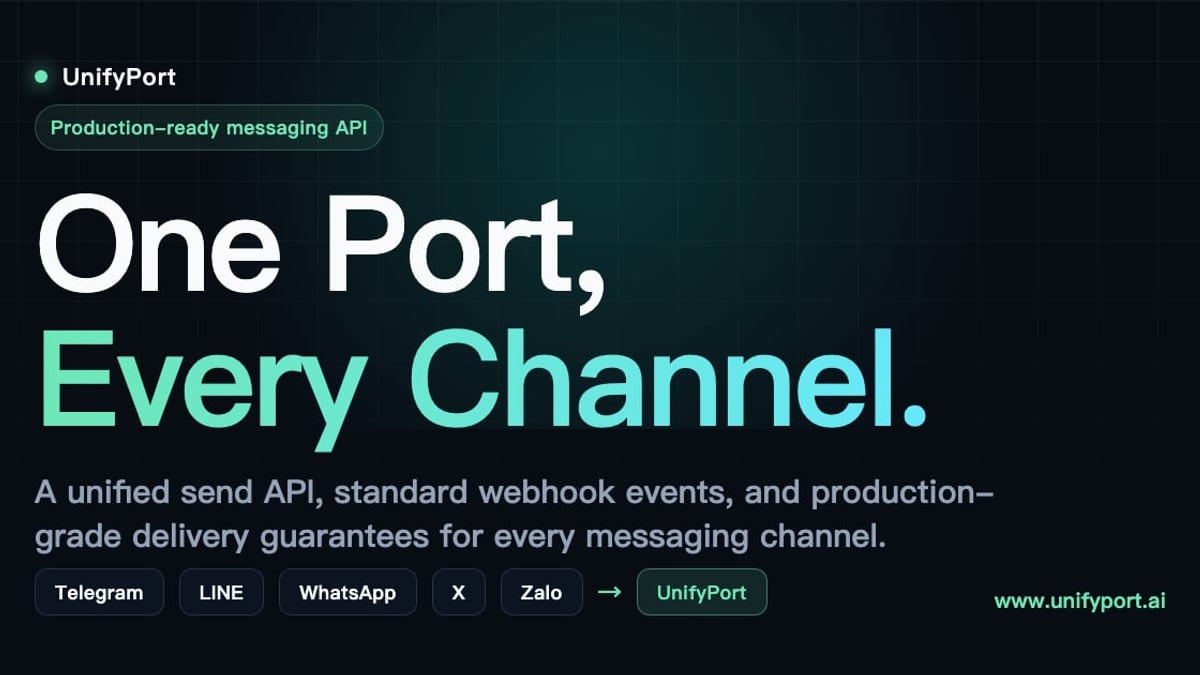
- UnifyPort connects WhatsApp, Telegram, LINE, X (Twitter), Zalo, and TikTok through a single REST API. It’s one of the few platforms that natively supports LINE, Zalo, and TikTok—the dominant messaging channels in Japan, Vietnam, and social commerce respectively. If your target audience is in Asia or you need native TikTok integration, this is a deciding advantage.
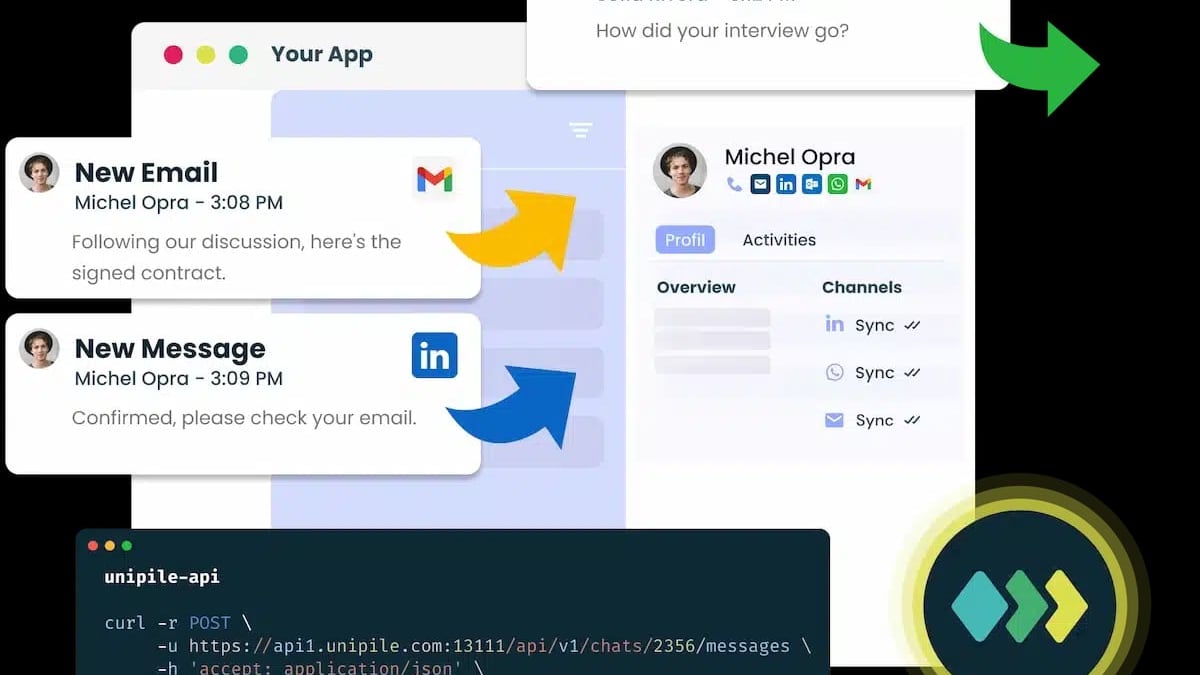
- Unipile bundles WhatsApp, LinkedIn (including Recruiter and Sales Navigator), Instagram, Telegram, Facebook Messenger, Gmail, Outlook, and calendar sync. The standout here is LinkedIn, which no other platform in this list covers natively, plus full email integration—making it ideal for sales outreach and recruiting tools. (Read our UnifyPort vs Unipile breakdown for a deeper channel-by-channel look.)
- CM.com offers RCS, WhatsApp, Voice, SMS, and social messengers alongside its own platform‑native channels. It’s less about being a pure developer API for cross‑app messaging and more about a business communication suite that unifies these channels with customer context and AI.
Takeaway: Choose UnifyPort when you need LINE, Zalo, or TikTok; pick Unipile if LinkedIn and email are non‑negotiable; consider CM.com when voice, SMS, and full business orchestration matter more than raw API abstraction.
API Architecture & Developer Experience

UnifyPort vs Unipile vs CM.com: Which Multi-Channel API Wins? product interface and feature overview.
All three products expose REST APIs, but the design philosophy differs sharply.
UnifyPort: Event‑Normalized, Production‑Ready
UnifyPort abstracts away provider‑specific SDKs and connection management, giving developers a single, normalized event stream. All provider events—regardless of the original shape—arrive through webhooks in one consistent JSON structure. The platform enforces rate limiting, retries, idempotency, and failure isolation out of the box. This means you don’t have to build your own delivery guarantees; they are part of the infrastructure.
Account lifecycle is another strong point: create virtual messaging accounts, authenticate via QR or session import, monitor runtime health, and tear them down—all through REST endpoints with fine‑grained status tracking.
Unipile: OAuth Simplicity, Unified Inbox
Unipile’s developer experience revolves around OAuth‑based account linking and a pre‑built unified inbox. After connecting an account, you can send and receive messages across LinkedIn, WhatsApp, email, and others through a consistent API. Real‑time webhooks and calendar sync are built in, and the platform handles message synchronization automatically.
There’s no built‑in campaign engine—you wire together sequences yourself—but official SDKs (Node.js, Python, PHP) and detailed guides lower the integration effort. See a third‑party comparison of Unipile’s pricing and feature depth for an outside perspective on its per‑account model.
CM.com: Customer Context, Not Just Messages
CM.com’s API sits atop its Customer Context Platform, meaning every interaction—message, payment, service ticket—is tied to a persistent customer profile. That enables AI agents (HALO) to handle routine queries while marketing campaigns run across channels. Developers get low‑level messaging APIs (SMS, WhatsApp, Voice) as well as higher‑level orchestration tools, but the experience is geared toward business teams rather than pure infrastructure abstraction.
Takeaway: UnifyPort is built for engineering teams that want a message‑bus abstraction with baked‑in reliability. Unipile is quicker to integrate if you rely on OAuth and value a pre‑built inbox. CM.com is the choice when you need customer context and AI alongside messaging.
Reliability & Delivery Guarantees
UnifyPort vs Unipile vs CM.com: Which Multi-Channel API Wins? product interface and feature overview.
When messages are business‑critical—order updates, authentication codes, AI‑agent replies—undelivered messages or silent failures aren’t acceptable.
UnifyPort codifies delivery guarantees into its platform layer. Idempotency keys prevent duplicate sends, automatic retries with backoff handle transient failures, and failure isolation ensures that a problem on one provider (say, a TikTok API outage) doesn’t cascade to WhatsApp or LINE. In contrast, Unipile leaves pacing and rate‑limit enforcement to your application on its GA v1 API (a v2 beta introduces server‑side rate limiting). CM.com, as a full‑stack platform, manages delivery internally but packages reliability as part of its enterprise SLAs rather than as API‑native primitives.
If your application cannot afford to drop a message, UnifyPort’s built‑in safeguards are a tangible advantage.
Account Lifecycle & Authentication
Managing messaging accounts at scale—creating, authenticating, monitoring, and retiring them—is a headache that multiplies across multiple channels. UnifyPort tackles this head‑on with a full lifecycle API: you can programmatically spin up virtual accounts, authenticate via QR codes, SMS codes, or session imports, monitor status through webhook events, and tear them down when needed. This is a differentiator for platforms that onboard and offboard many end‑user accounts dynamically.
Unipile simplifies account connection with OAuth flows and a white‑label auth wizard, but the infrastructure for managing the account journey after connection is thinner. CM.com operates at the business level; it provides channel onboarding wizards but doesn’t expose virtual account creation as a first‑class API primitive for third‑party developers.
Takeaway: UnifyPort gives you the most granular control over the full life of a messaging account, which is crucial for AI‑agent platforms and multi‑tenant SaaS products.
Pricing & Scalability at a Glance
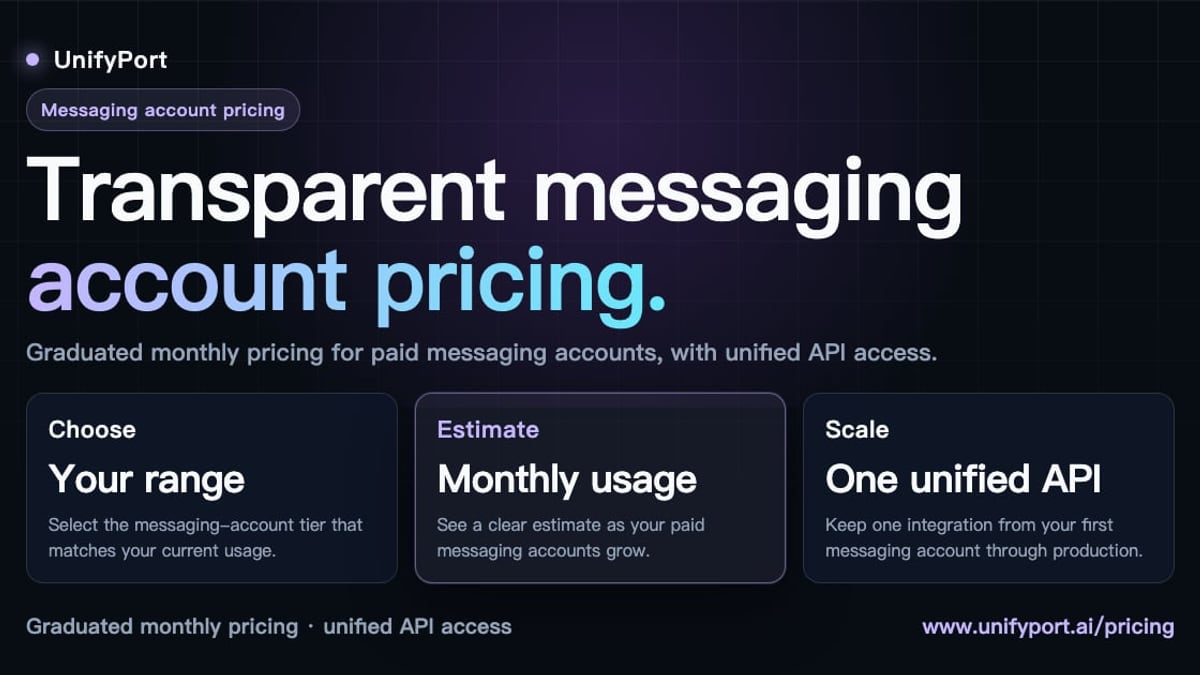
- UnifyPort uses transparent, graduated pricing based on the number of paid messaging accounts per month, with a free tier included in every workspace. The model scales predictably and makes costs easy to forecast for growing account fleets.
- Unipile charges per connected account per month, starting at €49 (or approx. $55) for up to 10 accounts, then sliding from €5.00 down to €3.00 per account as volume grows, post‑paid on peak usage. Volume discounts make it economical for high‑account‑count SaaS products.
- CM.com follows simple tiered plans (Basic, Advanced, Pro) that bundle channel access, AI, and support; exact pricing scales with usage and enterprise requirements.
If you’re connecting many end‑user accounts and want a predictable per‑account bill, both UnifyPort and Unipile offer clear pricing—UnifyPort’s free tier making it easier to start.
Practical Use Cases: Which Platform Fits Your Stack?
AI Agents and Notifications Systems → UnifyPort
When your AI agent needs to send and receive messages across WhatsApp, LINE, and TikTok while relying on guaranteed delivery, idempotency, and a standardized webhook event stream, UnifyPort’s infrastructure layer is purpose‑built. It removes the need to manage provider SDKs and lets you focus on the agent’s logic. LINE is a massive channel in Asia—our LINE App Review 2025 explains why native integration matters.
CRMs, ATS, and Sales Outreach Platforms → Unipile
If your product must bring together LinkedIn messaging, email, and WhatsApp under one inbox, Unipile’s multi‑channel aggregation and OAuth flows drastically reduce development time. Recruiting tools benefit from its Recruiter inbox and calendar sync, while sales platforms leverage LinkedIn outreach without browser extensions.
Omnichannel Customer Engagement and Commerce → CM.com
When the goal is to blend messaging, marketing automation, AI‑driven support, and integrated payments into a single customer journey, CM.com’s conversational commerce suite is the right fit. Its Customer Context Platform ties everything together, letting businesses move beyond siloed channel interactions.
Decision Guide: When to Choose Each
| If you need… | Choose |
|---|---|
| LINE, Zalo, TikTok, and production‑grade delivery primitives | UnifyPort |
| LinkedIn, email, and calendar alongside WhatsApp in a SaaS product | Unipile |
| A full business platform with AI, payments, and marketing clouds | CM.com |
| Predictable per‑account pricing with a free starter tier | UnifyPort (free tier) or Unipile (€49 for first 10) |
| Maximum control over account lifecycle and failure isolation | UnifyPort |
Sources and further reading
- LinkedIn Chrome Extension vs API Integration - Learn how LinkedIn Chrome extensions work, their limits, and why CRM, ATS and outreach platforms scale better with unified API integration for LinkedIn data.
- Linked API vs Unipile (2026): Features, Pricing, and Safety Compared - Linked API vs Unipile, compared honestly across features, real 2026 prices, and account safety – and who should pick which tool for which job.
Frequently Asked Questions
Do any of these platforms offer a self‑hosted option?
UnifyPort and Unipile are cloud‑managed services. CM.com offers enterprise‑grade hosting but not traditional self‑hosting. If full data sovereignty on your own infrastructure is required, you might need a different solution or a hybrid integration.
Can I send messages on multiple channels simultaneously?
All three platforms allow sending messages across their supported channels. UnifyPort’s normalized events make it straightforward to broadcast to multiple channels, while CM.com’s Customer Context Platform lets you orchestrate cross‑channel campaigns seamlessly.
Which platform is safest for account health on social channels?
UnifyPort implements built‑in rate limiting, retries with backoff, and failure isolation to reduce the risk of account flags. Unipile’s GA v1 leaves pacing to your application, while its v2 beta adds enforced limits. Always stay within provider guidelines regardless of the platform.
Does UnifyPort provide ready‑made integrations for these platforms?
UnifyPort integrates with messaging APIs to power AI‑agent communication layers. UnifyPort’s unified endpoint and event stream align naturally with tools that need deterministic, observable messaging across channels. We continuously evaluate API partners to ensure the best reliability for our users.
Conclusion
UnifyPort, Unipile, and CM.com serve three different stages of the messaging integration journey. UnifyPort is the infrastructure layer for developers who need strict delivery guarantees, deep channel coverage in Asia (LINE, Zalo, TikTok), and full account lifecycle control. Unipile excels when LinkedIn, email, and calendar are first‑class requirements and zero‑ops OAuth linking matters most. CM.com is the holistic business platform for brands that want AI, payments, and customer context wrapped around every interaction.
Pick the platform that matches your channel priorities and reliability needs—not the one with the longest feature list. And if you’re weighing UnifyPort against Unipile alone, our dedicated comparison goes into even more detail.
Start with a free tier or trial, test the channels that matter to your users, and see which API feels like the right foundation for your next project.