

Social Messaging: How It Works, Top Apps, and API Strategy
Learn what social messaging is, how the technology works, the top platforms for business, and how a unified messaging API simplifies multi-channel delivery.
Social Messaging: The Complete Guide to Platforms, Technology, and Multi-Channel Strategy
Social messaging has quietly become the backbone of digital communication. From a quick WhatsApp reply to a customer support thread on X (Twitter), billions of people now expect instant, conversational exchanges with friends, communities, and brands alike. What started as simple text chat has evolved into a rich ecosystem of voice notes, video calls, file sharing, and even in-chat payments.
This guide breaks down what social messaging actually is, the technology that powers it, the platforms that matter for businesses, and how engineering teams can connect to multiple channels without drowning in separate SDKs.
What Is Social Messaging?

Social Messaging: How It Works, Top Apps, and API Strategy - What Is Social Messaging?.
Social messaging refers to platforms and services that let people exchange messages in real time across text, images, voice, and video. The conversation can happen inside a product through in-app chat, or on standalone platforms like WhatsApp, Telegram, Messenger, and LINE.
While direct chat remains the core, modern social messaging extends far beyond one-to-one text. Group conversations, broadcast channels, threaded replies, reactions, and media sharing are all part of the experience. Social feeds add another layer: comments and replies on public posts often become entry points into private conversations.
The scale is staggering. WhatsApp alone reports over 3 billion monthly active users. Nearly 4 billion people used messaging apps globally by 2024. For businesses, that means social messaging is no longer optional, it is where customers already are.
How Social Messaging Works Under the Hood
Social Messaging: How It Works, Top Apps, and API Strategy - How Social Messaging Works Under the Hood.
For end users, sending a message feels instant and effortless. For developers and infrastructure teams, that experience depends on several technical layers working together reliably at scale.
Real-Time Transport Protocols
The first challenge is moving data between devices quickly. Most modern messaging systems rely on a combination of protocols:
- WebSocket maintains a persistent, bidirectional connection between client and server. This enables features like typing indicators, read receipts, and fast message synchronization without constant polling.
- WebRTC handles peer-to-peer audio, video, and data sharing directly between browsers or apps. It powers voice calls, video calls, and screen sharing inside messaging platforms.
- XMPP is an older open standard that still appears in some systems, supporting presence status, rosters, and extensions for group chat and file transfer.
Cloud Infrastructure
Messaging backends depend on distributed cloud infrastructure to stay responsive under load. Auto-scaling adds or removes servers as traffic fluctuates. Load balancers distribute requests to prevent overload. Multi-region deployment reduces latency for global users and provides failover when a region goes down. Message queues absorb bursts of traffic, while caches keep recent data in memory for faster retrieval.
Push Notifications
When a user's app is inactive or running in the background, the platform still needs to deliver messages. Apple Push Notification service (APNs) handles iOS devices, Firebase Cloud Messaging (FCM) covers Android, and Web Push enables browser notifications. These services wake the app or device so new messages appear promptly.
Security and Privacy
Trust is the foundation of any messaging platform. Transport Layer Security (TLS) encrypts traffic between clients and servers. Many platforms go further with end-to-end encryption (E2EE), which ensures only the sender and recipient can read message content. Signal and WhatsApp, for example, use the Signal Protocol to apply E2EE by default across personal and group chats.
Access management relies on standards like OAuth 2.0, which lets users grant limited permissions to apps without sharing passwords. JSON Web Tokens (JWTs) give servers a stateless, signed way to confirm identity and session validity. Behind the scenes, platforms also deploy DDoS mitigation, rate limiting, and compliance frameworks such as GDPR in Europe and HIPAA in U.S. healthcare.
Core Features Users Expect
Social Messaging: How It Works, Top Apps, and API Strategy - Core Features Users Expect.
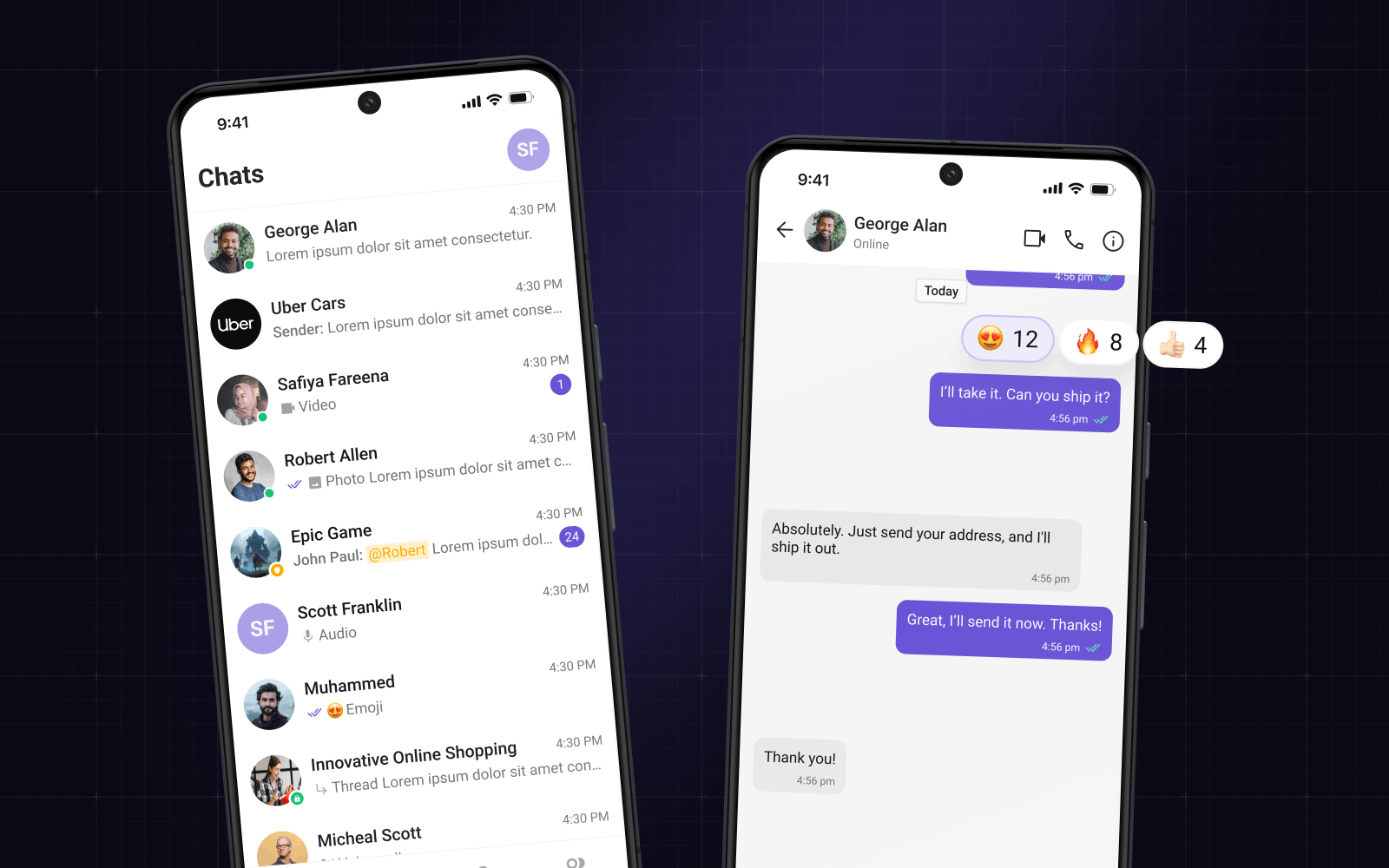
Most users never think about protocols or infrastructure. They notice the features layered on top. Modern social messaging apps typically include:
- 1:1 and group messaging, including channels and broadcast lists
- Read receipts and typing indicators for real-time awareness
- Presence status showing online, offline, or away
- Push notifications and offline delivery so messages arrive even when the app is closed
- File and media sharing for images, video, documents, and links
- Voice notes with in-app recording and playback controls
- Multi-device sync across phone, desktop, and web
- Location sharing for one-time or live location updates
- Voice and video calls, often with optional screen sharing
- Search across past messages, media, and participants
- Profiles and avatars to establish identity across devices
- Moderation tools for group admins, including member management and content restrictions
Top Social Messaging Platforms for Business

Social Messaging: How It Works, Top Apps, and API Strategy - Top Social Messaging Platforms for Business.
Choosing the right channels depends on your audience, geography, and use case. Here are the platforms that matter most for brands and developers in 2026.
With more than 3 billion monthly active users, WhatsApp is the global default for personal and business messaging. WhatsApp Business enables chatbots, video and voice calls, and six distinct message types for transactional and conversational use cases. Its end-to-end encryption and intimate, one-to-one feel make it powerful for personalized support and conversion.
Instagram Direct Messages
Instagram DMs are integrated directly into the app, which means no separate account is required. With over 2 billion monthly active users, Instagram messaging supports group chats, video calls, voice chat, and rich media with filters and stickers. When a user tags your brand in a Story, it appears automatically in your DMs, making it a natural entry point for engagement.
Messenger
Meta's Messenger has around 1.3 billion monthly active users and remains critical for North American markets. It supports automated replies, chatbots, a built-in GIF and sticker library, and video calls. Messenger is a strong choice for brands that already maintain a Facebook presence.
TikTok Direct Messages
TikTok messaging is integrated into the app and requires message request acceptance before a conversation begins. This extra step reduces inbox noise but adds friction to the customer journey. Business accounts can configure automated responses to acknowledge incoming messages and answer common questions based on keywords.
Telegram
Telegram offers channels, groups, bots, and a robust API that developers appreciate. It supports large communities, file sharing, and custom bot interactions. For businesses targeting tech-savvy audiences or communities, Telegram channels provide a powerful broadcast mechanism alongside direct messaging.
For brands reaching Chinese-speaking communities, WeChat is essential. It combines messaging, voice and video calls, broadcast capabilities, and social commerce through WeChat Pay, which boasts roughly 900 million users. WeChat is less a messaging app and more a full digital ecosystem.
LINE, Zalo, and Regional Leaders
Regional platforms matter enormously. LINE dominates in Japan, Taiwan, and Thailand. Zalo is the leading messaging app in Vietnam. Ignoring these platforms means missing large, engaged audiences in key markets. A multi-channel strategy should account for regional preferences rather than assuming one global app covers everyone.
X (Twitter) Direct Messages
X DMs are useful for public-facing support and brand interactions. Because conversations often start from public posts or mentions, X messaging serves as a bridge between social engagement and private resolution.
Business Use Cases for Social Messaging
Organizations use social messaging across the entire customer lifecycle.
Customer Support
Messaging replaces slow email queues with immediate, contextual interactions. WhatsApp Business and Messenger are now common support channels, with APIs enabling automated responses and seamless escalation to human agents. Customers expect responsive service on the channels they already use daily.
Conversational Commerce
Around 90% of consumers buy from a brand they follow on social media. Messaging enables personalized offers, product recommendations, and even complete purchases inside chat. WeChat and WhatsApp already support payments within conversations, and marketplace apps rely on built-in messaging to negotiate and confirm orders.
Marketing and Engagement
Brands use messaging to send opt-in updates, personalized offers, and transactional alerts directly into channels users check constantly. Unlike broadcast ads, these are two-way exchanges: customers can reply, ask questions, or complete purchases in the same thread.
Internal Collaboration
Work-focused platforms like Slack and Microsoft Teams demonstrate how messaging accelerates productivity with channels, direct chats, and file sharing. Gaming communities use Discord servers and in-game chat to coordinate teams and build community.
The Developer Challenge: Connecting to Multiple Channels
For engineering teams, the business case for social messaging is clear. The implementation challenge is less obvious until you start building.
Each platform ships its own SDK, API structure, authentication model, and webhook format. WhatsApp's API differs from Telegram's Bot API, which differs from LINE's Messaging API, which differs from Zalo's. Supporting five channels means maintaining five integrations, five sets of documentation, five retry strategies, and five ways to normalize incoming events.
That complexity compounds when you add features like rate limiting, idempotency, failure isolation, and signature verification. Teams end up spending more time on integration plumbing than on the actual product experience.
A Unified Messaging API Approach
A unified messaging API solves this by abstracting away provider-specific differences. Instead of learning each platform's SDK, developers interact with a single REST API and a standardized webhook event layer. Incoming messages from Telegram, WhatsApp, LINE, X, Zalo, and TikTok are converted into a consistent JSON shape, so your application logic only needs to handle one event format.
UnifyPort is an example of this approach. It positions itself as "One Port, Every Channel," providing a normalized interface for message delivery and event ingestion across multiple messaging platforms. Key capabilities include:
- Standard event layer that converts all provider messages into a consistent JSON shape
- Webhook control plane for managing signatures, subscriptions, and retries
- Built-in rate limiting and retries with idempotency
- Failure isolation so one channel outage does not affect others
- Secure integration via API keys and HMAC-SHA256 signatures
- Workspaces and accounts for isolation and virtual device management per channel
- Official SDKs for Node.js, PHP, and Go
This kind of infrastructure is designed for AI agents, CRMs, notification systems, and operations tools that need to connect with multiple messaging platforms without building separate integrations. For teams evaluating their options, comparing a unified approach against CM.com's platform features or reviewing Unipile API examples can clarify the tradeoffs between managed platforms and developer-first abstraction layers.
Choosing the Right Social Messaging Strategy
Your approach should follow your audience, not the other way around. Start by identifying where your customers already communicate. Consider geographic distribution, demographic preferences, and the nature of your interactions.
For support-heavy workflows, prioritize platforms with strong business APIs and automation capabilities. For community building, look at Telegram channels or Discord servers. For commerce, WeChat and WhatsApp offer the deepest in-chat transaction flows.
From an engineering perspective, evaluate whether you need direct platform integrations or a unified abstraction. Direct integrations offer maximum control but multiply maintenance overhead. A unified messaging API reduces complexity and speeds up time to market, especially when you need to support four or more channels simultaneously.
If your stack also includes email, consider how messaging fits alongside email API integration to create a coherent multi-channel communication strategy. Similarly, teams building CRM workflows should think about CRM messaging integration to keep customer conversations synced across systems.
Sources and further reading
- Social Messaging - What is it and how does it work? - Learn what social messaging is, how it works, and why businesses and users rely on it to connect, support, and engage with one another.
- 11 Social messaging apps every marketer should know in 2026 - Consumers expect to have conversational experiences with brands on social media. Learn more about the 11 most popular social messaging apps.
- The Best Private Messaging Apps for 2026 - These are the top private messaging services we've tested to keep your conversations confidential from advertisers, governments, and any other prying eyes.
Frequently Asked Questions
What is the difference between social messaging and social media?
Social media encompasses public feeds, posts, and broadcast content. Social messaging refers specifically to direct, often private, conversational exchanges between individuals or between brands and customers. The two overlap when public interactions lead to private conversations.
Which social messaging app is best for business?
It depends on your audience. WhatsApp offers the largest global reach and strong business APIs. Messenger is strong in North America. WeChat is essential for Chinese-speaking markets. LINE and Zalo dominate in Japan and Vietnam respectively. Most businesses benefit from supporting multiple channels rather than picking one.
What is a unified messaging API?
A unified messaging API is a platform that lets developers send and receive messages across multiple messaging channels through a single REST API and standardized webhook events. It abstracts away provider-specific SDKs and differences, providing a normalized interface for message delivery and event ingestion.
Is social messaging secure?
Security varies by platform. Many major apps, including WhatsApp and Signal, implement end-to-end encryption by default. Others rely on TLS encryption between client and server. For business integrations, look for API key authentication, HMAC signature verification, and compliance with relevant regulations like GDPR.
How do businesses automate social messaging?
Businesses automate messaging through platform APIs, chatbots, and unified messaging platforms. Automation can handle FAQs, route conversations to human agents, send transactional notifications, and trigger personalized campaigns based on user behavior.
What are webhooks in social messaging?
Webhooks are HTTP callbacks that messaging platforms use to notify your application when events occur, such as incoming messages, delivery confirmations, or read receipts. A unified messaging platform standardizes these webhook events so your application handles one consistent format across all channels.
Conclusion
Social messaging has evolved from a convenient way to chat into the primary interface between brands and customers. The technology stack behind it, real-time protocols, cloud infrastructure, push notifications, and security frameworks, has matured to support billions of concurrent conversations.
For businesses, the opportunity is clear: meet customers where they already are with fast, personalized, two-way communication. For developers, the challenge is equally clear: managing multiple platform integrations without sacrificing reliability or velocity.
Whether you choose direct platform integrations or a unified messaging API, the key is to build a strategy that scales across channels, regions, and use cases. The brands that treat social messaging as core infrastructure rather than an add-on will be the ones best positioned to serve the next generation of digital customers.
For a deeper look at specific platforms, explore how Telegram channels work or compare CM.com's integration options against unified messaging alternatives.