
Payment Solutions: Types, How They Work & Choosing the Right One
Explore modern payment solutions—from merchant services and gateways to unified APIs. Learn how they work, compare options, and choose the right infrastructure for your business.
Payment Solutions: A Complete Guide to Modern Payment Infrastructure
Choosing the right payment solution isn’t just about accepting credit cards anymore. It’s about orchestrating a complex flow of transactions, data, and customer touchpoints—whether you run a brick-and-mortar store, an online marketplace, or a software platform that needs to embed financial services. The landscape spans merchant accounts, payment gateways, issuing platforms, and unified APIs that connect everything behind the scenes.
This guide breaks down the core types of payment solutions, how they work under the hood, and what to evaluate when selecting infrastructure for your business. We’ll move beyond surface-level features and look at the architectural decisions that affect reliability, developer experience, and long-term scalability.
What Are Payment Solutions?
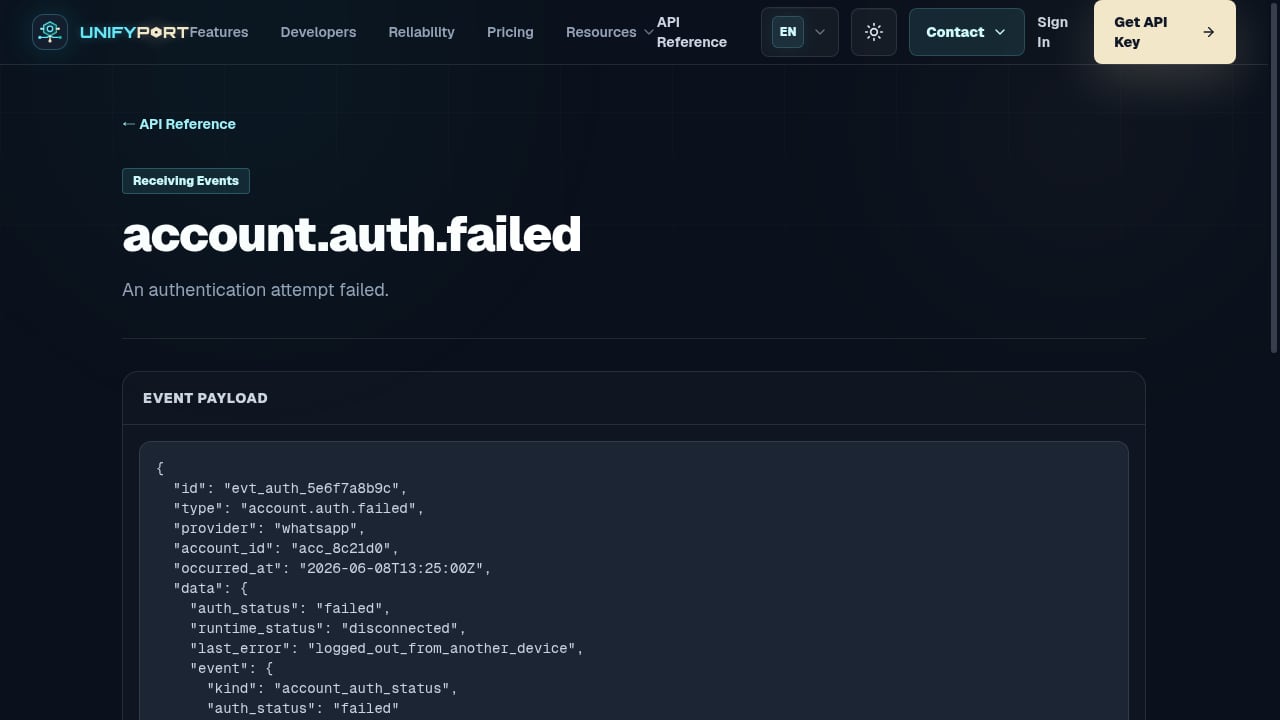
First viewport screenshot of account.auth.failed — API Reference — UnifyPort.
A payment solution is any combination of software, hardware, and financial services that enables a business to accept, process, or manage payments. At its simplest, that means a point-of-sale (POS) terminal and a merchant account. At its most complex, it’s an API-first platform that handles card issuing, real-time fraud scoring, cross-border settlement, and multi-channel customer communication—all within a single stack.
Modern payment solutions fall into a few broad categories:
- Merchant services and processing: The foundational layer that connects a business to card networks (Visa, Mastercard, etc.) and moves funds from a customer’s bank to the business’s bank.
- Payment gateways: The software layer that encrypts and transmits transaction data between a website or app and the processor.
- Issuing platforms: Infrastructure that lets banks and fintechs create and manage physical and virtual cards for their customers.
- Unified payment platforms: API-driven systems that consolidate multiple payment functions—processing, gateway, fraud management, reporting—into one integration point.
- Ancillary services: Automated invoicing, recurring billing, ACH debiting, check guarantee, and fraud prevention tools.
Each layer solves a distinct problem, and many businesses end up stitching several together. Understanding the stack helps you avoid vendor lock-in and unnecessary fees.
Core Types of Payment Solutions
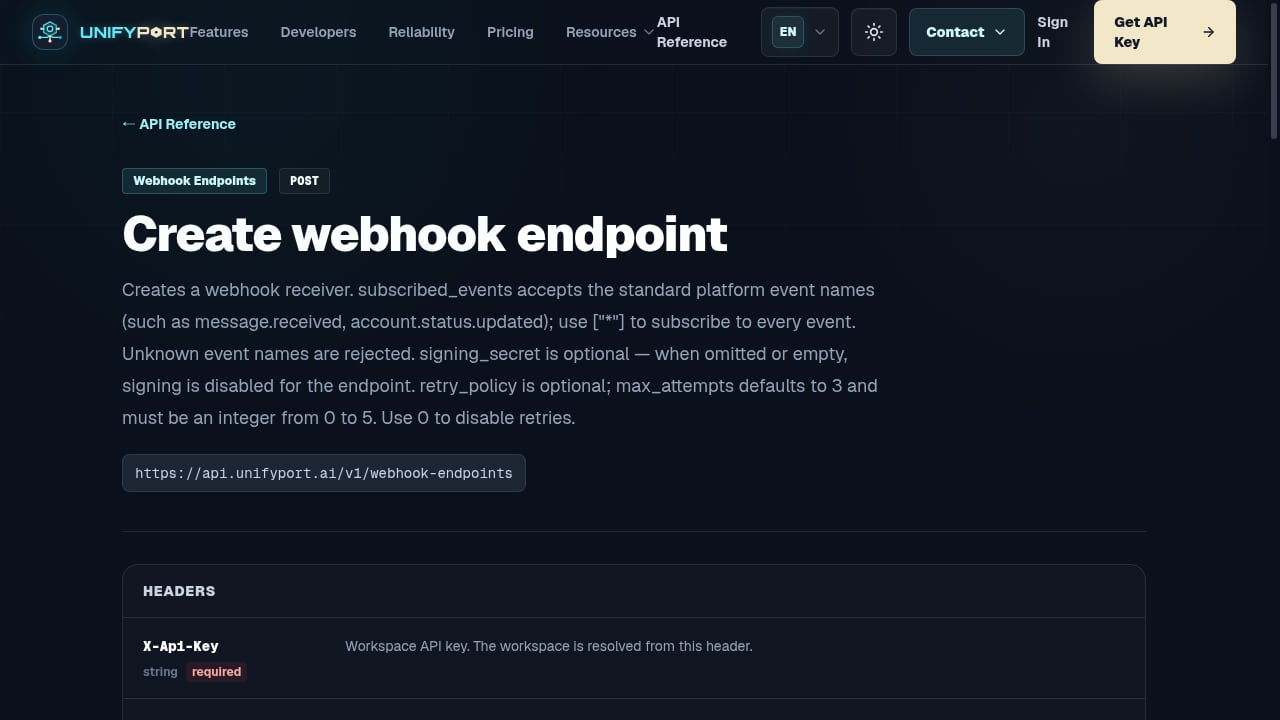
First viewport screenshot of Create webhook endpoint — API Reference — UnifyPort.
1. Merchant Services and Credit Card Processing
When a customer swipes, taps, or types in a card number, a chain of events fires behind the scenes. The processor—often called a merchant services provider—acts as the intermediary between your business, the card networks, and the issuing bank. They handle authorization, settlement, and funding.
Small businesses typically encounter two pricing models:
- Flat-rate pricing: A fixed percentage plus a per-transaction fee (common with aggregators like Square or Stripe).
- Interchange-plus pricing: The actual interchange fee set by card networks plus a transparent markup. This model often yields lower net costs for businesses with higher transaction volumes.
Some providers, like Chase Payment Solutions, bundle processing with business checking accounts to offer same-day deposits and integrated reporting. Others, like independent merchant service providers, emphasize competitive fees, hands-on installation, and freedom from long-term contracts. The key trade-off is between convenience and cost control.
What to look for:
- Transparent fee structures with no hidden monthly minimums.
- Month-to-month agreements rather than multi-year lock-ins.
- Dedicated support—not a call center maze—when disputes or chargebacks arise.
2. Payment Gateways and Online Processing
A payment gateway is the digital equivalent of a POS terminal. It encrypts sensitive card data, sends it to the processor, and returns an approval or decline response to your website or app. Gateways also handle tokenization—replacing raw card numbers with non-sensitive tokens for recurring billing and future transactions.
For e-commerce and SaaS businesses, the gateway is the most visible part of the payment stack. Modern gateways offer:
- Hosted payment pages and embeddable checkout forms.
- API libraries for custom integrations.
- Built-in support for digital wallets (Apple Pay, Google Pay).
- Recurring billing engines for subscriptions.
Security is non-negotiable. Any gateway you evaluate should be PCI DSS compliant and support 3D Secure 2.0 for strong customer authentication in regions where it’s required.
3. Card Issuing and Fintech Platforms
On the other side of the transaction sits the issuer—the bank or fintech that provides cards to consumers and businesses. Issuing platforms like FIS Total Issuing provide the infrastructure for creating, managing, and securing card programs at scale.
These platforms are API-first and cloud-native, designed for banks that need to launch virtual cards, control authorization rules, and embed fraud prevention directly into the transaction flow. Key capabilities include:
- Real-time virtual card issuance for digital wallets.
- Machine learning–driven fraud scoring that adapts to each issuer’s portfolio.
- Configurable workflows for dispute management and chargeback resolution.
- Scheme-agnostic processing across Visa, Mastercard, and regional networks.
For fintechs building neobanks or expense management tools, an issuing platform is the backbone. It abstracts away the complexity of BIN sponsorship, network compliance, and settlement so product teams can focus on user experience.
4. Unified Payment Platforms and API Abstraction
The most significant shift in the payments industry is toward unification. Instead of stitching together separate providers for processing, gateway, fraud, and reporting, businesses are adopting platforms that expose all these functions through a single API.
This pattern mirrors what’s happening in adjacent infrastructure domains. For example, UnifyPort applies the same abstraction philosophy to messaging—providing a single REST API that normalizes Telegram, WhatsApp, LINE, and other channels into one consistent interface. In payments, unified platforms do the same for transaction processing, settlement, and compliance.
A unified payment platform typically offers:
- One integration point for multiple payment methods and processors.
- Standardized webhook events for transaction status updates.
- Built-in rate limiting, retries with idempotency, and failure isolation.
- Centralized reporting across all payment activity.
For engineering teams, this reduces the surface area of payment-related code and makes it easier to add new payment methods without rewriting core logic. For operations teams, it means one dashboard for reconciliation and dispute management.
How Modern Payment Solutions Work: The Transaction Flow
Understanding the technical flow helps you diagnose issues and evaluate vendor architectures. Here’s what happens in a typical online card payment:
- Customer initiates payment: They enter card details on your checkout page or click a digital wallet button.
- Gateway encrypts and forwards: The payment gateway tokenizes the card data and sends an authorization request to the processor.
- Processor routes to network: The processor forwards the request to the appropriate card network (Visa, Mastercard, etc.).
- Network contacts issuer: The card network routes the request to the issuing bank’s platform—often an issuing solution like FIS Total Issuing.
- Issuer approves or declines: The issuer checks funds, applies fraud rules, and returns an authorization response code.
- Response flows back: The approval or decline travels back through the network, processor, and gateway to your checkout page—all in under two seconds.
- Settlement: At the end of the day, approved transactions are batched, settled, and funded to your business bank account.
Each step introduces latency and potential failure points. The best payment solutions provide detailed logs, automatic retry logic, and clear error codes so you can handle declines gracefully.
Choosing the Right Payment Solution for Your Business
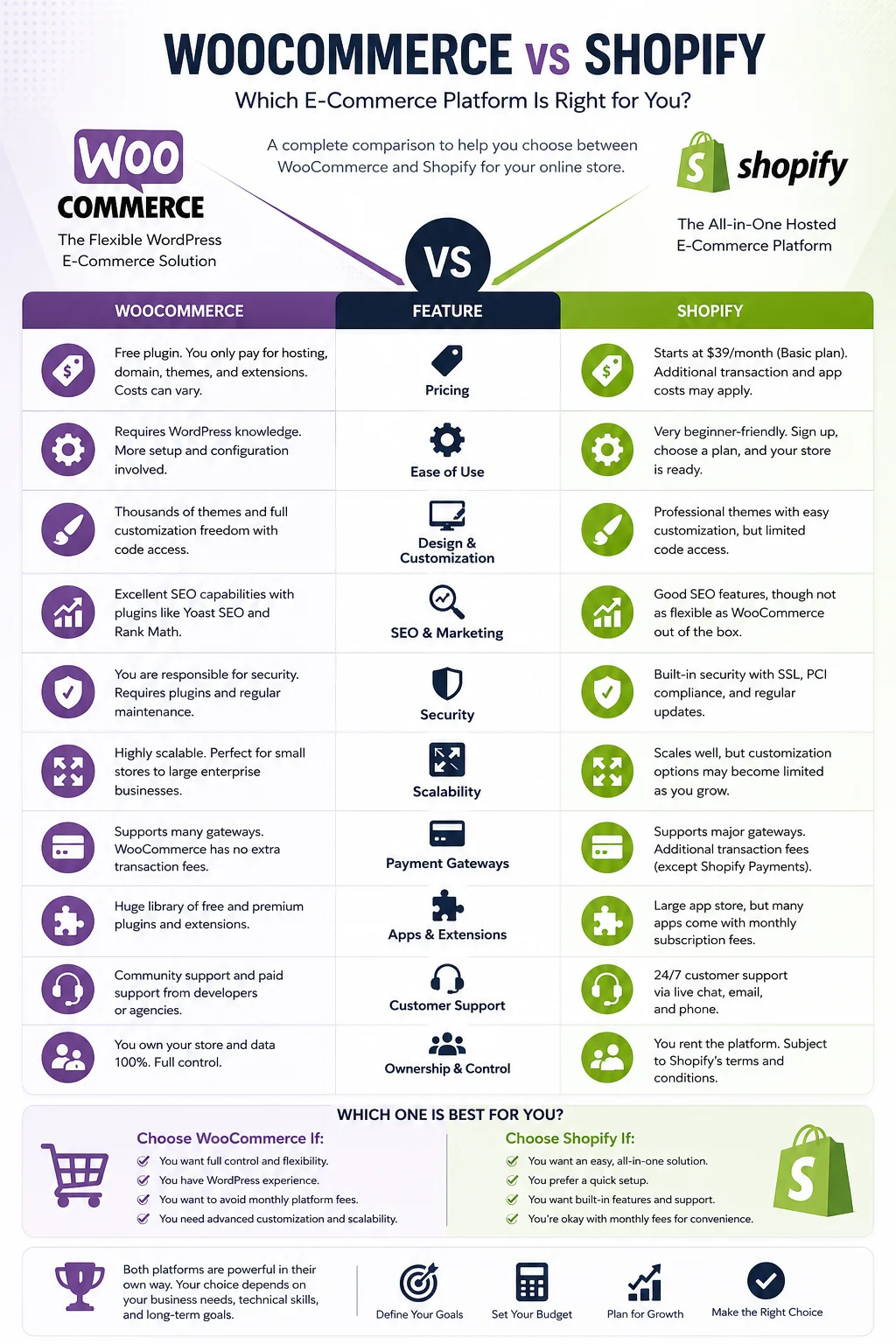
Payment Solutions: Types, How They Work & Choosing the Right One - Choosing the Right Payment Solution for Your Business.
There’s no universal “best” payment solution—only the best fit for your business model, transaction volume, and technical resources. Use this framework to evaluate options:
For Brick-and-Mortar Retailers
Prioritize reliability, speed at the checkout counter, and transparent hardware costs. Look for:
- Countertop terminals with contactless and mobile wallet support.
- Same-day deposit availability to improve cash flow.
- Hands-on installation and training from your provider.
- No long-term equipment leases that lock you into outdated hardware.
For E-Commerce and SaaS Businesses
Your payment solution is a product feature, not just a back-office function. Prioritize:
- A developer-friendly API with clear documentation and SDKs.
- Support for digital wallets, local payment methods, and multi-currency processing.
- Robust recurring billing and subscription management.
- Tokenization for returning customers and one-click checkout.
For Platforms and Marketplaces
If you’re processing payments on behalf of multiple sellers or service providers, you need:
- Split payment and escrow capabilities.
- Onboarding APIs for seller verification (KYC/KYB).
- Automated 1099-K reporting and tax form generation.
- A payment facilitator (PayFac) model or a managed marketplace solution from your processor.
For Banks and Fintechs
You’re building on the issuing side. Evaluate platforms on:
- API maturity and real-time data access.
- Fraud prevention that uses behavioral analytics, not just static rules.
- Cloud-native architecture with no downtime for maintenance.
- Support for virtual cards, tokenization, and digital wallet provisioning.
The Role of Unified APIs in Payment Infrastructure
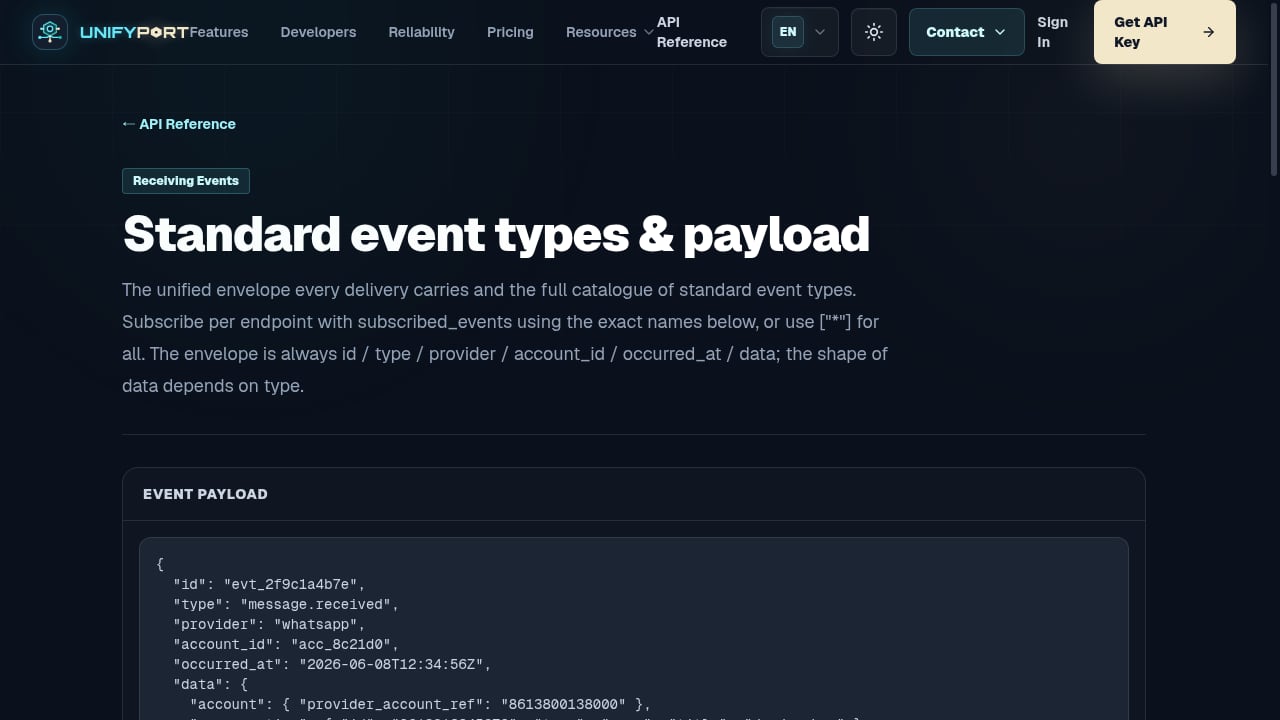
First viewport screenshot of Standard event types & payload — API Reference — UnifyPort.
A pattern worth watching is the convergence of payment and communication layers. As businesses embed financial services into their products, they also need to notify customers about transactions, payment reminders, and fraud alerts across multiple channels.
This is where unified API platforms become relevant. Just as a unified payment platform abstracts away processor differences, a unified messaging API like UnifyPort abstracts away the differences between WhatsApp, Telegram, LINE, and other messaging channels. For payment teams building notification systems, this means:
- Sending transaction confirmations and OTPs through a single REST API rather than integrating each messaging provider separately.
- Receiving standardized webhook events for delivery status and customer replies.
- Relying on built-in rate limiting and retry logic to ensure critical payment alerts are delivered.
When evaluating your overall payment infrastructure, consider how transaction communication fits into the picture. A payment solution that processes funds is essential; a messaging layer that reliably delivers confirmations and fraud alerts is what builds trust.
Fraud Prevention and Security Considerations
Payment fraud is a moving target. Modern solutions use multiple layers of defense:
- Tokenization: Replaces raw card numbers with tokens that are useless if intercepted.
- 3D Secure 2.0: Adds a frictionless authentication step that shifts liability to the issuer for enrolled cards.
- Behavioral analytics: Machine learning models that profile customer spending patterns and flag anomalies in real time.
- Velocity checks: Rules that limit the number of transactions from a single IP, device fingerprint, or card within a time window.
- Address Verification Service (AVS) and CVV checks: Basic but effective filters that catch many fraudulent attempts.
For businesses handling high-risk transactions or large volumes, dedicated fraud platforms like FIS Transaction Defense or third-party services like Sift and Riskified can reduce false positives while catching sophisticated attacks.
Payment Solution Pricing Models Explained
Pricing opacity is one of the biggest frustrations for businesses. Here’s how to decode what you’re actually paying:
| Pricing Model | How It Works | Best For |
|---|---|---|
| Flat Rate | Fixed % + fixed fee per transaction (e.g., 2.9% + $0.30) | Low-volume businesses, simplicity |
| Interchange-Plus | Interchange fee + fixed processor markup | Higher-volume businesses, cost transparency |
| Tiered | Transactions grouped into qualified, mid-qualified, non-qualified tiers | Avoid—opaque and often expensive |
| Subscription/Membership | Monthly fee + interchange + small per-transaction fee | High-volume businesses with predictable costs |
Always request an objective cost analysis based on your actual processing statement. Many independent providers will perform this for free and show you exactly where hidden fees are eating into margins.
Related reading
- The Best AI Chatbots in 2026: A Deep Dive into Models, Use Cases & Integration - Compare the top AI chatbots of 2026—ChatGPT, Claude, Gemini, and more. Learn how they work, which excels at coding, writing, or research, and how unified APIs connect them to messaging channels.
- MessengerPeople Review: Unified Messaging API Deep Dive - Evidence-based MessengerPeople review covering its unified messaging API, transparent pricing, developer experience, and ideal use cases for scaling customer communication.
- Unipile LinkedIn API: A Developer’s Guide to Integration & Pricing - Explore how the Unipile LinkedIn API simplifies integration, bypasses partner approval, and provides transparent pricing. Learn setup, use cases, and best practices.
Sources and further reading
- Payment Solutions, LLC - Payment Solutions, LLC offers Credit Card Processing for small business owners, local retailers, professional service providers, B2B companies, manufacturers, and online businesses.
- Merchant Services & Payment Processing | Chase Payment Solutions - Merchant services from Chase offer comprehensive solutions for businesses, including payment processing, point-of-sale systems and online payment gateways.
- Card Issuing & Payment Platform for Banks & Fintechs - Enhance operations and growth with a unified payment platform delivering efficiency, fraud prevention and personalized bank and fintech experiences.
Frequently Asked Questions
What’s the difference between a payment gateway and a payment processor?
A payment gateway is the software that captures and encrypts transaction data from your website or app. A payment processor is the service that routes that transaction through card networks to the issuing bank and facilitates settlement. Some providers bundle both; others keep them separate.
Do I need a merchant account to accept credit cards?
Yes, but it doesn’t have to be a dedicated merchant account. Payment aggregators like Stripe and Square provide a pooled merchant account, which simplifies onboarding but may have higher per-transaction fees and less stability for high-volume businesses.
How long do payment settlements take?
Standard settlement is 1–2 business days. Some processors offer same-day deposits for transactions approved by a cutoff time (often 5 p.m. PT), though this typically requires using their business checking account.
What is a unified payment platform?
A unified payment platform consolidates multiple payment functions—processing, gateway, fraud management, reporting—into a single API integration. This reduces the number of vendors you manage and simplifies your technical architecture.
How do I protect my business from payment fraud?
Use tokenization, enable 3D Secure 2.0, implement velocity checks, and consider a dedicated fraud prevention service that uses machine learning to analyze transaction patterns. Also, ensure your gateway is PCI DSS compliant.
Can I pass credit card processing fees to customers?
In many jurisdictions, yes—through a surcharge or service fee program. However, rules vary by card network and region. Some states in the U.S. prohibit surcharging, and you must disclose the fee clearly at checkout.
Building a Payment Stack That Scales
Payment solutions are not a commodity. The right infrastructure can improve cash flow, reduce churn, and unlock new business models. The wrong one can bury you in hidden fees, integration debt, and customer friction.
Start by mapping your actual transaction flow—from checkout to settlement to customer communication. Identify the layers you need today and the ones you’ll need as you scale. Then evaluate providers on transparency, API quality, and the ability to compose with other services in your stack.
The businesses that win on payments are the ones that treat it as a strategic capability, not a utility. Choose infrastructure that gives you control, visibility, and room to grow.